
Among people with large breasts,
"Is my breast really large enough to require surgery?"
Many people have this kind of concern.
In our society, there is still a tendency to treat open discussion about breast-related issues as taboo, so there is a lack of information in this area.
Because of this, the concerns of people with large breasts seem to grow deeper and deeper.

In general social perception, breast reduction is thought of as being for cosmetic purposes.
In fact, this aesthetic aspect can be an important factor in deciding on surgery, but from the perspective of patients who are suffering, the therapeutic purpose is much more important.
Because reduction surgery has both cosmetic and therapeutic aspects, unlike ordinary diseases, it is not easy to present a uniform indication or surgical standard.

Today, I will present surgical guidelines from the perspective of a specialist in breast reduction surgery.
When people think about reduction surgery, they often imagine improving large, drooping breasts caused by childbirth, breastfeeding, or aging. From this perspective, an individual's desire and willingness can be said to be the biggest factor in deciding on surgery.
Also, considering the nuance of the phrase "surgical standard," some people may want to know a specific weight or size in numerical terms.

However, the important factor in deciding whether a breast needs surgery is far from a number.
The main deciding factor is
whether the large breast is accompanied by symptoms.

In conclusion, macromastia accompanied by symptoms can be summarized as "breast reduction surgery is needed."
Here, symptoms can be broadly divided into three categories.

Physical symptoms
Mental stress
Disruption in daily life
First, when the breasts become excessively large, pain in the neck, shoulders, and lower back may occur. As a result, scoliosis may also develop. The bra straps can press into the shoulder area and leave deep grooves, and dermatitis called intertrigo can develop under the breast fold.
In addition, the ulnar nerve may be continuously compressed, causing numbness in the hands or carpal tunnel syndrome.
Other issues include emotional distress such as stress in interpersonal relationships, and inconvenience in daily life such as difficulty with activities or choosing clothes.

When these symptoms are present, it is necessary to consider breast reduction surgery.
Although it can be concluded that the presence of symptoms is the most important factor in deciding on surgery, the guideline you may want is a more specific number. While it cannot serve as an absolute standard, I would like to share my personal view on roughly what breast size tends to lead people to have surgery.

How large does a breast need to be to reduce it?
Of course, this depends on the individual's body type. If I were to give an approximate estimate, I think surgery is needed when one breast weighs around 1 kg or more.
Even if I say that,
"Is my breast really that large?"
There probably won't be many people who can immediately judge that. To determine this, you first need to understand the current size and volume of your breasts.

One way to measure breast volume at home is a tape-based volume calculation method.
Cut about twenty 10 cm strips of cotton adhesive bandage, layer them over the breast as if covering it, then peel them off so that a mold of the breast is formed. You can then fill the mold with water to measure the breast volume.

There may be slight differences depending on whether the breast is glandular-dominant or fatty-dominant, but if you roughly consider 1 cc to be 1 g, the margin of error is not large.
If this figure is 1000 cc, or 1 kg or more by weight, or if converted to bra size, a full E cup or larger, then it can be said that breast reduction surgery should be considered.
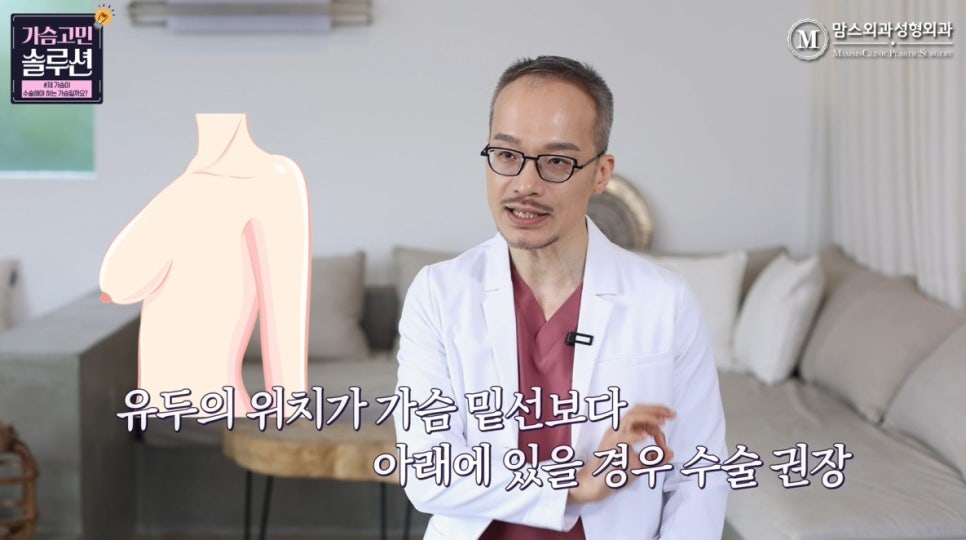
In addition, whether reduction or lift surgery is needed can also be determined based on the degree of sagging.
If the nipple is below the inframammary fold, surgery is recommended.

Surgery should be decided by comprehensively considering not only the weight of the breasts, but also their shape, the individual's body type, and whether symptoms related to large breasts are present.