
Hello.
This is Moms Plastic Surgery Clinic.
Today, with Director Shin Seung-han,
we’ll take some time to look into
some of the things you may be curious about.
Does exercise that is said to make the chest bigger actually work?
These days, there are various exercises
said to make the chest bigger.
However, there is not much medical evidence
for these exercises.
The glandular and fatty tissue in the chest
sit above the pectoralis major muscle.
Because the breast tissue is connected to this pectoralis major muscle
by very loose fibrous tissue,
even if you develop the pectoralis major,
it is hard for it to affect the chest
or make it look better.

Some people say,
"If the pectoralis major gets bigger,
doesn’t the chest get bigger too?"
But the pectoralis major is not part of the chest itself;
it is simply the base of the chest.
Also, because the shape of a muscle
and the shape of the chest are completely different,
we can say that "even if you build muscle, there is NO change in the chest."
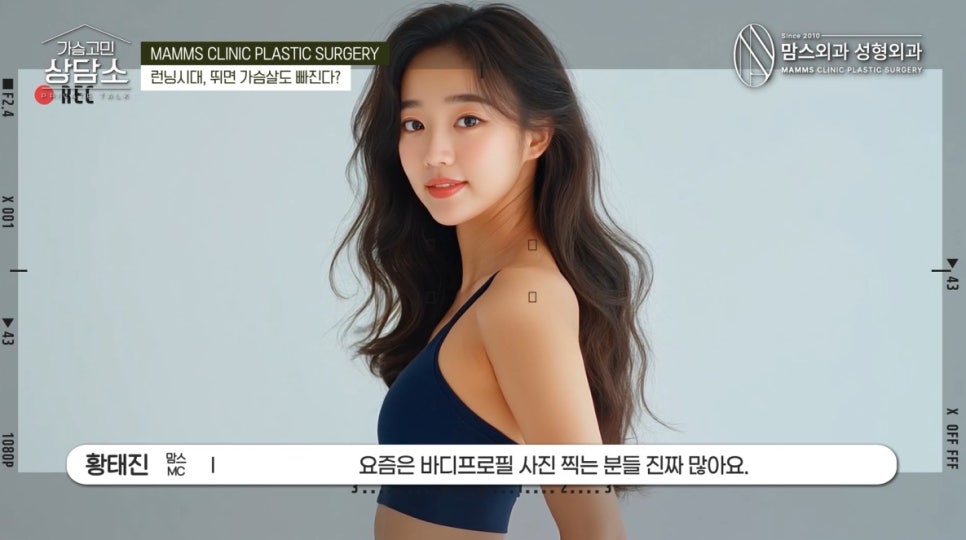
These days, there are really many people
taking body profile photos.
Then what about the buttocks?
Can hip-up exercises make them bigger?
The buttocks are a bit different.
What determines the shape of the buttocks
is the pelvic bones and muscles.
So hip-up exercises are effective,
but the chest is different.
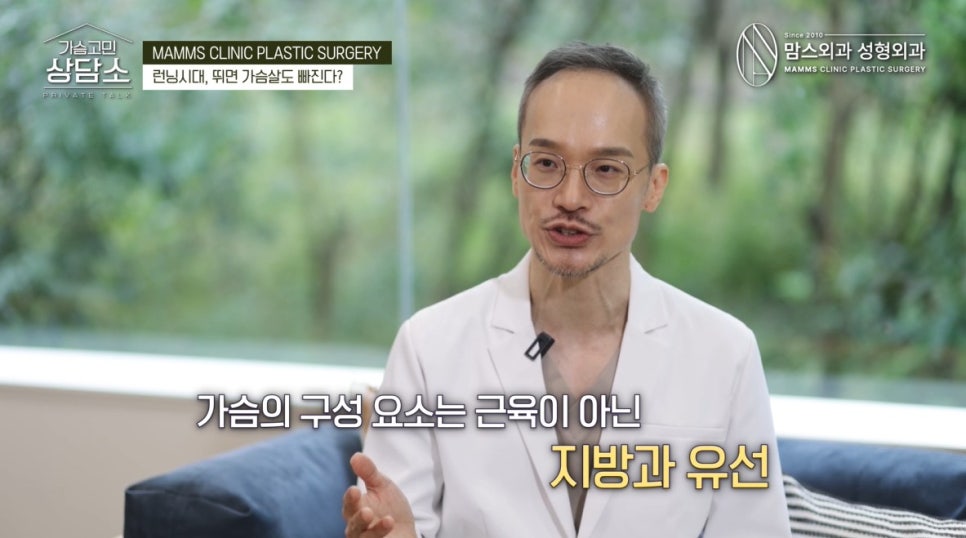
The components of the chest are not muscle,
but fat and glandular tissue.
Usually, many female trainers say
their own chest is a chest they built
through exercise.
But if you reduce body fat through exercise,
chest fat will also decrease.
The pectoralis major developed through muscle training
is located at the base of the chest,
and thinking of it as part of a woman’s chest
is a bit of a stretch.

Some people may say,
"I did it."
But it is hard to hide implants.
This usually shows up clearly when posing
at fitness competitions.
Especially during competitions, body fat is reduced dramatically,
so when seen from the side,
implant rippling can become visible on the surface.

Next, let’s talk about running.
There are really many people running these days.
If you run like this, does chest fat go away?
To give the conclusion first..
"Unfortunately, it does go away."
In fact, no matter what exercise you do,
if body fat decreases, chest fat
has no choice but to decrease as well.
In particular, in long-distance running,
fat burning happens rapidly,
so a significant amount of chest fat is lost too.
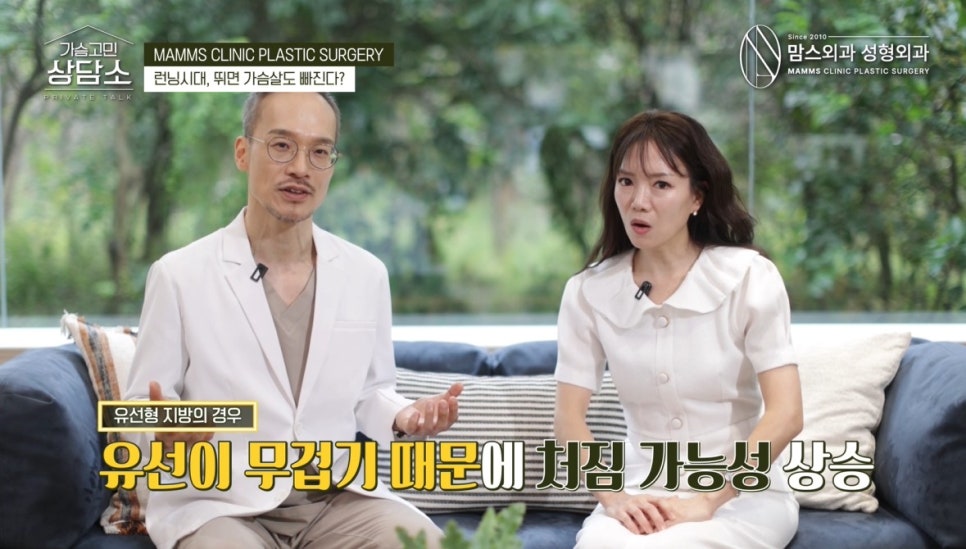
Of course, if there is very little fat,
as in a dense, glandular type,
there is less fat to lose,
so the size change is small,
but because the glands are heavy,
the likelihood of sagging increases.
In the end, if you run, to some extent
everyone inevitably loses out in terms of
chest size or shape.
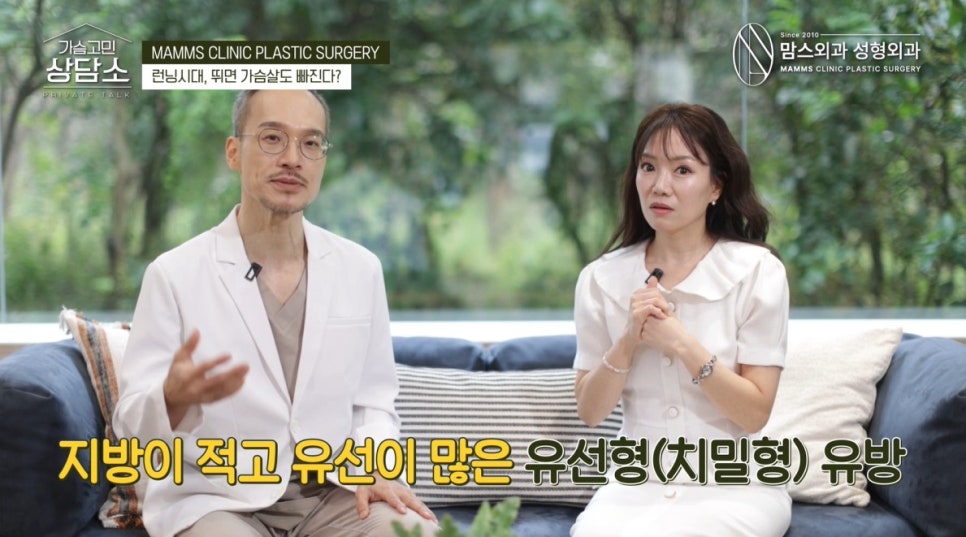
What is a dense glandular breast?
The chest is made up of glandular tissue and fat.
If there is less fat and more glandular tissue,
it is called a dense glandular breast.
You can think of glandular tissue as the firmer part,
and fat as the soft, jelly-like part,
which makes it easy to understand.
So a dense breast can be described
as relatively heavy and firm.

Exercise ability basically refers to
aerobic capacity.
Sports like gym workouts or golf
cannot really be called exercises
that build aerobic capacity.
On the other hand, there is nothing better than running
for improving aerobic capacity.

But running also has drawbacks.
As body fat decreases, facial fullness goes down,
and because you are exposed to sunlight and wind,
your skin becomes rougher
and you may look older—that is a downside of running.
For women,
there is also the drawback that the chest
can become smaller and sag more easily.
Of course, compared with these drawbacks,
the benefits of running are much greater.
What I want to say is that whether it is weight training
or running, rather than the aesthetic loss of chest fat,
what matters more in life is the healthy beauty gained through exercise
and the peace and stability that come in both mind and body.
Because these advantages are so much greater
than such minor drawbacks,
I personally recommend doing any kind of exercise.
Among them, lower-body exercises,
including running,
are directly connected to quality of life in old age.
The body area whose muscle mass has been shown
to correlate with human lifespan
is the lower body.

And the very best lower-body exercise in the world
is running.
But unfortunately, chest fat does go away.
Thank you.