Is It Impossible to Avoid Contracture After Nose Surgery?
Dr. Jang Wook Shares His Know-How

Hello.
This is Obje Plastic Surgery.
There is a phrase that is often heard among people who are preparing for rhinoplasty
or have already had surgery.
“Your nose tip will droop over time,”
“Eventually, you’ll need a revision surgery.”
In fact, after rhinoplasty,
there are not a few cases where
the nose tip lowers
or the shape changes.
So these kinds of comments
can feel less like a simple rumor
and more like a realistic concern.
But contracture after nose surgery
or a drooping nose tip
is not something that inevitably happens
to everyone.

The longevity of rhinoplasty
can vary greatly depending on
how the nose-tip structure was designed
at the time of surgery.
Today, we will go over
why the shape of the nose changes after rhinoplasty,
and how it can be prevented,
one step at a time.
If you read until the end,
you’ll be able to identify
the key points you should know before rhinoplasty.
A drooping nose tip is not a
“matter of time”
To understand why the nose tip changes after rhinoplasty,
you first need to know
the condition immediately after surgery.
Right after surgery,
swelling remains significantly,
so the nose tip appears
higher and sharper than it really is.

As the swelling goes down,
the soft tissue settles back into place,
and during this process,
you may feel that
the nose tip has “slightly dropped.”
This is not something to worry about;
it is a normal part of recovery.

If the medical team is experienced,
they anticipate these changes from the beginning
and design the height accordingly,
so that it settles into a natural position
within 3 to 6 months.
What you should pay attention to
starts here.
If, even 1 to 2 years after surgery,
or even later,
the nose tip drops noticeably
or asymmetry appears,
that is not part of the recovery process.
It happens because the support structure
holding up the nose tip
was not sufficient.

The nose tip is a structure
made of cartilage, not bone.
The bridge of the nose can remain relatively firm
because bone and silicone
combine there,
but the nose tip has to be supported
by cartilage alone,
so how firmly that cartilage structure is built
determines the long-term ability to maintain the shape.

Simply put,
for the nose tip, you do not just raise the height;
you have to build a pillar.
If the pillar is weak,
even if it looks beautiful at first,
it may become structurally difficult to maintain over time.
If the pillar is strong,
there is a high chance that
the original shape will be maintained
for years.
Why does contracture after nose surgery happen?
I’ll tell you only the <core point>
Contracture after nose surgery refers to
a phenomenon in which the shape of the nose changes
as the capsule around an implant thickens.
To understand the cause of this phenomenon,
you need to know what happens
when an implant touches the nose tip.
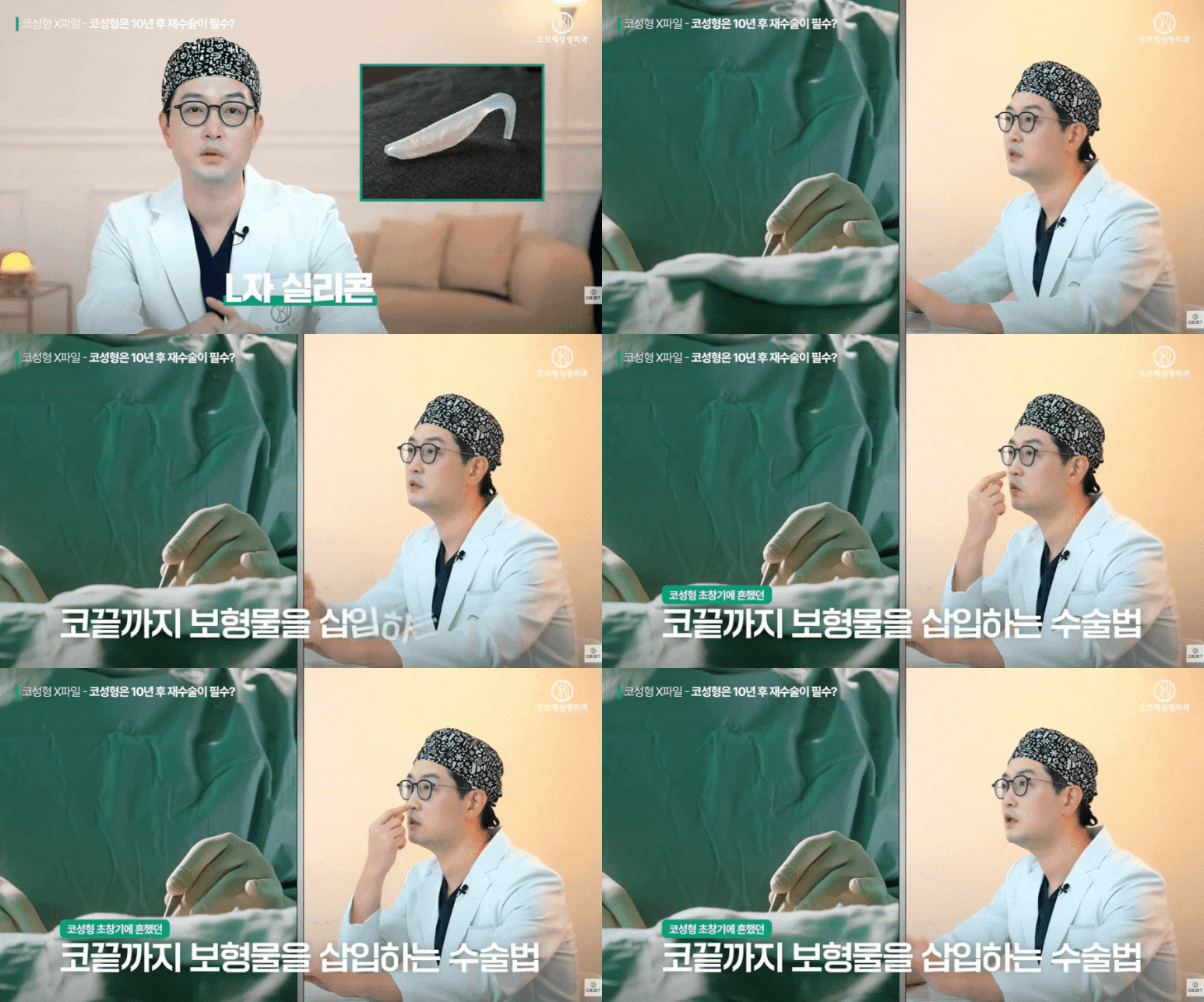
In the past, methods such as
L-shaped silicone or Gore-Tex,
which connected the bridge of the nose to the nose tip
with a single implant,
were widely used.
With this method,
because the implant reaches the nose tip,
the skin at the tip is continuously pressed from the inside.
When skin is pressed continuously,
it gradually becomes thinner.
Under thinned skin,
the implant may become visible,
or in severe cases, protrude.

That is not the end of it.
When our body is continuously stimulated by a foreign material,
it reacts by trying to form a protective layer around it.
This protective layer is the capsule,
and when the capsule gradually thickens and contracts,
compressing the implant,
the nose tip may turn upward,
harden,
or become deformed asymmetrically.
This is the core process behind
contracture after nose surgery.
In summary,
with a structure where the implant reaches the nose tip,
skin irritation and capsule contraction
occur at the same time,
which increases the likelihood that the nose shape
will change over time.
So then, in recent years,
in what direction have surgical methods changed?
Surgical design that reduces contracture after nose surgery
has changed like this
The biggest change in current rhinoplasty
is that the nose tip and the bridge
are approached separately.

Silicone is used on the bridge only when necessary,
and the nose tip is operated on by using autologous cartilage
to build a support structure.
Because the implant does not directly touch the nose tip,
the skin is less likely to be pressed and thinned,
and deformity caused by capsule contraction
is also reduced.

What matters here is not simply removing the implant,
but how the support structure is designed.
The structure supporting the nose tip is built using
septal cartilage, donor cartilage,
autologous rib cartilage, and similar materials,
and long-term stability depends on
the strength and placement direction of that cartilage,
and on how it is fixed.
If the cartilage is not sufficiently strong
or the structure is not built stably,
even if it looks good at first,
support may weaken over time
and the nose tip may droop.
On the other hand,
if it is structurally designed stably from the beginning,
there is a high chance that
the original shape will be maintained
even after several years.
That is why the statement,
“rhinoplasty always requires revision surgery,”
does not apply in every case.
Cases that end up needing revision surgery
usually involve a support structure
that was designed weakly,
or surgeries performed with an older method
in which the implant touched the nose tip.

Today, we looked at
why the nose shape changes after rhinoplasty,
how contracture after nose surgery occurs,
and the direction of surgical design
to reduce it.
A drooping nose tip
or a changed shape
is not a change caused by time alone;
it depends on how the structure was designed
at the time of the initial surgery.

Dr. Jang Wook of Obje Plastic Surgery
designs a cartilage-based support structure
that does not allow the implant to touch the nose tip,
and considers the strength and placement direction of the cartilage
so that the nose tip is less likely to droop
even as time passes.
If you are considering rhinoplasty,
rather than looking only at the height of the nose tip,
I recommend checking
how the nose-tip support structure
is designed.
This has been Obje Plastic Surgery.
Thank you.
<🔽🔽A Recommended Video to Watch Together🔽🔽>
| Consultation and Inquiries for Rhinoplasty |
|---|
| Quick phone consultation |
| Kakao easy consultation |
-
This post contains medical information written by Obje Plastic Surgery Clinic in compliance with the Medical Advertising Act.
-
Depending on the individual, treatment effects may vary, and side effects may occur.
Please be sure to have a thorough consultation with the medical staff in advance before deciding on the procedure.