
✏️Strabismus After Under-Eye Fat Repositioning?!
Why Does It Occur?
If you have looked into under-eye fat repositioning surgery,
you may have heard at least once that after under-eye surgery,
one eye can become abnormally misaligned,
resulting in “strabismus.”
Diplopia, in which objects appear as multiple images, or strabismus,
is a very rare phenomenon after under-eye surgery.
However, because it can cause significant discomfort in daily life,
it is considered one of the serious possible complications.
Then why does strabismus occur after under-eye fat repositioning?
Today, we will explain in detail why strabismus can develop after under-eye surgery!

🔎The Cause of Strabismus After Under-Eye Fat Repositioning Is “This Muscle”
Eye movements are not simply movements up and down;
they are produced by a combination of side-to-side movement and subtle rotation.
To understand this, it is important to first learn a few basic concepts.
“Adduction” refers to moving the eye inward, toward the nose,
while “abduction” means moving the eye outward, toward the ear.

In addition, our eyes do not simply change direction;
they also undergo slight twisting movements.
Rotation that tilts toward the nose is called “intorsion,”
while rotation that tilts outward is called “extorsion.”
When the eye is adducted, or turned inward,
the role of the muscles normally responsible for upward and downward movement is reduced.
Instead, muscles called the “oblique muscles” take the lead in controlling vertical movement.
The oblique muscles are broadly divided into the inferior oblique and superior oblique muscles.

The inferior oblique muscle is responsible for elevation, or moving the eye upward,
extorsion, or outward rotation,
and abduction.
In particular, when the eye is adducted, it helps move the eye downward.
If the inferior oblique muscle becomes paralyzed,
its ability to elevate the eye is reduced.
As a result, the eye cannot move upward and remains lower.
At the same time, reduced extorsion causes relatively prominent intorsion.
Conversely, when the superior oblique muscle becomes paralyzed,
its ability to depress the eye is reduced.
As a result, the eye cannot move downward and remains elevated.
At the same time, weakened intorsion produces a relative increase in extorsion.

🔎What If Strabismus Develops After Under-Eye Fat Repositioning?
This time, we will explain how to determine which muscle may have been damaged
if strabismus develops as a complication after under-eye fat repositioning.
In clinical practice, an important criterion for distinguishing abnormalities of the superior and inferior oblique muscles
is evaluating vertical eye movement while the eye is adducted.
When the eye is turned toward the nose and the patient is asked to look upward,
if the eye does not move up,
paralysis of the inferior oblique muscle may be suspected.
Conversely, if the eye does not move downward when the patient looks down,
this may indicate paralysis of the superior oblique muscle.

This examination alone can help distinguish whether there is functional impairment in either muscle to a considerable extent.
In addition, a “Bielschowsky head tilt test” may be performed.
This test is based on the principle that the oblique muscles act to maintain the eye’s rotational balance
when the head is tilted to one side.
In particular, in cases of superior oblique muscle paralysis,
when the body is tilted toward the affected side,
upward deviation of the eye, called “hypertropia,”
becomes more pronounced.
These muscle abnormalities do not merely change the position of the eye;
they can also affect the patient’s posture.
To reduce visual discomfort,
patients unconsciously adopt a compensatory posture by tilting their head.
In clinical practice, when a patient is tilting their head in the opposite direction,
this posture is considered an important clue suggesting superior oblique muscle paralysis.

🔎How to Prevent Strabismus During Under-Eye Surgery
If strabismus develops after under-eye surgery,
damage to the inferior oblique muscle may be more likely.
This may result from insufficient anatomical understanding during surgery
or limitations in obtaining a clear surgical view.
The inferior oblique muscle is located immediately beneath the under-eye fat,
very close to the structures directly treated during under-eye surgery.
Therefore, the inferior oblique muscle may be unintentionally damaged
during the removal or repositioning of fat.
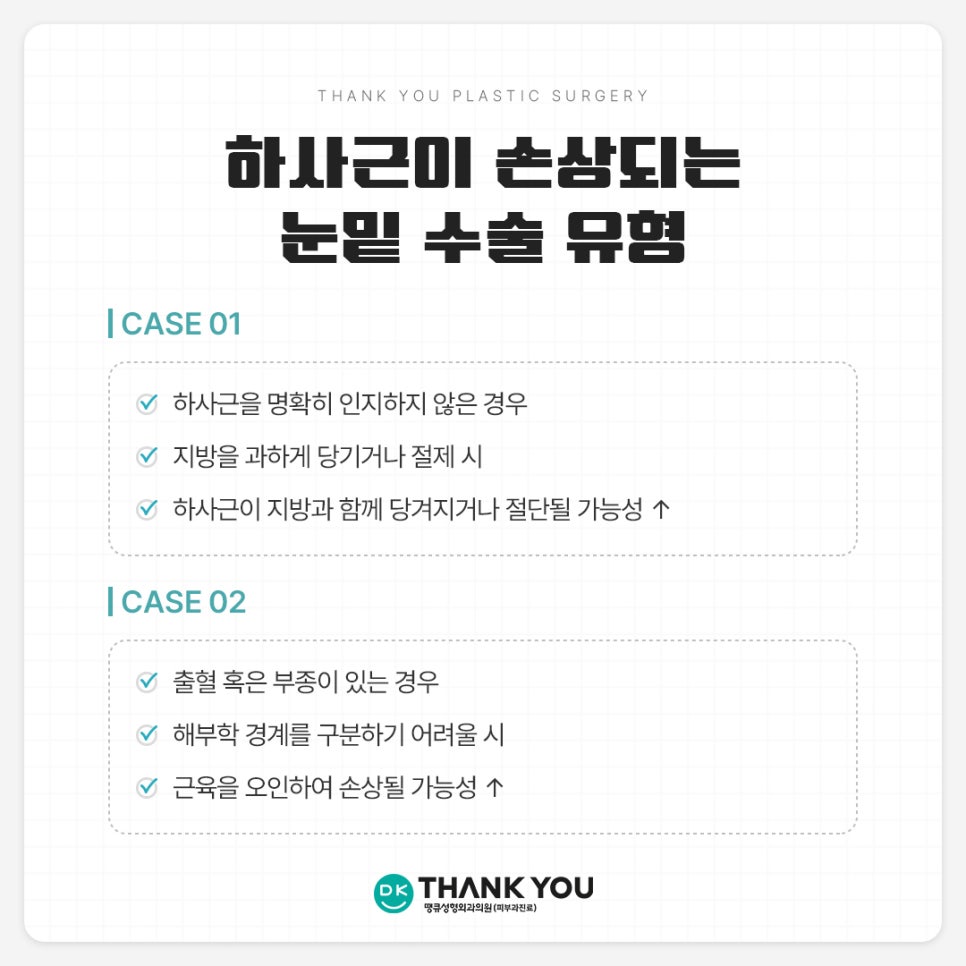
In particular, if the fat is pulled excessively or excised
without clearly identifying the inferior oblique muscle during surgery,
the muscle may be pulled along with the fat
or partially severed.
In addition, when bleeding or swelling makes it difficult to obtain a clear surgical view,
it becomes harder to distinguish anatomical boundaries properly,
which can lead to mistaking the muscle for another structure and damaging it.

As such, whether the inferior oblique muscle is damaged can depend on
how accurately its location is identified and confirmed during under-eye surgery.
That is why it is important not to approach the procedure as targeting only the under-eye fat,
but to perform precise surgery that also takes into account
the fine anatomical structures of the surrounding eye muscles.
Thank You Plastic Surgery
Expressing and sharing our gratitude, Thank You Plastic Surgery (Dermatology Services)
🟡Phone inquiries: 02-567-0900
💗KakaoTalk consultation: https://pf.kakao.com/_Pvrxgb
🍀Website: https://www.thankyoups.com/
-Gangnam-daero 446, Hanwell Building, 8th and 9th floors, Gangnam-gu [Registration: 9th floor]