Hello, I am Kim Tae-yoon, the chief director of Shinsung Dental Clinic.
Today, I’d like to talk about wisdom tooth extraction with a few cases.
Wisdom teeth are always a concern.
Are they teeth that absolutely have to be removed?
The answer is, “It depends on the situation.”
Whether extraction is needed depends on the wisdom tooth’s eruption angle, eruption height, the adjacent teeth, and the location of the nerve canal.
It would make this post too long to classify and explain every possible situation, so
Today, I’ll explain the most common case,
and the case in which wisdom tooth extraction is definitely necessary.
Statistically,
this is the situation that applies to the largest number of people,
and if it applies to you, I recommend visiting a dental clinic and having it removed as soon as possible.
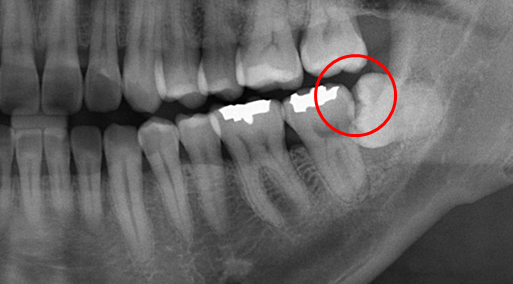
“Does this wisdom tooth really need to be removed even though it doesn’t hurt?”
This was a male patient in his early 30s who visited recently.
The situation I’m showing today is this kind of case.
The wisdom tooth is tilted forward,
attached to the molar in front,
and part of the crown is exposed above the gum.
Food debris and bacteria accumulate very easily in the gap between the two teeth marked with the red circle,
and once food gets stuck in that gap,
it is practically impossible to remove.
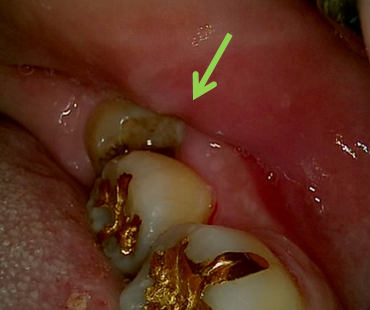
This is an intraoral photo of the same patient.
Just by looking at it, it seems like food could get in very easily, right?
If food debris and bacteria remain trapped like that,
cavities are only a matter of time.
In the photo, you can also see that the wisdom tooth is already decaying.
Actually, it does not matter if the wisdom tooth decays.
It is a tooth that is not used anyway.
All that matters is removing it.
The problem is that the very last molar, which must be used for life, also decays.
What happens if that wisdom tooth is left unremoved?
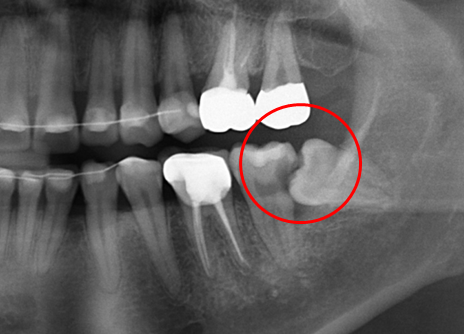
This is a photo of another patient.
If the wisdom tooth is left in place without being removed,
the last molar becomes decayed all the way to the nerve and root,
making it very difficult to save.
Because this patient was in their 20s, it was even more unfortunate to have to remove that molar as well.
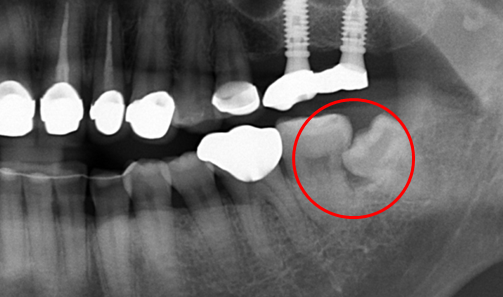
This is a photo of another patient.
In this case, the last molar had also started to decay,
but it was not as severe as the patient above,
so there is still hope that it can be saved and used.
However, if restorative treatment is performed,
the margin of the restoration has to extend quite far downward,
so the prognosis may not be good.
All three patients had their wisdom teeth completely removed,
and the extraction sites are healing well.
Before extraction After extraction
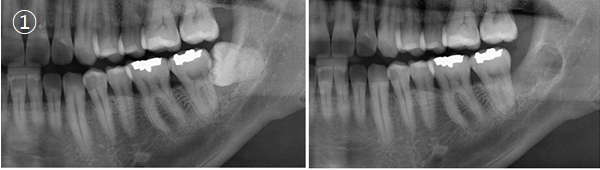
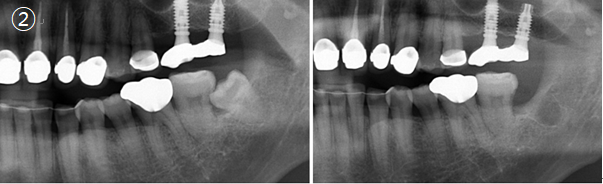
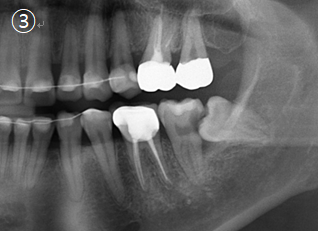
These are the before-and-after extraction photos of the three patients.
Unfortunately, the last patient has been very busy with work and has not been able to come in for follow-up appointments,
so I couldn’t take a post-extraction photo...
(Of course, after wisdom tooth extraction,
no news is good news ^^;)
To summarize,
all three patients had wisdom teeth in the same situation.
However, depending on when the wisdom tooth was removed,
The first patient’s
last molar was able to remain in good use as it was,
The second patient’s
last molar required crown treatment
(there is a possibility of root canal treatment.),
The last patient’s
last molar had to be extracted..
(even if it were difficultly saved and used, the prognosis would be poor)
In this way, they ended up at different crossroads of fate.
It was simply a matter of timing.
For wisdom teeth like the ones above,
once eruption is sufficiently complete,
it is better to have them removed as soon as possible if you can.
If you read this and your lower wisdom tooth is in the same situation,
please go to a dental clinic right away
and receive an extraction consultation.
I hope this was a helpful post,
and I’ll wrap up here.
Thank you for reading to the end. ^^