Hello, I’m Kim Taeyoon,
the chief director of Shinseong Dental Clinic.
Today, I’d like to talk about
bruxism and Botox treatment.
Many people grind their teeth during sleep.
Among the patients who have visited our clinic so far,
there have also been many bruxism patients.
According to a statistical study from Europe (Ohayon & Guilleminault, Chest 2001),
the current prevalence of sleep bruxism is said to be
8–10% of the total population.
And by age group,
it is as shown in the graph below.
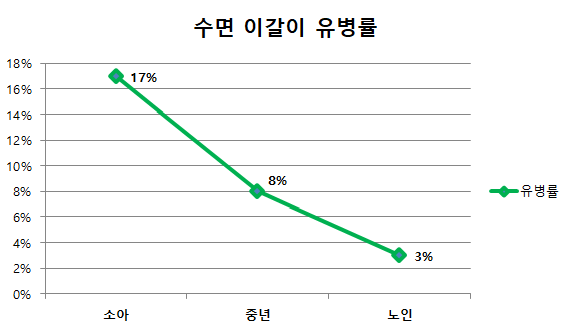
It shows the highest prevalence in people in their teens to 40s,
and tends to gradually decrease
as age increases.
I also had severe bruxism since I was young,
but when I left it untreated,
it only stopped after all four canines
in the upper and lower jaws became flat.
This is purely my own opinion, but
based on my clinical experience, the biggest cause of bruxism seems to be extraction orthodontic treatment during growth.
More than 90% of the bruxism patients I have seen
had undergone extraction orthodontic treatment during their growth period.
(I am included in that group as well.^^;)
The exact cause of bruxism has still not been identified
in academia.
Since the cause is not known exactly,
the exact treatment method has also not been established.
It is only symptomatic therapy—in other words, not a fundamental cure—
aimed at reducing the severity of bruxism
or preventing more harmful consequences from bruxism,
while protecting the teeth.
So, the most commonly used treatments for bruxism today are
bruxism appliances (night guards) and
Botox treatment.
Today, I will talk only about Botox treatment.
There are four major chewing muscles
that move the jaw.
They are the masseter, temporalis, medial pterygoid, and lateral pterygoid.
These muscles determine the force and frequency of clenching and grinding.
Therefore, the principle of bruxism Botox treatment is to inject Botox into these chewing muscles
and weaken the force applied to the teeth.
Among them, the pterygoid muscles
are difficult to access with a needle,
so Botox is mainly injected into the masseter and temporalis muscles.
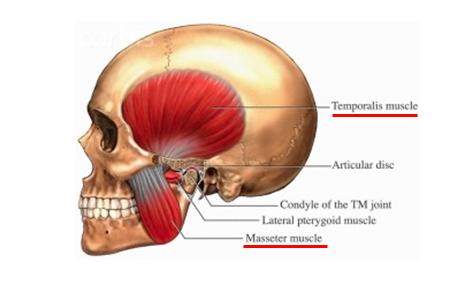 The lower underlined muscle is the masseter,
and the upper underlined muscle is the temporalis.
The lower underlined muscle is the masseter,
and the upper underlined muscle is the temporalis.
Botox is a type of toxin called botulinum toxin,
and it has the effect of paralyzing muscles
and weakening their function.
Because it is a toxin, if it is used repeatedly at short intervals,
tolerance can develop and its effect can decrease.
The appropriate injection interval is 4 to 6 months.
The injection point for Botox in the masseter muscle is
this area.
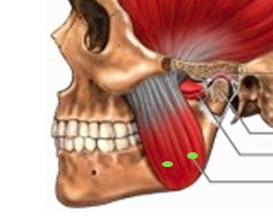
Usually, 25 units are used per side
for one treatment.
Sometimes, after receiving Botox injections in the masseter,
some muscle flickering can occur.
This is because the injection depth
and location of the needle were uneven,
so Botox was not absorbed into some of the muscles.
In that case, you can go back to the clinic and receive additional injections
in the muscles that are flickering.
The injection points for Botox in the temporalis muscle are
as shown in the figure.
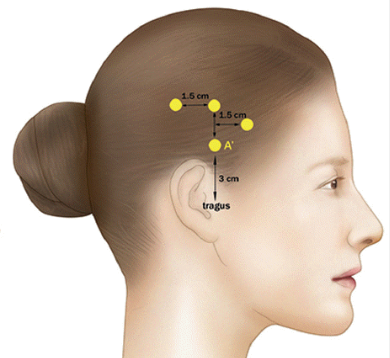
If the temporalis muscle is overly active,
it can also cause headaches.
In such cases, Botox injections
can also help relieve headaches.
If the degree of bruxism is not severe,
it is common to first treat only the masseter muscle with Botox.
Botox injections into the masseter muscle also have the effect of reducing the size of the jaw muscles,
so they are also widely used for cosmetic purposes.
They reduce bruxism and make the jaw look slimmer,
so it is a two-in-one benefit.
Therefore, if you have severe sleep bruxism,
I recommend that you do not simply leave it as stress and ignore it,
but consider Botox injection treatment.
At our clinic as well, there have been quite a few people who received Botox injections,
experienced less bruxism,
and were satisfied because their jawline became slimmer. ^^
This time, since the topic was bruxism and Botox,
unfortunately this was a post without actual clinical photos..
Still, I hope it was useful information.
Thank you for reading!
I’ll wrap it up here~