
Hello. We are Oziko Plastic Surgery and N+Plus, a clinic that has spent 16 years focusing only on the freedom to breathe and on creating a beautiful nose shape.
This time, we have prepared information about the pros and cons of autologous rib cartilage and donor rib cartilage.

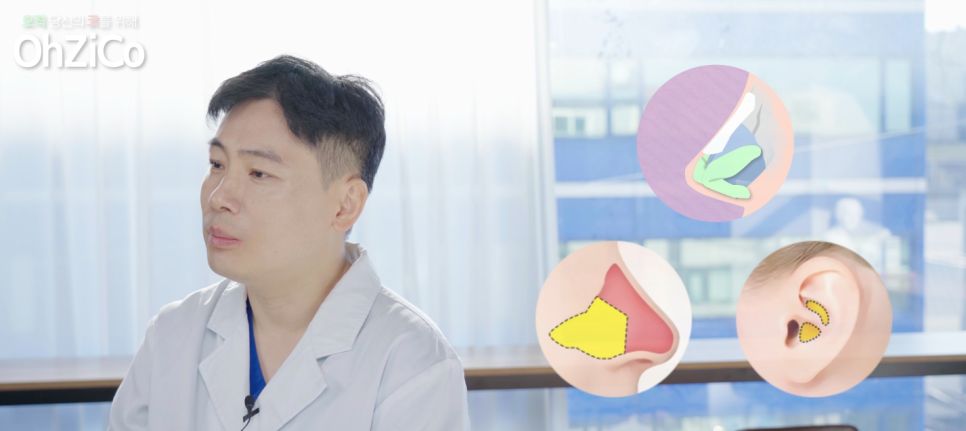
In the past, when performing nose surgery, silicone implants were usually used for the bridge of the nose, and septal cartilage, ear cartilage, and similar materials were often used for the tip of the nose.

Nowadays, when the septal cartilage or ear cartilage is small, bent, or weak, the use of autologous rib cartilage from the chest as a material for the nose tip has increased significantly, even in primary rhinoplasty.

However, in the case of autologous rib cartilage, because an incision has to be made in the chest area to harvest the cartilage, many people have been seeking donor rib cartilage as an alternative due to concerns about scarring.

What is donor rib cartilage? It usually refers to donor rib cartilage used as a material for the nose tip after the chest cartilage is harvested from a cadaver and then treated with radiation, chemicals, and sterilization to make it aseptic.

Recently, donor rib cartilage has been used a lot, and the main concern people have about it is the risk of inflammation and side effects.

However, the incidence of inflammation with donor rib cartilage is almost the same as with autologous rib cartilage, and in some cases autologous rib cartilage may even have a higher chance of causing inflammation. So I do not think there is a need to hesitate to choose donor rib cartilage because of inflammation alone.

However, one of the biggest drawbacks of donor rib cartilage is its absorption rate. Simply put, this refers to the phenomenon of it gradually dissolving over time. According to published papers, the degree of absorption has been reported to range from 15% to 85%. That is a very wide range. If donor rib cartilage is absorbed, what happens is that when support is built at the nose tip or the height is increased, that height gradually decreases and the nose tip sags.

The causes of donor rib cartilage absorption can include the donor’s physical condition, the size of the patient’s nose tip, and pressure caused by thickness. Therefore, rather than the occurrence of inflammation or side effects, the issue may be that absorption makes it difficult to know how the condition will change for each individual over time.

Another point is that donor rib cartilage undergoes medication treatment and chemical processing, so it is often very hard. If it is subjected to a strong impact, there are cases where it breaks after holding up for a while. In that case, the nose tip may sag, or absorption may progress further.

In addition, donor rib cartilage has supply issues. Due to COVID, logistics and transport are not smooth, imports are restricted, and donor 확보 is limited, so there are many cases where hospitals that use donor rib cartilage do not have enough of it. Therefore, if you specifically want to use donor rib cartilage, it would be a good idea to check whether the hospital has donor rib cartilage available and whether the surgery can be performed.
�00

So, because of the disadvantages of donor rib cartilage, is autologous rib cartilage better? That is not always the case. If autologous rib cartilage is used, a scar will form, but because this scar is not actually exposed to sunlight and is not in an area that moves a lot, scarring is not a major issue. Over time, it fades to the point of being barely noticeable.

However, the problem with autologous rib cartilage is that if the patient is somewhat small-framed or petite, the autologous rib cartilage size may also be small, and the cartilage may be much smaller than expected.

But in such cases, this is something that can be sufficiently checked by directly feeling the ribs, so it is not a problem. If the cartilage is bent, that too can be adjusted during the trimming process, so this is also not a problem.
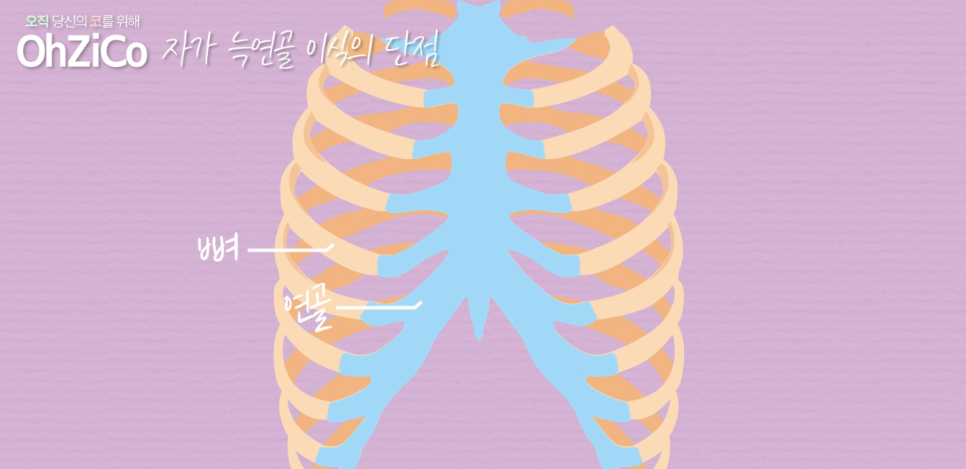
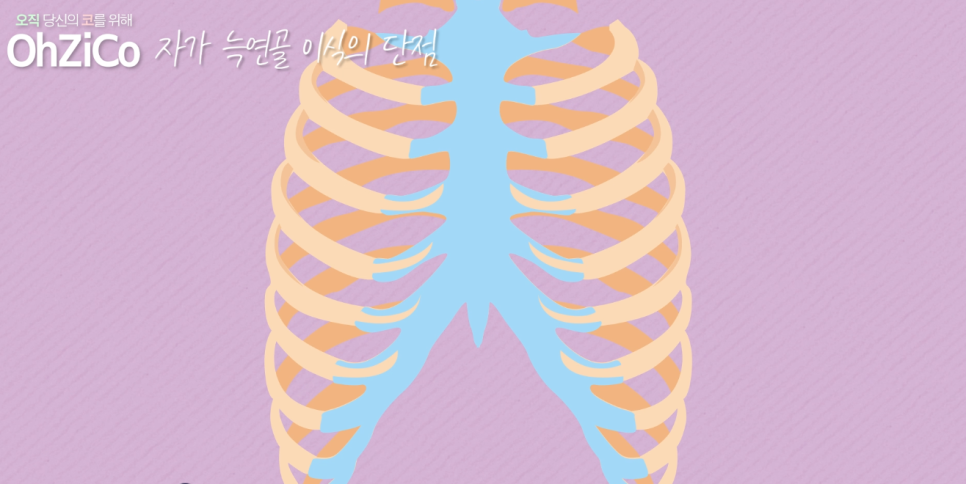
However, the biggest problem with autologous rib cartilage is what is called "ossification" or "calcification." In this condition, the outside of the rib is bone and the inner side is cartilage, but as a person gets older, there are cases where bone grows inside the cartilage, almost as if a pencil lead has been inserted into it. If you were planning to use autologous rib cartilage and it has this kind of shape, it can become difficult to deal with.

In addition, even in younger people, there can be cases where bone is present due to congenital factors. In other words, ossification has progressed. In such cases, the ossified portion inside is sometimes removed and then used.

However, if the ossified portion is large, there are cases where donor rib cartilage must be used instead of autologous rib cartilage.

So far, I have summarized the materials commonly used in recent nose tip surgery, autologous rib cartilage and donor rib cartilage, along with their pros and cons. I hope this article will be very helpful for those who are currently looking into rhinoplasty because they are unhappy with the shape of their nose. Thank you.
https://youtu.be/agQHOC1pWJ8