
Hello. This is Oji Hospital N+Plus, which thinks only about your beautiful and healthy nose.
The topic I’ll introduce this time is autologous implants used in nasal bridge augmentation.

Last time, I organized information about artificial implants used in nasal bridge augmentation. This time, I’d like to explain autologous implants in more detail.

Recently, there have been cases of raising the nasal bridge using the patient’s own tissue in nasal bridge augmentation. Autologous implants include dermis and chest cartilage.

First, in the case of dermis, since the harvested area is usually the buttock, a large scar may remain. You can think of the size as about the length of an index finger.

Also, rather than producing a sharp nasal bridge shape, it may create a somewhat blunt shape. Because of this, autologous dermis is often used to cover or reconstruct areas where the shape has changed or been damaged due to many problems caused by previous surgery.

Another critical drawback is its high absorption rate. So it is difficult to predict the final shape we want, because more absorption occurs than expected. Even if the surgery is performed with this in mind, during the period when absorption is taking place, the shape often appears quite awkward.

And when nasal bridge augmentation is performed using chest cartilage or autologous rib cartilage, carefully shaping the cartilage smoothly is a very difficult task. So it is difficult to achieve a sharp shape like silicone.

In addition, one of the biggest problems with chest cartilage and autologous rib cartilage is the so-called warping phenomenon, which refers to bending. Chest cartilage itself has a curved shape, and even if it is designed and trimmed at first, after about 6 months to 1 year after surgery, the shape may become distorted from the inside.
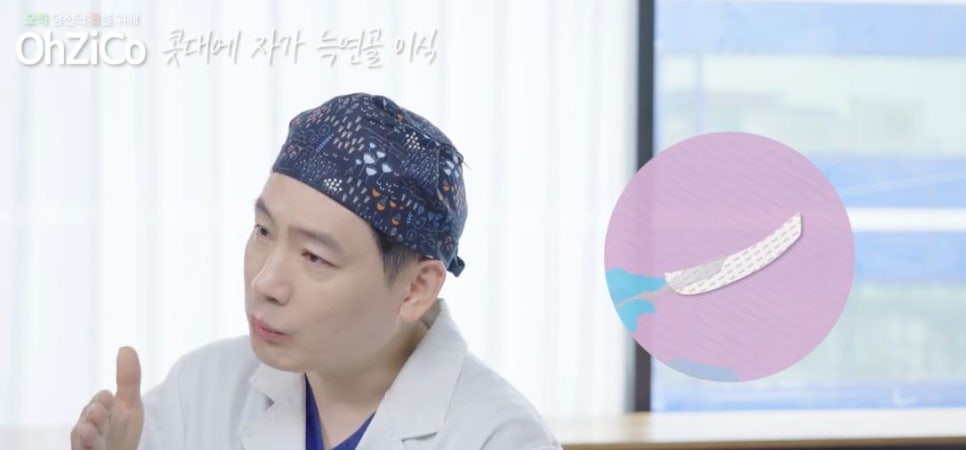
To prevent this warping phenomenon, countless cuts are sometimes made on the cartilage surface, but this still cannot fully complete the final shape.

Another recent method involves harvesting what is called “fascia,” specifically the “temporalis fascia” that covers the temporalis muscle inside the head area,

then making it into a pouch, finely mincing the cartilage, and filling that pouch with the cartilage pieces to raise the nasal bridge.

However, even in this case, because it is placed in a pouch, the shape may look natural, but detailed design is difficult, and over time the cartilage fragments tend to be somewhat absorbed, even though they are autologous cartilage.

Another issue is that revision surgery is extremely difficult. For example, if the nasal bridge is too high, too low, or bent, the cartilage pouch must be dissected and readjusted as a whole. In such cases, the cartilage already packed inside the pouch is stuck together, and the pouch itself is adhered to the surrounding tissues, so lowering the height or correcting the bent shape can be very difficult.

Because of this, there are people who say they are worried about using silicone when undergoing nasal bridge augmentation,

but the probability of inflammation caused by an artificial implant is about 3%, roughly three out of every hundred people, which is quite low. Also, if inflammation does occur, it is actually somewhat easier to treat or control when it is related to an artificial implant than when problems arise from autologous implants or tissue. Therefore, when it comes to handling shape and similar issues, there is no need to be overly negative about using implants such as silicone.

Today, I explained the discomfort many people feel about silicone, which is one of the biggest concerns you often have during outpatient consultations, and also explained artificial implants and autologous implants. I hope this article is very helpful for those of you considering rhinoplasty. Thank you.
https://youtu.be/WX21mrnlkx4