There are many different types of noses.
Some noses are pretty and well-balanced, but some people also undergo cosmetic nose surgery such as alar reduction surgery, bulbous nose surgery, or low-nose surgery because their nose shape is less ideal.
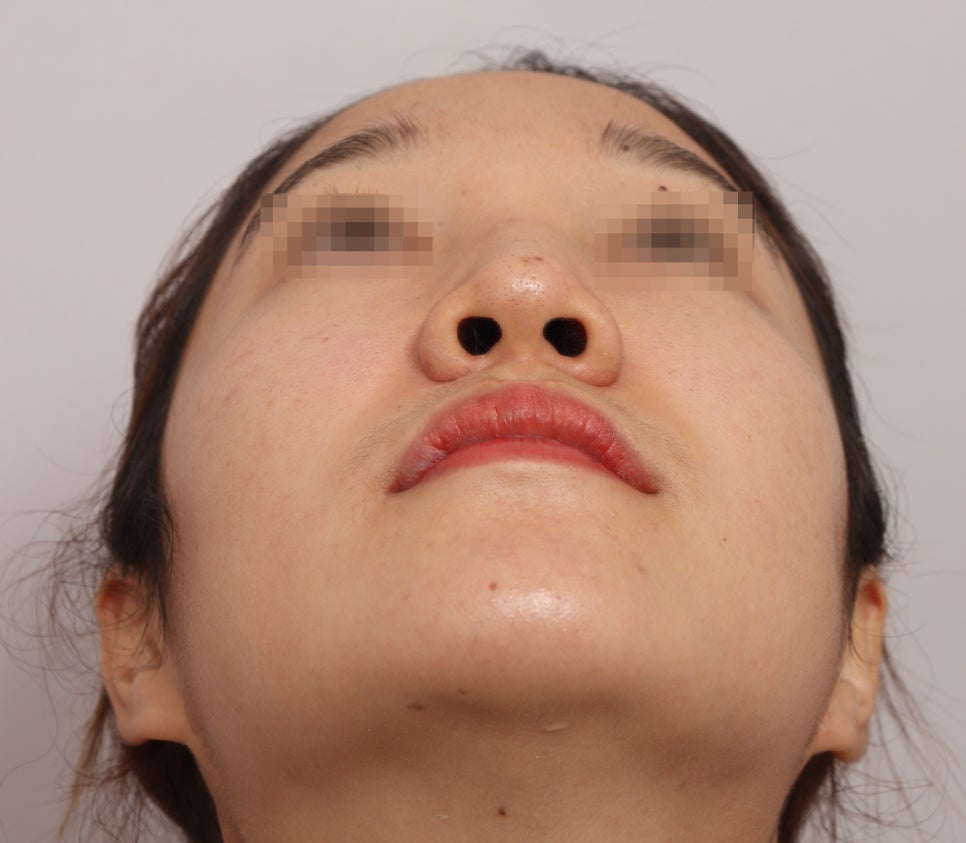
Today, among these, let’s talk about wide nostrils that may require alar reduction surgery.
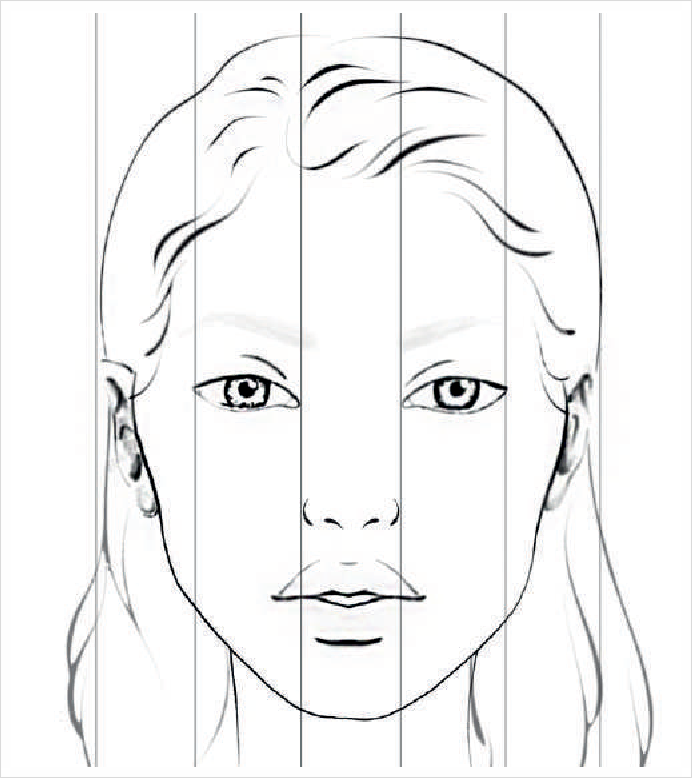
In general, the ideal size of the nose is considered to be when the face is divided vertically into five equal parts and the nose occupies 1/5 of the total.
Alar reduction surgery is also called nostril reduction surgery or nostril narrowing surgery.
It reduces the size of wide nostrils and improves overall facial balance.
When the nostrils become smaller and the alar area is reduced,
it can make the face look fresher and younger.

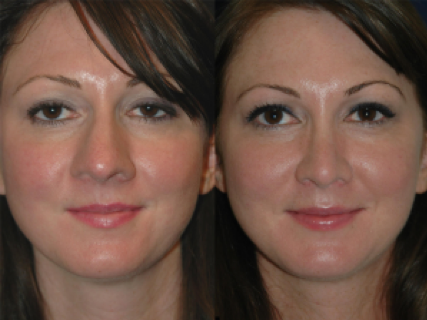
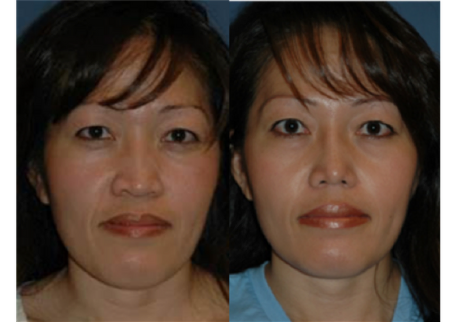
<Before alar reduction surgery>

<After alar reduction surgery>
What are the advantages of alar reduction surgery?
- The nose appears slimmer, giving the face a sharper overall shape.
- Breathing through the nose improves.
- Complexes about the face lessen, which can boost confidence.
A wide nose can be divided into three main types.
- Cases where alar reduction is not necessary
- Cases where alar reduction surgery leaves almost no visible scar
- Cases where the scar from alar reduction surgery is visible externally
First, let’s look at cases where a scar is visible after alar reduction surgery.
This refers to cases where the alar area is excessively wide,
and both the nostrils and the skin are thick.
In such cases, alar reduction surgery is unavoidable,
and the overall size must be reduced through an external incision.
The method involves making incisions along the outer lines of both alar wings,
removing a large amount of unnecessary soft tissue,
and then suturing the area again to reduce the alar width.
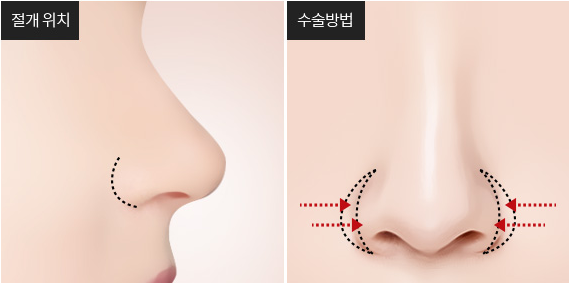
The external-incision alar reduction method is the most effective in terms of results,
and it has the advantage of significantly reducing alar size.
However, the downside is that it leaves an external incision, so a scar may be visible.
For the first two weeks after alar reduction surgery,
there may be some redness around the scar.
The scar starts to fade after about three weeks, but the rest of the healing can take about a year.
Of course, because the incision is made along the crease beside the nose,
it is not something that stands out visibly,
and after more than a year, it is usually only noticeable upon close inspection.
What should definitely not be done after alar reduction surgery?
- To reduce the risk of infection and scarring, do not touch the surgical site or remove the tape.
- Exercise, lifting heavy objects, activities that raise blood pressure, and strenuous workouts increase the risk of bleeding. It is best to avoid intense exercise for at least two weeks after surgery.

- Wearing glasses or sunglasses can put pressure on the surgical area and affect the healing process. Do not wear glasses or sunglasses for at least two weeks after surgery, or until your doctor gives permission.

- Smoking and tobacco products can impair the body’s natural healing process, increase the risk of infection, and affect healing at the surgical site. It is recommended to avoid smoking or tobacco for at least two weeks.

- Exposing the surgical site to direct sunlight can increase the risk of scarring and pigmentation. It is recommended to avoid direct sun exposure for at least six weeks after surgery.

So, what surgical methods are available in the second case, when the nose is not very wide and only a mild alar reduction is needed?
If the lower part of the nostrils is wide,
a tiny vertical incision is made in the middle of the nostril.
The periosteum and ligaments adhered to the flared alar wings are dissected and repositioned.
Then the incised area is sutured again.
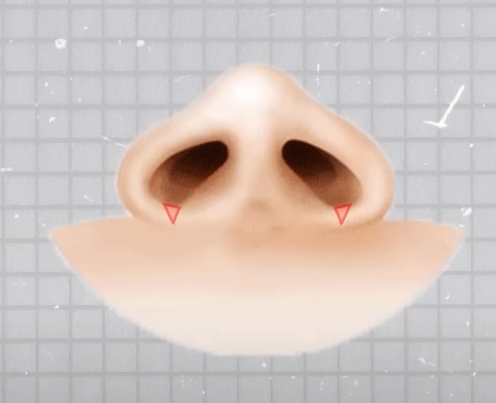
In this case,
the micro-incision area is not exposed externally,
so no scar is visible.
When alar reduction is performed with a micro-incision inside the nostril like this,
the wide and blunt-looking alar area can be reduced,
and the nostrils can become smaller, giving the nose a more refined appearance.
However, because the skin inside the nostril tends to pull in both directions,
the incision may widen,
so it is recommended to have the procedure done by a medical team with extensive experience in vertical micro-incision alar reduction surgery.
Also, during post-surgery care, it is important to be careful not to widen the incision site
and to avoid touching it unnecessarily or applying excessive force.
Lastly, when is alar reduction surgery not necessary?
Many people who undergo alar reduction surgery have wide alars,
along with a low nasal bridge or a blunt nasal tip.
In cases like the ones mentioned above, where the alar area is too wide, the skin is too thick,
or the nostrils are too wide,
external alar reduction or vertical micro-incision surgery is needed.
But in cases where the alar width is only slightly wide,
raising the nasal bridge and nasal tip, or just the nasal tip,
can also produce a narrowing effect on the alar area.
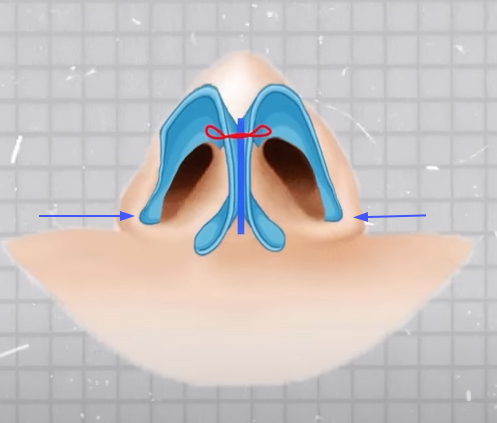
In general, silicone is used when raising the nasal bridge,
and autologous cartilage is often used for the nasal tip.
In such cases, when the bridge and tip are raised,
the nasal bridge line and tip rise,
and the alar area often rises along with them.
In this case, there is no need to perform alar reduction surgery separately,
because you can still see the effect of a smaller alar area.
Also, even when undergoing surgery to raise only the nasal tip without raising the bridge,
the type of autologous cartilage used will vary depending on the height of the tip.
In most cases, when only a slight tip lift is needed, septal cartilage is used,
and when a little more height is needed, septal cartilage and ear cartilage are used together.
If a greater increase in tip height is desired than this,
autologous costal cartilage is harvested from the ribs and used to support the nasal tip.
If the cartilage at the tip has spread apart, adding autologous cartilage along with cartilage suturing can raise it to the desired height.
When the nasal tip is lifted like this, as mentioned earlier,
it is like driving a central pole into a tent, causing the edges to rise and become tighter,
and the alar area also rises and becomes smaller at the same time.
So when the bridge and tip are lifted, or when only the tip is lifted,
you can achieve a reduced alar area without separate alar reduction surgery
and without scarring.
If you choose the surgical method that suits you best,
taking into account the width of the alar area, the size of the nostrils, and the thickness of the skin,
I think you can have alar reduction without regret.
Thank you~^^
https://youtu.be/QlieX5EvI8s