Hello, I’m Dr. Jo Wonjin, and I have been seeing patients for 10 years.

When I see patients in the clinic, I really notice that there are just as many concerns about dissolving filler as there are about injecting it.
I didn’t like the filler, so I dissolved it,
and now that area has sunken in..
It was from several years ago,
but I’ve already dissolved it three times and it still doesn’t work.
As in these cases, many people come in regretting the unexpected results after thinking, “I’ll just dissolve it.”
Dissolving filler is an area that is much more difficult than injecting it, and it requires precise diagnosis and experience.
With the topic, Three Reasons Why Filler Dissolving Side Effects Can Make You Regret It Twice,
I’ll talk about the side effects you can experience when it is dissolved without much thought, and how to address them.

Table of Contents
-
Reason 1. Existing volume can also disappear
-
Reason 2. There is no effect even after treatment
-
Reason 3. Other side effects such as swelling and allergy occur
-
How to avoid regretting it twice
Filler Dissolving Side Effects
Reason 1. Existing volume can also disappear
This is when, while trying to dissolve filler, your original tissue volume also decreases.
The reason is simple.
The enzyme used to dissolve filler (hyaluronidase) cannot accurately distinguish between hyaluronic acid injected from outside
and the hyaluronic acid in your body.
Basically, the more generously the dose is given, the better the ingredient dissolves,
and in reality, it is difficult to target only that exact area for dissolution.
As a result, some of the surrounding normal skin tissue can also be dissolved, making the area look more sunken.
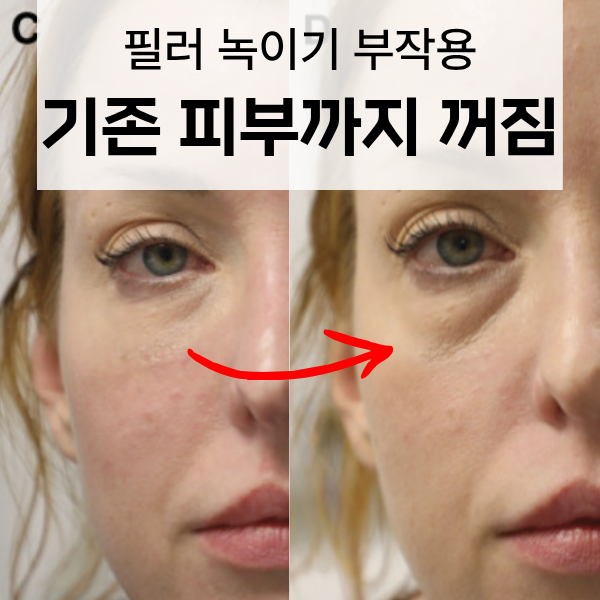 Excerpt from the paper The Posthyaluronidase Syndrome
“Is it possible to reduce it just a little because it was injected too much?”
It depends on the situation.
If necessary, we sometimes perform the procedure in detail so that only part of it is removed by adjusting the dilution of the solution or changing the skin layer into which it is injected.
Not long ago, there was also a case where a patient had filler treatment at another clinic but visited for correction because they were unhappy with the result.
If you are planning a repeat procedure, it is better to preserve as much of the existing tissue as possible, since it will serve as the foundation for the next treatment.
I recommend going to a place that performs removal especially carefully and in detail.
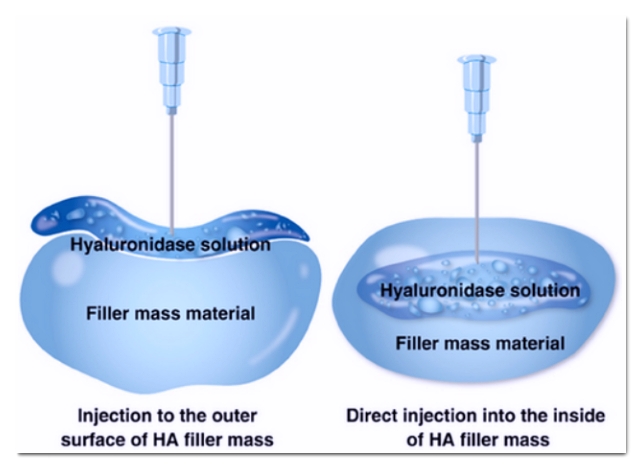
Filler Dissolving Side Effects
Reason 2. There is no effect even after treatment
"I had it dissolved three times at another clinic, and it’s still the same."
To start with the conclusion, if it has been more than 2 to 3 years since the procedure, or if a specific type of filler has been injected repeatedly into the area, it may no longer be in a simple filler state.
Our body may recognize it as a foreign substance and build a firm defensive wall (capsule) around it,
or there may be fibrosis or nodules where collagen has abnormally clumped together.
In this state, to use an analogy, the filler mass is trapped inside a hard cement wall.
No matter how much dissolving substance is applied from the outside, it cannot break through the cement wall, so it cannot be dissolved.

What should be done in this case?
At times like this, rather than blindly repeating injections, an accurate diagnosis must come first.
It is important to determine exactly which skin layer the filler is in, how much it is entangled with the surrounding tissue, and how far fibrosis or nodules have progressed.
If the diagnostic result shows only mild fibrosis, it may be possible to try a method of injecting a high concentration of enzyme while physically breaking up the nodule.
However, if the diagnosis shows that the fibrosis is so severe that it has hardened like a stone, I would say that it is difficult to treat with a simple injection procedure.
In such cases, surgical removal or other treatments may need to be considered.

Filler Dissolving Side Effects
Reason 3. Other side effects such as swelling and allergy occur
The first is an allergic reaction.
The enzyme used to dissolve filler (hyaluronidase), though rare, can cause hives, itching, and in severe cases, even difficulty breathing in some patients.
So before the procedure, an allergy skin reaction test for 5 minutes must be performed.
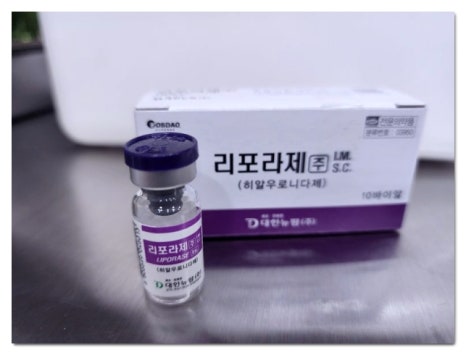
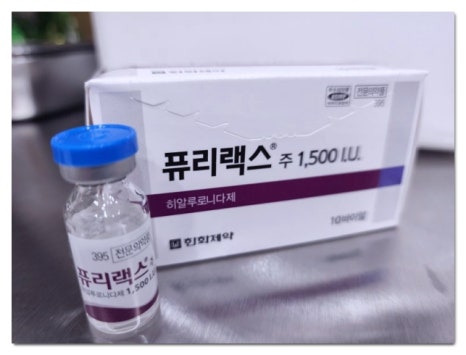
The second is swelling and pain.
"Doctor, I got more swollen after dissolving it."
This is a completely natural process, so please do not worry too much.
When the enzyme dissolves the filler (a solid gel) into water (a liquid),
our immune cells think, “Ah, there’s something to clean up,” and gather in that area to start removing the broken-down fragments.
This immune response appears as swelling and a slight feeling of warmth.
Usually, swelling or pain is felt most strongly immediately after the procedure and on days 1 to 2, and then subsides after 3 to 7 days.
Bruising may also occur, but it will be naturally absorbed, so it is fine as long as you manage it with cold compresses, etc.
How to avoid regretting it twice
To summarize the filler dissolving side effects discussed today in three lines:
-
When trying to dissolve filler, even the surrounding normal tissue can dissolve, causing the area to sink in.
-
If it is old or fibrotic, it may not respond to the enzyme and may have no effect.
-
Allergic reactions, swelling, bruising, and similar side effects may occur.
Filler dissolving is a highly advanced corrective procedure that requires an accurate diagnosis of the current condition and a plan tailored to it.

Before saying, “Just dissolve it,”
it is the only way to avoid regretting it twice to get a proper diagnosis of the current condition of your skin tissue and to find an experienced medical team that can respond precisely to various variables.
When you are wondering whether to dissolve it or not?
It is best to make that decision together with experienced medical professionals.
Thank you. This was Dr. Jo Wonjin.
- A must-read column to reduce regrettable procedures -