0000000000000000000000#Ptosis #Double Eyelid #Eye Shape Correction #Double Eyelid Surgery #Uneven Eyes #Uneven Eye Correction #Uneven Double Eyelids #Uneven Double Eyelid #Famous Eye Plastic Surgery Clinic #Famous Eye Plastic Surgery Hospital #Famous Eye Plastic Surgery Clinic in Gangnam
#Before and After Double Eyelid Surgery #Uneven Eye Double Eyelid Surgery #Best Place for Double Eyelid Revision Surgery #Best Place for Double Eyelid Revision in Gangnam #Outer Canthoplasty #Lateral/Lower Canthoplasty #Outer Canthoplasty #Lateral Canthoplasty #Canthoplasty Restoration #Outer Canthoplasty Restoration
#Revision for Sausage Eyes #Hospital for Eye Revision Surgery #Gangnam Eye Revision Hospital #Double Eyelid Surgery Review #Gangnam Eye Plastic Surgery #Eye Health #Best Place for Eye Plastic Surgery #Famous Hospital for Eye Revision Surgery #Best Place for Eye Plastic Surgery in Gangnam #Double Eyelid Surgery
#Double Eyelid Revision #Upper Canthoplasty #Ptosis Correction #Restorative Medial Canthoplasty #Outer Canthoplasty for the Eyes #Outer Canthoplasty Restoration #Gangnam Double Eyelid Surgery #Before and After Medial Canthoplasty #Gangnam Double Eyelid Surgery #Double Eyelid Surgery #Double Eyelid
#Double Eyelid Surgery #Double Eyelid Revision Surgery #Eye Plastic Surgery #Eye Shape Correction Surgery #Gangnam Eye Revision #Apgujeong Eye Revision #Sinsa Eye Revision #Plastic Surgery Clinic Good at Eyes #Double Eyelid #Sleepy Eyes #Sleepy Eye Shape
#Hospital for Double Eyelid Revision #Eye Shape Plastic Surgery #Gangnam Double Eyelid Surgery #Eye Revision Surgery Done Well #Before and After Double Eyelid Surgery #Ptosis Symptoms #Double Eyelid Line #Best Place for Double Eyelid Surgery #Incisional Eye Shape Correction #Eye Shape Correction Surgery
#Best Place for Double Eyelid Surgery #Best Place for Double Eyelid Surgery in Gangnam #Best Place for Double Eyelid Surgery in Apgujeong #Best Place for Double Eyelid Surgery in Sinsa #Best Hospital for Double Eyelid Revision #Before and After Lower Canthoplasty #Puffy Eyes
#Incision Double Eyelid #Sausage Double Eyelids #Best Hospital for Double Eyelid Revision #Eye Stitching #Gangnam Double Eyelid Surgery #Double Line Creation #Double Eyelid Line #Types of Double Eyelids #Inner and Outer Canthoplasty #Famous Eye Plastic Surgery Clinic
#Before and After Eye Plastic Surgery #Outer Canthoplasty Reconstruction #Removing Double Eyelids #Small Eyes #Types of Eye Plastic Surgery #Double Eyelid #Non-incisional Eye Shape Correction #Hospital for Double Eyelid Revision #Double Eyelid Surgery Review #Double Eyelid Outer Line
#Famous Place for Eye Plastic Surgery #In-Out Line Double Eyelids #Incisional Double Eyelid Revision #Types of Double Eyelid Surgery #Surgery to Enlarge the Eyes #Uneven Double Eyelids #In-Out Line Double Eyelids #Double Eyelid Review #Out Line Double Eyelid Surgery #Double Eyelid
#Best Place for Double Eyelids #Types of Double Eyelid Surgery #Incisional Double Eyelid #Ptosis Hospital #Incisional Method #Plastic Surgery Clinic for Eye Revision #Non-incisional Eye Shape Correction Release #Thick Double Eyelids #Hospital for Double Eyelid Surgery #Uneven Eye Surgery



Purpose of double eyelid surgery
Double eyelid surgery is
not simply intended to create a double eyelid line.
The purpose of double eyelid surgery is
to make the eyes look bigger and clearer,
and to create bright, lively eyes
with a refined eye shape.
Surgery done only to make a double eyelid line
often leads to unwanted results.
The purpose of double eyelid revision surgery is the same.
It aims to correct the eye shape so that it looks larger, clearer,
and more natural.
Director Shin Duhan

Correcting asymmetrical double eyelid lines
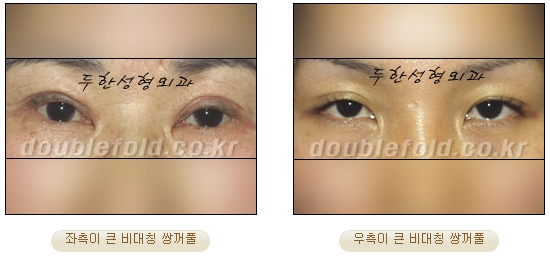
★ When the height of the double eyelid creases is different
★ When ptosis is present in one eye
★ When one double eyelid line has loosened
★ When the skin on one side has sagged
★ When the line has been pulled upward because the orbital fat is insufficient and the eyelid has sunk in
★ When the line has been pulled upward due to scar adhesion
When the skin on one side has sagged
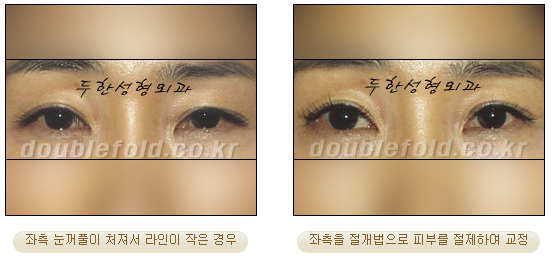
If the height of the double eyelid lines is the same but asymmetry occurs because the skin has sagged, the sagging side is corrected by removing the excess skin with the full incision method.
When both sides are asymmetrical and both double eyelid lines look awkward
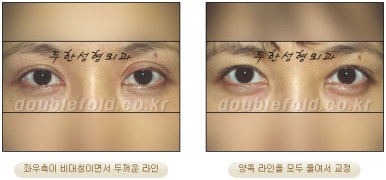
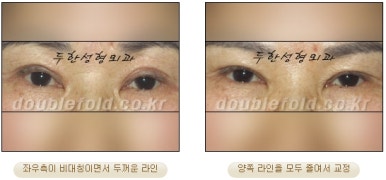
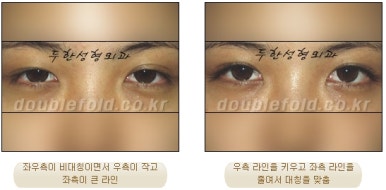
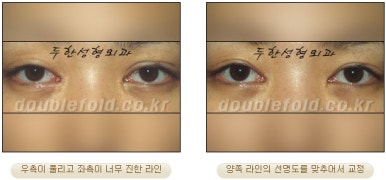
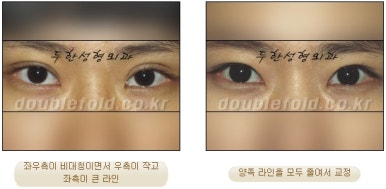
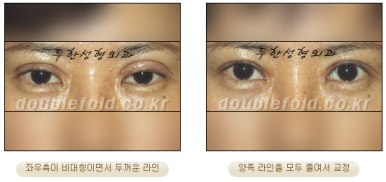
If both sides are asymmetrical and neither line looks attractive or natural, both sides need revision surgery.
The lines must be redesigned to the same height, the existing scar line removed, and the new line created by fully repositioning the tissue.
When one double eyelid line has loosened
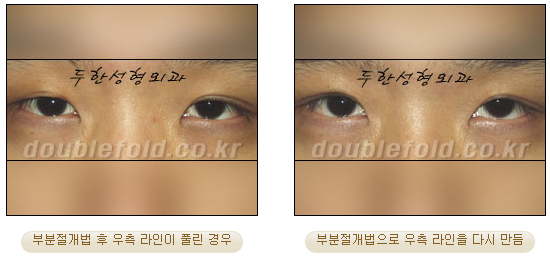
If one line has loosened, the loosened side is corrected using either the partial incision method or the full incision method.
If the skin is very thick or the scar is not severe, partial incision is the preferred first option.
If it still loosens, correction is done with the full incision method.
When one eyelid has sunk in and the line has been pulled upward, causing asymmetry
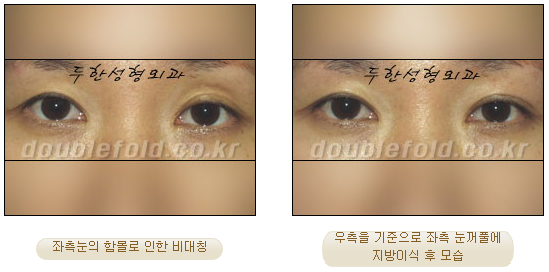
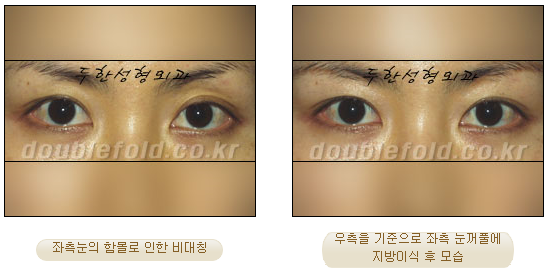
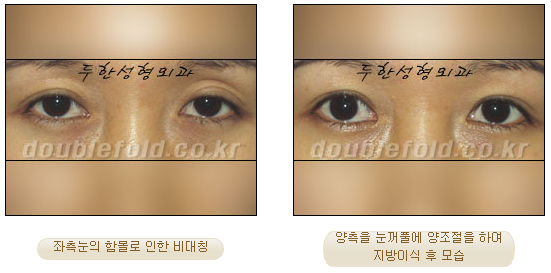
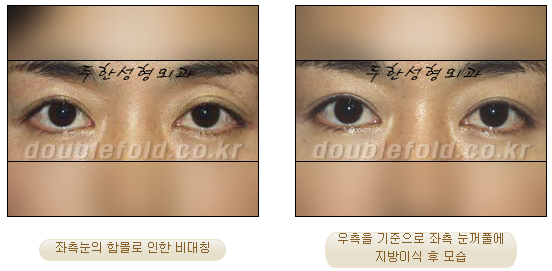
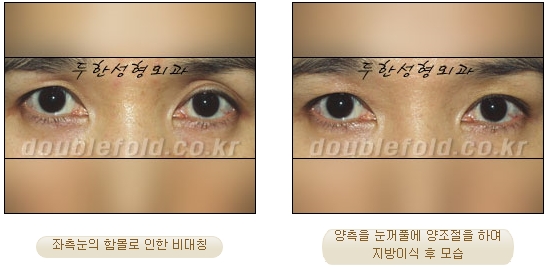
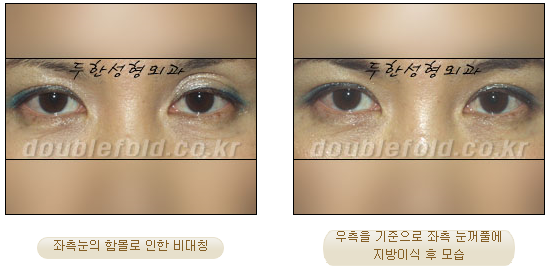
When the orbital fat is insufficient and the eyelid sinks in, the line is pulled upward and appears larger.
In such cases, it can be simply corrected with micro fat grafting without revision surgery.
Micro fat grafting is a simple procedure that injects fat with a syringe.
http://www.doublefold.co.kr

Correcting pseudoptosis with a thick line
Full incision method
To correct pseudoptosis with a thick line,
the full incision method can be used.
The full incision revision surgery process
is very delicate and requires extensive experience,
advanced skill, and know-how.
It usually takes about 2 to 3 hours.
The operation is carried out in 10 steps,
and if even one step is skipped,
it may lead to less-than-expected results.
Even if it takes some time, carefully checking each step
and performing the surgery with sincerity is necessary for better results.
Director Shin Duhan
Two goals of the full incision method
The goals for correcting pseudoptosis with a thick line can be broadly divided into two.
First: Reduce the large, unattractive double eyelid line and make it into a natural, thin double eyelid line
Second: Make the sleepy, half-open-looking eyes open wider and look clearer
Double eyelid revision surgery is performed as described below with these two goals.
Full incision method surgery process
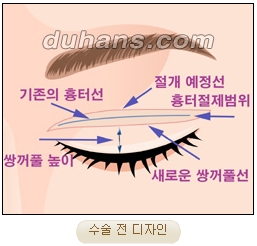
Step 1 - Design the incision line, including the existing incision scar tissue.
Before surgery, the design is made so that a new double eyelid line is created below the scar line, and the width of skin to be removed up to the scar line is determined.
For example, if the existing scar line is 10 mm above the eyelashes and the new double eyelid line is set at 7 mm, the skin excision width becomes 3 mm.
The new double eyelid line is determined by considering how much the line should be reduced and how much excess skin there is.
The average height of a double eyelid revision line is around 5 to 7 mm.
Step 2 - Cut away the skin and scar tissue.
The scar tissue is removed along the design line.
The incision is made precisely with a scalpel, and then the tissue is excised with surgical scissors.
The lower excision line becomes the new double eyelid line, and the upper line must be naturally pulled downward after tissue dissection so that it can be sutured.
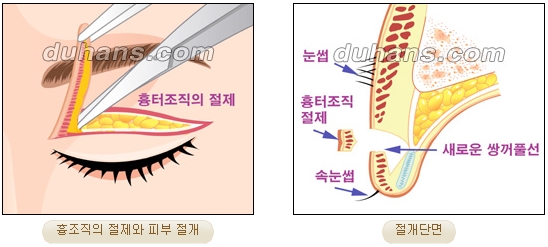
Step 3 - Dissect the orbicularis oculi muscle, orbital fat, and skin that are adhered to the levator muscle.
Because the skin above the incision line must be pulled downward, the firm scar tissue that has become attached must be dissected.
Scar tissue dissection involves separating the space between the orbital fat layer and the levator muscle, and in some cases the space between the muscle and fat is also dissected for forward repositioning of the fat.
Through this dissection process, the tissue can be moved forward and repositioned downward, and it is an important preparatory step for achieving a natural double eyelid line.
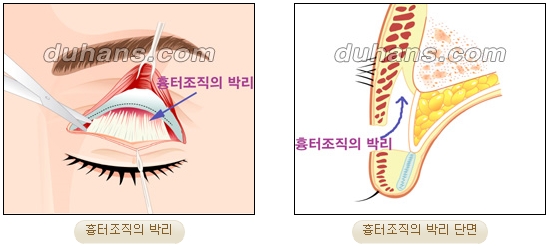
Step 4 - If there is contracture of the orbicularis oculi muscle, the muscle is incised or removed to relieve it.
When scar adhesion is too severe, in rare cases a vertical incision of about 1 to 2 mm may be made in the orbicularis oculi muscle to release the contracture.
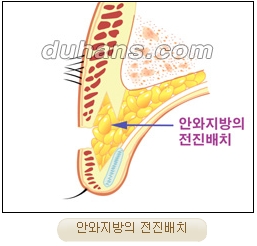
Step 5 - Reposition the orbital fat up to the incision line to prevent re-adhesion.
Forward repositioning of the orbital fat is a process to prevent the tissue from adhering again.
If the fat is not repositioned, the tissue will reattach, which can lead to ptosis and sleepy-looking, half-open eyes.
Sometimes a triple eyelid may also occur, damaging the double eyelid line.
Another effect of repositioning the orbital fat is that if the eyelid has sunk in, the depression can be corrected to some extent. So even if fat grafting may be needed later for a sunken eyelid, the surgery itself may improve it enough that fat grafting is not necessary.
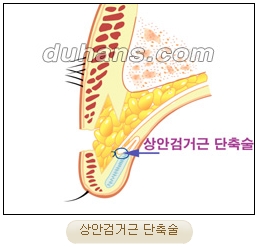
Step 6 - Shorten the levator muscle to strengthen its function.
Levator shortening is one method of correcting ptosis.
It is simple and effective, and has the advantage of being able to correct the problem with almost no tissue damage.
The method does not cut out the levator muscle; instead, it is simply advanced and tied to the tarsal plate (cartilaginous plate).
In revision surgery, the effect of levator shortening is to make the eyes open wider so they can be corrected into a clearer, more refreshed look, and because the eyes open wider, the double eyelid line also becomes smaller.
Step 7 - After incising the orbicularis oculi muscle at the medial canthus, orbital fat is inserted between the muscles to prevent re-adhesion.
Along with forward repositioning of the fat, fat is inserted into the inner corner of the eye to prevent scar tissue adhesion.
The inner side of the eye is the area where scar adhesion most easily occurs, and adhesion in this area makes the eyes look sleepy and makes it difficult to open them comfortably.
To prevent this, orbital fat, which can act as a lubricant, is placed between the orbicularis oculi muscle and the tarsal plate and fixed with sutures.
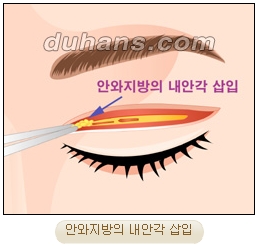
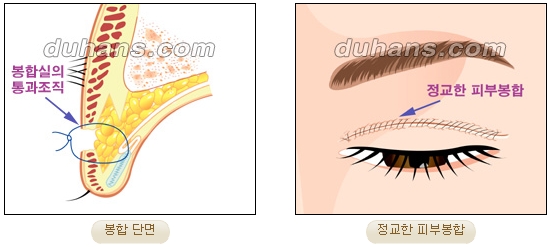
Step 8 - During suturing, layered sutures are used so that the repositioned structures do not move.
The suturing method for double eyelid revision surgery is not simple.
The purpose of suturing is to close the open wound and create the double eyelid line.
To obtain the double eyelid line as originally designed, the skin below the incision line must not be pulled upward.
To do that, the lower skin at the incision line must be firmly fixed to the tarsal plate (cartilaginous plate), and sutures must also be placed so that the forward-repositioned fat does not get pulled upward.
In addition, only when the orbicularis oculi muscle and skin above the incision line are passed through by the sutures and firmly layered together can the desired double eyelid line be achieved.
Step 9 - To prevent hematoma and inflammation, a small amount of an anti-swelling agent (hyaluronidase) is administered to the surgical site.
Hyaluronidase, an anti-swelling agent, is a medication that disperses fluid and has the effect of quickly reducing swelling as soon as it is administered.
However, excessive use can instead cause significant bruising, so it is used only in a limited way for reducing swelling.
Step 10 - Suture removal is divided into two stages, on day 4 and day 7.
Stitches are usually removed around 7 days after surgery.
The reason stitches are removed later is that, in revision cases, there is usually not enough excess skin, and because the surgery involves moving all tissues forward, a lot of tension is placed on the suture line.
Therefore, if the stitches are removed on day 3 or 4, the tense suture line may open up or the scar line may widen, leading to a larger scar and causing the tissue to gradually pull upward again, which can also enlarge the double eyelid line.
So, until the tissue stabilizes, the stitches should hold the tissue in place, which is why it is better to leave them in longer.
To prevent the stitch marks from making the scar look messy, most stitches are removed on day 4 and only 3 to 4 stitches are left, so there are almost no visible stitch marks.
To quickly reduce the early inflammation and swelling, steroid medication is administered for about 1 to 2 days.
After surgery, artificial tears are used for about 1 to 3 months to prevent dry eye.
If all of the above principles are followed with skilled technique, satisfying results can be achieved.
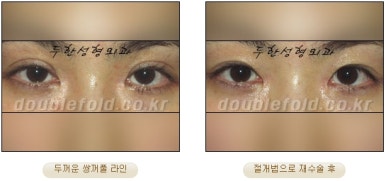
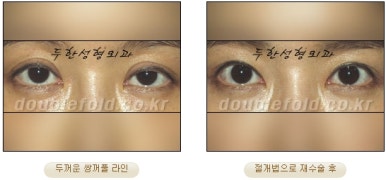
Examples of the full incision method
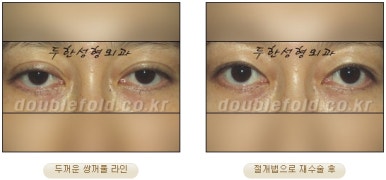
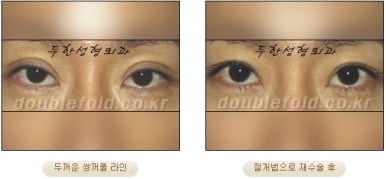
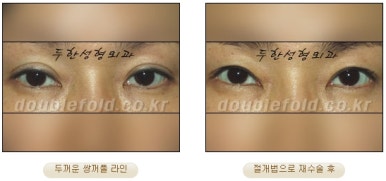
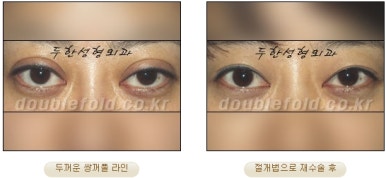
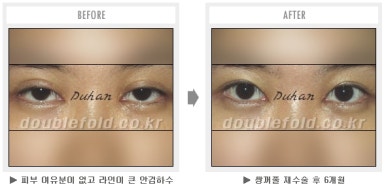
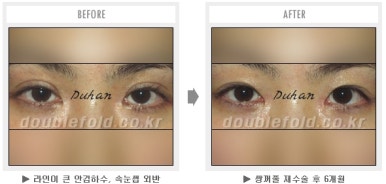
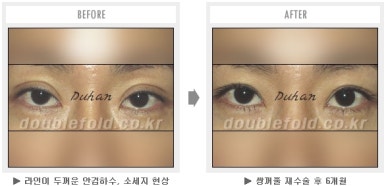
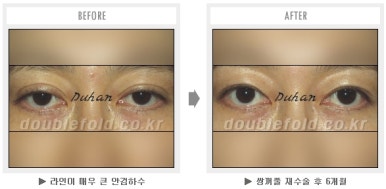
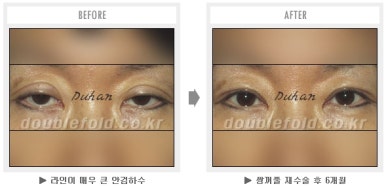
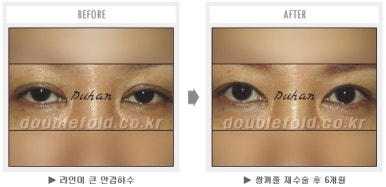
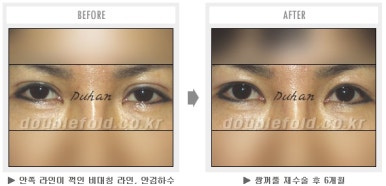
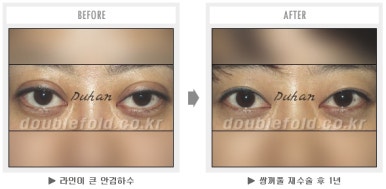
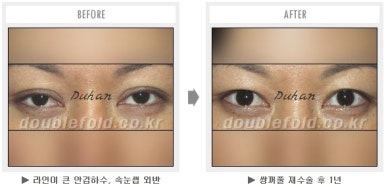
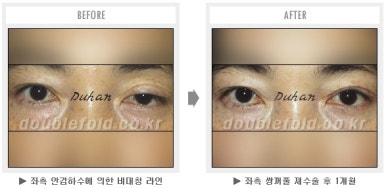
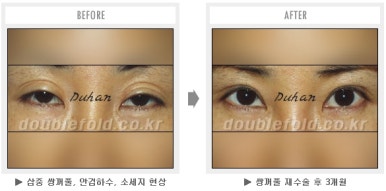
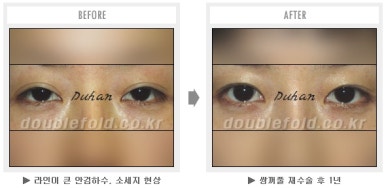
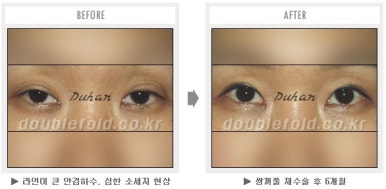
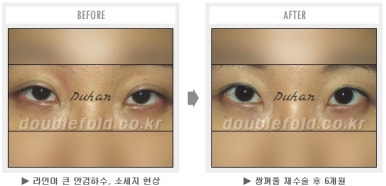
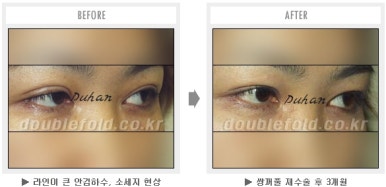
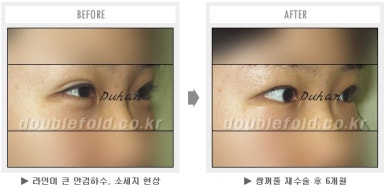
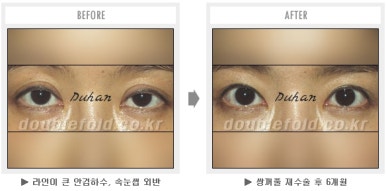
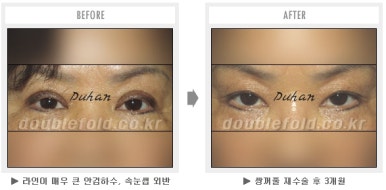
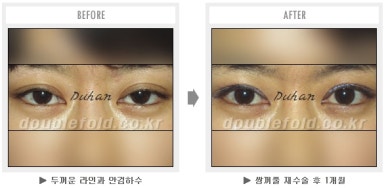
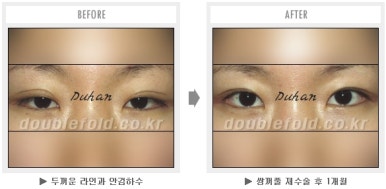
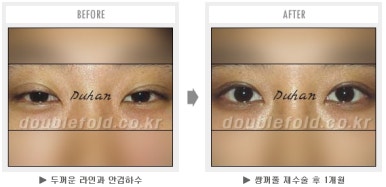
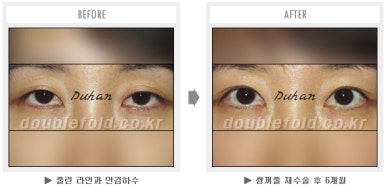
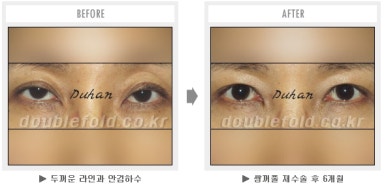
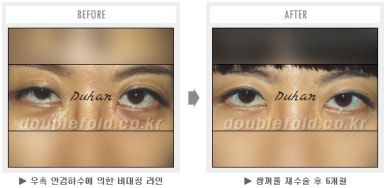
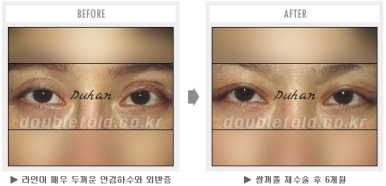
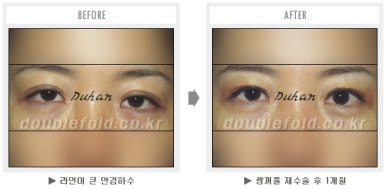
http://www.doublefold.co.kr

In cases of double eyelid lines with outer canthoplasty
These days, side effects from outer canthoplasty surgery at other hospitals are frequently reported.
Outer canthoplasty refers to surgery that opens the outer side of the eye, unlike inner canthoplasty.
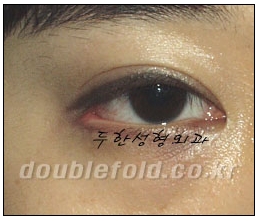
Types of outer canthoplasty side effects
♠ Eversion of the eyelid and lifting
♠ Distorted scars on the outer corner of the eye
♠ Exposure of the conjunctiva and drooping eyelid
♠ Excessive exposure of the lower white of the eye
♠ Deformation of the eye shape and twisting of the lateral canthus
♠ Dry eye and tearing
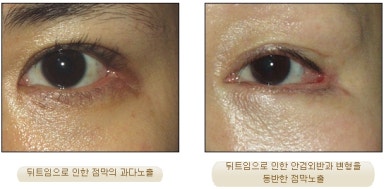
Examples of outer canthoplasty side-effect surgery at other hospitals
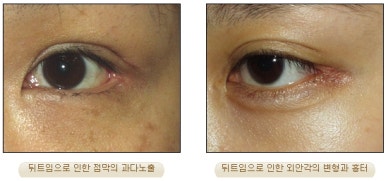
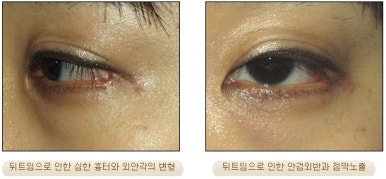
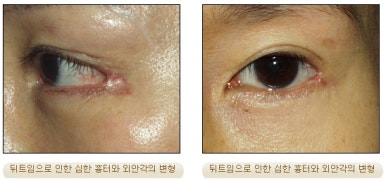
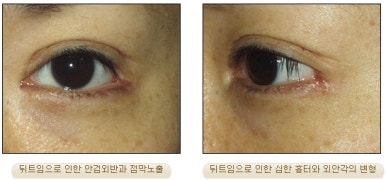
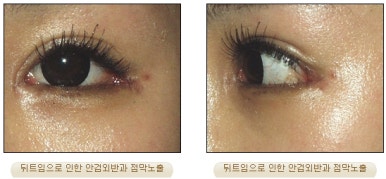
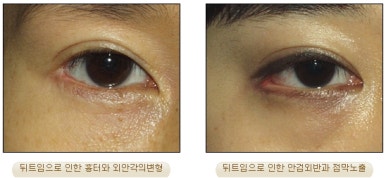
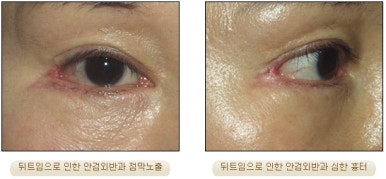
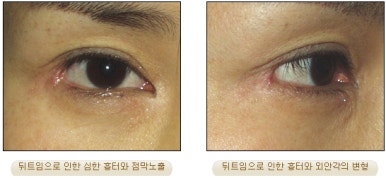
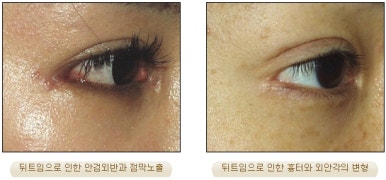
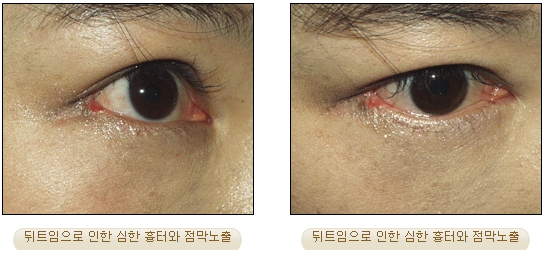
Duhan Plastic Surgery's lateral/lower canthoplasty method
If the outer corner of the eye is upturned and the horizontal length of the eye is short, combining outer canthoplasty and lower canthoplasty can create a larger and softer impression.
However, with lateral/lower canthoplasty, there are eyes for which the effect can be very noticeable and eyes for which it is less so, depending on the shape and structure of the eyes and the eyeball.
In lateral/lower canthoplasty, the tissue that tends to stick together is sufficiently removed through skin dissection, so it does not reattach, and the surgery delicately sutures the inside of the eye from the conjunctiva through the ligament-fascia layer, muscle layer, and skin layer according to anatomical structure.
This surgical method addresses the drawback of traditional outer canthoplasty, which is reattachment.
Because the skin and mucosa are sutured separately, it does not form a C-shape and there is no need to worry about reattachment.
Also, unlike at other hospitals, it is not performed with skin incision alone; it is firmly fixed to the periosteum so it does not loosen, and it is a safe operation that can also be reversed later.
The sutured area is naturally hidden along the eye corner line, minimizing visible scars, and due to years of know-how in double eyelid revision surgery, delicate and precise suturing leaves almost no scar.
Through extensive surgical experience, patient safety and satisfaction have been improved.
Our clinic does not perform uniform, identical eye surgeries.
With 1:1 customized design, we design according to each patient’s eyes and create a natural eye shape that harmonizes with the existing double eyelid line.

Tips for pre- and post-operative care for double eyelid revision surgery
Pre-operative care tips
① Before surgery, you should fully understand through sufficient consultation the cause of the failed double eyelid surgery and the surgical process yourself.
② Do not drink alcohol the day before surgery.
Alcohol can reduce the effect of anesthetic drugs, which may cause problems with anesthesia during surgery.
③ Try to avoid undergoing surgery during your menstrual period.
If there is a lot of bleeding during surgery, it can interfere with the operation and cause significant bruising.
Post-operative care tips
The usual return visits are the day after surgery and again one week later, for a total of two visits.
Day 1 after surgery: The surgical site is disinfected at the hospital, you receive an anti-swelling injection, and your progress is checked.
Day 4 after surgery: Your progress is checked and the continuous sutures are removed.
Day 7 after surgery: Your progress is checked to see whether the surgery went well or if there are any problems, and the remaining sutures are removed.
One month after surgery: The double eyelid line is checked to see whether it is settling in well.
Things you should do at home
Cold compress
Apply a cold compress using the cooling pack provided by the hospital.
Do this for 2 hours a day for 3 days.
The 2 hours can be done continuously, or divided into 20 to 30 minute sessions.
It is usually convenient to do it before going to sleep.
Disinfection and eye drops
Disinfect the surgical site with the prescribed medication.
Disinfection is done only until you remove the stitches yourself.
Use the artificial tears and eye drops prescribed by the hospital to prevent dry eye.
Scar care
Apply the prescribed ophthalmic ointment to the surgical site for about one month.
The scar-prevention eye ointment helps reduce scarring and calm redness, so apply it twice a day for 3 to 4 weeks.
Makeup and facial cleansing
These are possible starting one week after the stitches are removed.
Until then, replace face washing with a damp towel.
Swelling after surgery
This varies by individual, and usually some swelling subsides within 7 to 14 days, but the full settling-in period is between 1 and 3 months.
If levator shortening is performed during revision surgery, temporary lagophthalmos may occur, meaning the eyes do not close fully.
Depending on the degree of ptosis and the amount of levator shortening, it varies, but it usually takes 15 days and, in very rare cases, more than 6 months.
Lagophthalmos care
If levator shortening is performed to make the eyes open wider, temporary lagophthalmos can occur, meaning the eyes do not fully close. Depending on the degree of ptosis and the amount of levator shortening, it varies, but it usually takes 15 days and in some cases more than 6 months.
On average, it progresses for about 2 to 3 months and then the eyes naturally close normally.
During this time, artificial tears prescribed by the hospital are used to prevent dry eye.
Success requirements for double eyelid revision surgery
♪ For double eyelid revision surgery, you yourself must understand the cause of the failed double eyelid surgery better than anyone else.
It is not easy to undergo double eyelid revision surgery without recognizing the cause of the problem yourself.
♬ Only when you understand the cause and the doctor also identifies it can the patient and doctor proceed with the surgery in a relationship of trust.
♩ To identify the cause of the failed double eyelid surgery yourself, it is essential to seek a detailed consultation from an experienced board-certified plastic surgeon whenever possible.
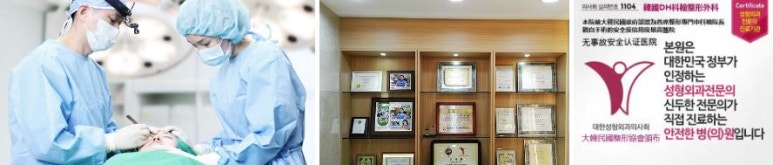
| The surgery must be performed by a board-certified plastic surgeon.You should confirm whether the operating surgeon holds a board certification in plastic surgery before undergoing surgery. Many clinics have a plastic surgery signboard, but in reality non-specialists provide treatment. It is important to understand this well and avoid being operated on by a non-specialist. |
|---|
| There must be extensive surgical experience in double eyelid revision surgery.Even among board-certified plastic surgeons, specialties vary slightly. If you are considering double eyelid revision surgery, you may get better results by consulting a specialist who focuses on double eyelid revision surgery. Double eyelid revision is one of the more difficult, high-level procedures in plastic surgery. To restore a more beautiful and natural eye shape, it is better to be treated by a specialist with solid know-how and accumulated experience in double eyelid revision surgery. |
| You should not think of double eyelid revision surgery as easy.If you think revision surgery is easy, the likelihood of another failed surgery is very high. Compared with the first surgery, double eyelid revision surgery is much more delicate and difficult, and is among the most challenging plastic surgery procedures. We recommend thinking carefully before deciding on surgery. |
| You must accurately identify the reason for the failure of the double eyelid revision surgery.The patient must understand the cause of the first surgery’s failure as clearly as possible. Through consultation, you should be able to accurately understand why the initial surgery was done incorrectly and by what process the revision surgery will be performed, so that you can proceed with trust and obtain good results. |
| The double eyelid revision surgery should not be too short.Double eyelid surgery usually takes about 30 minutes to 1 hour. Full incision double eyelid revision surgery cannot be completed in a short time. Unlike the first double eyelid surgery, revision surgery progresses from releasing the original double eyelid, to dissecting scar tissue, repositioning tissue, and performing precise layered suturing. Therefore, the operation inevitably takes longer, and good results require that every step be carried out according to the proper principles. |
| The eyes should be able to open well right after double eyelid revision surgery.Most patients have thick double eyelid lines and sleepy-looking pseudoptosis. The goal of double eyelid revision surgery is to make the double eyelid line as thin as possible and to make sleepy eyes open clearly. If the surgery goes smoothly, in most cases the eyes should open clearly as soon as the operation ends; this is a successful outcome. The appearance immediately after surgery should not look awkward, because in most cases it will look natural after the swelling goes down. |
| The thick front line should be reduced immediately after double eyelid revision surgery.The highlight of double eyelid revision surgery is naturally converting a severe out-fold line into an in-fold line. Right from the moment after surgery, the inner line that serves as the first button should be properly formed so that the outer line connects naturally and the prognosis is good. If the line is still thick immediately after surgery and the inner line is not properly narrowed, then it cannot be considered a good prognosis. |
| There should be some lagophthalmos for a period of time after double eyelid revision surgery.If the eyes close perfectly right after surgery, that is considered an incorrect result. In most double eyelid revision cases, there is not enough excess skin. When surgery is performed in such a state, for the eyes to close well, the skin has to stretch somewhere, and in most cases it stretches below the incision line. If that happens, the double eyelid line becomes larger again. During the adaptation period, the skin above the incision line gradually stretches and eventually the eyes close naturally. When there was not enough excess skin, recovery from lagophthalmos is slower; conversely, when there is enough excess skin, recovery is faster. |
| The stitches should be removed a little later after double eyelid revision surgery.Usually the stitches are removed in two stages, on day 4 and day 7, depending on how much excess skin there is. Unlike primary double eyelid surgery, where all stitches are removed around day 3 to 4 after surgery, in double eyelid revision surgery the final stitches are removed around day 7. If stitches are removed too early after revision surgery, the scar may widen and the tissue above the incision line may be pulled upward again, resulting in a surgery that might as well not have been done. Because revision suturing is performed when tissue is lacking, the stitches must hold the tissues in place until they settle into their new position. If the stitches are removed before the tissues have settled, the tissues that have not yet stabilized may be pulled upward again, leading to a failed surgery. |
http://www.doublefold.co.kr

http://www.duhans.com