#fat grafting #micro fat grafting #autologous fat grafting #facial fat grafting #facial micro fat grafting #facial autologous fat grafting #fat injection #full-face fat grafting #sunken cheek fat grafting
#facial micro fat grafting #best place for facial fat grafting #autologous cheek fat #fat grafting after filler #autologous cheek fat grafting #facial fat grafting surgery #forehead fat grafting swelling #long face fat grafting
#forehead fat grafting maintenance period #cheek fat grafting #before and after facial fat grafting #forehead autologous fat grafting #Gangnam fat grafting #front cheek fat grafting #cheek fat grafting #nasolabial fat grafting #sunken cheeks
#sunken cheek fat grafting #chin fat grafting #forehead autologous fat #forehead fat grafting #fat grafting effects #back of hand fat grafting #before and after fat grafting #chin tip fat grafting #full-face fat grafting maintenance period
#male facial fat grafting #nasolabial fold fat grafting #Seoul fat grafting #small chin #facial autologous fat #fat grafting surgery #facial fat grafting swelling #partial fat grafting #glabella fat grafting
#microgenia fat grafting #Duhan #Duhan Plastic Surgery #Duhan autologous fat grafting #Director Shin Duhan #pelvic fat grafting #lip fat grafting #depressed buttocks #hip fat grafting #youthful appearance #butt fat grafting
#revision aristoplasty #temple fat grafting #facial fat grafting #nose revision surgery #nose fat grafting #how to gain facial fat #under-eye lifting #deep-set eyes #dark circle fat grafting #under-eye hollow fat grafting
#upper eye hollow #non-incisional facial contouring #non-surgical facial contouring #facial fat grafting bruising #long face correction #eyelid fat grafting #nose bridge fat grafting #thigh fat grafting #eye fat grafting #hollow eyes
#hollow eye fat grafting #neck line fat grafting #under-buttock fat #upper eye fat grafting #upper eyelid fat grafting #facial fat redistribution #wrinkle removal #aegyo-sal fat grafting #sunken eye fat grafting #under-eye
#under-eye fat grafting #nasolabial fat suction #love handle fat #very sunken eyes #eyelid wrinkles #facial fat suction #upper eyelid fat grafting #cheek hollows #sunken eye surgery #lifting laser #submental fat removal
#sunken eyelids #cheek fat removal #facial fat #eye wrinkle removal #forehead wrinkle treatment #aristoplasty #upper-eye fat redistribution #sunken eyes #hollow eyes #cheek fat suction #aegyo-sal surgery #back of hand filler
#under-eye lifting #thread lifting procedure #hollow eye filler #facial volume #forehead wrinkle improvement #straight forehead lines #horizontal forehead wrinkles #forehead wrinkle removal #cheek fat removal #tear trough fat grafting
#thick double eyelids #sunken eye surgery #multiple double eyelids #non-incisional lifting #neck wrinkle thread lifting #aristoplasty implant #forehead lifting #forehead thread lifting #fill out the cheeks #facial cheek hollows
#cheek hollow filler #facial fat grafting removal #nasolabial fold implant #upper eyelid fat removal #lose cheek fat #nose bridge reduction #lifting effect #facial liposuction #non-surgical under-eye fat repositioning
#upper eyelid hollow #lip surgery #double chin #youthful face #forehead wrinkle procedure #multiple double eyelid surgery #cheek lifting #nasolabial lifting #male deep cheek removal #dissolving under-eye filler #under-eye filler
#sagging under-eye skin #front cheekbone wrinkles #Indian band #recommended fat grafting #Apgujeong fat grafting #Sinsa Station fat grafting #wrinkle correction #wrinkle fat grafting #facial wrinkle fat grafting #under-eye fat grafting
What is fat grafting
Fat grafting is also called fat injection.
Because it is a delicate and precise fat grafting procedure,
it is also referred to as micro fat grafting.
Using a syringe, your own fat is harvested
and then injected again with a syringe into the desired area,
correcting the contours of the face.
The key to micro fat grafting is
natural, smooth contour expression and a high graft survival rate.
Using three-dimensional volumetric fat grafting and two-dimensional planar fat grafting,
the most ideal fat grafting is performed for each area.
Except for bone surgeries such as the cheekbones and jawbone,
contour correction of other sunken areas
can be corrected with fat grafting.
The procedure is simple and has no side effects,
and because it can be corrected naturally to the desired extent in any area,
it is one of the best facial contouring procedures.
http://www.duhans.com
What are the side effects of fat grafting?
Of course, the goal is to achieve a good result, but depending on the surgeon's skill and technique, sometimes unavoidable problems can occur.
Poor results due to a low graft survival rate, awkward shape, asymmetry, severe swelling, inflammation, fat necrosis, calcification, contour irregularities, sagging, and pigmentation can occur.
| Inflammation | Occurs when bacteria enter during the procedure, or when the grafted fat fails to survive during the engraftment process and dissolves |
|---|
| Necrosis | A state in which fat that failed to survive due to insufficient blood supply during the engraftment process rots and dissolves, leaving behind remnants |
| Calcification | A phenomenon in which fat that failed to survive due to insufficient blood supply during the engraftment process hardens and calcium deposits form, creating a firm mass |
| Contour irregularity | A phenomenon in which the shape becomes bumpy because the fat was not grafted evenly or was concentrated in one area |
| Sagging | If too much fat is grafted or if it is grafted in the wrong location, sagging of the face can occur. |
| Pigmentation | If bruising or swelling is severe, iron components left in the bruise may deposit in the skin and oxidize, turning brown depending on the individual; this may sometimes occur after under-eye procedures depending on body type. |
| Asymmetry | When the left and right graft survival rates differ, or when the amount is not adjusted properly during the initial procedure, causing imbalance between both sides |
| High absorption rate | A phenomenon in which the fat does not survive sufficiently to create the desired contour and much of it is absorbed, so the appearance before and after the procedure does not differ much |
| Awkward shape | A phenomenon in which the fat survives excessively or is grafted to an inappropriate area, disrupting the overall balance of the face |
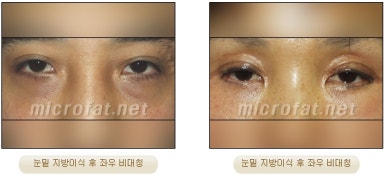
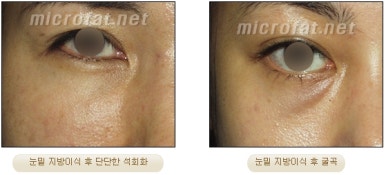
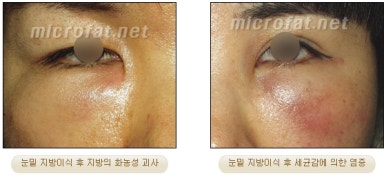
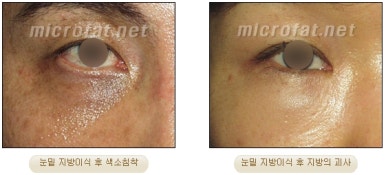
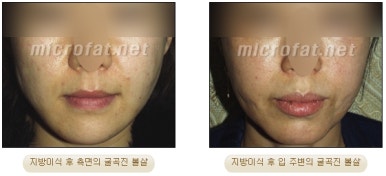
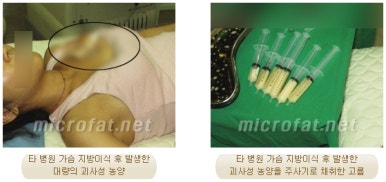
What are the problems with fat grafting side effects?
Because fat grafting uses your own fat, unlike commercial filler materials, it has very few side effects.
Except for slight swelling and bruising after the procedure, it can be said to have no side effects at all.
Therefore, it can be considered one of the safest procedures compared with any other plastic surgery.
However, this is based on cases where fat grafting is performed properly. If the procedure violates the principles, side effects may occasionally occur, such as a bumpy shape, fat necrosis and hardening, inflammation, or an awkward appearance due to excessive injection.
This is determined by the practitioner's experience and skill; it is absolutely not an overall problem with fat grafting itself.
Therefore, if the procedure is performed according to the principles, these side effects are very unlikely to occur.
How can fat grafting be performed without side effects?
- Perform the procedure under sterile conditions
As with all surgeries, fat grafting must also be performed with completely sterilized instruments and materials.
After the procedure is finished, the inside of the suction cannula should be thoroughly cleaned with a brush and disinfected in an autoclave so that no fat residue remains inside the cannula or grafting tube. Anesthetic agents and saline should also be carefully managed to avoid contamination.
Thorough disinfection and proper management of materials can prevent bacterial infection and inflammation.
- Multiple purification steps for fat
Fat purification must remove impurities completely through several stages to maximize effectiveness.
Harvested fat usually contains about 80% impurities, and only about 20% is actually usable.
If the remaining impurities (blood, serum, anesthetic solution, oil, water, etc.) are not removed, the result will not be good no matter how well the graft is performed.
- Preconditioning work before fat grafting
A high graft survival rate should make it possible to achieve a satisfactory effect with a single procedure whenever possible.
The fine fat should be placed evenly in multiple layers, and before that, space must be secured at the graft site so that previously grafted fat is not compressed by surrounding tissue. Only then can the fat avoid pressure and survive well.
- Precise and even grafting into multiple tissue layers
The expression of a soft and natural contour is the core of fat grafting.
To express a soft contour, grafting in a three-dimensional manner that distributes fat evenly across multiple layers is recommended.
The grafting locations include the subcutaneous layer, muscle layer, and fascial layer, and the fat must be spread through the tissue as evenly as if sowing seeds to achieve a smooth contour without irregularities.
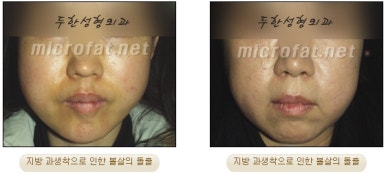
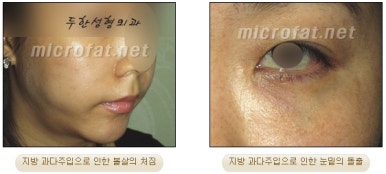
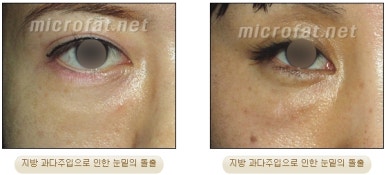
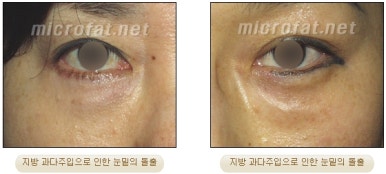
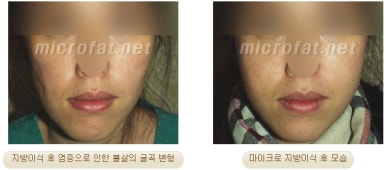
Pigmentation side effects that occurred after fat grafting
Before-and-after procedure images
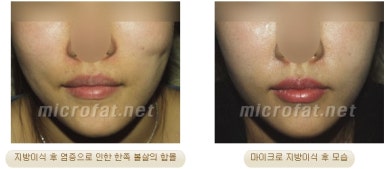
It can sometimes occur constitutionally after under-eye fat grafting.
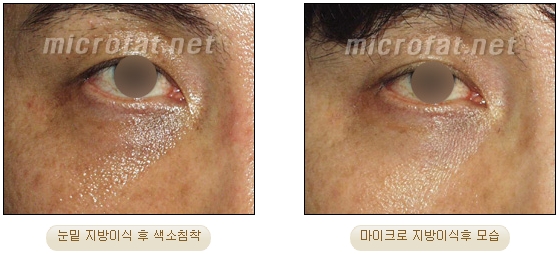
After bruising from the under-eye procedure appears and then disappears,
this occurs when iron components left in the bruise deposit in the skin.
In most cases, it gradually disappears on its own over time.
If it does not go away easily, the color can be lightened through micro fat grafting.
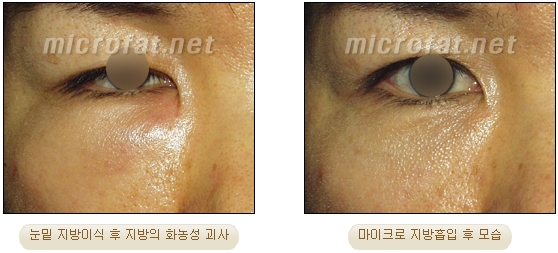
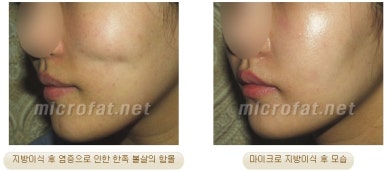
Necrosis side effects that occurred after fat grafting
Before-and-after procedure images
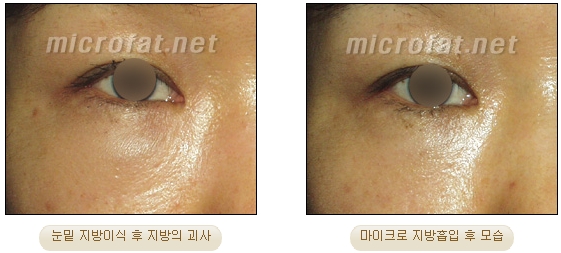
This happens when too much fat is injected into one area, so it fails to survive,
and the fat melts into liquid and pools.
In some cases, it suppurates and turns into pus.
It is removed by suction with a micro cannula.
Bacterial infection side effects after fat grafting
Before-and-after procedure images
This occurs when bacteria enter for some reason after fat grafting and inflammation develops.
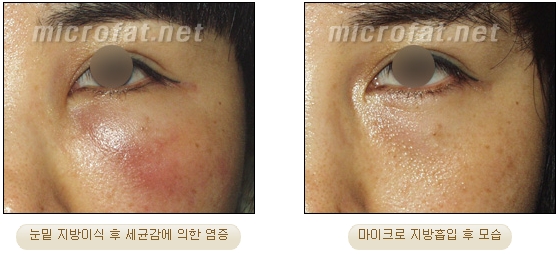
It can occur constitutionally when immunity is low,
or when surgical instruments or materials are not sterilized during the procedure.
All inflamed tissue must be removed using a micro cannula.
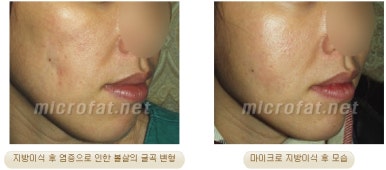
Asymmetry side effects after fat grafting
Before-and-after procedure images
There are cases where the amount of fat injected differs, or the engraftment conditions differ for some reason,
so both sides do not survive evenly.
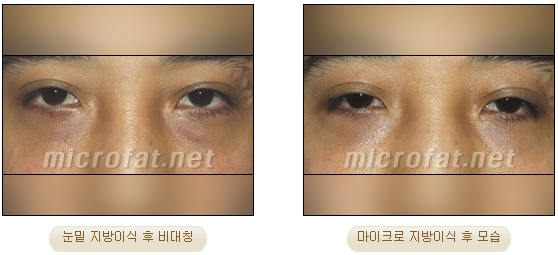
In such cases, the deficient area is supplemented with additional correction.
Micro liposuction
for correcting fat grafting side effects
| 1. A design is drawn on the skin to mark the liposuction area. |
|---|
| 2. Painless sedation anesthesia is performed to eliminate pain during local anesthesia. |
| 3. Local anesthesia is administered to the liposuction area. |
| 4. The fat is dissolved using an ultrasonic liposuction device. |
| 5. Necrotic tissue or dissolved fat is suctioned out using a micro cannula. |
| 6. After liposuction, the treated area is effectively compressed with a face band. |
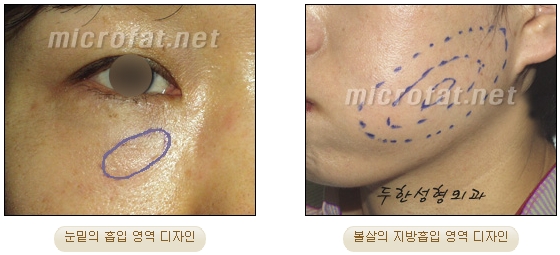
The area to be suctioned is designed on the skin.
The shape of the design differs from person to person, and the area is designed according to where the side effect has occurred, such as the cheeks, jawline, or under the eyes.
A plan is made for which area will be suctioned and how much fat will be removed.
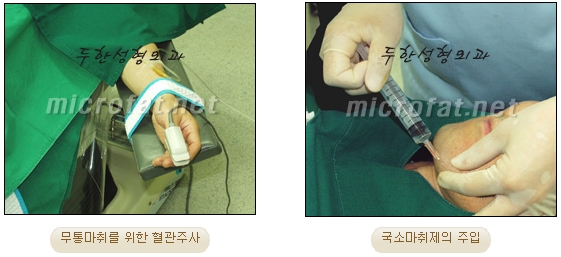
Anesthesia is given through an intravenous line in the arm with sedation anesthesia.
Because there is pain during local anesthesia, if local anesthesia is administered after first inducing sedation, the local anesthesia can be done without pain.
After the local anesthesia is finished, the patient wakes up.
The time to fall asleep with sedation anesthesia is usually about 5 minutes.
Sedation anesthesia is different from general anesthesia; it is a safe anesthesia method and is used as an adjunct to local anesthesia.
The cannula is inserted from the edge of the suction area and suction is performed delicately and gently.
When the suction volume is large, the fat is first dissolved with ultrasound and then suctioned with a fine cannula. When the amount is not large and more delicate suction is needed, suction is sometimes performed only with a micro cannula attached to a syringe.
The main point of suction is to remove tissue evenly from the designed area without irregularities.
In cases of necrotic abscess in the breast, necrosis often occurs extensively, so if it cannot be corrected by suction, an incision may be necessary.
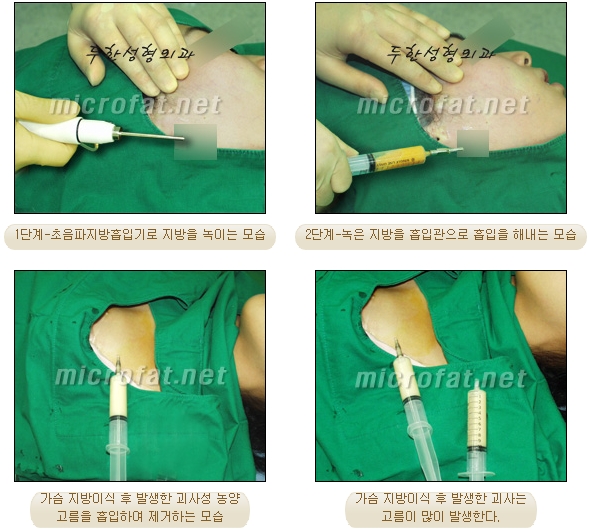
Our clinic has specialized in fat grafting since 2001, but we do not perform breast fat grafting.
The breast is an area that requires a large amount of fat injection to see an effect, so it is difficult to graft enough fat. In addition, if a large amount of fat is injected, the breast can become hard due to fat necrosis or calcification, and lumps may form.
In severe cases, large abscesses may develop due to inflammation.
In future breast cancer screenings, these calcifications may prevent cancer from being diagnosed, so breast fat grafting is not recommended.
Plastic surgery has principles.
Because both good and opposite results must be considered, if there is a chance of a poor result after surgery, that procedure should not be performed.
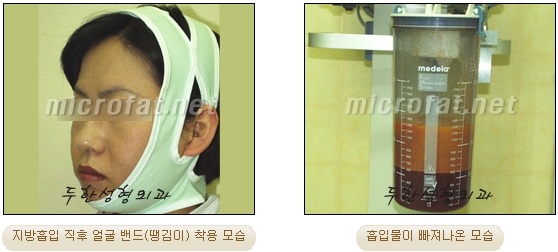
Suction time varies by area, from as little as 10 minutes to as long as 30 minutes, and after suction is completed, a face band is worn.
The face band increases the effect of liposuction, reduces swelling and bruising, and prevents skin sagging.
The wearing period is about 4 to 7 days, and areas such as under the eyes are not wrapped with a band but only lightly taped.
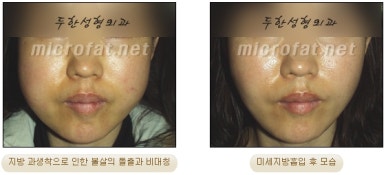
Examples of micro fine liposuction application
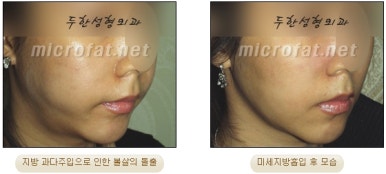
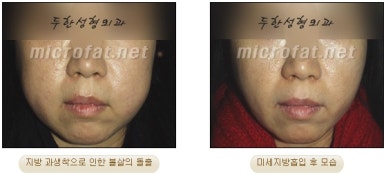
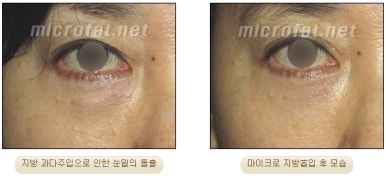
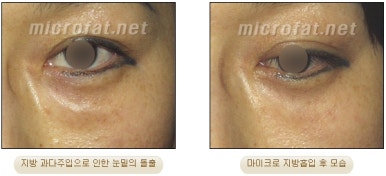
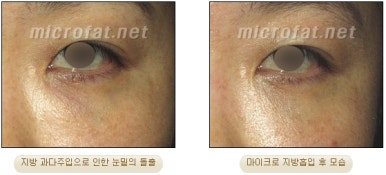
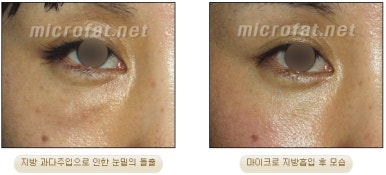
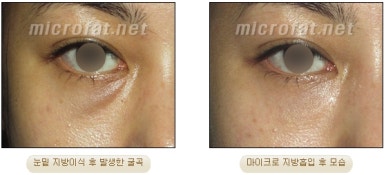
Micro fat grafting
for correcting side effects
① Fat is harvested from areas where your own fat is abundant, such as the lower abdomen, waist, or thighs.
For wrinkle correction, not much fat is needed, so harvesting from the lower abdomen is preferable.
-
Because local anesthesia is performed with painless sedation anesthesia, there is no pain at all.
-
A fine liposuction cannula is used to collect the fat into a syringe.
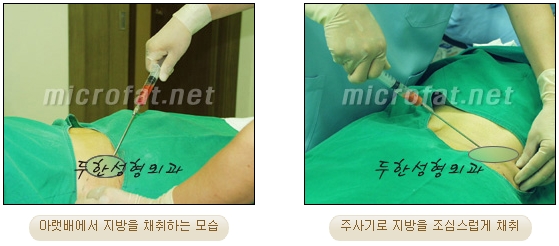
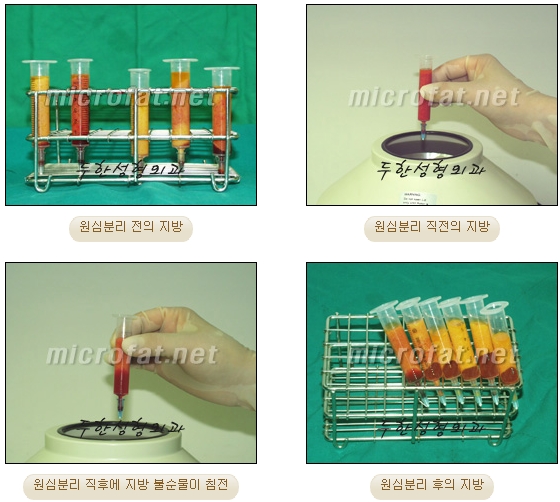
② The harvested fat is placed in a centrifuge to remove impurities (local anesthetic, serum, red blood cells).
The purpose of centrifugation is to increase fat concentration by removing impurities contained in the fat and to improve the fat graft survival rate.
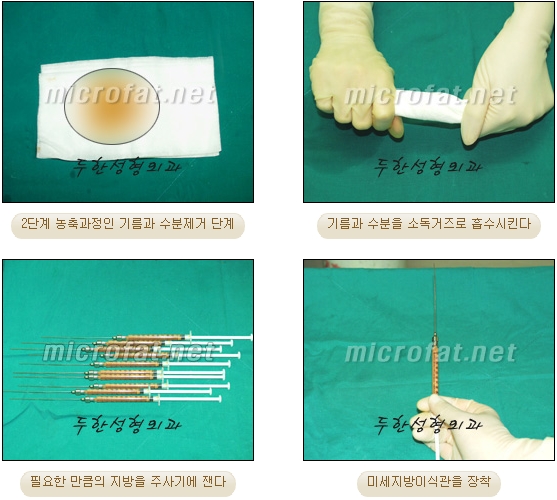
③ The fat that has been centrifuged goes through a second concentration step to remove water and oil.
By removing water and oil, nearly 100% concentrated fat is obtained.
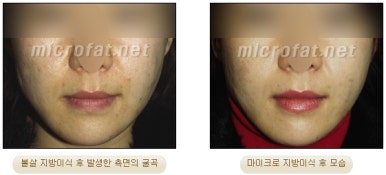
④ The purified fat is transferred into a thin 1 cc syringe and grafted into the desired area.
The purified fat is transferred again into a thin 1 cc syringe and grafted into the desired area.
Our clinic uses a micro needle (fine grafting cannula) developed in-house.
The micro needle is a special grafting cannula used only by our clinic, allowing ultra-precise grafting.
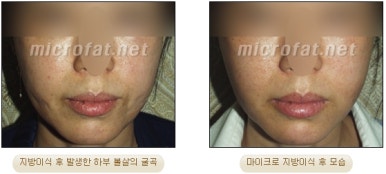
Examples of micro fat grafting application for correcting side effects

Misconceptions about fat grafting
Does fat grafting work for the buttocks or breast area?
Fat grafting is sometimes performed to address buttock depression or breast enlargement.
However, there are problems with this.
In the case of the buttocks, because it is an area that must keep moving, the fat survival rate is extremely low, and if grafted incorrectly, side effects such as pigmentation may occur.
Fat grafting to increase buttock volume is inevitably limited.
For breast augmentation with fat grafting, at least about 1000 cc of fat must be harvested, but it is difficult to harvest that much fat.
The reason is that people with small breasts are usually not very heavy, and therefore there is often not enough fat in the lower abdomen, waist, or thighs for harvesting, making it difficult to obtain and graft as much fat as desired.
Also, if a large amount of fat is injected into the breast area, part of the fat may necrose and form an abscess, or calcify and become hard.
If an abscess forms with pus, healing is quite difficult, and even after healing it may leave significant aftereffects.
In addition, calcification can become a critical problem because breast cancer may not be diagnosed properly in future breast cancer screenings, so breast fat grafting should, in principle, not be performed.
Plastic surgery has principles.
Because both good and bad results must be considered, if there is even a 1 in 10 chance of a poor result after surgery, that is a procedure that should not be done.
Breast fat grafting falls into the above category, so fat-based breast surgery should be decided very carefully.
Is it true that fat taken from the thighs engrafts better?
The harvest site for fat is not fixed.
Strictly speaking, the thighs are not the preferred site for fat harvesting.
The issue is that fat contains a lot of oil.
Oil is an impurity and does not help engraftment.
After the procedure, there is more bruising and swelling, and until the bruising subsides, you should not walk more than necessary, which can make daily life inconvenient. If too much is harvested, problems such as changes in thigh shape or pigmentation can occur.
The choice of harvest site is not based solely on engraftment rate.
You must consider whether there is enough fat, the convenience of harvesting, swelling and pain after the procedure, the extent of bruising, ease of returning to daily life after harvesting, the engraftment rate of the harvested fat, and also the shape of the harvest site and possible future side effects.
For fat grafting, fat must first be harvested from an appropriate area.
The harvest site is determined by considering the amount of fat that needs to be suctioned. When a small amount is grafted, such as under the eyes, the nose, or nasolabial folds, harvest is usually done from the lower abdomen.
The reason the lower abdomen is preferred is that it is easy to harvest from, and swelling and pain after the procedure are mild, making it more comfortable in daily life.
If a large amount of fat is needed for areas such as the cheeks or forehead, it must be checked whether enough fat can be harvested from the donor area.
If there is a lot of excess fat in the lower abdomen, it is harvested from there. However, if there is little or no fat in the lower abdomen, or if the abdominal skin has lost a lot of elasticity due to aging or childbirth, it cannot be harvested even if there is fat.
This is because the abdomen may sag after harvesting.
In such cases, fat is harvested from the thighs. The thigh is divided into the inner, outer, and back areas when deciding the harvest site, and the area with the most excess fat is selected.
Fat is carefully suctioned and harvested so that no distortion or hollowing occurs at the harvest site.
In some cases, if the patient specifically prefers a certain area, harvesting is done from the desired area whenever possible.
Because the areas with excess fat and body constitution differ from person to person, the most appropriate harvest site should be determined according to the individual's body characteristics and constitution.
The site from which fat is harvested does not determine the engraftment rate.
To achieve good results with fat grafting, the entire sequence of procedures must be done properly, including delicate harvesting, proper oil removal and other purification steps, preconditioning of the treatment area, even grafting of an appropriate amount of fat into the treatment area, and grafting in a way that produces a natural shape.
In other words, good results can only be obtained if the entire procedure is carried out correctly from start to finish.
Does grafted fat flow downward or move?
Fat is a solid cell graft.
It either engrafts and remains permanently as your own cells, or it melts away and disappears.
Solid cells never move or flow downward.
There are cases where unlicensed procedures inject industrial silicone or paraffin into the face carelessly, and because these are liquid substances, they mostly flow downward in the direction of gravity.
Liquids can move by seeping between cells.
Some people see or hear about side effects from unlicensed procedures and become biased, mistakenly thinking that fat grafting can also cause problems. But solid fat cells remain in the place where they were grafted and can never move to another area.
Sometimes at another clinic, fat is injected excessively or into the wrong area, making the shape awkward or appearing saggy. Seeing this, one might think that fat has moved, but that is not because the fat flowed or moved; it is because the graft itself was done improperly, or because too much was grafted, making it appear saggy due to the weight of the fat.
Is there a theory that air exposure must be blocked during the fat purification process?
No step in fat grafting can be neglected, and the purification process is no exception.
Fat purification is performed to remove all unnecessary impurities other than fat cells.
The impurities removed during centrifugation are water, anesthetic solution, serum, red blood cells, and so on.
What cannot be purified at the centrifugation stage is the oil component of the fat cells themselves.
Oil is one of the impurities that must be removed from fat cells and accounts for a significant proportion.
It is distributed both inside and outside the fat cells, so fat cells can be thought of as being entangled with oil.
The only way to remove oil is to wrap the centrifuged fat in sterilized gauze and remove it by natural absorption. At this time, the fat is exposed to the outside.
Some claim that exposure to air increases the risk of infection or damages the fat by oxidation, but in reality such effects are almost negligible.
Under a microscope, fat cells are surrounded by a thick oil membrane both inside and outside, so the fat cell itself cannot directly contact air.
Also, because diluted antibiotics are applied to the fat during the gauze purification process, bacterial infection can be prevented even more effectively.
Misconceptions and truths about the lasting effect of fat grafting?
There are many clinics that perform fat grafting, but only a few can produce proper results.
If fat grafting is not done properly, the result can be worse than not doing it at all.
In principle, fat grafting can achieve good results only when performed accurately.
Each clinic has a different procedure, and the outcome varies greatly depending on experience.
The engraftment period for fat is about 3 months.
Fat that survives beyond that point remains permanently as your own fat cells.
It is often misunderstood that grafted fat disappears after 1 to 2 years and returns to the original state, but once fat has engrafted, it does not disappear without reason.
Also, the reason the second procedure is done after 3 months is to see the shape after the first graft has fully engrafted and settled before performing the next procedure.
Up to about 3 months after fat grafting, some of the fat may be absorbed, but fat that has engrafted and not been absorbed by 3 months will no longer be absorbed and will remain permanently as your own tissue.
However, the shape of the grafted area does not last forever.
As time passes and you age, the skin sags, wrinkles form, and the skeleton changes due to aging, so the area that received fat grafting does not stop aging.
For that reason, the effect of fat grafting is sometimes described as semi-permanent, but more precisely it is also referred to as permanent.
Although the wording differs, the effect can be considered to last until significant aging progresses later in life.

Frequently asked Q&A about fat grafting
What kind of anesthesia is used for fat grafting, and is there pain?
All fat grafting is performed under painless sedation anesthesia with local anesthesia.
Sedation anesthesia is not general anesthesia; it is an anesthetic that keeps you asleep for about 5 minutes to eliminate pain during local anesthesia.
Therefore, there is no need to worry about pain.
How is the fat grafting process carried out?
All fat grafting is performed under painless sedation anesthesia with local anesthesia.
From fat harvesting to purification and grafting, every step is carried out delicately and accurately.
During harvesting, living fat is collected with minimal damage, and the fat then goes through centrifugation and oil/water removal to become highly concentrated.
Also, before grafting, subcutaneous tunneling is performed to secure space for the fat.
When grafting the fat, micro fat grafting is used to maximize the engraftment rate.
It can be completed in as little as 20 to 30 minutes, and when multiple areas are treated at the same time, it may take more than 2 hours.
You can go home immediately after the procedure.
From which area is it best to harvest fat?
For fat grafting, fat must first be harvested from an appropriate area.
The harvest site is determined by considering the amount of fat that needs to be suctioned. When a small amount is grafted, such as under the eyes, the nose, or nasolabial folds, harvest is usually done from the lower abdomen.
The reason the lower abdomen is preferred is that it is easy to harvest from, and swelling and pain after the procedure are mild, making it more comfortable in daily life.
If a large amount of fat is needed for areas such as the cheeks or forehead, it must be checked whether enough fat can be harvested from the donor area.
If there is a lot of excess fat in the lower abdomen, it is harvested from there. However, if there is little or no fat in the lower abdomen, or if the abdominal skin has lost a lot of elasticity due to aging or childbirth, it cannot be harvested even if there is fat.
This is because the abdomen may sag after harvesting.
In such cases, fat is harvested from the thighs. The thigh is divided into the inner, outer, and back areas when deciding the harvest site, and the area with the most excess fat is selected.
Fat is carefully suctioned and harvested so that no distortion or hollowing occurs at the harvest site.
In some cases, if the patient specifically prefers a certain area, harvesting is done from the desired area whenever possible.
How many sessions of fat grafting are usually needed?
Depending on the area, satisfactory results can sometimes be achieved with a single session.
The graft survival rate differs by area, there are individual differences, and if the result after the first session is satisfactory, a second session may not be necessary.
In the case of the cheeks, the graft survival rate is relatively good at about 50 to 70%, so in most cases a slight overcorrection is made in the first procedure, eliminating the need for a second one.
In the case of the lips or nose, the survival rate is about 30 to 50%, so a second procedure is usually needed.
Because the survival rate differs by area, there are individual differences, and the level of satisfaction varies, the number of procedures can differ depending on the situation.
On average, one to two procedures are enough to achieve satisfactory results.
How much swelling and recovery time is there after fat grafting?
Swelling and bruising vary depending on the area and the individual's constitution.
The area with the most swelling is the lips, and the area with the most bruising is under the eyes.
Areas with very little swelling or bruising are the bridge of the nose, temples, and forehead.
In general, severe swelling or bruising after fat grafting is not very common.
On average, mild awkward swelling lasts for about 1 to 2 weeks and then subsides.
The recovery period can be thought of as about 1 week, during which swelling and bruising are present.
Does the second fat grafting have to be done exactly after 3 months? Can it be done earlier or later?
A second procedure is not mandatory; it is only performed when needed.
On average, the second fat grafting is scheduled after 3 months.
The reason is that fat engraftment occurs over 3 months, and after 3 months the appearance hardly changes, so deciding whether to do a second fat grafting based on the shape at that time allows for a more accurate judgment.
Another reason is that if the second fat grafting is done too soon, the fat grafted during the first procedure may be damaged during the second procedure before it has fully engrafted.
It is not a problem to have the second procedure 5 or 6 months after 3 months have passed.
However, after 10 months, the stored fat is discarded, so it is more convenient to have the second fat grafting within 10 months.
If the second procedure is performed after 10 months, fat must be harvested again.
How long do the lasting effects of fat grafting last?
Up to about 3 months, some of the fat may be absorbed, but fat that remains engrafted beyond 3 months is no longer absorbed and remains permanently as your own tissue.
However, the shape of the grafted area does not remain for life.
As time passes and you age, the skin sags, wrinkles form, and the skeleton changes due to aging, so the area that received fat grafting does not stop aging.
For that reason, the effect of fat grafting is sometimes described as semi-permanent, but more precisely it is also referred to as permanent.
Although the wording differs, the effect can be considered to last until significant aging progresses later in life.
What is the difference between fat grafting and micro fat grafting?
Fat grafting is a general term used to describe the entire process of harvesting fat and moving it to the area where it will be grafted.
In other words, removing fat in bulk and grafting it surgically is called fat grafting, and harvesting it with a syringe and grafting it with a syringe is also called fat grafting.
Micro fat grafting is a method of fat grafting using a syringe. To increase the survival rate of the fat, even if the same amount is grafted, small amounts are placed in many locations, about the size of millet grains, to increase precision and graft survival.
What is the difference between two-dimensional fat grafting and three-dimensional space fat grafting?
So-called three-dimensional fat grafting means grafting fat evenly across multiple layers.
Under the skin there are several tissue layers, such as the subcutaneous fat layer, fascial layer, muscle layer, and periosteal layer.
Three-dimensional fat grafting means grafting fat evenly across these layers to maximize space usage, improve graft survival, and allow for soft and even grafting.
Two-dimensional fat grafting means grafting only into one layer, such as the muscle layer or fat layer, among the multiple layers.
However, three-dimensional fat grafting is not always better.
Depending on the area to be grafted and the amount to be grafted, some areas require three-dimensional grafting, while others require two-dimensional grafting.
For example, the upper eyelid area should be grafted below the muscle layer; if it is grafted three-dimensionally, the shape becomes bumpy and a side effect of a heavy eyelid can occur.
Therefore, two-dimensional planar fat grafting, which grafts only into the fat layer, is better for the upper eyelid.
For areas such as the chin or cheeks, if a relatively large amount is grafted, distributing the fat evenly across the muscle and fat layers is preferable because it creates a softer shape and helps engraftment, so three-dimensional fat grafting is better.
It is important to choose the proper method for each area.
How is the procedure performed to increase the fat survival rate?
To increase the fat survival rate, the harvesting process is first very important.
The fat must be harvested carefully so that the fat cells are damaged as little as possible, and impurities must be filtered out as much as possible.
To do this, a small liposuction cannula is used to carefully harvest the fat, and the harvested fat is centrifuged for only about 3 to 4 minutes at an appropriate speed.
Also, after centrifugation, the fat goes through a second purification step, where oil and water are removed using sterilized gauze.
Only by going through these steps can fat that is nearly 100% pure be obtained.
Only when the fat is concentrated to nearly 100% does the result after fat grafting turn out well.
Even if the same amount is grafted, if impurities such as oil or water account for 50% of it, the actual grafted amount is effectively only half, and the effect is reduced by half.
It is not an exaggeration to say that the key to maximizing the effect of fat grafting depends on whether the fat is properly concentrated.
People say that if you do fat grafting, it is mostly absorbed and often has no effect. Is that true?
The procedure method differs by clinic, and the outcome varies greatly depending on skill.
If fat grafting is performed poorly against the principles, most of the graft may be absorbed, resulting in little difference from not having done it at all.
Only when the entire process from harvesting to purification to grafting is performed accurately and according to principles can a high graft survival rate and a smooth, even contour be achieved.
Is it true that the face can become bumpy after fat grafting?
The principle of fat grafting is to achieve a smooth and even contour.
If a bumpy side effect occurs, it is the result of improper fat grafting that violates the principles.
There are many causes of a bumpy appearance.
These include grafting fat irregularly directly under the skin, grafting too much fat into one place, grafting unevenly by area instead of evenly, and failing to perform molding properly after the procedure.
Therefore, to obtain a smooth and even contour, fat should not be grafted too superficially, micro fat grafting should be performed evenly and uniformly, and finishing with molding is necessary to achieve a smooth facial contour correction effect.
How many times do I need to visit the clinic after fat grafting?
Two days after fat grafting, you visit the clinic to check the progress.
You also visit about twice a week.
If your situation is not convenient or your home is too far away, you do not necessarily have to visit after the procedure.
Sutures at the fat harvest site can be removed at a nearby clinic after one week, so if you live far away, you only need to come on the day of the fat grafting procedure. After that, if you judge that your recovery is going well, you do not need to visit again.
What side effects can occur after fat grafting?
Because fat grafting uses your own fat, unlike commercial filler materials, it has very few side effects.
Except for slight swelling and bruising after the procedure, it can be said to have no side effects at all.
Therefore, it can be considered one of the safest procedures compared with any other plastic surgery.
However, this applies only when fat grafting is done properly. If the procedure violates the principles, side effects may occasionally occur, such as a bumpy shape, fat necrosis and hardening, inflammation, or an awkward appearance due to excessive injection.
How long can stored fat be kept?
Any remaining fat after grafting is cryogenically stored under sterile conditions for 10 months.
After 10 months, the stored fat is discarded.
Due to storage capacity limits, it is not kept longer than 10 months.
If a second procedure is performed within 10 months after fat grafting, it can be done easily using the frozen stored fat. If you return for a second procedure after 10 months, the fat will already have been discarded, so fresh fat must be harvested again.
Is there any difference in results between grafting with stored frozen fat and grafting with freshly harvested fat?
If frozen fat is stored properly, the characteristics of the fat cells hardly change.
Therefore, frozen stored fat shows almost no difference in results compared with freshly harvested fat.
How well fat can be stored is also one of the techniques in fat grafting.
Without fat storage technology, it is difficult to store fat for even one month.
It also means the hassle and effort of harvesting each time a procedure is done.
The storage method must be sterile, low-temperature frozen storage, and impurities must be removed before storage so that the fat does not deteriorate, which can extend the storage period.
Usually, fat cells can be stored sufficiently for up to about 10 months without deterioration.
Frozen fat deteriorates easily and the procedure effect declines, so if a clinic says the fat must be harvested again each time, that clinic has no storage facility or technology at all.
In other countries, frozen stored fat is sometimes used for up to 3 years.
Features of Duhan Plastic Surgery Autologous Fat Grafting Clinic
All anesthesia is performed with local anesthesia (sedation anesthesia).
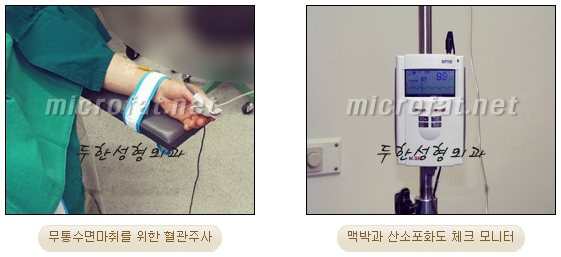
All fat grafting procedures are performed under local anesthesia, regardless of the area treated.
Local anesthesia is administered together with sedation anesthesia, allowing the procedure to be performed without any pain during or after anesthesia.
Depending on the area, hyaluronidase, a swelling-prevention agent, is mixed with the local anesthetic and administered.
Hyaluronidase is an expensive anti-swelling agent with tissue-fluid-diffusing action that helps prevent swelling almost immediately after the procedure.
We have a systematic and advanced fat grafting system.

The success of fat grafting depends on the graft survival rate.
To maximize the graft survival rate, the following are necessary.
★ Living fat cells must be harvested.
★ To increase fat purity, centrifuge purification and unnecessary oil removal are used to maximize the purity of the fat.
★ Before fat grafting, subcutaneous tunneling is performed at the graft site to secure space where the fat will be placed.
★ A micro fat grafting cannula is used to perform delicate and precise grafting for each area.
★ Micro grafting across multiple layers in a three-dimensional manner increases the survival rate and creates a smooth contour.
Fat is harvested from appropriate and diverse donor sites.
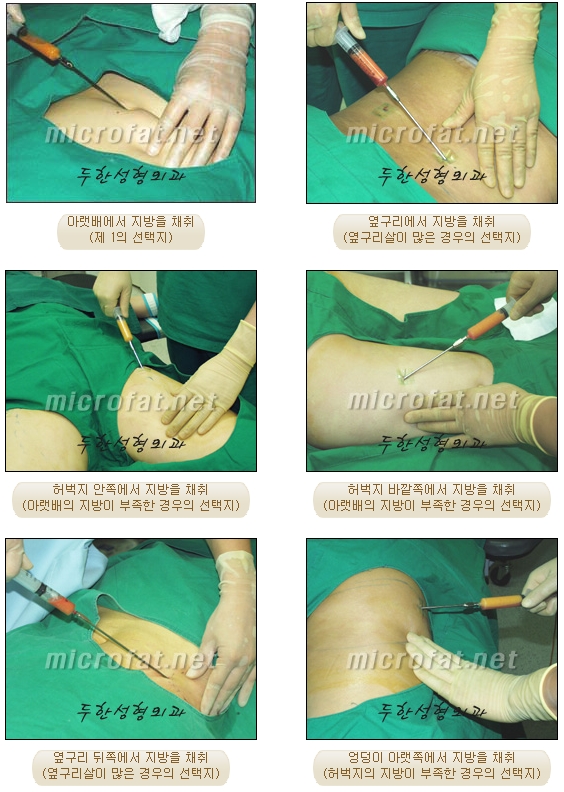
The most commonly used fat harvest site is the lower abdomen. Because the lower abdomen has less pain after the procedure, less swelling and bruising, and is comfortable for daily life, it is the first choice for fat harvesting.
If the lower abdomen does not have enough fat, or if the patient prefers another area, fat may be harvested from other sites as well. The next most commonly selected area is the inner thigh, followed by the outer thigh.
There is no fixed rule for which area is best for fat engraftment.
Results are similar regardless of the harvest site, and while the area with the most excess fat is ideal for harvesting, it is better to choose the harvest site by considering the amount of fat needed and post-procedure activity.
A two-step purification process for the harvested fat maximizes the fat survival rate.
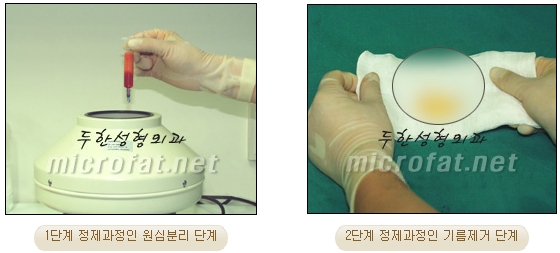
The harvested fat goes through a two-step purification process to remove impurities other than fat cells.
Among the impurities in harvested fat, the largest proportion is local anesthetic, followed by oil.
Other impurities include serum and red blood cells.
First, a centrifugation step lasting about 3 to 4 minutes is performed, followed by an oil-removal process as the second step.
The parts purified by centrifugation are local anesthetic, red blood cells, serum, and so on.
Oil is removed manually by natural absorption using gauze.
Through the two-step purification process, nearly 100% concentrated fat is obtained, maximizing the effect of fat grafting and increasing the survival rate as much as possible.
Space for fat grafting is secured through subcutaneous tunneling.
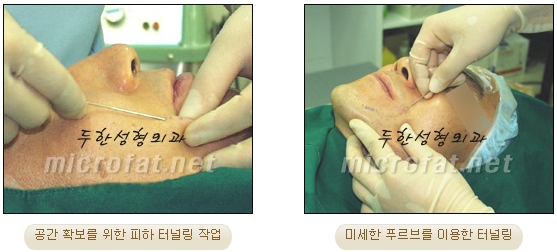
Subcutaneous tunneling is a necessary process for securing space in advance at the area where fat will be grafted, ensuring a high survival rate and even grafting.
It is the process of moving a thin probe beneath the skin several times in a fan-like pattern to create space for fat grafting.
The effect of subcutaneous tunneling is to increase the fat survival rate and prevent fat from clumping, thereby creating a smooth and even contour.
Three-dimensional micro fat grafting creates a smooth and even facial contour.
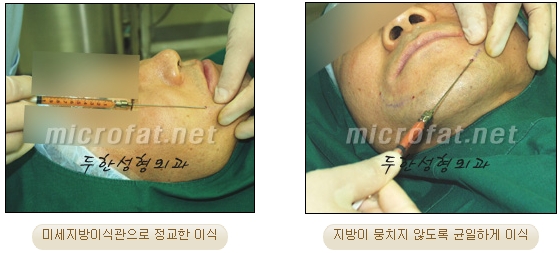
Although there are exceptions depending on each area, the basic method of fat grafting is the three-dimensional approach.
By dividing the fat into multiple layers and grafting small amounts evenly in each area, the survival rate of the fat is improved and the survival becomes more uniform, allowing a smooth contour to be created.
A micro fat grafting cannula is used for precise grafting.
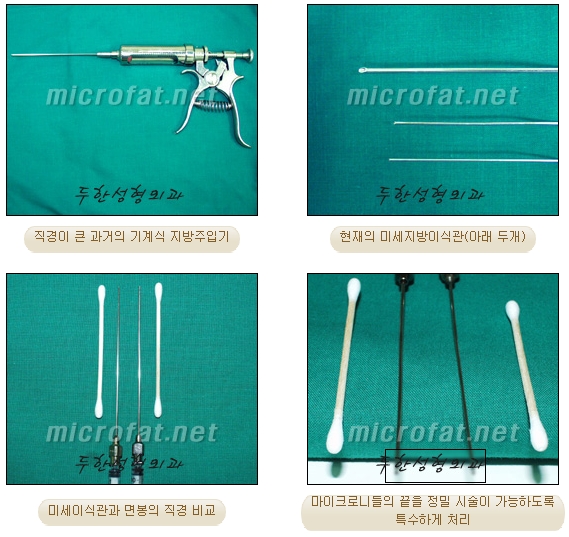
In the past, methods using fat injection machines forced fat under the skin at high pressure, causing various problems.
The absorption rate of fat was high, survival was uneven, the contour became bumpy, and grafting was difficult in delicate areas such as under the eyes.
To solve these problems, during fat grafting the fat is transferred again into a thin 1 cc syringe and grafted into the desired area.
Our clinic uses a micro needle (fine grafting cannula) developed in-house.
The micro needle is a special grafting cannula used only by our clinic, allowing ultra-precise grafting.
Fat grafting can also be performed on the upper eyelids, lower eyelids, forehead wrinkles, glabella wrinkles, nasolabial folds, and the bridge of the nose, making fat grafting possible in almost all cases except fine wrinkles.
Molding immediately after fat grafting helps create a smooth and even facial contour.
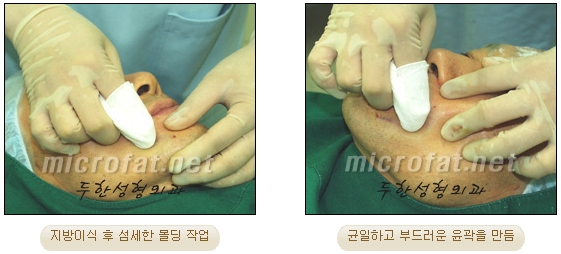
Immediately after fat grafting, delicate molding is performed to spread the grafted fat evenly and create a soft shape.
Molding is the final step of fat grafting and one of the most important steps.
Rapid freezing and sterile storage of the remaining fat makes the second procedure convenient.
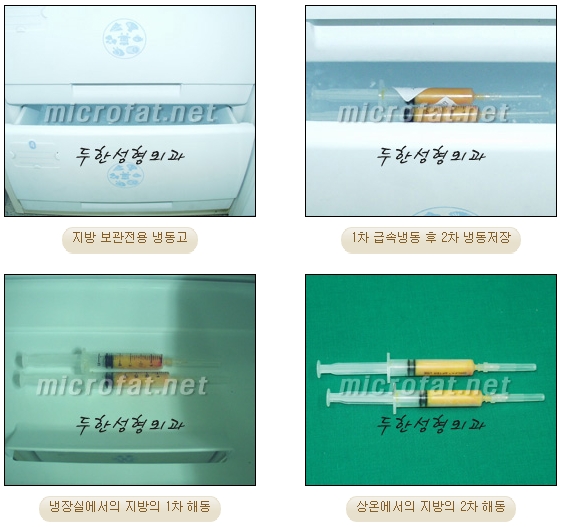
If a second procedure is performed 3 months after fat grafting, the remaining fat from the first procedure is used without harvesting fat again.
The remaining fat after the first procedure is stored after rapid freezing and sterile processing.
For the second procedure, the stored fat is thawed and the procedure can be performed more conveniently.
The storage period for fat is up to 10 months, and if you visit within 10 months, the stored fat will be used for the procedure.
Thorough aftercare system

After fat grafting, we carefully monitor the progress until the fat has fully engrafted by providing thorough aftercare.
During follow-up, if necessary, we try to minimize patient dissatisfaction through swelling-reduction injections, shape correction, and molding.
Procedures before and after fat grafting and post-procedure care instructions
This is the pre- and post-procedure process for receiving fat grafting surgery.
- Make a consultation appointment by phone or online.
- Visit at the scheduled consultation time and receive a consultation.
- If you want the procedure, make a surgery appointment immediately after the consultation and leave. You can also make a surgery appointment later by phone or online.
- Arrive 30 minutes before the surgery appointment time, receive an explanation of the fat grafting procedure, and undergo design.
- After the design is complete, change clothes and receive an intravenous line for painless sedation anesthesia.
- The procedure time for fat grafting varies by area, and if multiple areas are treated at the same time, the procedure may take longer. On average, it takes from 30 minutes up to 2 hours.
- After the procedure, you will receive antibiotic and anti-inflammatory injections and rest in the recovery room for about 30 minutes.
- You will be given post-procedure precautions and scheduled for the next visit.
- Two days after the procedure, visit for progress monitoring of the fat grafting area, and the fat harvest site is disinfected. You may shower starting two days after the procedure. On the 7th day after the procedure, visit for follow-up and suture removal from the fat harvest site (navel). If it is difficult to visit because you live too far away, you do not have to come in.
- If a second procedure is needed, it will be performed after visiting sometime between 3 months and 1 year.
http://www.duhans.com