#double eyelid revision surgery #eye revision surgery #double eyelid reoperation #double eyelid revision surgery #best hospital for double eyelid revision surgery #double eyelid reoperation #best hospital for double eyelid revision surgery #best place for eye revision surgery #double eyelid reoperation
#best place for double eyelid revision surgery #timing for double eyelid revision surgery #hospital for double eyelid revision surgery #swelling after double eyelid revision surgery #methods of double eyelid revision surgery #problems after double eyelid surgery #thin double eyelids #incisional ptosis correction
#effects of double eyelid revision surgery #double eyelid surgery #double eyelid removal surgery #revision for a high crease #natural-looking eyes #uneven eyes #beautiful eyes #ptosis correction surgery #canthoplasty restoration #conjunctival incision #levator aponeurosis
#adhesion of the double eyelid line #non-incisional natural adhesion #crease loosening #double eyelid line loosening #double eyelid asymmetry #double eyelid line asymmetry #incorrect double eyelid line #double eyelid re-correction #high double eyelids
#revision of high double eyelids #surgery for drooping eyelids #after eye plastic surgery #when the double eyelid line is positioned too high #double eyelid line that became too large #methods for double eyelid reoperation #methods of double eyelid surgery #types of eye revision surgery
#upper double eyelid line adhesion #eye plastic surgery #double eyelid revision surgery at Sinsa Station #double eyelid revision surgery at Apgujeong Station #in-fold double eyelids #out-fold double eyelids #in-out fold double eyelids #appropriate double eyelid line
#double eyelid line #types of double eyelid lines #finding the double eyelid line #out-line double eyelids #types of double eyelid lines #male eye revision surgery #male eye revision surgery #male double eyelid revision surgery #male double eyelid revision surgery
#double eyelid surgery in-out fold #out-line double eyelids #double eyelid line #out-line double eyelids #in-fold #out-fold #double eyelid surgery #double eyelid surgery #recovery period after double eyelid surgery #double eyelid surgery method
#best place for canthoplasty #sleepy eyes #outer canthus #male double eyelid removal #partial incision double eyelid surgery #magic epicanthoplasty #double eyelid incision revision surgery #incisional double eyelid surgery #Gangnam canthoplasty #Seoul double eyelid surgery #eye shape
#close-set eyes #recommended double eyelid surgery hospital #small eye surgery #canthoplasty #natural adhesion eye shape correction #downward canthoplasty #best hospital for canthoplasty #lowering the double eyelid line #best place for under-eye canthoplasty #double eyelid incision
#partial incision double eyelid surgery #epicanthoplasty scar removal #epicanthal fold #surgery to make eyes look bigger #double eyelid surgery without swelling #one-sided double eyelid #upper eyelid #upper eyelid #thick eyelids #surgery to lower the eye corner #outer double eyelid
#double eyelid epicanthoplasty #surgery to make eyes bigger #inner corner eye surgery #double eyelid swelling #double eyelid eye shape #eye surgery at Apgujeong #eye surgery at Sinsa #best place for ptosis correction #best place for ptosis correction in Gangnam #eye surgery in Gangnam
#how to make eyes look bigger #surgery for drooping eyes #double eyelid surgery in Gangnam #out-line double eyelid surgery #double eyelid surgery out-line #uneven eyes #types of eye surgery #eye plastic surgery near Gangnam Station #partial incision ptosis correction #double eyelid out-line
#out-line double eyelid surgery #ptosis correction hospital #double eyelid surgery #double eyelid out-line #drooping eyelid double eyelid #incisional double eyelid #revision plastic surgery #double eyelid eye #Gangnam eye plastic surgery clinic #double eyelid surgery #recommended double eyelid surgery
#epicanthoplasty scar #canthoplasty clinic #best hospital for double eyelid surgery in Gangnam #plastic surgery clinic for ptosis correction #types of eye plastic surgery #epicanthoplasty and canthoplasty #double crease #making double eyelids #double eyelid eye #epicanthoplasty
#double eyelid plastic surgery #famous eye plastic surgery hospital #famous eye plastic surgery hospital in Gangnam #types of double eyelids #loosening buried sutures #male double eyelid removal #Seoul double eyelids #eye plastic surgery clinic #in-out fold double eyelid buried sutures
#double eyelid surgery near Gangnam Station #ptosis correction in Gangnam #double eyelid #eye health #in-out fold double eyelid surgery #non-incisional buried suture #upper eyelid revision surgery #best hospital for eye surgery #famous eye plastic surgery clinic #epicanthoplasty clinic

http://www.doublefold.co.kr
♥ What is double eyelid revision surgery?
This refers to surgery that revises the double eyelid line and restores it to its original natural, clean appearance when the line is too large, uneven, or has loosened.
♥ What are the indications for double eyelid revision surgery?
When the double eyelid line is too large
When the double eyelid line has loosened
When the double eyelid line is asymmetrical
When the eyes feel tired after double eyelid surgery
When there is a thick sausage-like appearance in the area below the incision line
When the expression looks worse after double eyelid surgery
When one wants to recover beautiful and natural-looking eyes
♥ What is the purpose of double eyelid revision surgery?
The purpose of double eyelid surgery is not simply to create a double eyelid line.
The goal of double eyelid surgery is to make the eyes look larger and clearer, and to create bright eyes and a refined eye shape.
Surgery performed only to create a double eyelid line can easily lead to unwanted results.
The same applies to double eyelid revision surgery.
Its purpose is to correct the eye shape so that it looks larger, clearer, and more natural.
♥ Features of Duhan Plastic Surgery’s double eyelid revision clinic
| 1. We have accumulated extensive experience and know-how in double eyelid revision surgery. |
|---|
| 2. We have a systematic system for double eyelid revision surgery. |
| 3. Through preoperative consultation for double eyelid revision surgery, we perform various examinations and tests to predict the postoperative outcome. |
| 4. We perform surgery only when examinations and tests show there is sufficient room for improvement. If we determine that the results the patient wants cannot be achieved, our principle is not to attempt surgery. |
| 5. Through examination, we identify the problems with the previous double eyelid surgery, provide thorough and clear explanations, and suggest the best surgical method for the best result. |
| 6. We explain the surgical process and postoperative course so that there is a clear understanding, and we do not omit explanations of possible side effects after surgery. |
| 7. We provide thorough aftercare after double eyelid revision surgery. We closely observe the postoperative course to ensure that recovery is progressing properly. |
| 8. Our clinic makes the utmost effort and continues research so that people seeking double eyelid revision surgery can make us the last hospital they need to visit. |
♥ Examinations and tests during consultation for double eyelid revision surgery
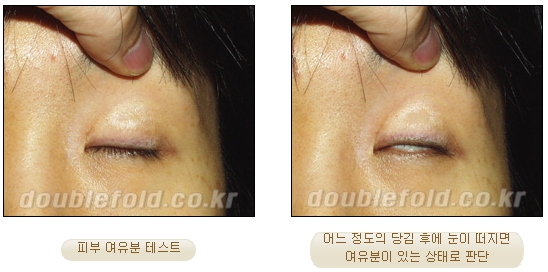
The most important test for determining whether double eyelid revision surgery is needed is the amount of excess skin available.
Because double eyelid revision surgery requires removing at least part of the scar tissue before operating, the amount of excess skin is an important indicator for estimating the prognosis of the surgery.
If there is no excess skin, surgery may not be possible.
If surgery is performed forcefully when there is insufficient excess skin, the result will be poor, and the inability to close the eyes properly can worsen, causing lagophthalmos. For this reason, this is the most important test that must be done before double eyelid revision surgery.
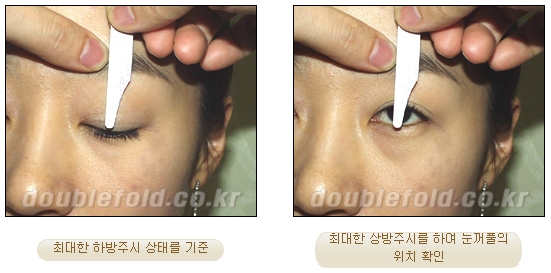
The second important test for determining whether double eyelid revision surgery is needed is levator function testing.
When ptosis is severe, how much levator function remains is a key issue.
The levator is the muscle that lifts the eyelid upward.
A certain degree of function in this muscle is needed to predict the success of revision surgery.
In patients with ptosis, if levator function is significantly reduced, surgery may not be possible.
As a principle, surgery should not be performed when levator function has dropped below a certain threshold.
♥ Other examinations and tests
○ Measurement of the thickness of the eyelid skin
○ Examination for the presence of eyelash eversion
○ Examination of the scar and the degree of scar adhesion in the existing double eyelid line
○ Selection of the method that can produce excellent results and maximize satisfaction
○ Measurement of the height and symmetry of the existing double eyelid line (scar line)
○ Measurement of the amount and presence of orbital fat, and the thickness and presence of the orbicularis oculi muscle
○ Measurement of the degree of ptosis by measuring the palpebral fissure height (vertical size when looking straight ahead at eye level naturally)
○ Measurement of the horizontal eye length and the distance between the eyes (to determine the presence of an epicanthal fold)
○ Measurement of the presence of strabismus
♥ Planning double eyelid revision surgery based on the above examination results
① Set the height and design shape of the new double eyelid line
② Set the width of skin (scar) excision
③ Set the width of levator shortening
④ Determine whether orbicularis oculi muscle excision is needed
Based on the above examination results, we estimate the postoperative outcome
and predict the likelihood of successful double eyelid revision surgery.
Surgery is recommended only when it is judged to be possible.
If double eyelid revision surgery is not possible,
we explain why it is not possible, or
explain how far surgery can realistically be performed.
Chief Director Shin Duhan
http://www.duhans.com
What is a thick double eyelid line?
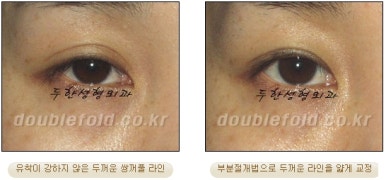
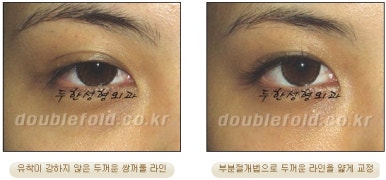
A double eyelid line that is excessively thick looks artificial and awkward, and gives the impression that the surgery was performed recently.
It also often causes ptosis that makes the eyes look sleepy.
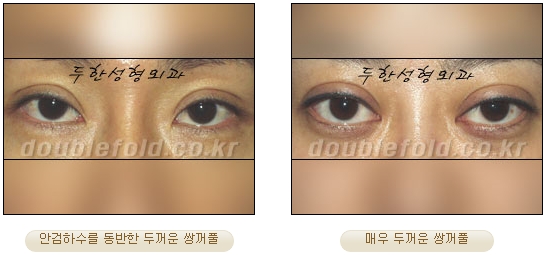
♥ What causes a thick double eyelid line?
◇ When the initial surgery was designed too high
The average height of a natural double eyelid in Koreans is around 6 to 8 mm.
However, since each person’s eye size and shape are different, the height of the double eyelid line must also be adjusted accordingly.
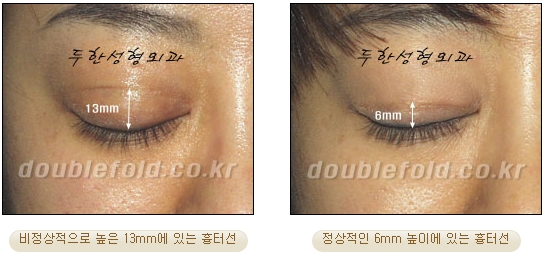
The design standard must begin by temporarily creating a line while sitting upright and finding the line that best suits the person’s eye shape.
However, when designing in the lying position, it is difficult to find a suitable line, and because the tarsal plate is used as the reference, there is a high possibility of designing a larger double eyelid line.
◇ When the skin is thick
Even if the double eyelid line is set at the same height as other people, thick skin can make the line look thick and unnatural.
In cases with thick skin, it is often necessary to set the line slightly lower than the average height.
◇ When ptosis is present
When ptosis makes the eyes look drowsy, the double eyelid line can appear larger even if it is set at the same height as in other people.
This is because the eyes do not open widely.
In cases of ptosis, the line should be set lower, or ptosis correction should be performed at the same time.
◇ Protruding eye shape
When the eyes protrude, the line should be set slightly lower than in normal cases.
This is because globe protrusion can make the double eyelid line appear larger.
It is important to temporarily create a line while sitting to find the most natural line for one’s own eye shape.
◇ Sunken eyelid
When the eye is sunken, the double eyelid line is pulled upward and becomes higher.
This occurs because the line is pulled upward along with the skin as the eye becomes sunken.
In such cases, the line should be set lower than normal, or fat grafting should be performed first before double eyelid surgery to create a normal eye shape, and then the double eyelid surgery should be done several months later to achieve a satisfactory result.
♥ Why is it difficult to reduce the double eyelid line using conventional methods?
In cases with a high line, the incision line is usually 8 mm or more from the eyelashes.
This typically needs to be reduced to a line of about 5 to 6 mm, and to do so, it is common to excise 2 to 3 mm of skin, including the existing scar line.
One must understand what happens when the skin is excised and simply sutured.
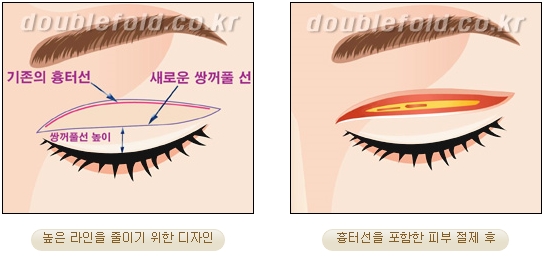
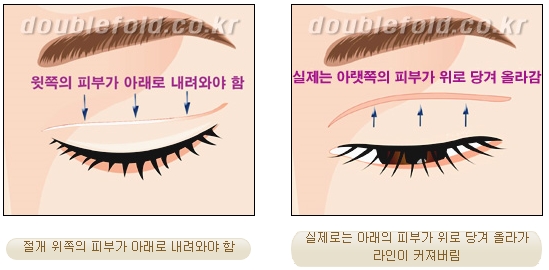
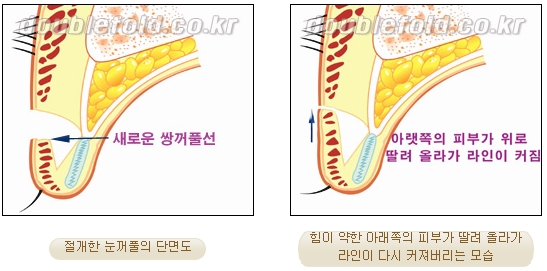
If only excision and suturing are performed, the skin below the excision line will be pulled upward and adhere to the skin above the excision line, resulting in another large line of 8 mm or more, and the surgery will fail completely.
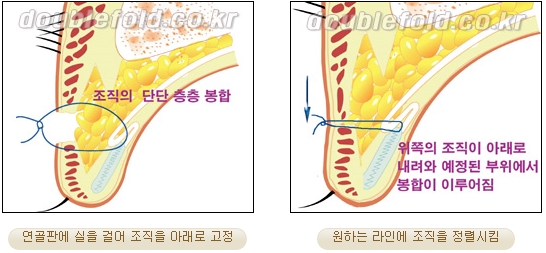
Therefore, the key to the surgery is to pull the skin above the excision line downward.
To do this, tissue repositioning must be performed, and for tissue repositioning, it is necessary to precisely dissect between the levator and orbital fat so that the tissues can be repositioned and the line reduced.
♥ How to reduce a thick double eyelid line?
◇ Method using full incision surgery

① Excise the scar.
③ Precisely dissect between the levator and orbital fat so that tissue repositioning can take place.
③ After dissection, advance the fat to prevent adhesion of scar tissue.
④ In order to prevent the skin below the excision line from being pulled upward, firmly fix the skin below the excision line to the tarsal plate.
⑤ Perform levator shortening so that the eyes open slightly wider.
The more widely the eyes open, the more the double eyelid line can be reduced.
⑥ Perform firm layered suturing through the tissues to complete tissue repositioning and prevent the tissues from being pulled upward.
⑦ Remove the sutures a little later so that the scar does not widen and the repositioned tissues can stabilize.
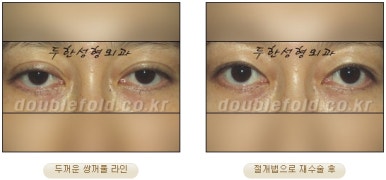
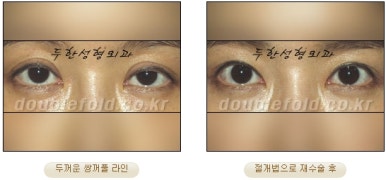
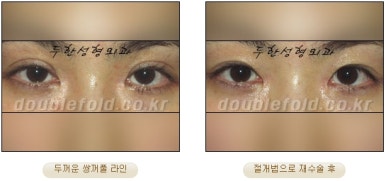
◇ Example of applying a thick double eyelid line with full incision surgery
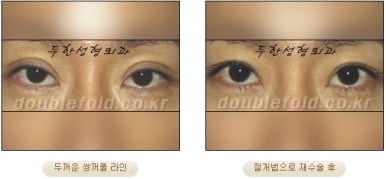
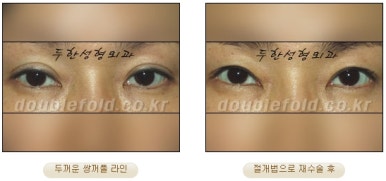
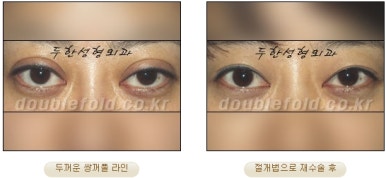
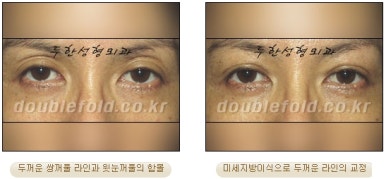
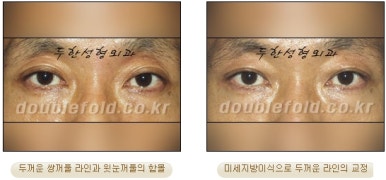
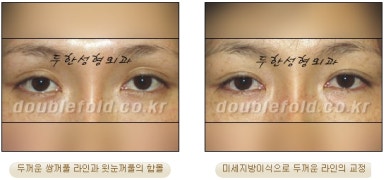
◇ Method using micro fat grafting
This is applied only when the upper eyelid is sunken.
Micro fat grafting requires highly skilled technique and know-how.
The anatomical structure of the eyelid must be understood precisely.
Therefore, eyelid fat grafting can only be performed properly by someone with extensive experience in double eyelid revision surgery.
It is a very advanced procedure that must also consider correction of the awkward double eyelid line along with the sunken eyelid.
It is better not to undergo the procedure from someone without sufficient experience or from a non-specialist plastic surgeon.
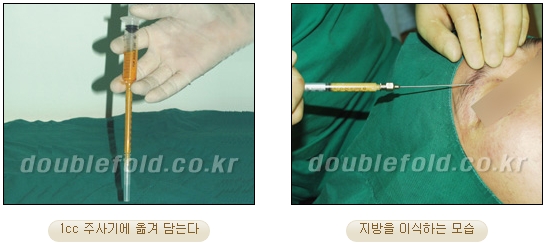
① Sedation anesthesia and local anesthesia are administered.
② Fat is finely harvested from the abdomen using a syringe.
③ The harvested fat is centrifuged and purified.
④ The purified fat then undergoes a second oil removal process.
⑤ Tunneling is performed at the treatment site to secure space for grafting.
⑥ Precise grafting is performed into the orbital fat layer of the sunken eyelid.
⑦ The procedure is finished by adjusting the contour of the eyelid and the height of the double eyelid line through molding and retunneling.
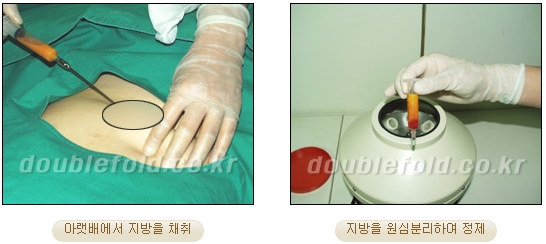
◇ Example of correcting a thick double eyelid line with micro fat grafting
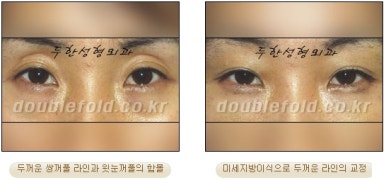
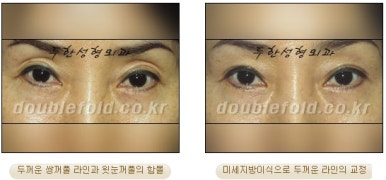
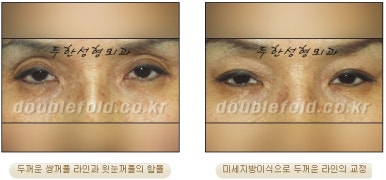
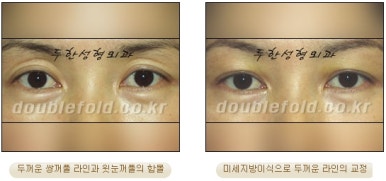
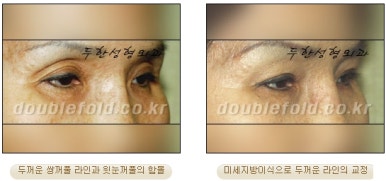
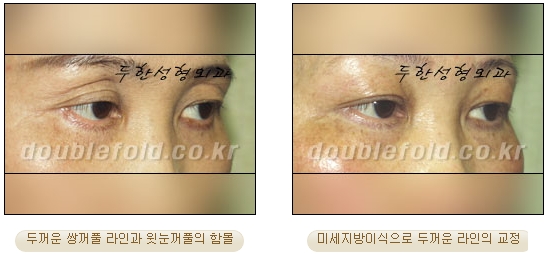
◇ Method using partial incision surgery
In the case of naturally occurring double eyelids or thick lines that appeared after buried-suture surgery, there are cases where correction is possible without necessarily performing incision surgery, depending on the severity of adhesion.
If, during the examination, a temporary line is made and the double eyelid line forms naturally while the existing line disappears, then correction is possible with partial incision surgery as well.
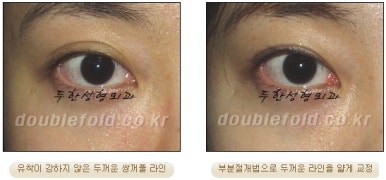
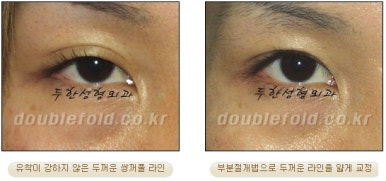
http://www.doublefold.co.kr
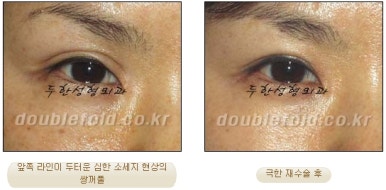
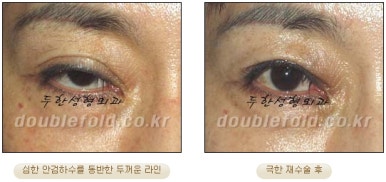
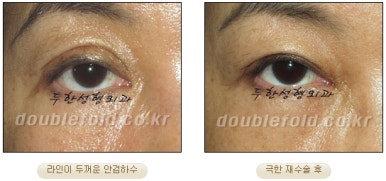
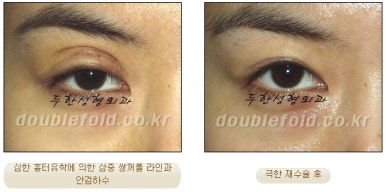
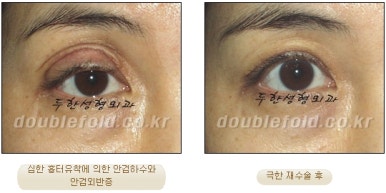
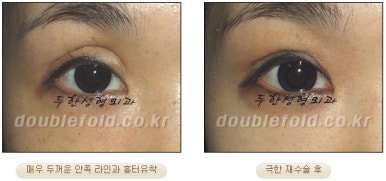
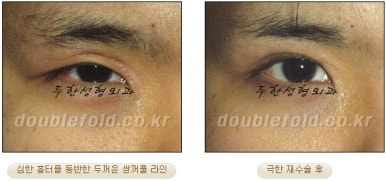
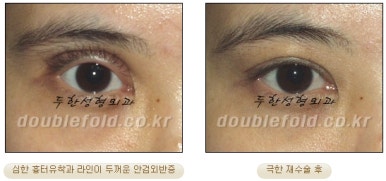
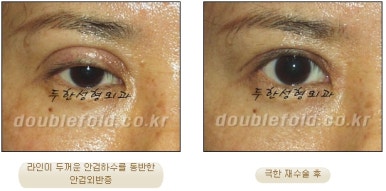
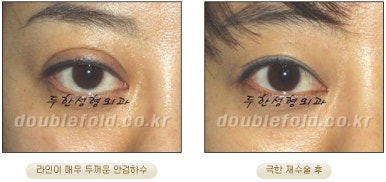
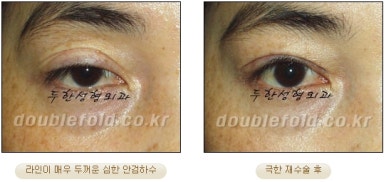
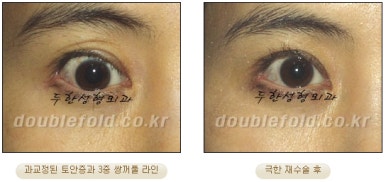
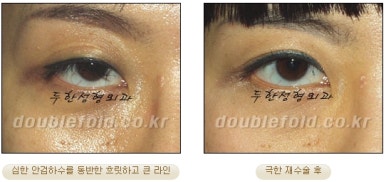
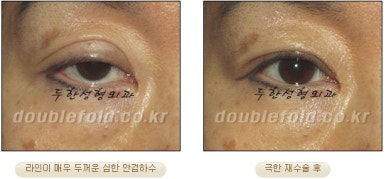
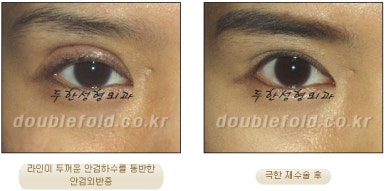
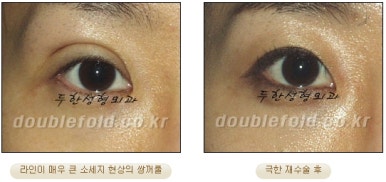
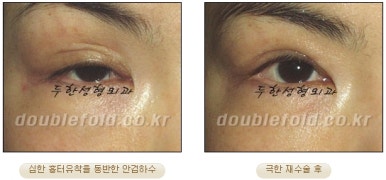
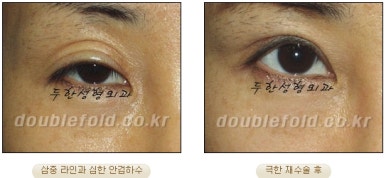
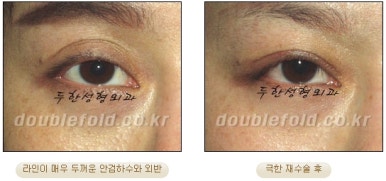
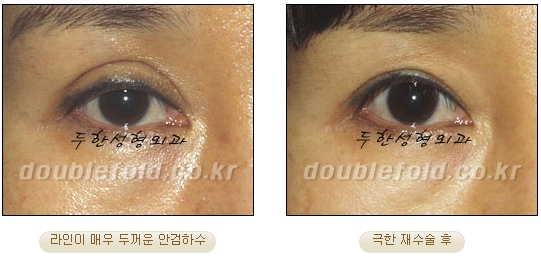
What is extreme revision surgery for correcting a thick double eyelid line?
This is surgery that restores a normal eye shape through double eyelid revision surgery in extremely severe cases or when it is judged that no further surgery is possible.
It is a procedure performed to bring an eye shape that is in very poor condition, or in a state that is nearly impossible to restore to a normal eye shape, closer to normal.
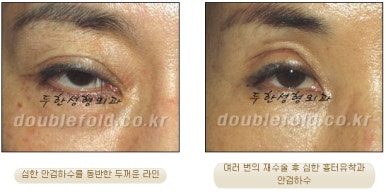
The goal of extreme revision surgery is to restore eyes with repeated double eyelid revision surgeries, foreign substances such as fillers injected into the eyelid, or thick grafted fat masses causing severe irregularity and adhesion, along with severe ptosis, to a normal eye shape.
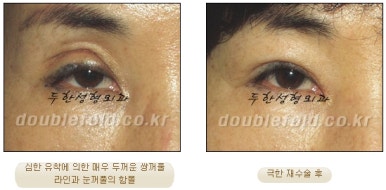
Examples of severely damaged double eyelids
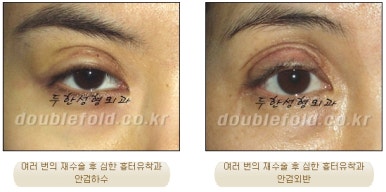
What is the difference between extreme double eyelid revision surgery and ordinary double eyelid revision surgery?
It refers to revision surgery in which all available techniques are concentrated for restoration to a natural and beautiful double eyelid, using every possible method such as multiple tissue dissection and repositioning to release scar adhesion, insertion of microfat tissue, levator shortening, and dissection and excision of the orbicularis oculi muscle below the incision line.
Ordinary double eyelid revision surgery may simplify or omit some steps depending on the condition, but in extreme eye (double eyelid) revision surgery, when there is insufficient excess skin or when the existing scar line is too high and too dark, making revision nearly impossible, subcutaneous dissection is performed instead of excising the scar, and a new line is created below it.
What is the plan for extreme double eyelid revision surgery?
① If there is a shortage of tissue or skin, measure the limit of what can be expanded and extend it.
② If levator function is almost absent, calculate the extent to which it can be lifted.
③ If the skin is very thick, make a plan to excise the orbicularis oculi muscle to thin the tissue.
④ If scar adhesion is severe and cannot be released, plan microfat insertion after scar dissection.
⑤ If the sausage-like appearance is severe, plan to remove it through dissection of the incision line and partial excision of the orbicularis oculi muscle.
⑥ If the scar line is very high, plan to smooth it rather than excise it.
⑦ In cases of very dark and sunken scar lines that cannot be excised, plan to fill the depressed area.
⑧ If eyelash eversion is severe, plan to correct the eversion by sublash-root dissection.
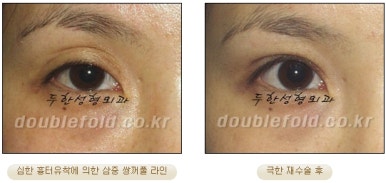
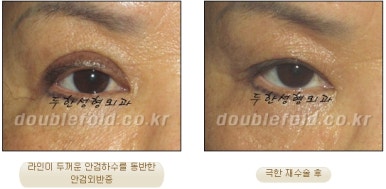
Examples of extreme double eyelid revision applications
Even in very difficult and demanding cases, double eyelid revision surgery can produce good results if it is performed according to principle with sufficient planning.
Surgery is not possible in every case.
When there is too little excess skin or when scar adhesion is very severe, there are limits to surgery, and sometimes surgery cannot be performed at all.
If preoperative examination determines that revision surgery will be difficult, the principle is not to make a surgical plan in the first place.

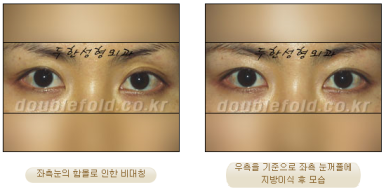
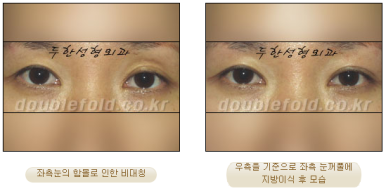
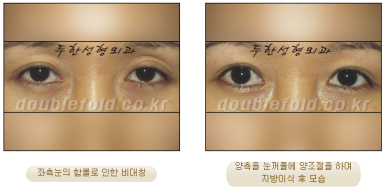
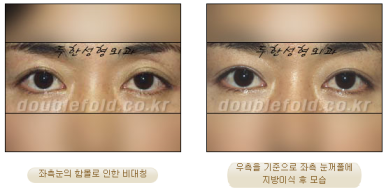
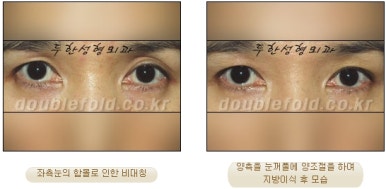
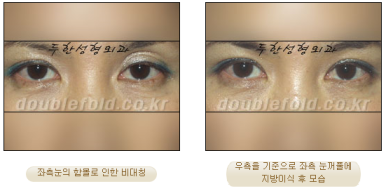
What is an asymmetrical double eyelid line?
A double eyelid line with too much difference between the two sides looks awkward and gives a poor impression.
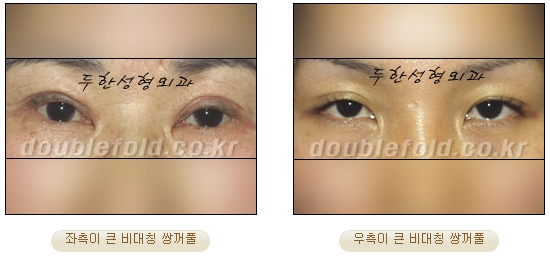
In cases of asymmetrical double eyelid lines, the principle is to correct the line that is not satisfactory based on the side that is satisfactory.
If neither side is satisfactory, both sides must be corrected.
There are many causes of asymmetrical double eyelid lines.
There are also several methods of correction.
★ What causes asymmetrical double eyelid lines?
◇ When the height of the double eyelid line differs
◇ When ptosis is present in one eye
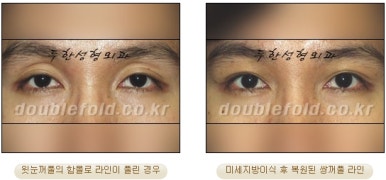
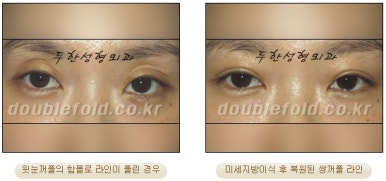
◇ When one double eyelid line has loosened
◇ When the skin on one side has sagged
◇ When the eyelid line is pulled upward because orbital fat is insufficient and the eyelid becomes sunken
◇ When it is pulled upward by scar adhesion
★ How are asymmetrical double eyelid lines corrected?
◇ When the height of the double eyelid line differs after buried-suture surgery
If the initial surgery was buried-suture surgery, repeating buried-suture surgery has a high chance of loosening again.
A new line is made at the desired position using partial incision surgery.
As the new line forms, the existing double eyelid line naturally smooths out and disappears.
However, if the existing line is too distinct, correction with partial incision surgery may not be possible, and full incision surgery may be required.
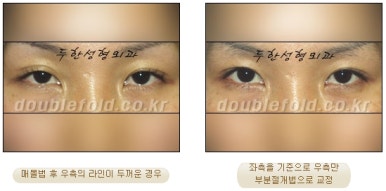
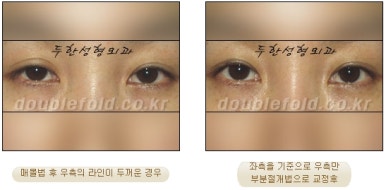
◇ When the height of the double eyelid line differs after full incision surgery
- When correcting a small double eyelid line to match a larger one by making it larger
If one side is lower and the smaller line needs to be made larger, a new double eyelid is created above the existing line.
This is generally corrected with partial incision surgery, and if the existing scar line is dark, correction is performed with full incision surgery.
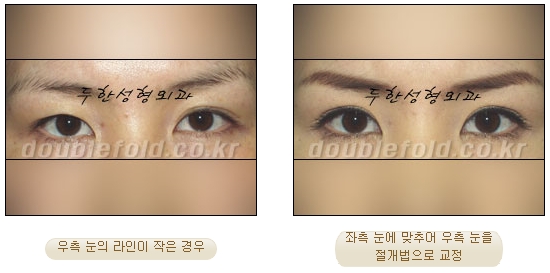
- When correcting a large double eyelid line to match a smaller one by making it smaller
To reduce a large double eyelid line created by full incision surgery, correction is performed again with full incision surgery.
The existing scar line is excised and removed, and a new double eyelid line is created to match the opposite side.
To reduce a large double eyelid line, tissue is dissected and completely repositioned.
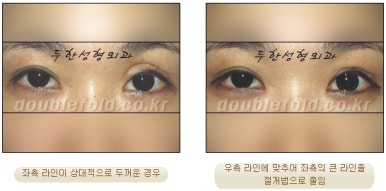
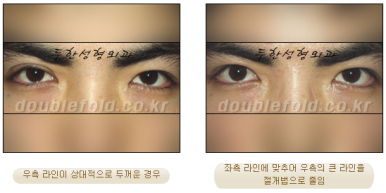
◇ How to correct when ptosis is present in one eye
Surgery is performed to make the ptotic eye open wider.
Levator shortening surgery is performed using full incision surgery, in which the levator (the muscle that lifts the eyelid) is pulled and attached to the tarsal plate.
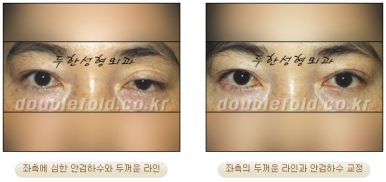
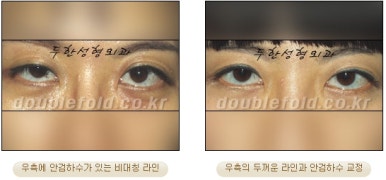
◇ When one side’s double eyelid line has loosened
If one side’s double eyelid line has loosened, the loosened side is corrected using partial incision surgery or full incision surgery.
If the skin is very thick or the scar is not severe, the principle is to first correct it with partial incision surgery, and if it still loosens, correct it with full incision surgery.
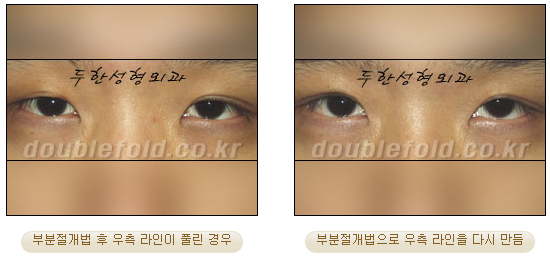
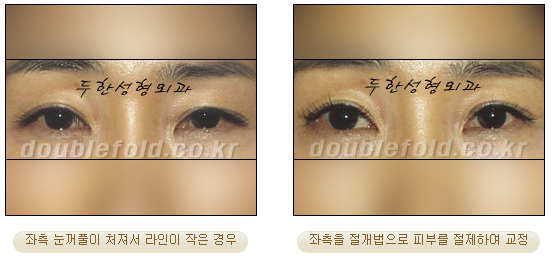
◇ When the skin on one side has sagged
If the height of the double eyelid line is the same but asymmetry occurs due to sagging skin, correction is done with full incision surgery by excising the sagging skin on that side.
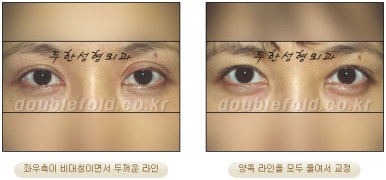
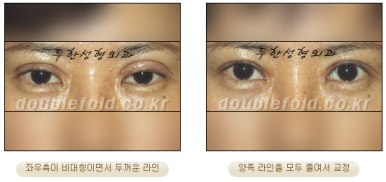
◇ When both sides are asymmetrical and both double eyelid lines look awkward
If the left and right sides are asymmetrical and both double eyelid lines are unattractive and awkward, both sides need revision surgery.
The height of the lines is designed to match, the existing scar lines are removed, and the tissues are completely repositioned to create new lines.
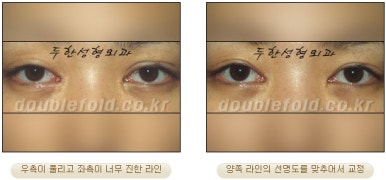
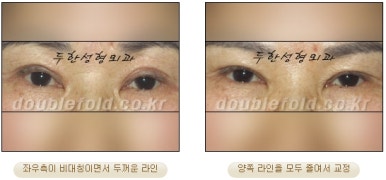
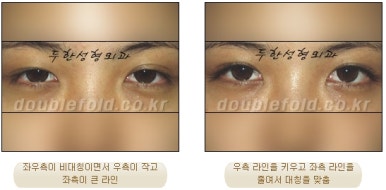
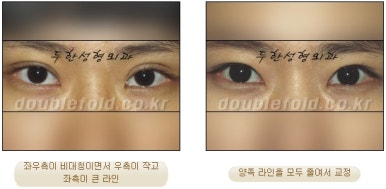
◇ When one eyelid becomes sunken and the double eyelid line is pulled upward, causing asymmetry
When the eyelid becomes sunken due to insufficient orbital fat, the line is pulled upward and becomes larger.
In such cases, it can be simply corrected with micro fat grafting without revision surgery.
Micro fat grafting is a simple procedure in which fat is injected with a syringe.

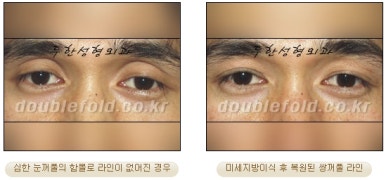
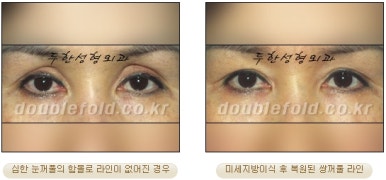
What is a loosened double eyelid line?
There are many reasons why a line loosens, but there are also cases where the orbicularis oculi muscle and fat that interfere with double eyelid formation were not properly removed, or where the scar tissue beneath the skin, which is an essential requirement for forming a double eyelid, does not properly form due to constitutional factors.
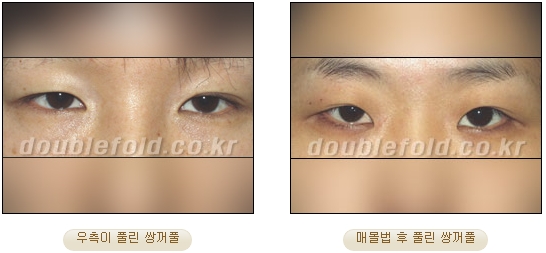
♠ What causes a loosened double eyelid?
◇ When the skin is thick
◇ When there is a lot of preaponeurotic fat
◇ When the orbicularis oculi muscle is thick
◇ When scar tissue does not form properly
◇ Lack of experience or skill on the part of the surgeon
◇ Choosing the wrong surgical method
◇ Habitually rubbing the eyes
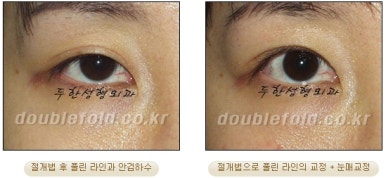
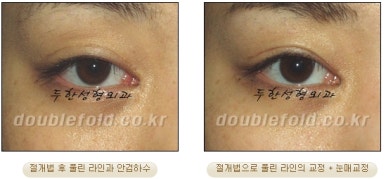
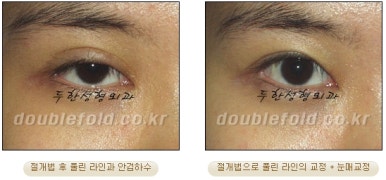
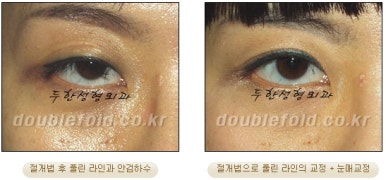
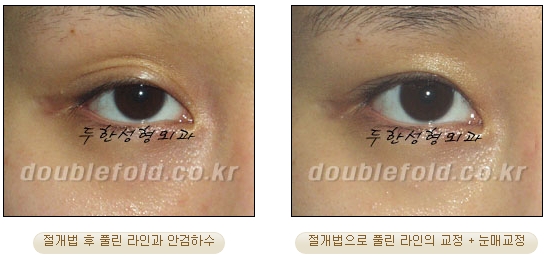
♠ Loosened double eyelid — correction with full incision surgery
If a double eyelid loosens after incision surgery, partial incision surgery can sometimes be used for correction.
If the goal is to correct both the scar line and the height of the double eyelid line, correction is performed with full incision surgery.
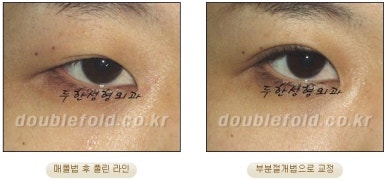
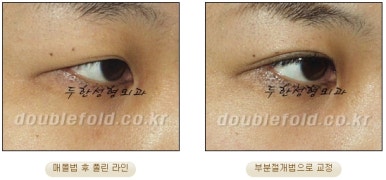
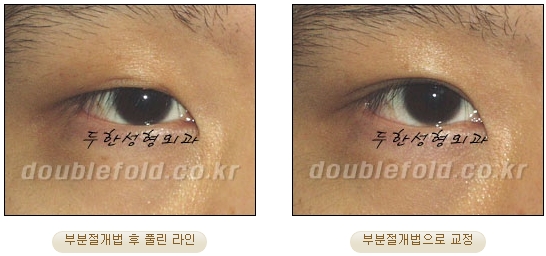
♠ Loosened double eyelid — correction with partial incision surgery
If a double eyelid loosens after buried-suture surgery, the principle is to correct it with partial incision surgery because repeating buried-suture surgery has a high chance of loosening again.
If it loosens again even after partial incision surgery, it is corrected with full incision surgery.
♠ Loosened double eyelid — correction with micro fat grafting
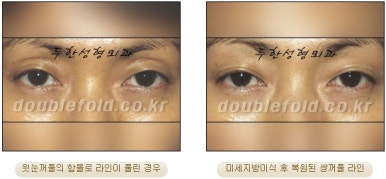
When the eyelid becomes sunken and the double eyelid line is pulled upward and loosens, the loosened line can be corrected together with the sunken eyelid using micro fat grafting.
However, this only applies when the cause of the loosened double eyelid is solely the sunken eyelid.
The main purpose of the procedure is to correct the sunken eyelid, and correction of the double eyelid line is a secondary goal.
If the line does not naturally restore even after the eyelid is restored, revision surgery must be performed.
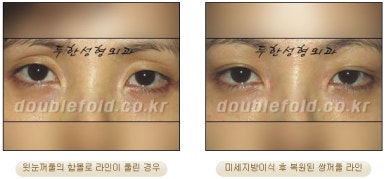
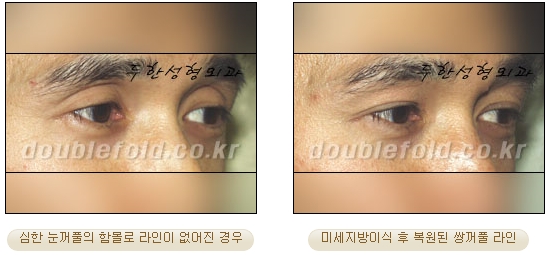

What are the causes of double eyelid revision failure?
If double eyelid revision surgery was performed but the result was not as desired, there can be several reasons.
Main phenomena seen after double eyelid revision failure
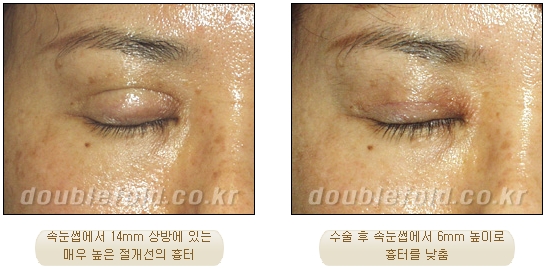
① Surgery was performed to make a large double eyelid line smaller, but the line barely changed or remained the same.
② The swelling does not go down easily and looks awkward. - sausage-like appearance
③ It is uncomfortable to open the eyes, and the eyelids feel heavy.
④ There is a pulling sensation when opening the eyes, and they feel stiff.
⑤ The double eyelid lines are severely asymmetrical.
⑥ Eyelash eversion does not recover.
⑦ Opening the eyes feels uncomfortable, but the eyes close well.
⑧ The scar line at the incision site is too dark.
Causes of double eyelid revision failure
The biggest cause of failure is the patient’s own perception that double eyelid revision surgery is simple.
The thought, after a failed double eyelid surgery, that “it can just be corrected again,” leads to failed revision surgery.
To undergo double eyelid revision surgery, the patient must understand the cause of the original problem more than anyone else so that failure does not happen again.
The following 내용 analyzes cases in which patients underwent double eyelid revision surgery at another hospital, failed, and then came to our clinic for revision, where the causes of failure were analyzed through various examinations.
① When double eyelid revision surgery is performed together with epicanthoplasty
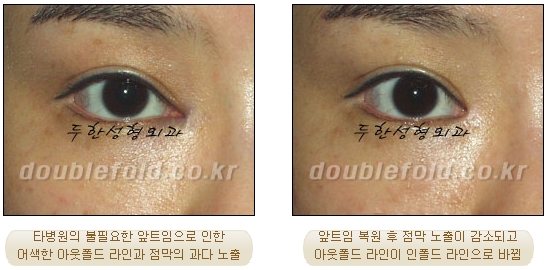
Some hospitals perform epicanthoplasty together with revision surgery to reduce the double eyelid line.
Epicanthoplasty can cause the inner (medial canthal) line to become thicker.
It does not make sense to perform revision surgery to reduce the double eyelid line while, at the same time, performing surgery that makes the inner line larger.
Unnecessary epicanthoplasty can cause various problems.
Epicanthoplasty should be performed only when necessary for eyes with an epicanthal fold, and unnecessary epicanthoplasty can cause side effects such as excessive exposure of the inner mucosa, a severe out-fold line, the eyes appearing too close together, or a sharper appearance.
Unnecessary epicanthoplasty often damages the overall impression, so caution is needed.
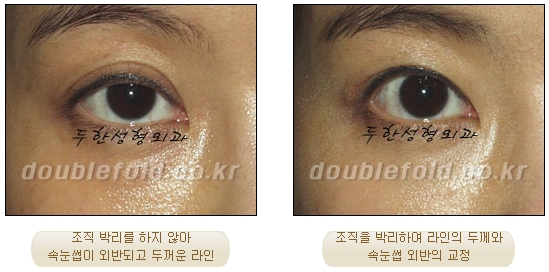
② When scar tissue is not fully dissected during double eyelid revision surgery
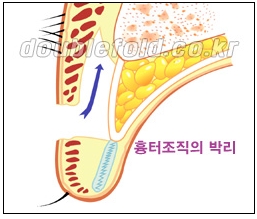
During double eyelid revision surgery, the existing scar must be removed or fully dissected to release the adhesion between the tissues that have become stuck together.
Otherwise, tissue repositioning does not occur.
If the muscle layer and fat layer are not fully dissected while releasing adhesions, tissue repositioning becomes impossible and it is difficult to narrow the double eyelid line.
If suturing is done without proper dissection, not only will the double eyelid line not narrow at all, but the skin below the incision line will be pulled upward, causing eyelash eversion.
③ When orbital fat is not repositioned
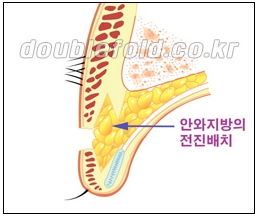
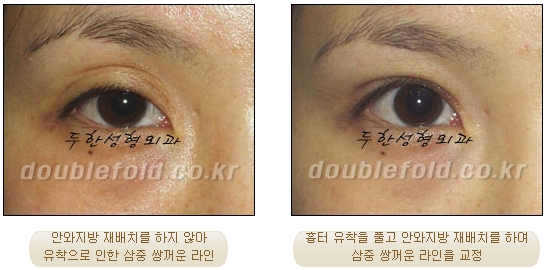
If fat repositioning is neglected when it is needed, the dissected tissues can stick together again, preventing the eyes from opening widely and even creating a triple eyelid.
Along with scar tissue dissection, orbital fat repositioning is an important part of surgery that acts like lubricant to prevent the tissues from sticking together again.
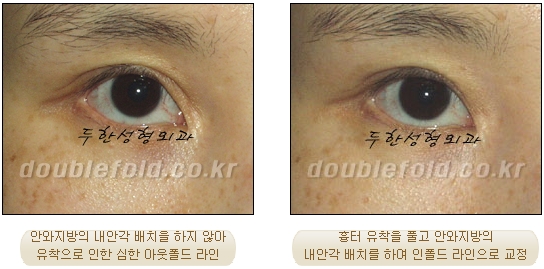
④ When fat is not repositioned at the inner canthus (inner corner of the eye)
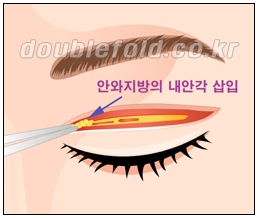
If orbital fat is not repositioned at the inner canthus, scar tissue can form in the inner corner of the eye and interfere with opening the eyes widely.
Scar tissue should not form in the inner corner of the eye.
The inner corner of the eye plays an important role in helping the eyes open widely, and if excessive scar tissue forms in this area, the eyes cannot open widely or a natural line cannot be created.
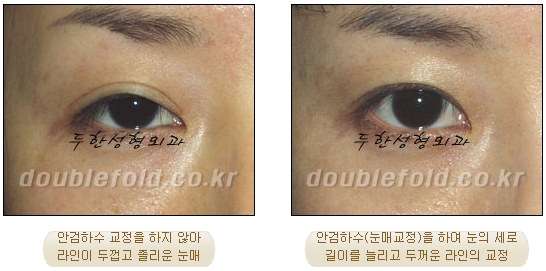
⑤ When ptosis correction (eye-shape correction) is not performed
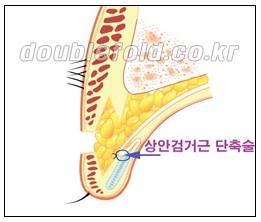
In sleepy-looking eyes, ptosis correction should be performed to make the eyes open wider.
Usually, levator shortening surgery is performed. The levator is an important structure that helps open the eyes, and in most patients undergoing double eyelid revision surgery, the levator muscle is weakened.
It is important to perform levator shortening surgery (step 6) to make the eyes open widely.
If this is not done, the existing drowsy eye shape is not corrected, which reduces the effect of double eyelid revision surgery.
⑥ When sutures are removed too early
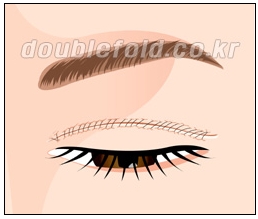
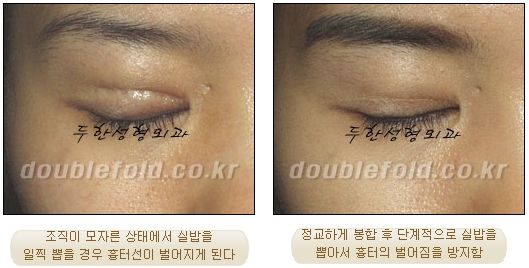
The reason sutures are removed late in double eyelid revision surgery is that most revision patients have little excess skin, and because the tissues have been repositioned, the tissues must be firmly held in place by the sutures.
The repositioned tissues have a tendency to return to their original position, like a spring, so they need to be held in place by the sutures. If the sutures are removed before the tissues have stabilized in their new position, the tissues will return to their original location and lead to poor surgical results.
⑦ When fat grafting and double eyelid revision surgery are performed at the same time for sunken eyelids
Some hospitals perform fat grafting and double eyelid revision surgery at the same time when the eyelid is sunken and revision surgery is also needed, but this should not be done.
Fat grafting should be performed first, and double eyelid revision surgery is possible 3 to 6 months later.
When performing double eyelid revision surgery, the tissues must be dissected, but fat grafting cannot be placed into the dissected tissue.
If fat grafting and double eyelid revision surgery are done at the same time, it is like spreading fat into the dissected empty space, so the fat does not properly survive, and only the double eyelid line is damaged.
Therefore, doing the two surgeries at the same time is not appropriate.
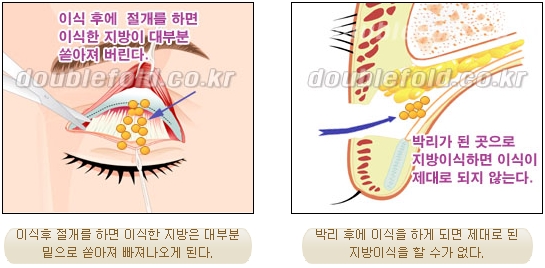
⑧ Problems that occur when fat grafting and double eyelid revision surgery are done together
◇ After fat grafting, swelling makes it almost impossible to accurately assess or adjust the double eyelid line.
As a result, the desired line is not created, leading to dissatisfaction with the surgery.
◇ If the incision is made immediately after fat grafting for double eyelid surgery, the grafted fat will spill out through the incision site.
This is because during revision surgery, one must dissect and enter between the orbital fat layer and the levator layer, and fat has been grafted into that area.
◇ Conversely, if fat is directly grafted into the orbital fat layer after incision, the grafting will not be accurate or precise, and later survival of the graft may not occur properly, or unsatisfactory results such as an uneven appearance may occur.
◆ Double eyelid revision process when the eyelid is sunken
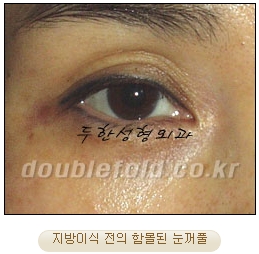
A sunken eyelid causes the double eyelid line to be pulled upward and become deformed.
As people age, fine wrinkle lines often develop.
In this condition, the proper sequence is to first correct the sunken eyelid with fat grafting.
When the eyelid is sunken, the double eyelid line usually does not turn out beautifully even if revision surgery is performed.
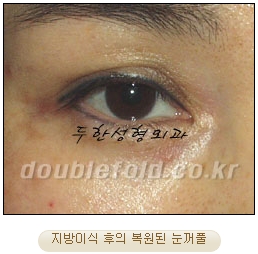
After micro fat grafting using micro-needles, the sunken eyelid is corrected.
The width of the line has also decreased from before, but fine wrinkles remain on the line, and the inner line is thick, so it does not look natural.
The double eyelid line must be corrected naturally through revision surgery, and surgery is planned 3 months later, after the fat has completely taken hold.
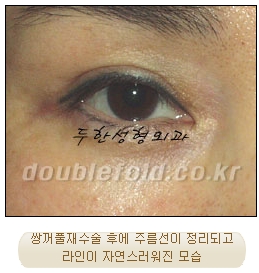
Three months after fat grafting, double eyelid revision surgery is performed to restore a natural line.
A natural double eyelid is narrow on the inner side and gradually becomes wider toward the outer side.
→ As in the example above, only by first correcting a sunken eyelid with fat grafting, then checking the appearance after it has fully settled 3 months later, planning accordingly, and then performing double eyelid revision surgery can the operation be accurate and produce good results.
Choosing when the consultation for double eyelid revision surgery is very difficult or complicated
When a patient visits for consultation regarding double eyelid revision surgery and is examined, there are cases where, from the surgeon’s point of view, the eye shape is very complicated or there is no confidence that a satisfactory result can be achieved.
In such cases, one cannot simply say with complete confidence that it is possible, but answering that it is difficult may reduce trust in the hospital or lead to being mistaken for an inexperienced doctor.
From the surgeon’s perspective, if they want to provide an honest and principled consultation and accurately assess the patient’s condition by explaining what is difficult and why the result may turn out poorly, some patients will accept it, but many will react differently.
If patients are misled by exaggerated consultations and undergo surgery, the situation may become even more desperate.
From the patient’s perspective, it is very important to distinguish between a consultation without exaggeration and a surgeon who acts with conviction.
The prognosis of double eyelid revision surgery varies.
There are people who think that if they meet a highly skilled doctor for double eyelid revision surgery, they will automatically get a good result.
This is a very dangerous way of thinking.
Even with a skilled doctor, some cases may improve through surgery, while others may not improve, and sometimes the result may still be insufficient.
Before surgery, one should keep these three possibilities in mind during consultation and make a realistic judgment by confirming whether surgery is possible, how much improvement can be expected if possible, or whether it is impossible.
Cases where double eyelid revision surgery is difficult or impossible
There are many cases where double eyelid revision surgery is impossible or difficult.
These include cases with insufficient excess skin, cases where the scar line is too dark to release the adhesion, cases where the skin and muscle are excessively thick, cases where repeated revision surgeries have made the tissue hard and thick, cases with severe sausage-like appearance that is likely to recur because it will be pushed down again even after surgery, and cases with severe ptosis.
In very complicated and difficult cases, patients must understand the limitations themselves, but some people refuse to accept those limitations.
Undergoing surgery with vague hope alone only causes the patient to fall into a deeper pit.
One must carefully judge the limits and prognosis in one’s current condition before deciding on surgery.
http://www.duhans.com