Sausage-like double eyelids,
With revision eyelid correction, it has been restored to a natural and clear eye shape ~
Very feminine ~
What is the problem with an overcorrected eye shape?
Bringing an overcorrected eye shape back down to a normal size is much more difficult than correcting ptosis.
When ptosis correction or eyelid correction has been done too strongly and the white of the eye is exposed, levator palpebrae superioris relaxation surgery must be performed to reduce the size of the eye again. However, if the levator palpebrae superioris is relaxed incorrectly, ptosis may develop a few months later and the eye may not open as well.
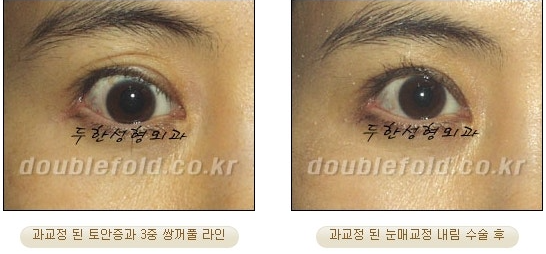
Reversing an overcorrection is much more difficult than correcting ptosis, and it is hard to predict the outcome later.
It takes extensive experience and know-how to properly control the degree of levator palpebrae superioris relaxation.
Dull-looking eyes, ptosis
If the eyes do not open naturally after double eyelid surgery and look dull, they should be corrected so that the eyes can open naturally and brightly again.
A dull impression can easily leave a bad impression on anyone.
The causes include congenital ptosis, pseudoptosis, and adhesion from scar tissue.
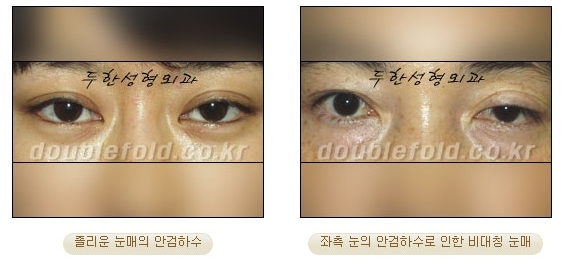
If the eyes do not open naturally after double eyelid surgery and look dull, they should be corrected so that the eyes can open naturally and brightly again.
In the case of ptosis, the most common corrective method is levator palpebrae superioris shortening or resection.

The competitiveness of our clinic’s revision eye surgery, extreme revision eye surgery ~ lowering the line of sausage eyes, revision eyelid correction for ptosis, transforming into very beautiful eyes ~
Revision double eyelid surgery
This refers to surgery that corrects the double eyelid line and restores it to a naturally attractive double eyelid shape when the line is too large, uneven, loosened, or otherwise problematic.
Indications for revision double eyelid surgery
-
When the line is too large
-
When the line has loosened
-
When the line is asymmetrical
-
When the eyes feel tired after double eyelid surgery
-
When there is a thick sausage-like appearance below the incision line
-
When the impression looks worse after double eyelid surgery
-
When you want to restore beautiful, natural eyes
Purpose of general double eyelid surgery
The purpose of double eyelid surgery is not simply to create a double eyelid line.
The purpose of double eyelid surgery is to make the eyes look larger and brighter and to create sparkling eyes and a refined eye shape.
Surgery done only to create a double eyelid line can easily lead to unwanted results.
The purpose of revision double eyelid surgery is the same.
It aims to make the eyes larger, brighter, and more natural.

`The extensive revision-surgery know-how of our head doctor, Shin Duhan ~
What is the full-incision method for eyelid correction?
For correcting ptosis with a thick line, the full-incision method can be used.
The full-incision revision surgery process is very difficult and requires extensive experience, advanced skill, and know-how.
It usually takes about 2 to 3 hours.
The operation proceeds in 10 steps, and if even one step is omitted, the result may fall short of expectations.
Even if it takes some time, better results can be achieved by carefully checking every step and performing the surgery with dedication.
What is the surgical process of the full-incision method for eyelid correction?
- Design the planned incision line, including the existing incision scar tissue.
Before surgery, the design is made to create a new double eyelid line below the scar line and determine the width of skin excision up to the scar line.
The width to be excised runs from the new double eyelid line to the existing scar line.
For example, if the existing scar line is 10 mm above the eyelashes and the new double eyelid line is set at 7 mm, the skin excision width would be 3 mm.
The standard is determined based on the midpoint width.
The new double eyelid line is determined by considering how much the line will be reduced and the amount of excess skin.
The average line height for revision surgery is 5 to 7 mm.
- Remove the skin and scar tissue.
Scar tissue is excised along the design line.
An incision is first made precisely with a scalpel, and then the tissue is excised with surgical scissors.
The lower excised line becomes the new double eyelid line, and after dissection, the upper line must be naturally drawn downward so that it can be sutured.
- Dissect the orbicularis oculi muscle, orbital fat, and skin adherent to the levator palpebrae superioris.
Because the skin above the incision line must be pulled downward, the firm scar tissue that has stuck together must be dissected.
Scar tissue dissection proceeds by separating the space between the orbital fat layer and the levator palpebrae superioris, and in some cases, dissection is also performed between the muscle and fat to advance the fat forward.
Through this dissection process, the tissue can be advanced and repositioned downward, which is important as a preparatory step for obtaining a natural double eyelid line.
- If there is contracture of the orbicularis oculi muscle, cut or remove the muscle to eliminate the contracture.
When adhesion of the scar tissue is too severe, in rare cases the orbicularis oculi muscle is vertically incised by about 1 to 2 mm to release the contracture.
Enter photo description.
- Reposition the orbital fat up to the incision line to prevent re-adhesion.
Forward repositioning of the orbital fat is a step to prevent re-adhesion of the tissue.
If the fat is not repositioned, the tissue will stick together again, and as a result, ptosis may occur and the eyes may become dull and sleepy-looking.
In some cases, a triple eyelid may develop, which can damage the double eyelid line.
Another effect of repositioning the orbital fat is that if the eyelid is sunken, the sunken appearance can be partially corrected. Therefore, if fat grafting might otherwise be needed later for a sunken eyelid, the surgery itself may improve it to some extent, sometimes making fat grafting unnecessary.
- Shorten the levator palpebrae superioris to strengthen its function.
Levator palpebrae superioris shortening is one method of correcting ptosis.
It is simple, effective, and has the advantage of being able to correct the condition with almost no tissue damage.
The muscle is not cut out; it is simply advanced and attached to the tarsal plate.
In revision surgery, the effect of levator palpebrae superioris shortening is to make the eyes open wider so they can be corrected in a more refreshed way, and by opening the eyes more widely, the double eyelid line is also reduced. These are the two purposes.
◆ Surgical process of levator palpebrae superioris shortening
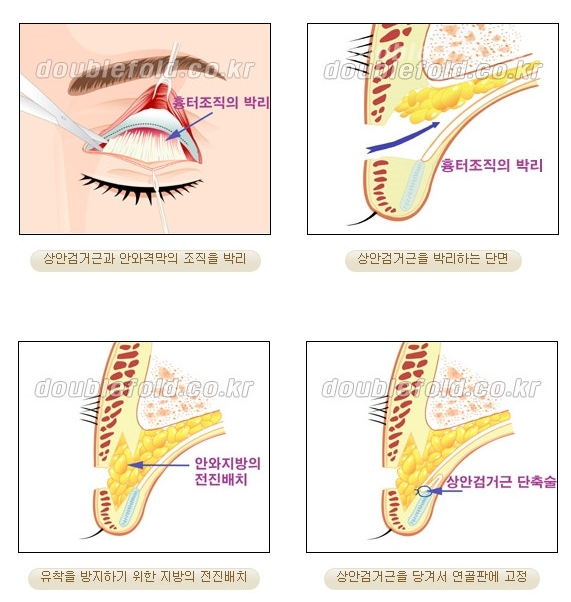
① Design is made and local anesthesia is administered.
② An incision is made along the design line.
③ After the incision, the orbital septum is opened to expose the levator palpebrae superioris.
④ After exposing the levator palpebrae superioris and marking the amount to be shortened, the marked portion and the upper edge of the tarsal plate are tied together with sutures.
⑤ Three sutures are buried to create the double eyelid line.
⑥ The outer skin is sutured.
- After incising the orbicularis oculi muscle at the inner canthus, orbital fat is inserted between the muscles to prevent re-adhesion.
Along with forward repositioning of fat, fat is inserted into the inner canthus of the eye to prevent adhesion of the orbicularis oculi muscle.
The inner part of the eye is the area where scar tissue adhesion occurs most easily. Adhesion in this area can make the eyes look dull and prevent them from opening properly, causing discomfort when opening the eyes.
To prevent this, orbital fat that can serve as a lubricant is placed between the orbicularis oculi muscle and the tarsal plate and fixed with sutures.
- During suturing, layered sutures are used to prevent the repositioned structures from shifting.
The suturing method in revision surgery is not simple.
The purpose of suturing is to close the open wound and create the double eyelid line.
Therefore, in order to obtain the double eyelid line as originally designed, the skin below the incision line must not be pulled upward.
To do this, the skin below the incision line must be firmly fixed to the tarsal plate, and sutures must also be placed to prevent the advanced fat from being pulled upward.
In addition, the orbicularis oculi muscle and skin above the incision line must all be passed through by the suture and firmly secured with layered suturing in order to achieve the desired double eyelid line.
- To prevent hematoma and inflammation, a small amount of anti-swelling agent (hyaluronidase) is administered to the surgical site.
The anti-swelling agent hyaluronidase is a drug that has the effect of dispersing water, and it helps quickly reduce swelling as soon as it is administered.
However, if too much is used, it can instead cause significant bruising, so it is used selectively only for reducing swelling.
- Suture removal is kept relatively delayed, from 7 to 14 days, depending on the patient’s condition.
Sutures are removed in two stages, on day 4 and day 7.
The reason for removing sutures late is that in revision surgery, most cases do not have enough excess skin, and because the surgery involves advancing all tissues, there is a lot of tension on the suture line.
Therefore, if sutures are removed on day 3 or 4, the tense suture line may open or the scar line may widen, causing a larger scar, and the tissue may gradually be pulled upward, which can also enlarge the double eyelid line.
Thus, until the tissue stabilizes, the sutures need to hold the tissue in place, so it is better to leave them in longer.
In many hospitals, sutures are removed early out of concern that suture marks will remain, but that applies only to the first double eyelid surgery.
It does not apply to revision surgery.
To minimize suture marks, most sutures are removed first on day 4, and only about 3 to 4 remain; these are then removed on day 7. This minimizes suture marks and prevents the scar from widening, while also minimizing distortion of the double eyelid line.
To quickly reduce early inflammation and swelling, a steroid is administered for about 2 days.
After surgery, artificial tears are used for about 1 month to prevent dry eye.
If all of the above principles are followed with skilled technique, satisfactory results can be achieved.
Overcorrected eye shape, undercorrected eye shape, eyelid correction for ptosis, revision surgery for ptosis
Overcorrected eye shape, undercorrected eye shape, eyelid correction for ptosis, revision surgery for ptosis
Revision eyelid correction, improvement of lagophthalmos, incision-based eyelid correction, more than 30 years of know-how in eyelid correction by Head Doctor Shin Duhan, many successful cases~~~
Ptosis eyelid correction surgery
| When the eyes do not open brightly and always look sleepy, this is called ptosis. It is broadly divided into congenital ptosis and acquired ptosis. | It is divided into true ptosis, in which the function of the levator palpebrae superioris, the muscle that lifts the eyelid, is reduced, and pseudoptosis, which only appears to be simple ptosis (false ptosis). | The purpose of correcting ptosis (sleepy-looking eyes) is to return to large, bright eyes. Depending on the severity of the condition, the appropriate method must be selected, and the surgeon’s skill and experience are required. |
|---|
| The purpose of double eyelid surgery is to create larger, brighter eyes and add a line to the eyelid to make the eye shape look more refined. However, if the eyes end up looking sleepier after surgery, it is worse than not having surgery at all. | | |
What are the types of ptosis?
- Congenital true ptosis
This occurs when the function of the levator palpebrae superioris, the muscle that lifts the eyelid, is reduced, and it can occur in both eyes or in one eye.
In cases of congenital ptosis, it is better to correct it early before the function of the levator palpebrae superioris deteriorates further.
In true ptosis, double eyelid surgery alone has almost no effect on increasing the visible size of the eye, and ptosis correction must be performed additionally to increase the vertical size of the pupil.
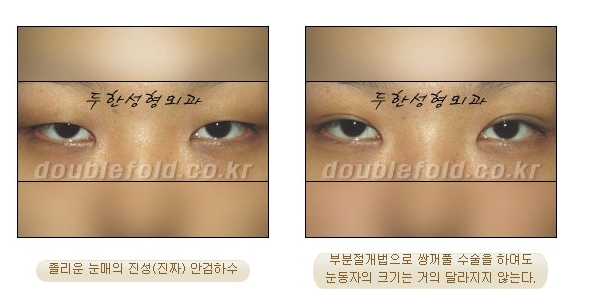
- Congenital pseudoptosis
There are cases where the levator palpebrae superioris function is not reduced, yet the eyes still look sleepy.
This happens because, in eyes without a double eyelid, the drooping eyelid covers the pupil.
This can be mistaken for ptosis, and even plastic surgeons sometimes incorrectly judge it as true ptosis, so caution is needed.
Congenital pseudoptosis can make the eyes appear larger just by double eyelid surgery alone, so ptosis correction is not separately necessary.
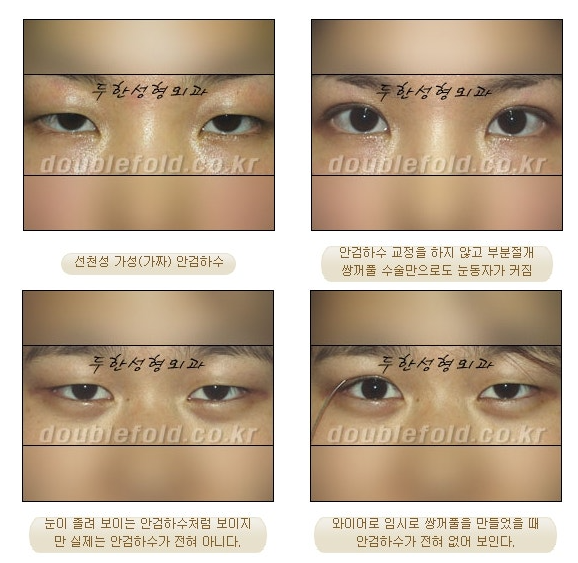
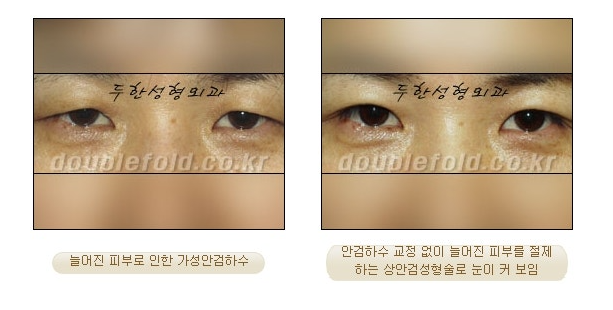
In the case above, the patient wanted ptosis correction (eyelid correction) because the eyes looked sleepy, but when a temporary line was made with a wire, the hidden pupil was revealed much more clearly, showing that there was no ptosis at all.
This is a typical case of pseudoptosis, where only double eyelid surgery is needed.
Nevertheless, some clinics recommend ptosis correction (eyelid correction) unnecessarily, so caution is needed.
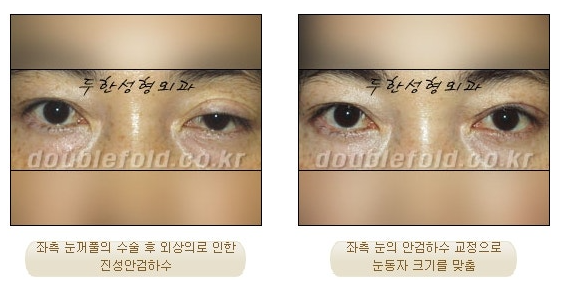
- Traumatic true ptosis
This occurs when the levator palpebrae superioris, the muscle that lifts the eyelid, is damaged by improper surgery or trauma.
If the damaged levator palpebrae superioris is only partially injured, restoration is not difficult, but in cases of complete damage, restoration can be difficult if it is not repaired quickly because the muscle may retract.
The damaged levator palpebrae superioris is located and restored.
- Traumatic pseudoptosis
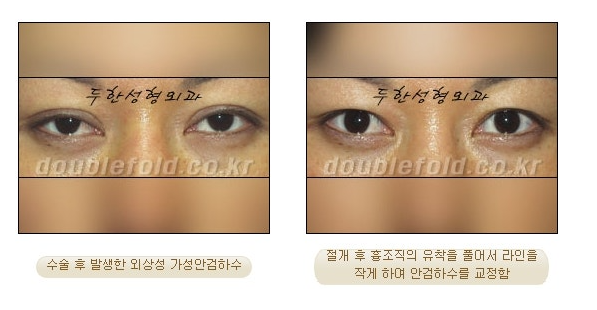
This refers to cases where the function of the levator palpebrae superioris, the muscle that lifts the eyelid, is normal, but external factors interfere with its function, preventing the muscle from exerting proper force.
It commonly occurs when the double eyelid line is made too thick and scar tissue adhesion develops.
It is corrected by releasing the scar tissue adhesion below the double eyelid line with a full incision and lowering the line.
- Senile true ptosis
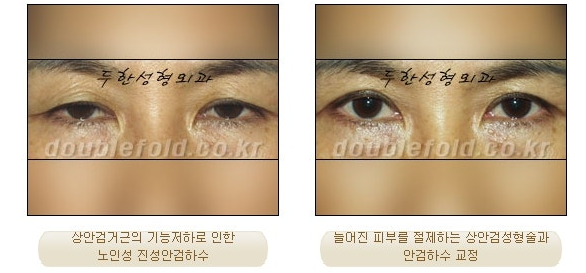
This occurs as the levator palpebrae superioris, the muscle that lifts the eyelid, gradually loses function due to aging, weakening the ability to open the eyes.
It usually occurs after age 50, and in senile cases, as with congenital ptosis, postoperative prognosis is often not good.
Surgery combines upper blepharoplasty, which removes skin, with ptosis correction.
- Senile pseudoptosis
As people age and the eyelids sag due to aging, the pupil may be covered, making it look as though the eyes are not opening fully, similar to ptosis.
In such cases, the eyelid skin should be temporarily lifted or a temporary double eyelid should be created to check the true vertical size of the pupil.
A diagnosis of ptosis should not be made simply because the eyelid covers the eye.
Since upper blepharoplasty, which removes eyelid skin, can make the eyes appear larger on its own, ptosis correction is not necessary.
What are the causes of acquired ptosis?
| When the double eyelid line is made too high | When the function of the levator palpebrae superioris declines due to aging |
|---|
| When you rub your eyes habitually, scar tissue forms on the inside of the eyelid and interferes with the function of the levator palpebrae superioris | When the levator palpebrae superioris is damaged by trauma |
What is the difference between ptosis and a normal eye?
| When the eyes are naturally open and looking forward, it is normal for the upper part of the black pupil to be slightly covered by about 1 to 2 mm. If the black pupil is covered more than that, ptosis should be suspected. | When the eyes are naturally open and looking forward, the vertical height of the eye should be at least 8 mm to be normal. If the vertical height is narrower than that, it is ptosis. | When shifting gaze from looking down as much as possible to looking up, the eyelid movement range should be about 14 to 16 mm. If it is less than that, it can be judged as true ptosis. |
How is ptosis examined?
It is checked by measuring the vertical height of the pupil while looking straight ahead.
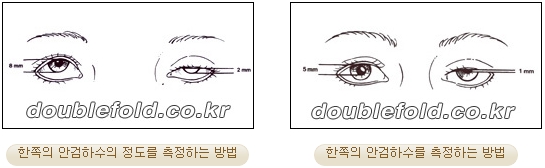
In normal individuals, the vertical height is between 8 and 9 mm, and generally cases of 8 mm or less are considered ptosis.
However, because everyone’s eye shape and size are different, ptosis is not diagnosed using only exact numbers.
It is judged by whether the impression is objectively sleepy-looking, and the diagnosis is made by comparing this with the measurements.
The function of the levator palpebrae superioris is also measured and used in the assessment.
| ① Vertical palpebral fissure height (measurement of the eye’s vertical opening) ② Check whether the impression looks sleepy ③ Measure the function of the levator palpebrae superioris (normal: 14–16 mm) |
What are the surgical methods for ptosis?
① Levator palpebrae superioris shortening
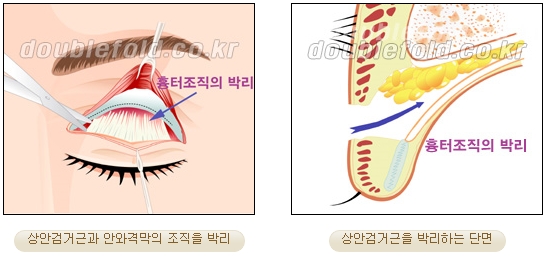
This method shortens the eyelid-lifting muscle (levator palpebrae superioris) by overlapping and suturing it by about 4 to 8 mm, and is mainly used in cases of mild ptosis.
Since surgery must be performed through an incision, a double eyelid line is created in the process, so people without a double eyelid have no choice but to create at least a partial double eyelid.

② Levator palpebrae superioris resection
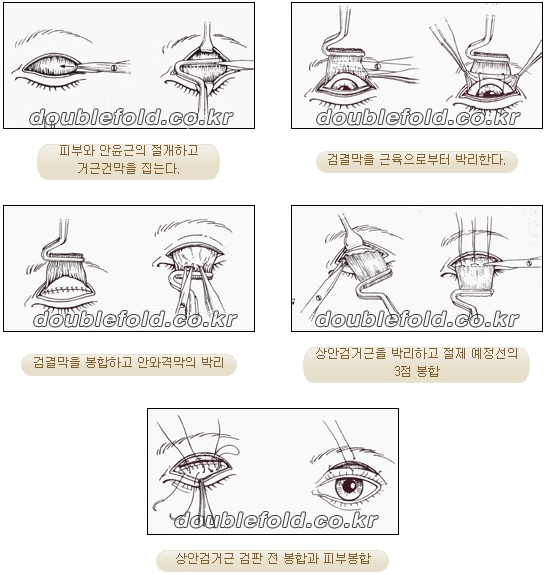
This method shortens the length of the eyelid-lifting muscle (levator palpebrae superioris) by resecting about 5 to 10 mm and suturing the cut end of the levator palpebrae superioris to the tarsal plate.
It is mainly used in cases of moderate ptosis.
③ Frontalis suspension
This method is used in severe ptosis where the levator palpebrae superioris function is 5 mm or less, and it is performed when improvement cannot be expected with levator palpebrae superioris shortening or resection.
By advancing the frontalis muscle of the forehead and attaching it to the tarsal plate of the eyelid, the frontalis muscle takes over the function of the levator palpebrae superioris.
General anesthesia is required, and severe lagophthalmos may occur as a side effect.
④ Müller’s muscle shortening
Instead of levator palpebrae superioris shortening, a shortening method using Müller’s muscle beneath the levator palpebrae superioris is sometimes used.
Müller’s muscle shortening has the advantage of minimizing lagophthalmos, but postoperative prognosis is difficult to predict and recurrence is common.
To access Müller’s muscle, surgery must be performed while damaging the levator palpebrae superioris, so it is not a method with any special advantages.
Anatomically, many people have little or a very thin Müller’s muscle, and in such cases this method cannot be applied.
How is ptosis managed after surgery?
- Apply a cold pack provided by the hospital for cold compresses.
Do this for 3 days, 2 hours a day.
The cold compress can be done continuously for 2 hours or divided into 20 to 30 minutes at a time.
It is usually convenient to do it before going to bed.
-
Use the prescribed artificial tears and eye drops to prevent dry eyes.
-
Follow-up visits are usually twice: the day after surgery and on the day sutures are removed.
Sutures are removed on day 3 or 4.
- Makeup and facial washing are allowed after suture removal.
Until the sutures are removed, wash the face with a wet towel.
-
Because no bandage is applied to the surgical area, daily life activities are possible.
-
Postoperative swelling varies from person to person, and although it usually subsides significantly in about 7 days, it takes about 1 to 3 months to fully settle.
-
Lagophthalmos, in which the eyes do not close fully, varies depending on the degree of ptosis and the extent to which the levator palpebrae superioris was shortened, but it usually takes 15 days and in some cases more than 6 months.
On average, it progresses for about 2 to 3 months before the eyes naturally close.
Previously overcorrected eyes due to eyelid correction surgery can be improved with the full-incision surgical method.
To “release” eyelid correction means a surgery that compensates for overcorrected eyelid correction surgery.
In other words, it is a surgery that reduces eyes that open too widely and appear overly wide-eyed.
It is not possible to simply undo eyelid correction surgery.
A process is needed to lengthen the already shortened muscle.
To lengthen the muscle, the muscle end must be separated,
and surgery to advance the upper eyelid fat is needed while connecting surrounding tissues such as fat or fascia.
If surgery is performed through the process above, the eyes will not become wide-open again after surgery.
However, there is the problem that it is difficult to predict the final eye size after surgery.
Eyelid correction surgery can be understood in a broad sense as including ptosis surgery.
The difference depends only on the preoperative condition or the surgical goal.
Simply put, when someone cannot open the eyes well at all, it is called ptosis surgery,
and when the eyes are somewhat small and look sleepy, it is described as eyelid correction surgery.
These days, many hospitals perform what is called eyelid correction surgery.
However, this surgery is not necessary for all patients,
and it is not a surgery that can guarantee satisfactory results for everyone.
Eyelid correction surgery must be performed only as much as needed for patients who truly need it.
If the eye-opening strength is not weak and the eyes are not small, eyelid correction surgery is not necessary.
If eyelid correction surgery is performed forcefully when the eyes are not currently small,
it can result in a retracted eye.
That is why careful attention is needed so that the eyes do not open too widely.
http://duhans.com/m/
http://doublefold.co.kr/m/