Hello.
I’m Yoo Young-gi, a board-certified plastic surgeon.
If I had to name the hottest procedures at Roy Plastic Surgery these days,
they would be facelift surgery, mini facelift, under-eye fat repositioning, and revision rhinoplasty.
In particular, mini facelift surgery is so popular that people even keep coming from Japan to have it done.
But one important point you need to know is this:
mini facelift, as the name suggests, is a mini lift.
There is a full facelift that produces much more dramatic results after surgery,
so why do people choose a mini facelift instead?
For most people, the biggest concern was fear of incision scars.
The burden of a long recovery period,
and the concern about rising surgical costs also seem to have played a role.
So when you decide to get a mini facelift,
I’d like to introduce a way to self-check whether you are likely to get good results.
(However, the surgical method for mini facelift can vary greatly depending on the surgeon.
I am speaking about the tissue layer that is typically targeted in a conventional mini facelift.)
Before deciding on surgery,
not only the surgeon
but also the patient needs to know an important concept.
It is the concept of Fixed SMAS and
Mobile SMAS.
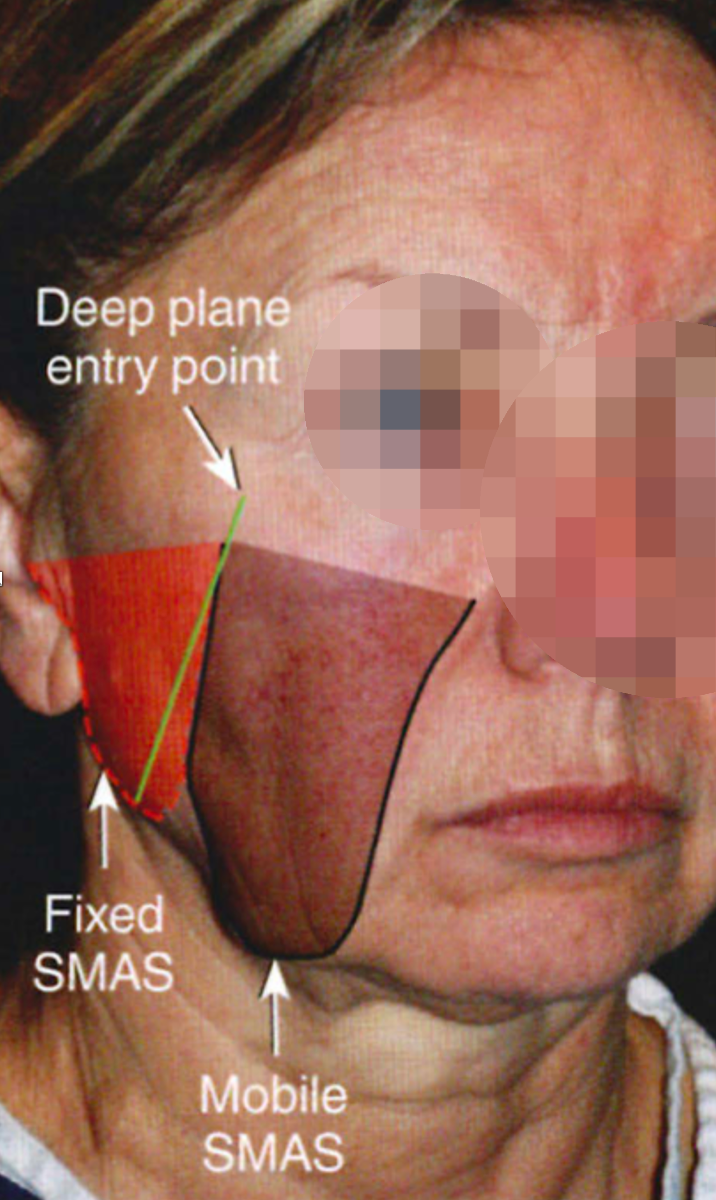
Look in the mirror right now,
and use your finger to gently press the Fixed SMAS area marked in the photo above
while pushing it in different directions.
Now, press the Mobile SMAS area with your finger
and try pushing it in different directions.
Did you notice the difference between the two areas?
Those with a quick eye probably noticed right away!
Fixed SMAS is literally a “fixed” area.
Even if you push it with your finger, the range of movement is limited.
But Mobile SMAS is quite different.
As the name suggests, it is a “mobile” area.
You’ll see that the range of movement is much greater.
This latest knowledge is something I emphasize even when teaching doctors,
and it is very important in surgery.
In general, during the aging process, the SMAS layer sags.
Therefore, surgery should be performed to lift the SMAS layer.
You may have heard this before.
According to the latest understanding, this SMAS layer has different characteristics in the “Fixed” and “Mobile” areas,
which is now the mainstream view in academia.
I also have a TMT (Too Much Talker) tendency when explaining things like this,
so I’m full of the desire to go into even more detail, haha.
But if I go too deep anatomically, there would be too much to talk about,
so let’s just understand it simply as “the two are different”
and move on to the next part!
The procedure that can firmly lift this mobile (freely moving) SMAS layer
is the Deep plane technique.
Literally, around the middle layer of the SMAS
(at a location where major facial nerve damage can definitely be avoided),
the SMAS layer is split once to access the deep layer,
and the deep layer is approached through that opening.
Going one step further,
the surgical technique I use is called Extended Deep Plane.
Literally, it is an extended deep layer,
meaning that even within the deep layer, dissection is carried out more widely,
almost up to the area where the nasolabial folds and marionette lines are located.
By doing so, all the resistance factors that interfere with lifting are released,
making it easy to lift and secure the tissue,
and compared with methods that simply pull hard without proper dissection,
the pain is almost negligible,
and the surgical results are incomparably better.
Since today’s topic is mini facelift surgery,
I’ll stop the discussion of full facelift here
and return to the fixed SMAS layer that mini facelift mainly targets.
The biggest feature and advantage of a mini facelift is that the incision line is small.
The mini facelift handled at Roy Plastic Surgery is
called “zip-up lifting,”
and the incision is made within the scalp when a virtual extension line is drawn from the height of the eyebrows.
Usually, a 2.0–3.0 cm incision is made,
and unless it is a special case, it does not exceed 3 cm.
But with such a small incision,
it is impossible to safely access the deep plane of the SMAS layer
without damaging important facial nerves.
A superficial plane is possible, however.
This means that reaching the Mobile SMAS is difficult,
but the fixed SMAS can be addressed.
In other words,
it is best to understand mini facelift surgery as a procedure that improves the fixed SMAS layer,
not the mobile SMAS layer.
A deep plane procedure with a mini facelift?
Impossible.
If it were possible, the incision would have to extend all the way to the front of the ear,
and if you cut that far, it’s no longer a mini facelift.
Then how can you tell who will have good results from surgery?
First,
basically, the skin should not be too tough or too firm.
(If you don’t have much experience, it can be hard to tell whether skin is tough or not.)
If you’re unsure, I recommend getting a consultation with an experienced board-certified plastic surgeon.
People with this type of skin
may have somewhat less noticeable results compared with other skin types,
even if they undergo a full-face facelift.
But on the other hand,
that also means they have sagged less than others because of the nature of their tougher skin,
so there is no need to be too discouraged. :)
If, after being evaluated by a specialist,
you are told that surgery would not make much of a difference,
then don’t dwell on it any longer
and for the time being, don’t think about face lifting.. :(
There is one self-check method that can help you judge the effect of “zip-up lifting.”
Look in the mirror and palpate your cheekbones with your hand.
While feeling the firm cheekbone and following it outward toward the face,
just before you reach the ear (roughly the sideburn area),
press that area gently with your hand and try lifting it upward.
As you lift it upward by about 2 cm,
observe any changes in the jawline, nasolabial folds, and marionette lines.
If that degree of change satisfies you,
going for a consultation for surgery would probably not be a waste of time.
If you think that degree of change would not be enough to satisfy you,
it may be better not to have the surgery.
You may want to consider a full facelift instead.
Second,
people who can get dramatic results are those whose fixed SMAS has sagged directly.
People who have undergone contouring surgeries such as cheekbone reduction or square jaw reduction,
or who have had excessive liposuction in those areas,
sometimes see their jawline collapse even at a relatively young age.
In such cases, I often see very high satisfaction.
Now let’s look at the surgical case I’m introducing today.
She was a woman in her mid-30s.
At first, she came in for a liposuction consultation because she thought her cheeks were too full and sagging.
However, after examination, while there was some fat,
the structure of the support tissues inside the face had decreased as a result of her previous contouring surgery trio
(cheekbone reduction + square jaw reduction + chin surgery),
so the sagging tissues that had lost support were judged to be a major cause of the collapsing jawline.
Let’s look at her preoperative appearance.
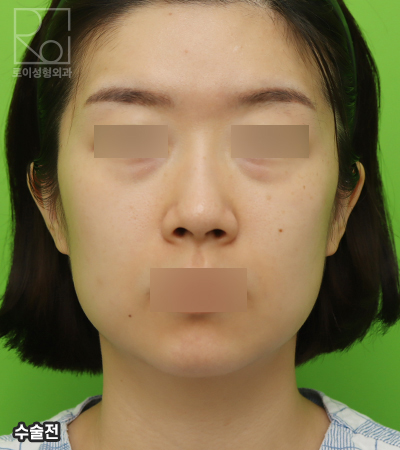
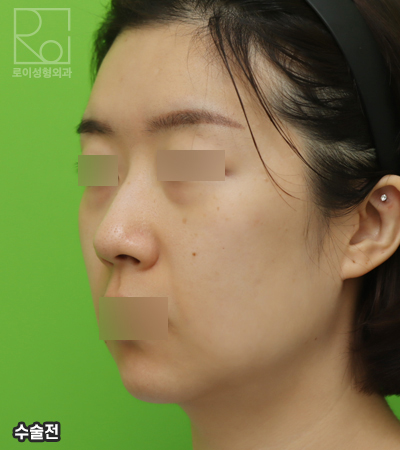
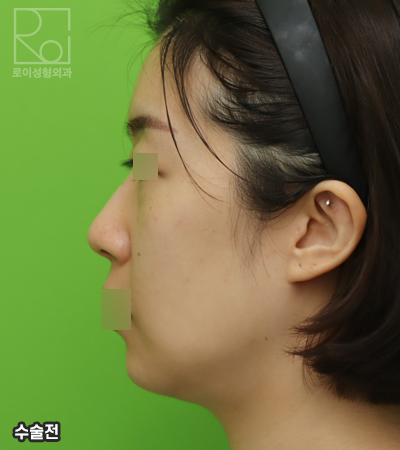
The location of the incision line is as follows.
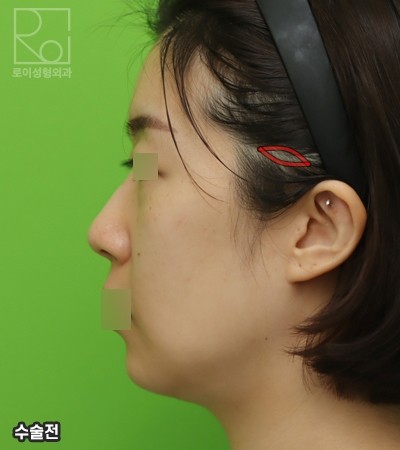
If the lifted tissue is left as it is,
the skin will become uneven and wrinkled.
To prevent this, some of the excess skin is removed from the hidden scalp area.
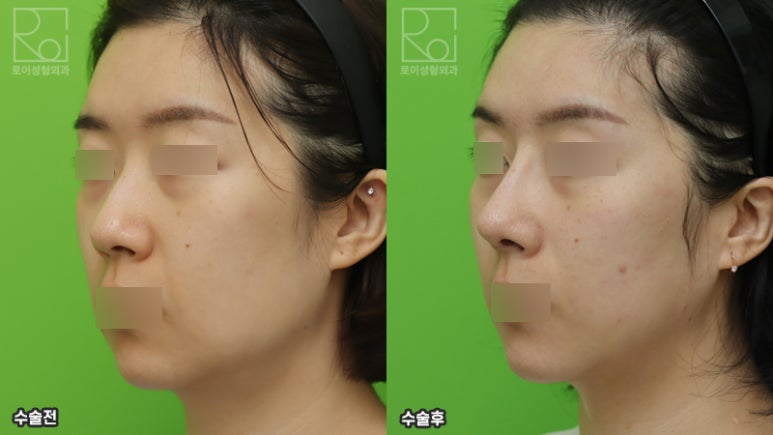
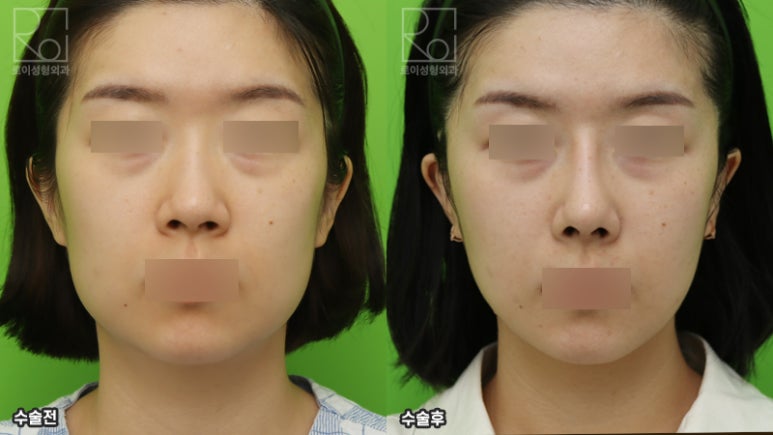
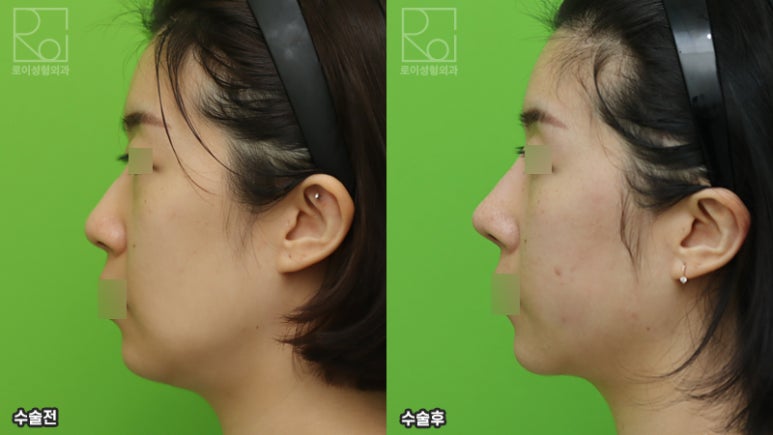
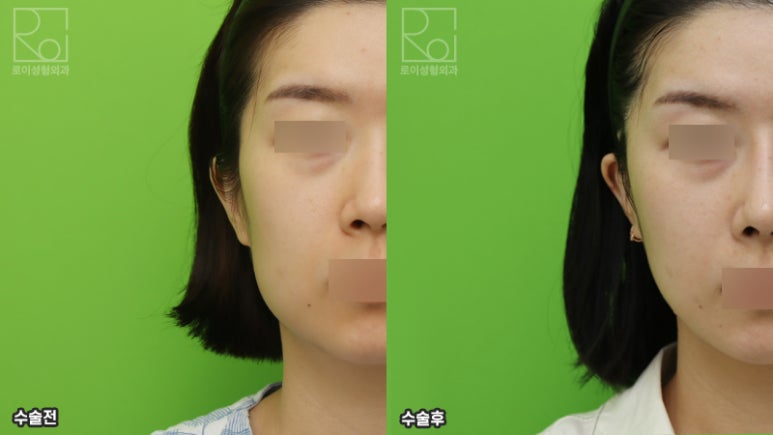
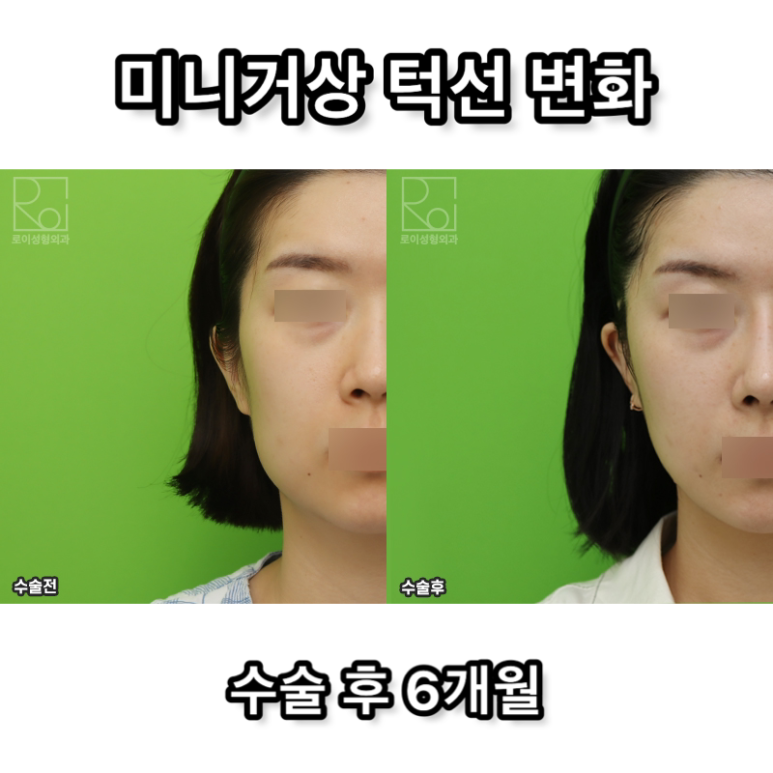
It is 6 months after surgery.
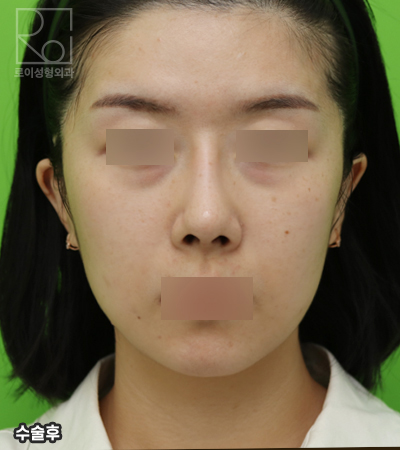
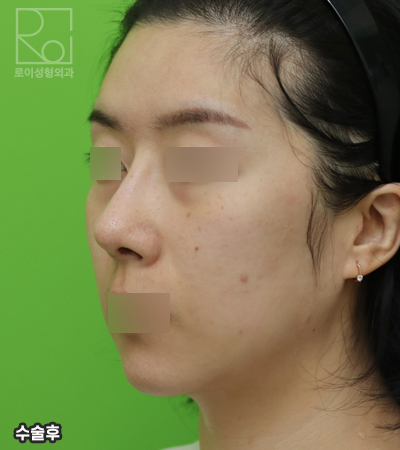
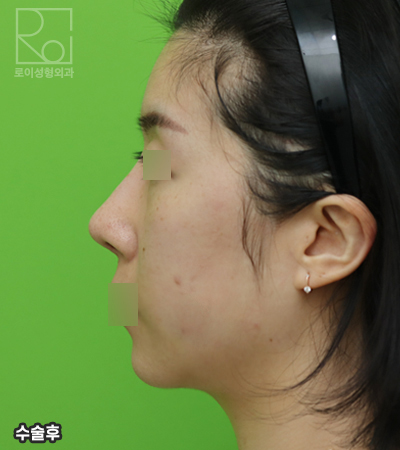
Here are the comparison shots.
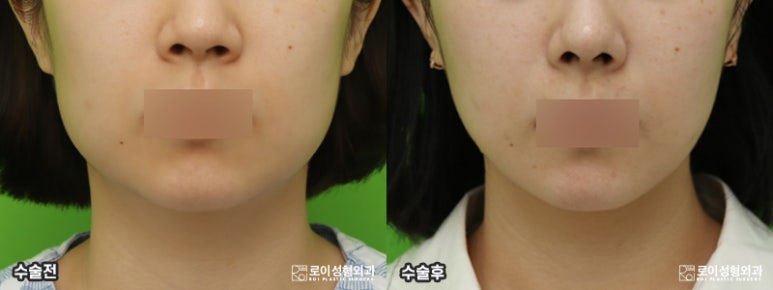
By the way, in the meantime she had revision rhinoplasty at the hospital where she had surgery before.
Her jawline became much slimmer and more refined,
so I asked whether she had lost a lot of weight...
But surprisingly,
she said she had actually gained weight. Haha.
We showed her the preoperative photos and the photos taken on the day of surgery side by side,
and left while both of us exclaimed how amazing the result was.
Before I finish, there is something I’d like to ask you to keep in mind.
The purpose of a mini facelift was, as mentioned earlier, to reduce scars, shorten recovery time, and lower costs.
The main goal should be to minimize the incision line and make it inconspicuous,
in other words, to keep the scar from being visible.
But sometimes, when people come for a consultation saying they had a mini facelift at another hospital and it had no effect,
and now want a full facelift,
I see cases where the incision line is almost as extensive as a full facelift...
If you are going to make the incision that long,
it is much better to just perform a proper facelift with the Deep Plane technique from the beginning.
If the result is poor
and the area to be dissected has become full of adhesions,
it is considered a revision surgery,
so the cost can end up being several times higher.
(Useful note: our zip-up lifting uses a different dissection layer,
so even when a facelift is performed later after zip-up lifting,
the difference in surgical difficulty is almost negligible.)
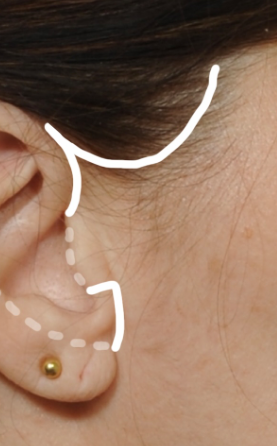
If you are told that a mini facelift will be performed along the white line shown here,
please think again.
It would be somewhat understandable if it were done only above the white line,
that is, only toward the hairline,
but doing a mini facelift with an incision that unnecessarily follows the line in front of the ear?
If you only pull the skin along that incision line without properly lifting the mobile SMAS layer,
the results will be disappointing,
and it is easy for ear shape deformities to occur.
Please think again.
You must not forget the purpose of a mini facelift.
The purpose is to minimize the incision line.
If you are going to choose a visible incision line, it would be better to have a full facelift instead!
If you want to read about a full facelift review with dramatic results,
-->
https://blog.naver.com/youngkeeyoumd/223379329569
Chat inquiries via Plus Friend: click the image below
Roy Plastic Surgery Clinic (Line 3, Sinsa Station)
Main phone: 02-516-5525
Weekdays 10:00 ~ 19:00
Saturdays 10:00 ~ 16:00
Roy Plastic Surgery complies with medical laws.
The photos in this post were taken under the same conditions,
and are images taken with the patient’s prior consent.
In addition, after plastic surgery and procedures, side effects such as bleeding, infection, and inflammation may occur depending on the individual, so caution is required.
#mini facelift price #mini facelift review #mini facelift side effects #mini facelift duration #mini facelift swelling #mini facelift scar #mini facelift cost #mini facelift effect #facelift #forehead lift #brow lift #mini facelift surgery #face lift #mini facial lift #neck lift #mini face lift #mini forehead lift #mini facelift operation #Gangnam mini facelift #facelift surgery #forehead lift surgery #mini lifting #lifting surgery #facelift surgery price #forehead lift surgery price #mini lifting price #facelift surgery review #lifting surgery #facelift surgery cost #mini lifting #neck lift surgery #facelift operation #facelift lifting #facelift cost #midface lift #facelift review #facelift surgery effect #best facelift clinic #mini lifting review #facelift price #facelift revision