Hello.
A doctor who teaches doctors
Board-certified plastic surgeon Yu Young-gi.
How exactly should you choose a clinic?
Is this clinic really experienced in under-eye hollow reconstruction surgery?
What if it doesn't improve even after surgery?
If you nodded even once to any of the above, you've come to the right place.
Among these, if the under-eye hollow was caused
by having had under-eye fat surgery in the past,
then you need a precise understanding of this situation.
You may think you just need to check reviews when choosing a clinic.
However, because people usually post only the surgeries that went really well,
there is no way to know whether consistently good results are being achieved every time.
I receive multiple inquiries every day through referrals from patients I've operated on,
but
I can't step out to do consultations in the middle of surgery, so the number of consultations I can do each day is limited.
And because I only perform a limited number of surgeries per day in order to maintain high surgical quality,
even when people want consultations, I can't always schedule everyone.
That is something I regret.
Even if you don't come to our clinic,
I'll tell you three ways to tell a good clinic apart.
First, the case I'll introduce today is
someone who had under-eye fat removal a few years ago and ended up looking even more sunken,
so they were considering revision surgery.
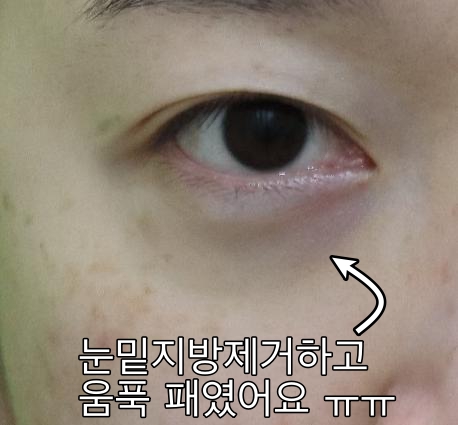
If the under-eye area is too puffy, it makes you look older,
and shadows form below the protruding fat, creating a tired impression.
On the other hand, if the under-eye area is too hollow, it can make your face look poor(?),
and sometimes the shadows created under the eyeball or aegyo-sal become even larger,
which can actually make you look darker.
Personally, I think surgery that does only under-eye fat 'removal' by itself
should be avoided whenever possible,
unless there is a very special case.
In special cases, such as Western patients whose orbital bone and cheekbone protrude,
and whose skin is very thin,
there are situations where 'removal' may be considered rather than 'repositioning.'
But in East Asian patients, given the usual bone structure,
it is difficult to get truly good results with fat removal alone.
Also, under-eye fat removal takes less than 10 minutes for both sides combined.
That is why the surgery fee is inevitably lower.
Because of these advantages, there are still people who seek it out,
but I do not perform under-eye fat removal as a standalone surgery at all.
Because it is a surgery with many side effects,
I don't have the confidence to handle the many complaints that can arise afterward...
When choosing a clinic,
if a doctor recommends only under-eye fat removal,
carefully ask whether there are any side effects,
and listen to an explanation that makes it clear why 'repositioning' was recommended instead of 'removal.'
Going back to the case,
this is a photo taken while looking straight ahead with a neutral expression.
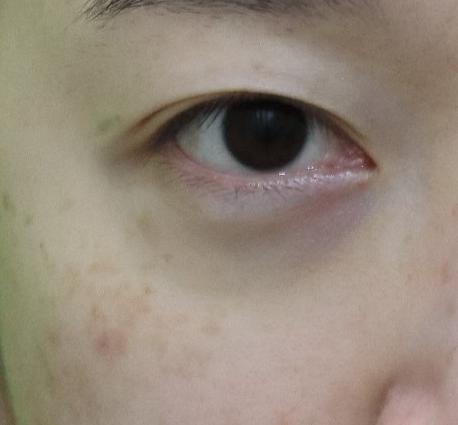
It is hard to tell that the fat under the eyes is protruding,
but it is easy to see that there is an unnatural hollow.
Next is a photo taken while smiling with the eyes.
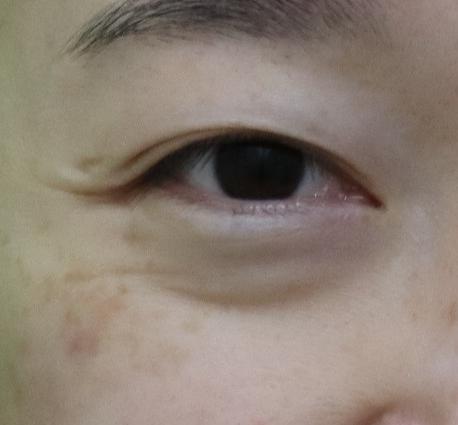
The natural aegyo-sal just below the eyelashes is coming out nicely.
But below that, do you see the fat that wasn't visible when the face was neutral protruding?
This is a common result after simple under-eye fat removal.
Recurrence is also common.
Strictly speaking, it's not really recurrence,
because it probably was never properly flattened in the first place.
Next is a photo taken while looking upward.
This photo is very important.
It makes it much easier to judge how much the under-eye fat is protruding
and how much volume there is.
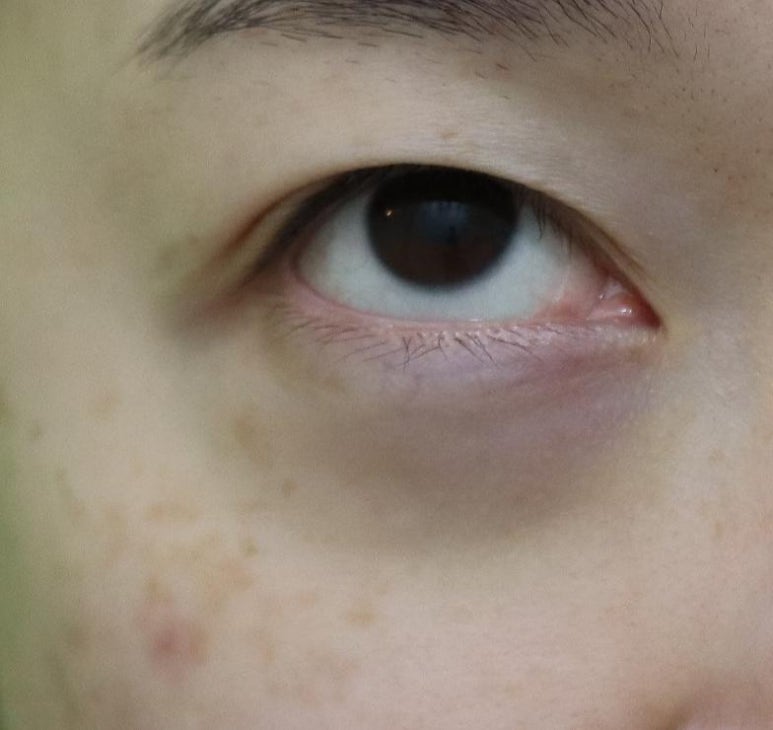
Again, the fat that was not very visible when looking straight ahead is confirmed to be protruding,
and you can also clearly see the shallow shadow underneath it.
When choosing a clinic,
check whether the doctor makes judgments based on eye movement during the examination.
As you can see in the photos, things that were not visible when looking straight ahead
begin to show as various muscles move, right?
Personally, I think this examination allows me to some extent
predict the surgical outcome, so I consider it very important.
This patient had been stressed for a long time because of the hollow under the eyes,
but at every clinic they visited for consultations,
they were told that surgery would be difficult and received a decision that surgery was not possible.
At one clinic, they were told that it could be improved with a simple filler,
so they spent nearly as much as the surgery fee on filler and radiofrequency treatment,
but it became even more uneven and unnatural,
so they had everything dissolved again and lived in a state of despair..
In fact, I also thought this case would not be easy,
so I discussed many things with the patient,
including the surgical method,
what could be improved,
what might not be improved,
and what surgical options were available.
First, we decided to carefully dissect and release the remaining fat as cleanly as possible
(this process is, in a sense, the most technically difficult part).
Then, after separating all the important tissues,
we planned to reposition them into the correct spaces and assess the shape,
and if necessary, perform fat grafting at the same time.
I do not perform under-eye fat grafting in the usual way.
Because the skin under the eyes is the thinnest in the human body,
using the standard method can easily make it lumpy,
and since multiple layers have already been dissected,
the fat is unlikely to stay where it is injected
and is more likely to flow along the empty dissected spaces.
That is why, after much research,
I developed a method to achieve better results.
First, the premise is to preserve the thin membrane (septum) surrounding the fat as cleanly as possible.
At this stage, we do not use the commonly used electrocautery device,
in order to dissect the tissue without damage.
And to achieve the result of septal reinforcement,
we reposition both the septum and the fat together.
As we perform this repositioning,
especially in revision cases, the fat mass itself is often irregular in shape,
so there are areas where fat is lacking in several places.
Rather than injecting fat grafts blindly based on finger sensation,
we inject while looking directly, and only up to an appropriate pressure inside the carefully preserved septum,
like a restaurant's secret know-how.
I have never seen it become lumpy,
and I often see results that are very flat and natural,
as if they had always been that way.
In this surgical method, simply preserving the septum cleanly with almost no damage
is itself highly advanced and directly affects the outcome.
I have shown this dissection method to many doctors
while teaching them the surgery,
but most of them could not easily move away from the methods they were already used to,
even when allowing a new technique..
As I was writing about the septum, a past episode suddenly came to mind.
One patient came back from a consultation at another clinic and said
that the doctor there had criticized it as nonsense fraud, asking how fat repositioning could be done without incising the septum, that is, while preserving the septum.
I asked the patient several times as well.
Was that person really a board-certified plastic surgeon?
I think I understand what that person meant.
In older surgical methods,
the septum surrounding the fat was incised and split open,
then the soft, protruding fat was removed and repositioned.
This is a very old surgical technique.
And while the level of difficulty is very low,
because it only fixes soft, flimsy fat,
firm fixation is difficult and the chance of recurrence is high.
Just because someone is experienced and has many years behind them
doesn't mean everything they do is good..
There is something I always warn revision patients about.
If the precious septum I explained to you has already been damaged too much during a previous surgery,
you need to lower your expectations for the surgical outcome a lot..
There are so many episodes like this that I may cover them again next time.
When choosing a clinic,
ask about the surgical method and how septal reinforcement techniques are used.
And if fat grafting is performed, ask how it is done.
Let's look at the comparison after surgery.
They came back for a one-month follow-up.
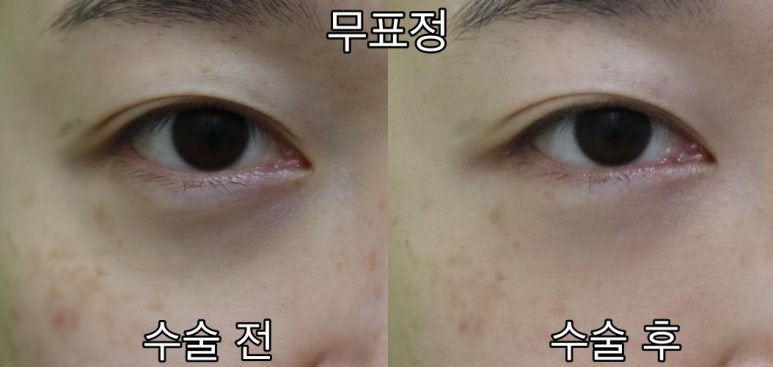
The under-eye hollow has improved a lot when the face is neutral.
The sunken feeling has also improved significantly,
and as a result, the dark shadow has become much less noticeable.
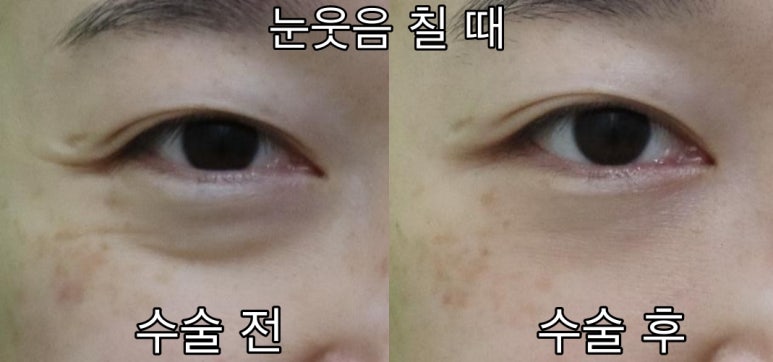
The fat that used to protrude beneath the eyes when smiling has become flatter.
This is closely related to the technique I mentioned above.
When separating the orbicularis oculi muscle, fat, septum, and so on from each other,
if they are separated as cleanly as possible without injury,
then when smiling, the orbicularis oculi muscle contracts and no longer drags the fat along with it.
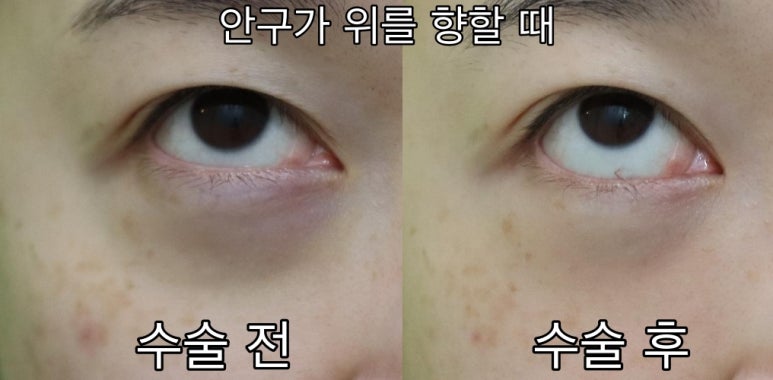
Even when the eyeball looks upward, the protruding fat is separated from the muscle,
repositioned into the hollow space below,
and at the same time, fat grafting was performed to improve the hollowed appearance as much as possible.
We had a brief Q&A session with the patient, who smiled brightly and said they were extremely satisfied.
Seeing how happy they were made me happy as well :)
Before I wrap up, the most important thing before surgery!
Considering the patient's facial structure, skin type, eye shape, and so on,
individualized, optimized procedures are important.
Recently, I have been doing a lot of research on how many cm from the bone's protruding point
it is best to pull and fix the fat.
I am currently applying for a patent for Roy's CT diagnostic method,
and I feel proud that these detailed elements are moving in a good direction,
helping raise surgical satisfaction. :)
▼ Plus Friend chat inquiry ▼

Roy Plastic Surgery complies with the Medical Service Act.
The photos in this post were taken under identical conditions,
and are images captured with the patient's prior consent.
Also, after plastic surgery and procedures, side effects such as bleeding, infection, and inflammation may occur depending on the individual, so caution is required.
#under-eye fat repositioning side effects #under-eye fat removal side effects #under-eye fat repositioning surgery cost #after under-eye fat repositioning surgery #under-eye fat repositioning review #under-eye fat repositioning swelling #under-eye fat repositioning pain #under-eye fat #under-eye fat removal #under-eye fat repositioning surgery #fat repositioning #under-eye fat repositioning price #under-eye fat grafting #under-eye fat repositioning laser #under-eye fat laser #eye fat repositioning #under-eye fat repositioning cost #under-eye repositioning #revision under-eye fat repositioning #under-eye fat repositioning precautions