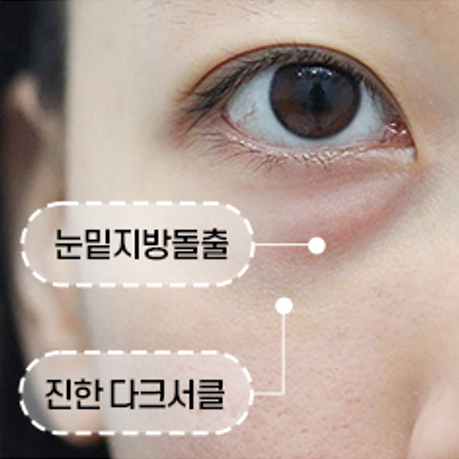
Hello.
I’m Yoo Young-ki, a board-certified plastic surgeon who focuses on rejuvenation surgery.
While filing my comprehensive income tax return this time, I found myself taking a close look at last year’s statistics.
Over the course of last year alone, I performed more than 700 lower eyelid fat repositioning surgeries.
Of these, there were only 6 complaints filed due to dissatisfaction.
Four of these were from patients who came in for follow-up saying they weren’t sure whether there had been any effect,
but after looking at the before-and-after photos,
they said they hadn’t realized it had been that severe before surgery..
they were so happy and left with big smiles. :)
Cosmetic plastic surgery does not produce 100% satisfying results for every patient.
Some people are 100% satisfied,
some are only 50% satisfied,
and some are dissatisfied because of side effects.
What I believe is the role of a plastic surgeon is as follows:
- Do no harm. (Do not harm the patient)
There should never be any recommendation for surgery when surgery is not needed.
- The results of most surgeries should be consistent,
and a certain minimum level of outcome should be guaranteed.
(In other words, skill matters.)
- During preoperative consultation,
the expected changes should be explained clearly so that the patient can understand them.
I have seen many patients who visited several clinics,
listened only to what the consultation manager said rather than the surgeon who would actually perform the operation,
and then came to expect unrealistic results.
For example,
claims such as, “The tear trough will completely disappear and become perfectly flat (?)”
All people do not get exactly the same result.
Dissatisfaction with surgery begins with unrealistic fantasies.
It is important for the patient to understand exactly what will improve
and what will not.
To help with this, I always take photos of the patient before consultation
and spend time analyzing them together.
Simply showing a mirror and saying, “Your dark circles will go away,”
can create unrealistic expectations.
No matter how well the surgery is done,
if the result is not what the patient expected,
disappointment is inevitable.
Many people come in for consultation with common questions about lower eyelid fat repositioning.
I have organized helpful information in an easy-to-understand way in this post before deciding on surgery.
For those encountering the term lower eyelid fat repositioning for the first time,
this concept may be unfamiliar.
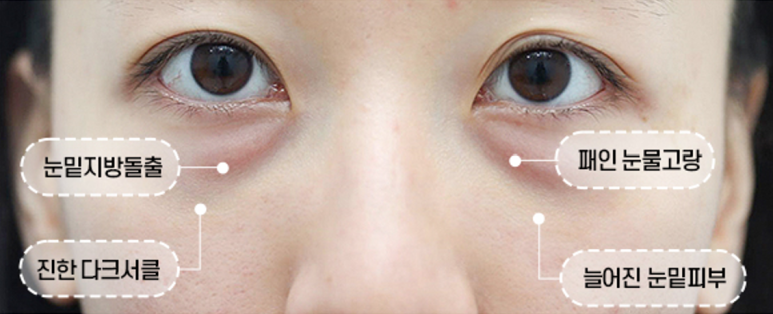
Lower eyelid fat repositioning surgery
is a procedure that improves dark circles and puffiness by flattening and repositioning the protruding fat under the eyes.
In other words, it is very effective at brightening the dark area under the eyes
and improving a tired appearance.
It also helps when bulging fat makes you look older;
once that area is flattened, you naturally look younger.
One thing to be careful about here is
that fat repositioning and fat removal
are completely different procedures.
Fat removal is a simple procedure that takes less than 10 minutes,
but it has many side effects.
I will cover the differences between the two procedures in detail in the next post.
Q) Why is lower eyelid fat repositioning surgery necessary?
As we age, the fat under the eyes becomes more prominent as the skin loses elasticity,
and the septum surrounding the fat gradually loosens,
so it can no longer withstand pressure and begins to bulge under the eyes.
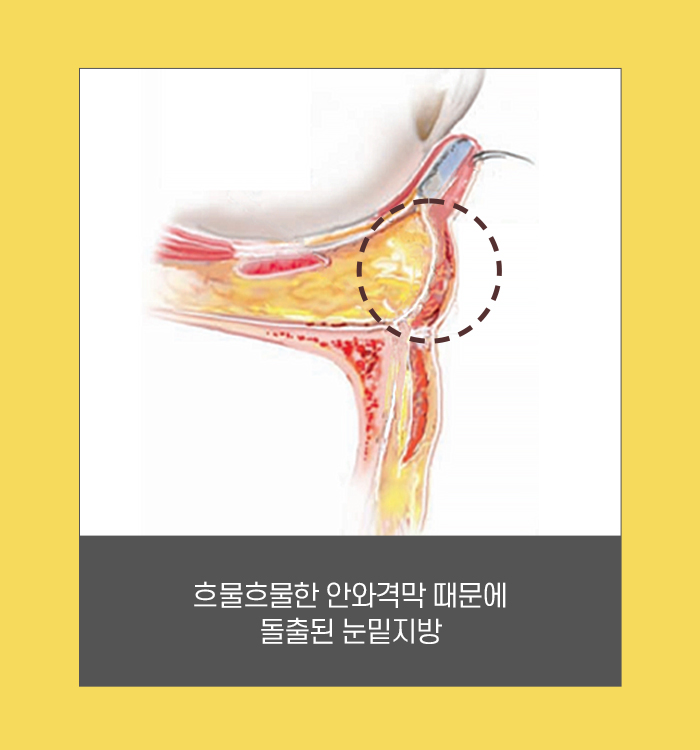
Because light usually shines from above,
shadows form beneath the protruding fat, making dark circles stand out more.
This can give a tired
or aged appearance.
Lower eyelid fat repositioning surgery
improves these issues,
helping restore a younger and healthier impression.
Q) Is there anything to prepare before surgery?
- Consultation and evaluation:
Consult with a board-certified plastic surgeon to evaluate the under-eye area,
and discuss whether surgery is necessary and what results can be expected.
At this time, you should explain your health condition, allergies,
and any medications you are taking in detail.
If you live far away or overseas and it is difficult to visit temporarily,
you can send photos, and the expected effect of surgery can be assessed based on those photos.
- Stop taking medications:
Aspirin, certain anti-inflammatory drugs, vitamin E, and similar supplements
should be stopped for a certain period before surgery.
This is to reduce the risk of bleeding.
If there is less bleeding during surgery,
it also helps reduce bruising and swelling afterward.
- Preparation the day before surgery:
Rest sufficiently the day before surgery,
and on the day of surgery, after a light breakfast,
maintain a 6-hour fast.
Q) How is the surgery performed?
Lower eyelid fat repositioning surgery
is performed through a relatively simple procedure.
The surgery is usually done under sedation anesthesia.
Local anesthesia is also possible, but
some nerves connected to fat pockets are located deep in the eyeball,
so local anesthesia is difficult.
At that time, you may feel an unpleasant pain,
as if the eyeball is being pulled out,
so sedation anesthesia is recommended.
During consultations, some patients have already researched the surgical technique extensively
and often ask what kind of technique is used.
The surgical method is as follows.
- Incision:
A small incision is made on the conjunctival side inside the eyelid (the invisible area on the opposite side of the skin).
This helps avoid leaving an external scar.
- Separation of the skin, orbicularis oculi muscle, and fat pad:
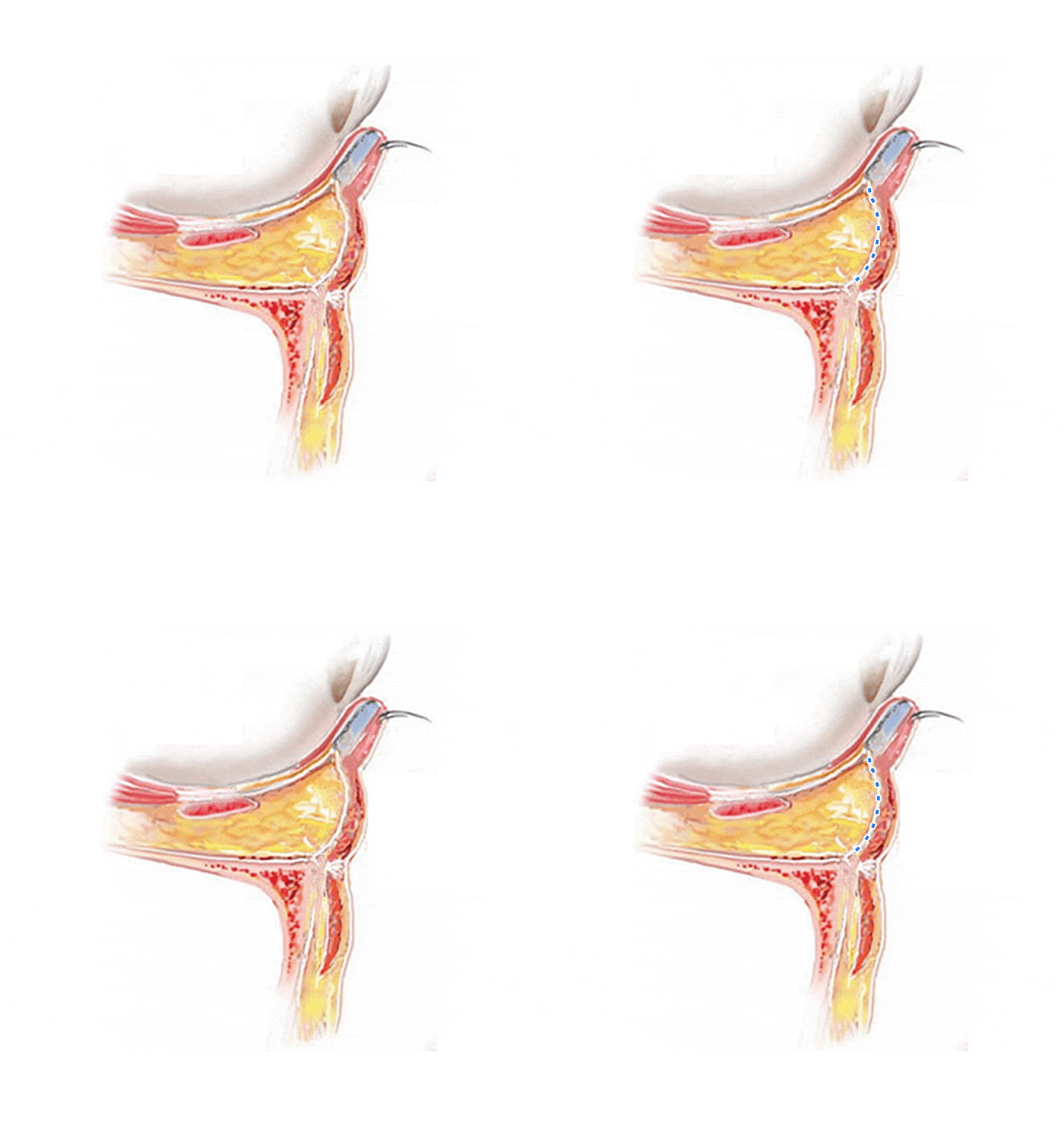 The skin, orbicularis oculi muscle, and fat pad are arranged in layers by depth.
The area between the orbicularis oculi muscle and the fat pad, marked by the blue dotted line, is carefully dissected.
If the so-called aegyo-sal becomes abnormally large when smiling, it is caused by strong adhesion in this area,
and when dissecting this space, it is important to preserve the septum surrounding the fat as much as possible.
At this stage, electrocautery should not be used so that unnecessary damage is prevented and the separation can be done cleanly.
- Creating space for fat transfer:
The boundary where the tear trough ligament meets the orbital bone is incised and dissected
to create space for moving the fat.
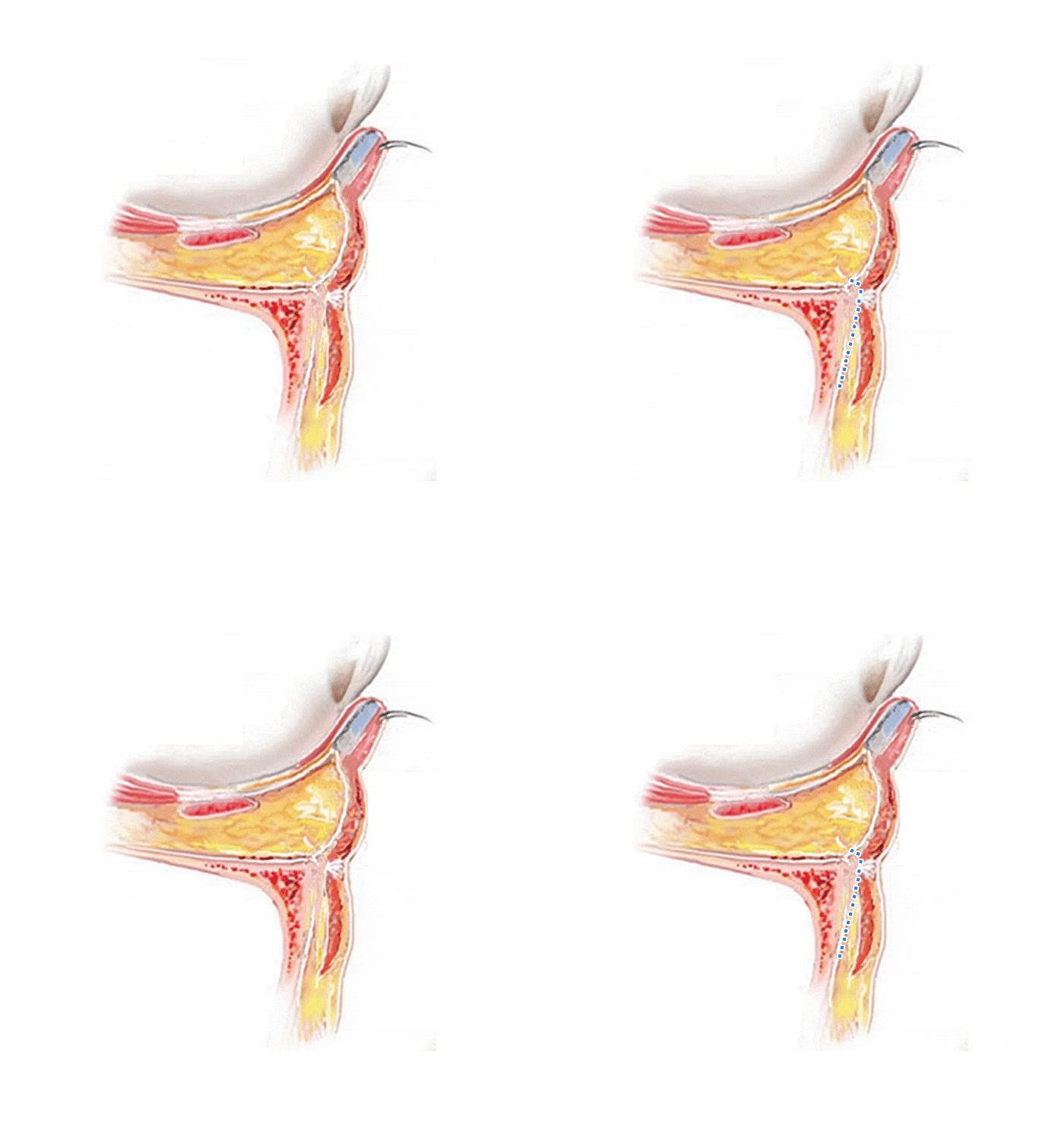 I prefer placing it close to the bone (subperiosteally).
For people whose skin and underlying tissue are thin,
it is easier to achieve a smooth result
when it is placed in the deepest possible layer.
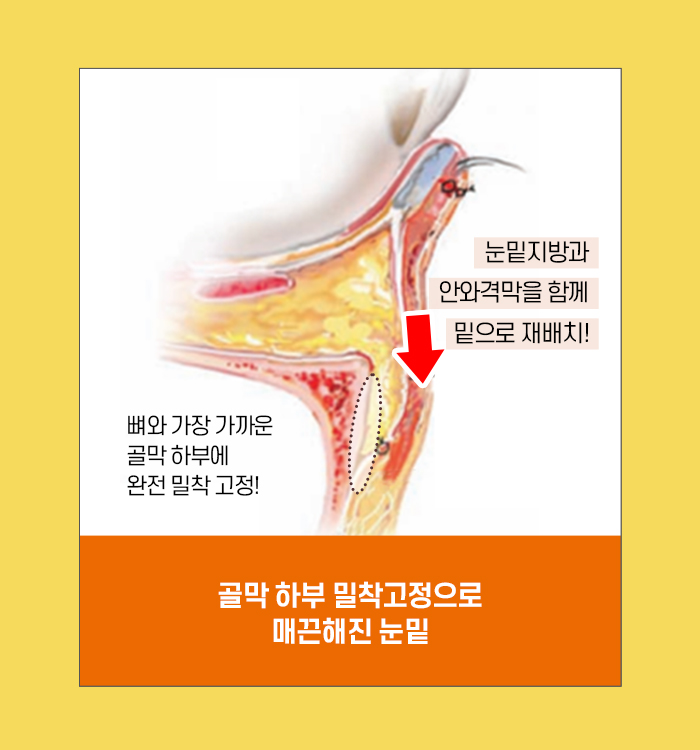
Another method is to avoid dissecting beneath the periosteum
and instead create a space in the muscle layer above it
to reposition the fat.
This method is easier to dissect and shortens the surgery time,
but for people with very thin subcutaneous tissue,
if the fat is placed this shallowly, the bulge may remain visible,
so I do not prefer this method.
- Preparing for fat repositioning:
I do not simply reposition the fat as soon as the space is created.
If everyone is moved according to the same formula, a hollow under the eyes can easily occur.
Since the shape and size of the orbital bone, the amount of under-eye fat, and other factors differ from person to person,
a customized approach is important.
I simulate repositioning from several angles in the dissected space
to determine the most appropriate direction and distance of movement.
I double-check by comparing the space and movement distance calculated on CT.
The diagnostic method for selecting the optimal repositioning position is currently pending patent application.
- Moving the fat pad:
If there is resistance when moving the fat pad,
I release it through small amounts of dissection.
This step is easy to overlook, but it is very important.
The key is a surgical technique that relieves resistance while preserving the septum.
If the resistance is left in place and the tissue is pulled the other way,
the muscles responsible for eyeball movement can be excessively compressed,
which may cause double vision.
At this time, leaving a little fat just below the under-eye area helps prevent later hollowing.
Although it looks simple, there are many points to consider during surgery.
- Fat repositioning and fixation:
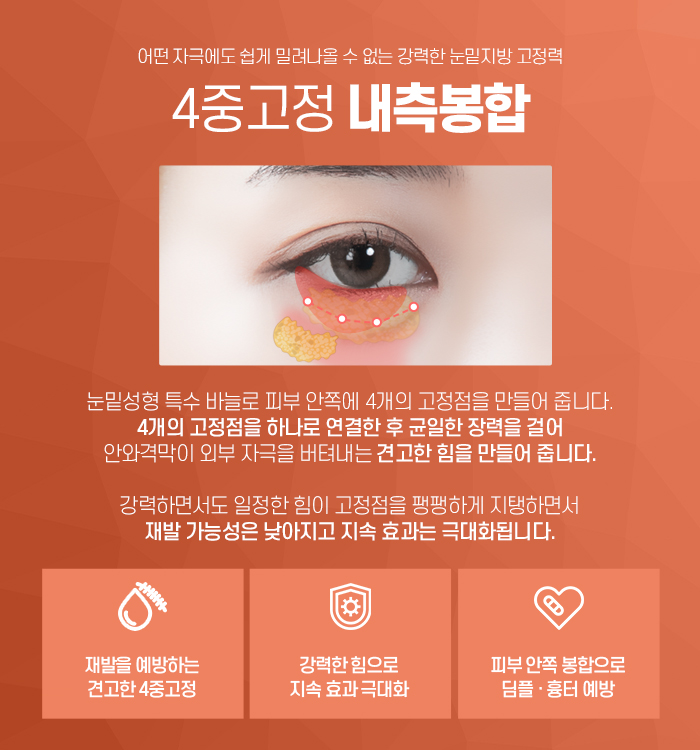
After repositioning the fat, it must be secured.
I use absorbable sutures to tie knots in the deep inner space.
Using the lower eyelid four-point fixation method I developed, I perform continuous suturing
so that the tension is distributed evenly.
Because the knot is placed internally, stitch removal is not necessary.
For reference, there is also a method in which the sutures are brought out and removed within 7 days,
but this has many side effects.
In particular, pus can easily form when removing the sutures,
and since it takes 3–4 weeks for the fixed fat to form firm adhesion,
removing the sutures before then increases the risk of recurrence.
- Additional fat grafting:
If there is too little fat compared with the hollow shape of the bone,
under-eye fat grafting can be performed at the same time.
This varies from person to person.
A commonly known general fat grafting method is,
because it relies on the sensation of the opposite-hand fingers,
a blind technique, so precision is lower.
That is why, when I perform under-eye fat grafting,
I use a more precise method.
Fat is injected into the pouch (septum) surrounding the fat,
so that it swells evenly,
like a balloon inflating.
This method has a high survival rate and helps prevent unevenness.
However, to use this method,
you need to know how to preserve the septum as much as possible during the separation of the orbicularis oculi muscle and the fat.
In other words, the surgeon’s technique is extremely important.
- Suturing:
Suturing the conjunctival incision is not always necessary.
If it is sutured too meticulously,
the drainage pathway can become blocked and swelling may worsen,
and if it is not sutured clearly and precisely,
side effects such as entropion can occur,
so in some cases it may be better not to suture at all.
However, in exceptional cases where there is an underlying condition
or concern about infection,
the surgeon may decide to close it with absorbable sutures.
Q) What is the recovery process after surgery?
The recovery process after surgery varies from person to person, but generally follows these steps:
- Immediately after surgery:
After surgery, swelling and bruising may occur,
and there may be swelling around the eyes and some mild pain.
This is part of the natural recovery process,
and most of it subsides within 1 to 2 weeks.
- Medication management:
Take the prescribed medications after surgery,
and use ice packs if needed to reduce swelling.
Cold compresses are especially important during the first 48 hours after surgery.
- Activity restrictions:
For at least 1 week after surgery,
you should avoid strenuous exercise or activities that strain the eyes.
In particular, avoid rubbing the eyes or wiping them forcefully.
- Additional care:
Most daily activities can be resumed after 2 weeks,
but complete recovery may take about 4 to 6 weeks.
In particular, strenuous exercise or activities that may raise intraocular pressure
are best done after 4 weeks.
Q) Are there any side effects to watch out for?
Lower eyelid fat repositioning surgery is considered a relatively safe procedure,
but all surgeries can involve side effects and risks.
Side effects to watch out for include:
- Infection:
An infection can occur at the surgical site,
and it can be treated with antibiotics.
- Bleeding and bruising:
Bleeding or bruising may occur,
and these usually go away naturally over time.
- Asymmetry:
After fat repositioning under the eyes, left-right asymmetry may occur,
but in most cases the asymmetry that was already present
becomes somewhat more balanced,
though it is often not perfect.
- Persistent swelling:
Swelling may last longer than expected,
and this can vary depending on each person’s recovery speed.
- Temporary double vision:
Unless a mistake is made and a muscle is cut during surgery,
permanent double vision does not occur.
However, when swelling develops, the muscle that moves the eye downward may not function smoothly,
which can temporarily cause double vision (seeing two of the same object),
but on average this improves within about a week.
Q) How should I care for myself after surgery?
To maintain successful surgical results and aid recovery, postoperative care is very important:
- Keep the area clean:
Keep the surgical area clean,
and disinfect it as instructed.
- Get adequate rest:
Get enough rest and avoid stress.
Also, when sleeping, keep your head elevated to reduce swelling.
- Regular checkups:
Check your condition through regular clinic visits after surgery,
and if there is any problem, consult a specialist immediately.
Lower eyelid fat repositioning surgery is an effective way to restore youthfulness
and vitality around the eyes.
However, for successful results, preoperative preparation and
postoperative care are very important.
Through sufficient consultation with a board-certified plastic surgeon,
it is necessary to clearly understand your own condition and expectations,
and make a careful decision.
To regain a healthy appearance and confidence,
lower eyelid fat repositioning surgery can be a good option.
▼ Plus Friend chat inquiry ▼
Roy Plastic Surgery complies with the Medical Service Act.
The photos in this post were taken under the same conditions,
and were taken with the patient’s prior consent.
In addition, after plastic surgery and procedures, side effects such as bleeding, infection, and inflammation may occur depending on the individual, so caution is required.