Hello.
I’m Yoo Young-gi, CEO and lead surgeon at Roy Plastic Surgery Clinic.
Today, I’d like to share the before-and-after story of a woman in her late 40s who underwent a facelift and deep plane neck lift (double chin contouring surgery).
This patient runs a sizable food business and is, quite literally, a very successful entrepreneur.
Even after trying to lose weight amid her busy daily life, the double chin under her jawline did not improve at all.
In the end, she came to our clinic.
Concerns Before Visiting the Clinic
Even though her weight had decreased, her facial line did not change much, and the remaining fullness under her chin was her biggest concern because it made her look older.
As someone who meets many people and is photographed often for work, she cared a great deal about managing her image and desperately wanted a natural, defined jawline.
She had already looked into various procedures said to be well known both in Korea and abroad, and had even considered laser treatments or thread lifting as a way to solve the problem in a short time.
However, she decided that surface-level procedures had limits when it came to addressing sagging around the cheeks and jaw area, which had been losing firmness over time, and chose a deep plane facelift and neck lift for a more fundamental change.
Preoperative Condition
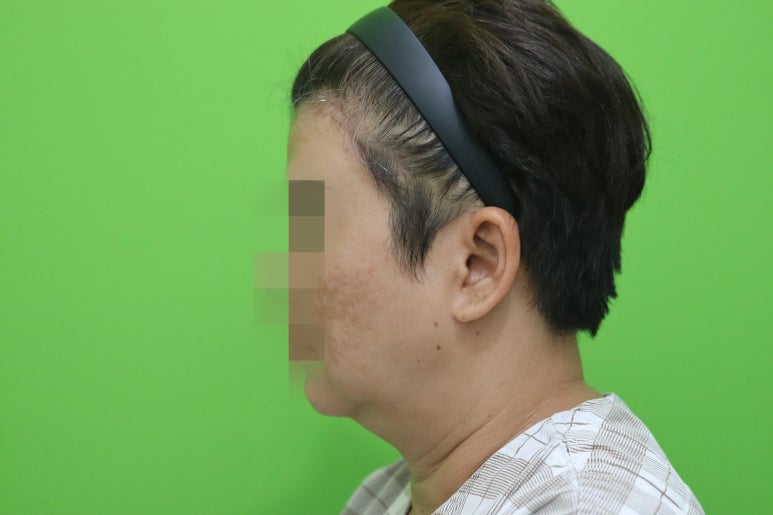
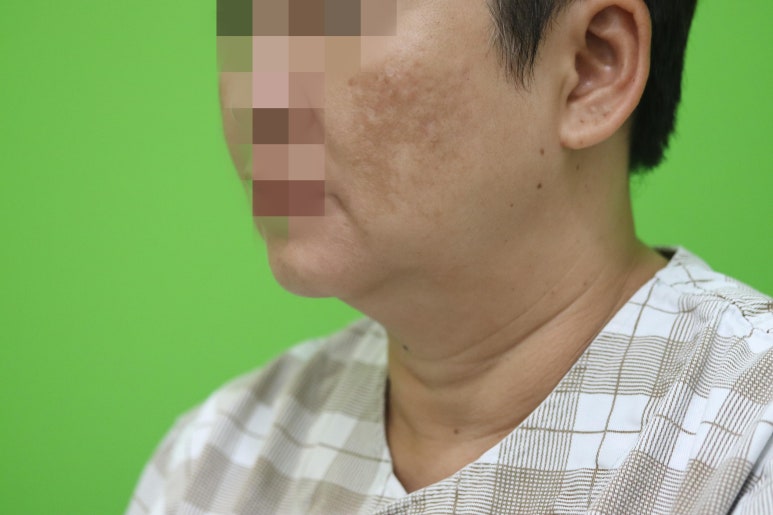
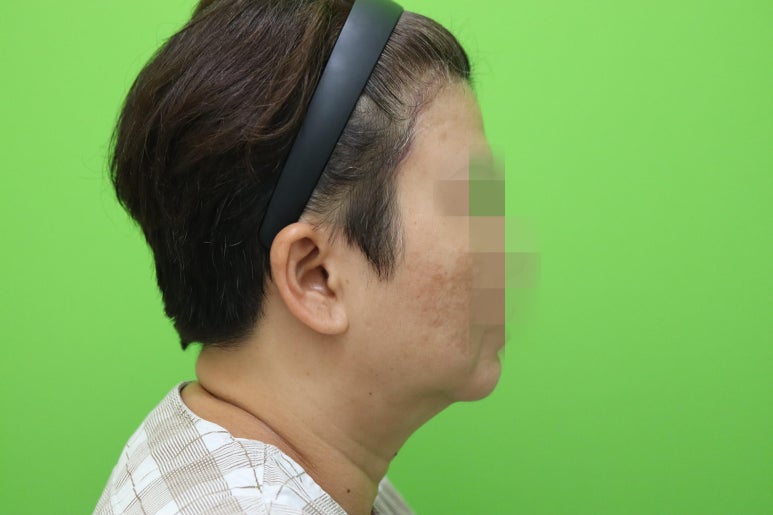
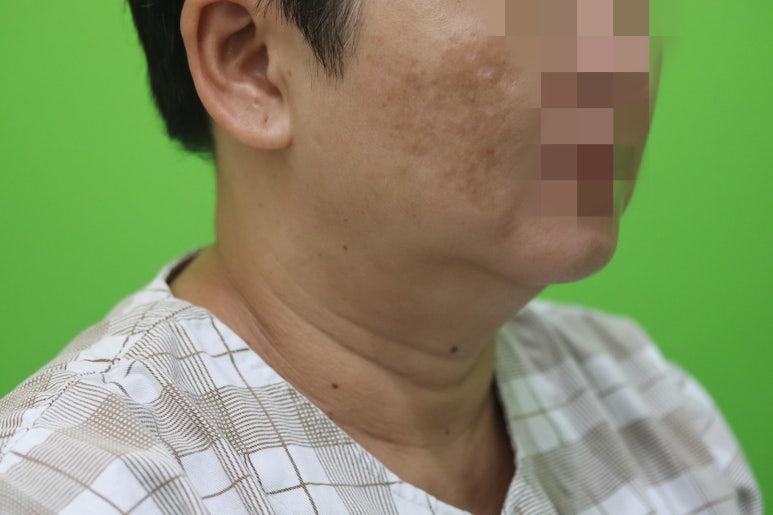
From the preoperative photos,
what stands out most is the blurred jawline and the appearance of fullness gathered under the chin in the side view.
She wanted her face to look generally slimmer, but the double chin in particular had remained stubbornly unchanged.
In addition, the cheeks (deep cheek fat) had slightly sagged downward,
adding weight beneath the cheekbones and making the facial contour less defined.
Meanwhile, as she had entered her late 40s, the natural aging changes that occur at this stage were also progressing, so areas of reduced elasticity were visible throughout the face.
This can make the face look heavier,
which may make someone appear older than their actual age.
Surgical Plan
(1) Deep Plane Facelift
A facelift involves making incisions around the front and back of the ears,
removing loose skin and the fascia layer (SMAS layer),
and lifting and securing the tissue that has lost elasticity back into its proper position to create a sharper, more youthful facial line.
When a patient like this one wants to improve overall contour along with sagging cheeks, a facelift is effective.
There are many different facelift methods,
but the most technically difficult method with excellent results is the deep plane technique.
Deep plane literally refers to the “deep layer.”
Deep layer of what?
It refers to the deep layer of the SMAS, widely dissected to release resistance and then lifted.
• Incision placement: Planned around the ears and along the hairline as much as possible so it would not be noticeable
• Tissue refinement: Lifting the sagging muscle and fascial layer (SMAS), and removing excess skin or fat
• Suturing and fixation: Careful suturing so the result can heal smoothly and naturally
(2) Deep Plane Neck Lift (Double Chin Contouring Surgery)
This is a procedure that goes one layer deeper than a standard neck lift,
which only addresses the subcutaneous layer and the platysma muscle.
It safely approaches a layer deeper than the platysma muscle,
sculpting and improving the double chin and neck line.
A common misconception is that the fullness under the chin is just fat.
But in reality, that is often not the case.
Unless someone is truly overweight,
there is less fat than people expect.
The 3-part set I’ll mention below is already in place like a framework,
and in some cases enlarged lymph nodes are also involved.
There are various possibilities.
• Deep Plane approach:
Rather than only addressing the subcutaneous layer directly beneath the skin,
this approach reaches the deep layer of the platysma,
sculpting the 3-part set that determines the double chin.
The 3-part set simply refers to the salivary gland, fat, and digastric muscle.
To explain further:
- An enlarged submandibular salivary gland that has sagged below the level of the hyoid bone,
- Grapelike double chin fat that cannot be removed by standard liposuction,
- And an enlarged digastric muscle that has little to no original muscle function even if it is resected
Safely and definitively removing these three elements is the only way to improve satisfaction with the surgery.
After that, additional necessary steps are taken as follows:
• Neck fat refinement:
Removing remaining unnecessary fat to create a smooth contour (standard liposuction)
The fat referred to here is subcutaneous fat.
In other words, it is the fat located above the platysma muscle.
The important thing is that as people get older, the amount of this fat decreases.
The double chin gets worse, yet the amount of fat decreases?
It’s surprising.
What is even more surprising is that as people age,
the amount of grapelike fat located deeper than the platysma layer
tends to increase instead.
• Restoring the boundary between the jawline and neck:
By lifting the sagging platysma muscle, the jawline becomes more prominent in side view or at a 45-degree angle.
The commonly mentioned double chin muscle tying technique is the basic version (the standard midline tying method).
In addition, Roy’s specialized technique,
the outer double chin muscle tying method,
pushes the tissue beneath the jawline firmly inward,
helping create a more defined shadow under the jawline.
In other words, it clearly restores the boundary between the face and neck.
Changes After Surgery
Right after surgery, swelling and bruising can appear, of course,
but because the patient needed to leave for an overseas business trip again in a short period of time due to her schedule,
she underwent an intensive management program.
As a result, the swelling had subsided significantly by the second week,
and around the third week she had recovered quickly enough to handle overseas travel without difficulty.
Before-and-After Photo Comparison (Before & After)
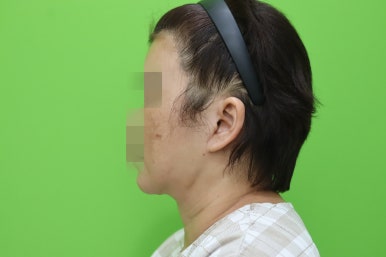
The patient returned after 1 year and 1 month (13 months).
This time, she came because she wanted a revision rhinoplasty.
Since these were taken when she came for nose surgery,
she was wearing surgical clothing, which may be confusing.
Left: before surgery,
Right: photo taken 1 year and 1 month after surgery.
If you look closely, you can see how much the position of the dot has been lifted,
and I think it would also be helpful to check how visible the scar is in the enlarged photo.
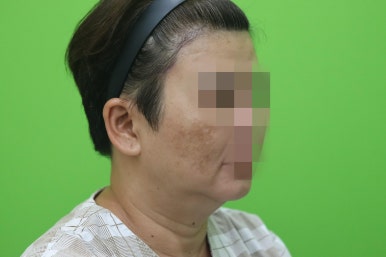
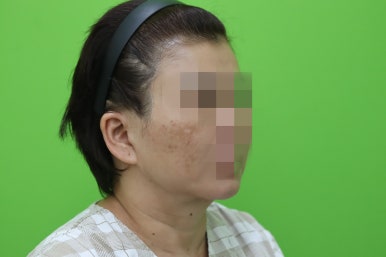
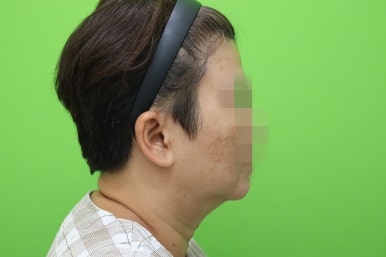
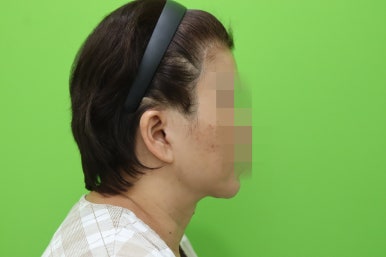
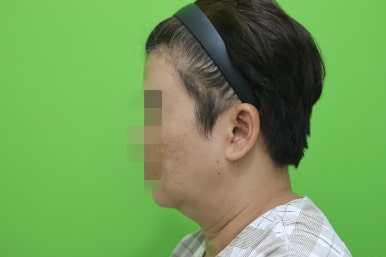
• Before:
The double chin stands out, making the side profile look heavy,
and mild sagging of the cheeks has progressed, making the jawline look less defined.
• After:
The cheeks and jawline, lifted in line with the incision around the front and back of the ears,
look much sharper than before,
and the neck area also appears flatter, making the face look slimmer overall.
As if lifting a head resting on the shoulders,
the neck and jawline became clearly defined,
making her image as a business owner look cleaner
and more refined.
The patient was very satisfied, saying, “It feels like my face has become lighter even though I didn’t lose more weight,”
and she said that people around her told her she looked “more passionate and more energetic.”
Recovery and Care Tips
• Up to 1 week after surgery:
This is the period when swelling and bruising are at their worst,
so it is advisable to use a compression bandage according to the clinic’s instructions along with cold compresses.
• Sleeping posture:
To minimize swelling,
a slightly elevated head position (using about two stacked pillows) is recommended.
• Light stretching:
Within a range that does not strain the neck or jaw,
simple stretching that helps blood circulation can be helpful for recovery.
• Other lifestyle habits:
It is best to refrain from smoking, drinking alcohol, and excessive exercise or sauna use for at least one month.
This case involves a woman in her late 40s who wanted to fundamentally improve the firmness of her face and neck line,
and who achieved good results through a facelift and deep plane neck lift.
Problems such as a double chin, neck wrinkles, and sagging cheeks that become concerns in middle age are often not solved simply by losing weight;
in many cases, structural changes in the skin and fascia layers are important.
Like this patient, who is active as a business owner,
if you are someone who needs to manage your image or wants to invest steadily in yourself,
it may be worth consulting a specialist at least once to create a customized surgical plan.
I always strive to put safety first
and to provide natural results with a high level of satisfaction.
I will continue to share more cases and useful information,
so if you have any questions, please feel free to contact me anytime.
Thank you for reading this long post.
https://blog.naver.com/youngkeeyoumd/223717306858
Click the image below to inquire via Plus Friend chat
Roy Plastic Surgery Clinic (Line 3 Sinsa Station)
Main phone number: 02-516-5525
Weekdays 10:00 ~ 19:00
Saturday 10:00 ~ 16:00
Roy Plastic Surgery Clinic complies with the Medical Service Act.
The photos in this post were taken under the same conditions,
and were taken with the patient’s prior consent.
In addition, after plastic surgery and procedures, side effects such as bleeding, infection, and inflammation may occur depending on the individual, so caution is required.