Hello.
I am Yoo Young-ki, the chief director of Roy Plastic Surgery Clinic.
Today, I’d like to introduce the case of a woman in her mid-50s who received treatment for a keloid scar that developed after facelift surgery at another hospital.
This patient underwent facelift surgery.
At first, there seemed to be no problem at all, but about one year after surgery, the scar gradually began to grow, and by the second year it had become quite large, to the point that it caused inconvenience in daily life.
The issue was that she lives in the United States, and treatment costs there were so high that she could not receive treatment. Then, when the opportunity came, she came to Korea for treatment.
What is a keloid scar?
A typical scar is a normal tissue change that occurs during the wound-healing process,
but a keloid is a scar in which collagen excessively proliferates even after the wound has healed, spreading beyond the surrounding normal skin area.
Unlike ordinary scars, it appears red and raised, and may also be accompanied by itching and pain.
In particular, constitutional factors play a major role, so people who are prone to keloids must be especially careful because even a very small wound can spread significantly.
When undergoing facelift surgery or other procedures, if the incision has high tension due to a surgical method that strongly pulls the skin rather than a deep-plane method that strongly lifts the SMAS layer,
the likelihood of keloid formation may increase.
In this patient as well, there did not seem to be any particular problem immediately after surgery, but around one year later, she said she felt as though the scar was gradually becoming more raised.
At first, the patient thought the scar was just turning red and slightly protruding, and that it would improve with light massage or ointment treatment.
However, as time passed,
the scar gradually became harder and larger,
and by around two years later,
it had swollen to the point that it was difficult to conceal even with makeup, interfering with daily life.
Because she is a very active person with many social interactions,
she came in saying that the visible scar on her face had lowered her confidence and caused significant stress.
She had received consultations at other hospitals several times, but because the scar had already become quite large, she was told that treatment would not be easy, and eventually she came to our clinic.
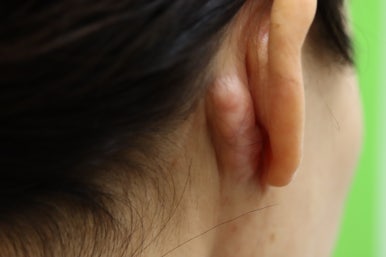
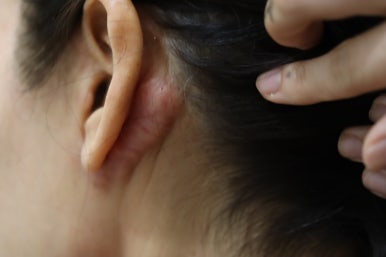
As shown in the photos, she visited us with severe keloids behind both ears,
with the left side being worse.
The left side was also affecting the cheek area in front of the ear.
Treatment plan: surgery + injection therapy
With keloids, simply cutting out the scar tissue has a high risk of recurrence.
Also, keloids that have entered a major proliferative phase, like in this patient, require various additional treatments along with surgical excision to prevent recurrence.
Surgical removal
First, the enlarged keloid tissue is excised as precisely as possible.
To reduce tension around the incision line,
if necessary, the skin around the scar is repositioned or the suturing method is carefully adjusted.
Since this is the face, cosmetic considerations must also be handled with care,
so the incision line is designed to be as inconspicuous as possible.
Injection therapy
After surgery, steroid injections or 5-FU injections are administered periodically to suppress keloid formation.
To prevent the scar from proliferating again,
we carefully observe it at regular intervals and provide additional injections when necessary.
Such injection treatment is very important for lowering recurrence, and it should be started immediately after surgical removal.
Comparison of before-and-after photos
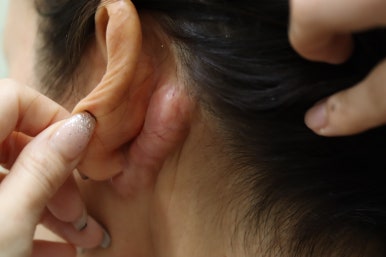
Keloids behind both ears before surgery
Before surgery:
Red, firm, swollen keloid tissue extended from behind both ears to the earlobes,
clearly visible even from a distance.
The patient complained of pain and itching caused by the scar,
as well as visual stress.
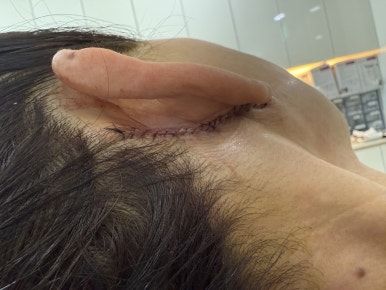
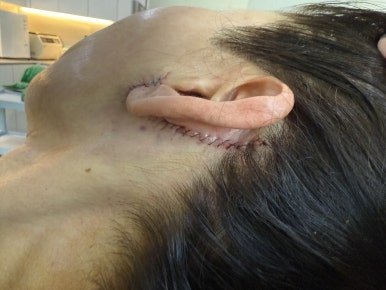
Immediately after keloid removal surgery following facelift surgery
After surgery:
The greatly swollen scar was removed,
and the area became flatter with a significantly reduced level of tension.
Steroid and 5-FU injections were administered to the area in parallel,
and so far it has been maintained without recurrence, with a natural-looking scar line.
We did perform the surgery in Korea first,
but at the patient’s request (due to her residence in the United States),
the remaining suture removal and follow-up injection treatment were arranged to be carried out in the United States
using my treatment plan and medical opinion letter.
The patient said she regretted not taking active measures from the beginning,
and after the large scar was removed, she was very pleased to say that she felt much more at ease in social situations as well.
Tips for preventing and managing keloid scars
The most important thing is that, when performing facelift surgery,
the technique must not involve pulling the skin too tightly upward and then suturing it.
The effect of a facelift
is absolutely not improved by removing more skin.
Skin tension should be minimized to reduce scarring,
and the key is how properly the underlying SMAS layer is lifted, not the skin itself.
However, what should patients do, in addition to the medical team?
The following:
Early detection & treatment:
If the scar becomes red or begins to protrude after surgery,
do not dismiss it as insignificant and consult the medical team right away.
If action is taken early, improvement can often be expected with simple injection treatment.
Scar protection:
After a facelift, the incision line is wide and skin tension tends to be relatively high,
so it is advisable to consistently use scar-protection tape or silicone gel made specifically for scars in the early stage.
Lifestyle habits:
Avoid strong massage or UV exposure that may irritate the scar area,
and manage it with sufficient moisturizing and sun protection so that the scar area is not stimulated.
Consider constitutional factors:
If a keloid-prone constitution is suspected,
before undergoing any procedure or surgery that may cause a skin wound,
please consult a specialist in advance and consider ways to minimize the risk.
In cases like this patient’s, where a keloid develops after facelift surgery,
it is very, very rare,
but once it occurs, treatment is difficult and the chance of recurrence is high.
Therefore, patients who suspect a keloid should not delay, even if the area seems only slightly red or raised, and should definitely consult a specialist.
We will continue to share better information and treatment reviews.
If you have any questions, please feel free to contact us anytime.
Below is an article about facelift scars.
https://blog.naver.com/youngkeeyoumd/223385451505
Plus Friend chat inquiries: click the image below
Roy Plastic Surgery Clinic (Sinsa Station, Line 3)
Main phone: 02-516-5525
Weekdays 10:00 ~ 19:00
Saturday 10:00 ~ 16:00
Roy Plastic Surgery Clinic complies with the Medical Service Act.
The photos in this post were taken under the same conditions,
and are images captured with the patient’s prior consent.
In addition, after plastic surgery and procedures, side effects such as bleeding, infection, and inflammation may occur depending on the individual, so caution is required.