“When your jaw makes a ‘click’ sound,
is it okay to leave it alone?”
In daily life, when opening your mouth or chewing food,
have you ever heard a ‘click’ from your jaw
or felt discomfort in its movement?
Most people tend to brush it off, thinking,
“Since it doesn’t hurt much,
it should be fine.”

But if these symptoms repeat
or are accompanied by pain,
it may be necessary to suspect a temporomandibular joint disorder.
Hello.
I am Im Jong-woo, the chief director of
Gwanghwamun The Square Dental Clinic.
Today, I would like to talk about
'temporomandibular joint disorder,' which many people take lightly
but which actually has a major impact on quality of life.

The temporomandibular joint is a joint that is being overworked more than people realize.
The temporomandibular joint moves every time we speak
or chew food.
The part you can feel in front of the ear when you open your mouth
is the temporomandibular joint.
This joint performs a complex movement of rotation and sliding,
and plays an important role in connecting the lower jaw and upper jaw.
Because it moves hundreds of times every day like this,
it can easily become fatigued
from repeated stress or bad habits.
Typical examples include

· Clenching your teeth tightly
· Grinding your teeth unconsciously at night
· Using only one side of your jaw
· Resting your chin on your hand
· Tension in the jaw muscles caused by stress
When these habits are repeated,
problems can develop in the disc, muscles,
and ligaments around the temporomandibular joint,
and eventually lead to pain, noise, or limited mouth opening (a symptom in which the mouth does not open well).
Not every sound coming from the jaw is a problem.
About 2 to 3 out of 10 people
may hear a ‘click’ from the jaw.
If there is only a sound and no pain or discomfort,
treatment is not necessarily needed right away.
However, you should be careful if the following symptoms
are accompanied:
· There is pain in addition to the sound
· The sound changes from a ‘click’ to a ‘crackling’ sound
· You feel a catching sensation when opening your mouth, or it opens only to one side
· Chewing is difficult, making meals uncomfortable
· You notice headaches or facial asymmetry
In such cases, it may be a sign that a temporomandibular joint disorder is progressing,
so an accurate diagnosis is needed.
A temporomandibular joint management method you can do at home,
the 666 exercise
If the pain is not severe and the discomfort is occasional,
you can relieve symptoms through self-care.
A representative method is the ‘666 TMJ exercise.’
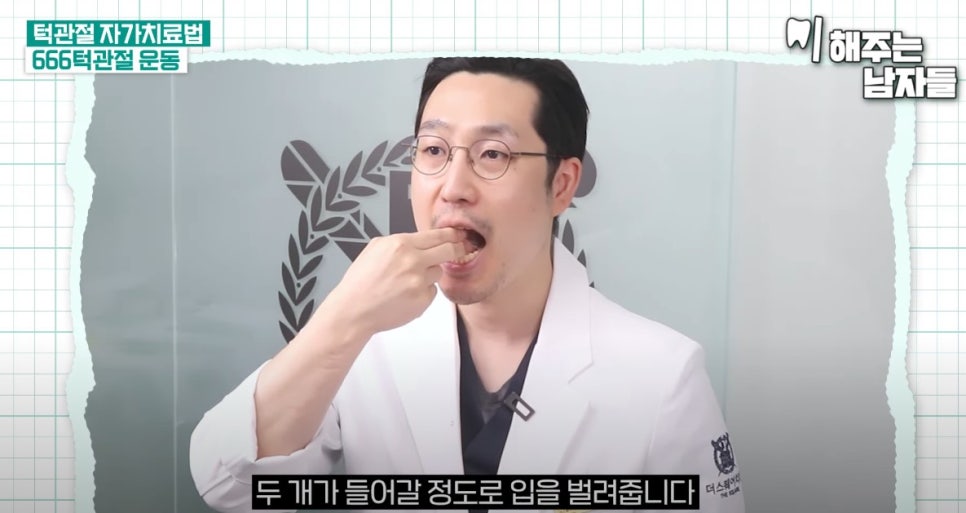

· Place your tongue on the front part of the roof of your mouth and separate your teeth
· Open your mouth enough to fit two fingers and hold for 6 seconds
Repeat this movement 6 times! Do 6 sets a day!
This exercise is effective in making the movement of the temporomandibular joint smoother
and relieving tension in the surrounding muscles.
There is also a 666 neck and shoulder stretch that is good to do together.
The muscles around the jaw are connected to the neck and shoulder muscles,
so it is important to release tension there as well.

In addition, if you apply a warm compress with a steam towel at around 40 to 45 degrees Celsius,
it can help relax the muscles and relieve pain.
If treatment is needed, what methods are available?
If symptoms do not improve with self-care,
or if the pain is severe, professional treatment is necessary.
Non-surgical treatments performed at the dental clinic include


- Botox treatment
It stabilizes the masseter muscle or temporalis muscle,
which exert strong chewing force, and reduces the burden placed on the temporomandibular joint.
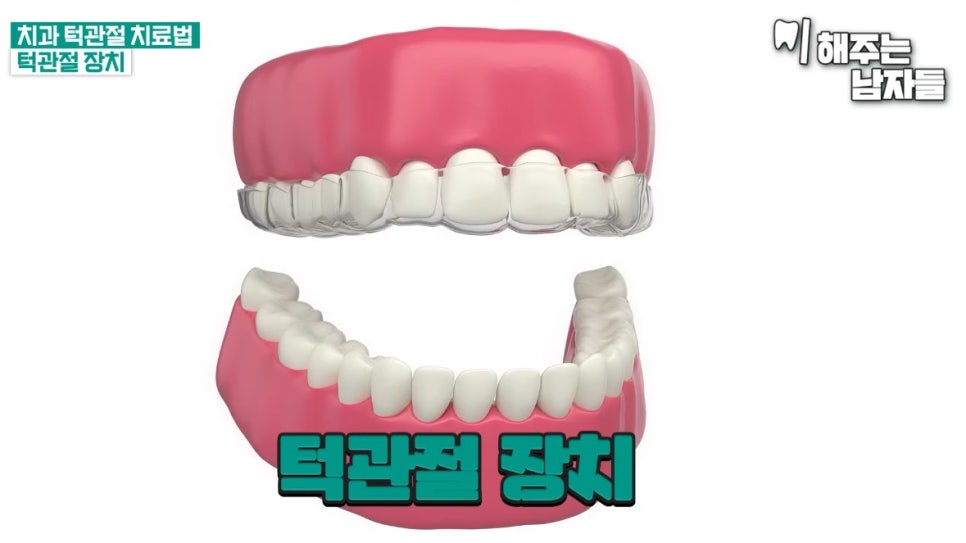
- Temporomandibular joint appliance (splint)
Wearing an appliance provides space and time for the temporomandibular joint to rest.
Depending on the situation, an appliance for the upper jaw or lower jaw may be used,
and in some cases it is worn only at night or throughout the day.
These treatments are mostly effective in relieving symptoms,
and surgical treatment is performed at a university hospital in very severe cases.
Do not neglect the temporomandibular joint; manage it early

Temporomandibular joint disorder is a 'self-limiting' condition,
so it may improve and worsen repeatedly.
However, if you miss the worsening phase and leave it untreated,
chronic pain, facial asymmetry, headaches, and other issues
can greatly affect your quality of life.
"When your mouth is closed, your teeth should not be touching.
Having your teeth apart is the stable resting position of the temporomandibular joint."
If jaw sounds or discomfort keep recurring,
do not leave it alone and be sure to get checked at a dental clinic.
It is fine to start with self-exercises,
and if necessary, you can recover with appropriate treatment.
A small change in habits is the first step in protecting temporomandibular joint health.
I will continue cheering for your healthy jaw and smile today.
—
From Im Jong-woo, Chief Director of Gwanghwamun The Square Dental Clinic