“Doctor, how many years does a crown usually last?”
Generally, the average lifespan of a crown
is known to be about 10 years.
However, in reality, it can vary greatly depending on how it is cared for.
Some people run into problems in less than 5 years,
while others use it for more than 20 years without any discomfort.

Hello.
I am Lim Jong-woo, the chief director of Gwanghwamun The Square Dental Clinic.
Today, I will talk about how to use crowns longer and keep them healthy.
The 3 principles that help crowns last longer

- Keep the balance of force
Crowns can easily withstand ordinary chewing force,
but repeated excessive force can damage them.
In particular, the habit of grinding your teeth or clenching unconsciously
puts a great deal of strain not only on the crown but also on the surrounding teeth.
If your jaw feels stiff in the morning or you have a headache,
you may want to suspect such habits.
In that case, wearing a night guard
is the most reliable preventive measure.

- Food choices also need a strategy
Diet is one of the factors that determines how long a crown lasts.
The habit of biting ice or chewing bones,
or enjoying hard foods such as squid or nut shells,
can create cracks in a crown.
Also, sticky foods like caramel or taffy
can weaken the adhesive bond and increase the risk of the crown coming off.
In addition, the habit of alternating between hot and cold foods
can create tiny gaps between the crown and the tooth.
In the end, it is fair to say that lifestyle habits
have a greater impact than the crown’s strength itself.
Even a little caution can more than double the lifespan of a crown.
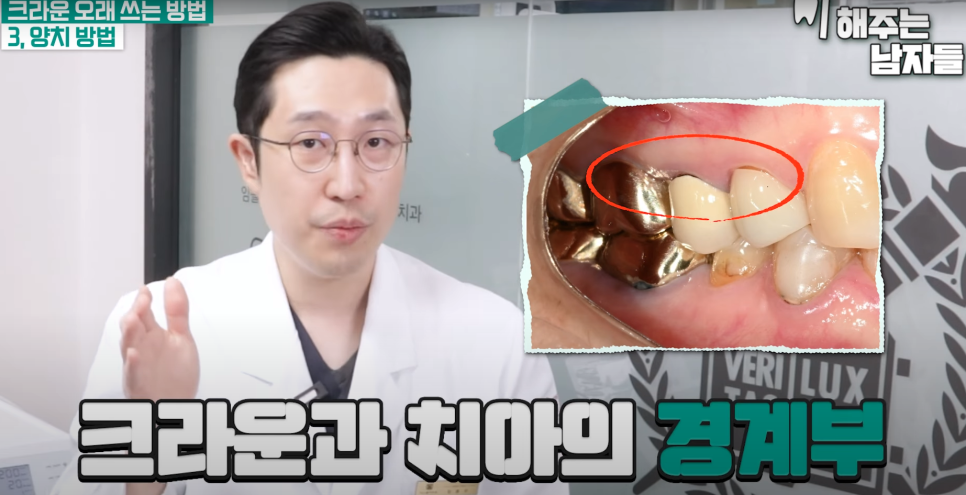
- Care at the margin determines longevity
The hardest part of caring for a crown is
the margin where the tooth and the crown meet.
This area easily collects bacteria and food debris,
which can cause cavities or gum disease.
Even if it looks fine on the outside, damage may already be
progressing on the inside, so consistent care is essential.
Proper brushing is basic, and using dental floss or
interdental brushes together is effective.
Dental floss is especially useful for front-tooth crowns,
while interdental brushes are especially useful for molar crowns.
Also, the Stillman brushing technique,
which gently sweeps upward from the gums toward the teeth,
helps keep the crown margin clean.

The lifespan of a crown depends more on the patient’s care habits
than on the characteristics of the material.
By keeping the force balanced, paying attention to food choices,
and carefully managing the margin area,
a crown can last not 10 years, but nearly 20 years.
Dental treatment is not finished with the procedure itself;
it is truly completed through the care that follows.
If you want to protect a treated tooth for a long time,
I encourage you to put the small habits mentioned today
into practice in your daily life.
Your efforts will double the lifespan of the treatment
and help create a healthier oral life.
_
Gwanghwamun The Square Dental Clinic
From Lim Jong-woo, Chief Director