Hello.
Based on restorative and preservation treatments,
we aim to provide highly refined care
that harmonizes aesthetics and function.
This is The Square Dental Clinic.

One day, you may look in the mirror—or bump into something or bite into food—and discover that a crack has formed in your tooth, commonly referred to as a “front-tooth crack.”
It is natural to feel frightened when you become aware of a symptom you did not know about.
But did you know?
The fact that a crack has appeared in a front tooth does not necessarily mean that you must undergo treatment immediately.
In this post, we will discuss the following three topics step by step:
-
Cases in which treatment for a front-tooth crack is not necessary
-
Cases in which treatment for a front-tooth crack is necessary
-
Treatment methods for front-tooth cracks
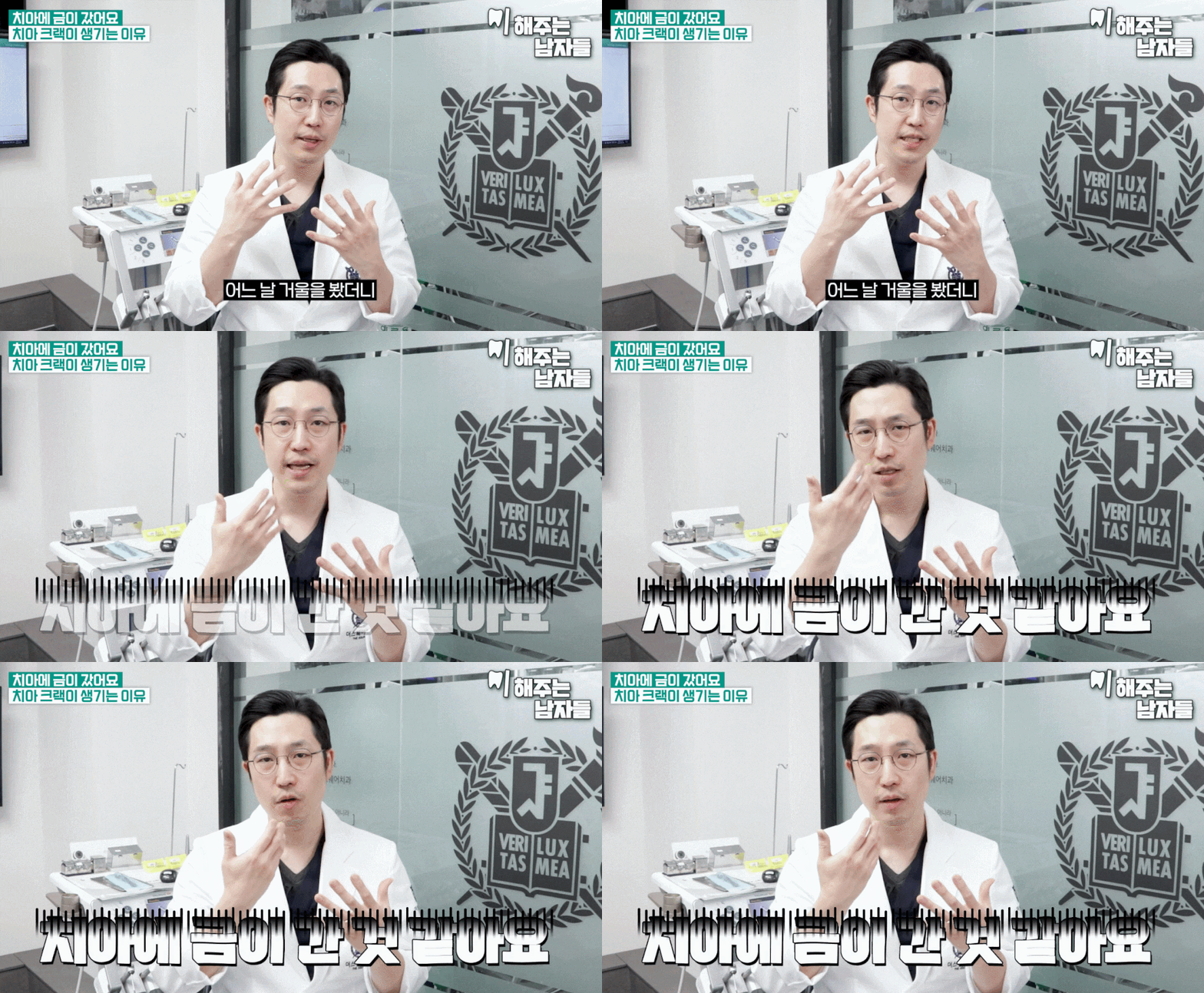
When is treatment not necessary?
As described above, the appearance of a crack in a front tooth does not automatically mean that the tooth must be shaved down or covered with a restoration.
If the crack falls into one of the following categories, monitoring it for a little longer may be the better approach.
✔️ When the crack is limited to the enamel

This is when the tooth appears to have a fine hairline crack.
In fact, all adults have some degree of fine cracks.
That is because teeth are continually subjected to chewing forces throughout life.
If there is only a crack, with no pain or sensitivity at all,
it is highly likely to be a simple crack limited to the enamel on the outer surface of the tooth.
In this case, rather than unnecessarily disturbing the tooth,
avoid hard and tough foods and take care not to let the crack progress further.
✔️ When the crack extends into the dentin,
but symptoms are mild

If the crack extends deeper than the enamel into the dentin,
you may feel a sharp twinge when chewing or drinking cold water.
However, even in this case, if the symptoms occur only very occasionally or are minimal,
we recommend observing the tooth carefully rather than rushing into treatment.
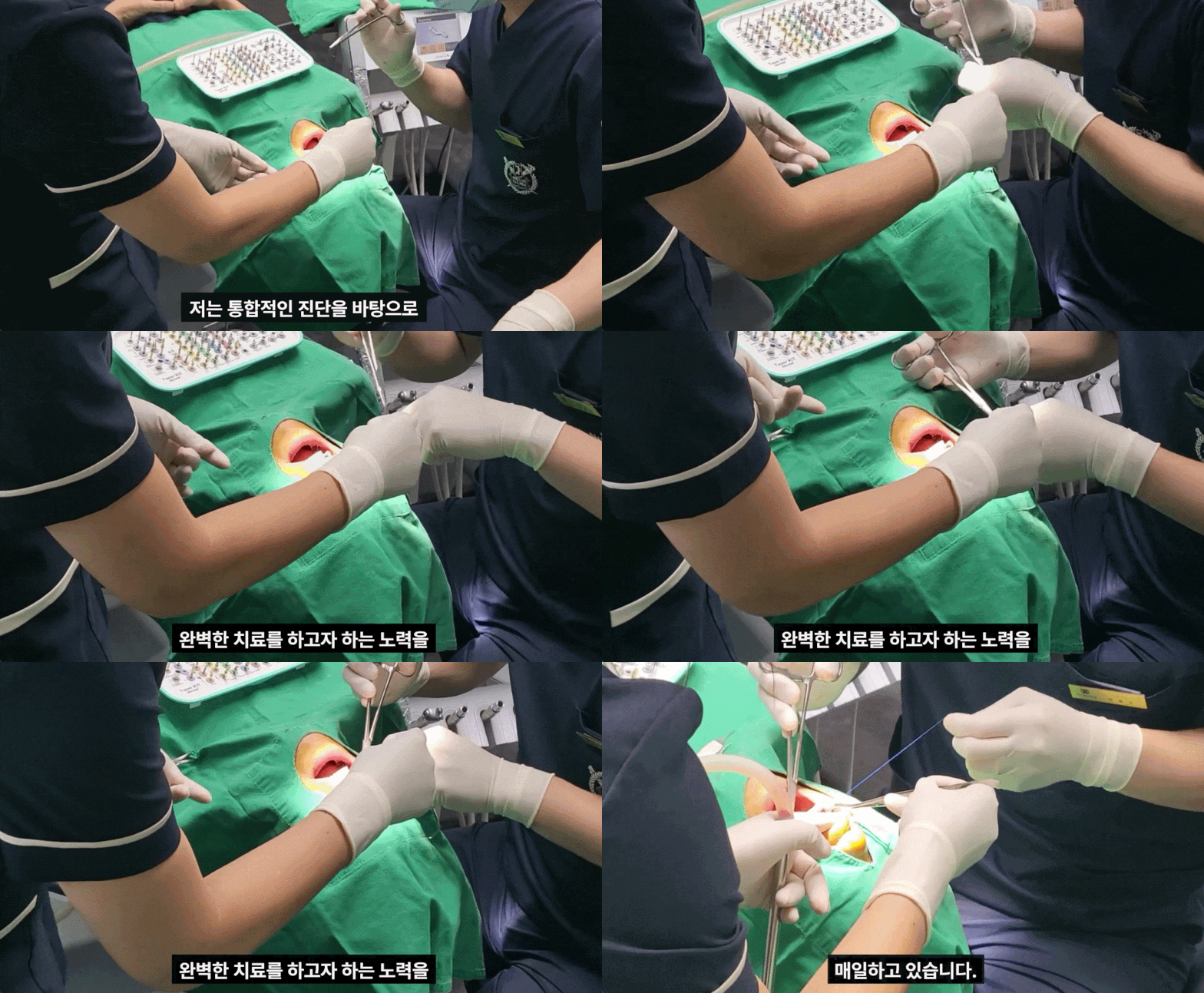
When is treatment definitely necessary?
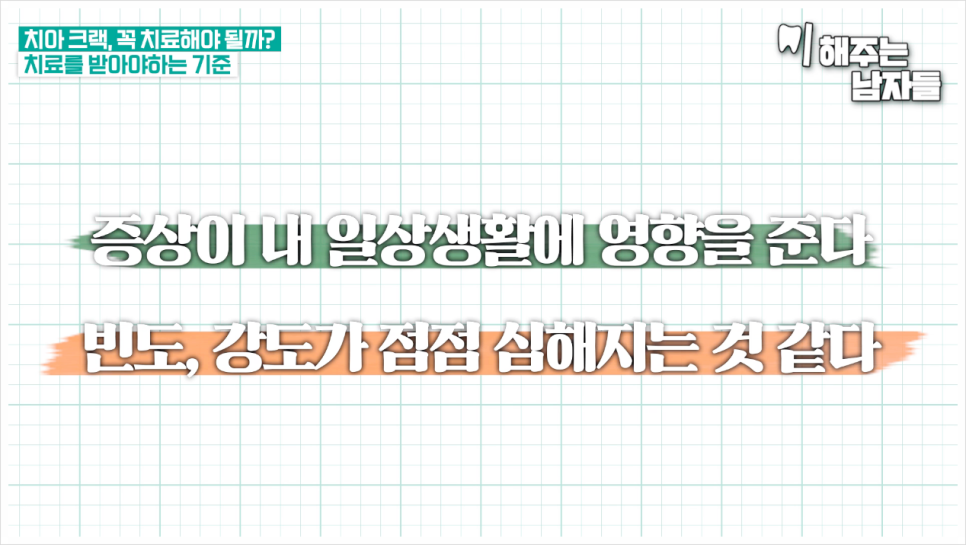
On the other hand,
-
if it affects your daily life, such as causing throbbing pain at night severe enough to prevent you from falling asleep, or
-
if you experience excruciating pain when eating or drinking something cold or hot, or
-
if the frequency and intensity of the pain are gradually increasing,
you should not leave the symptoms untreated and should receive treatment immediately.
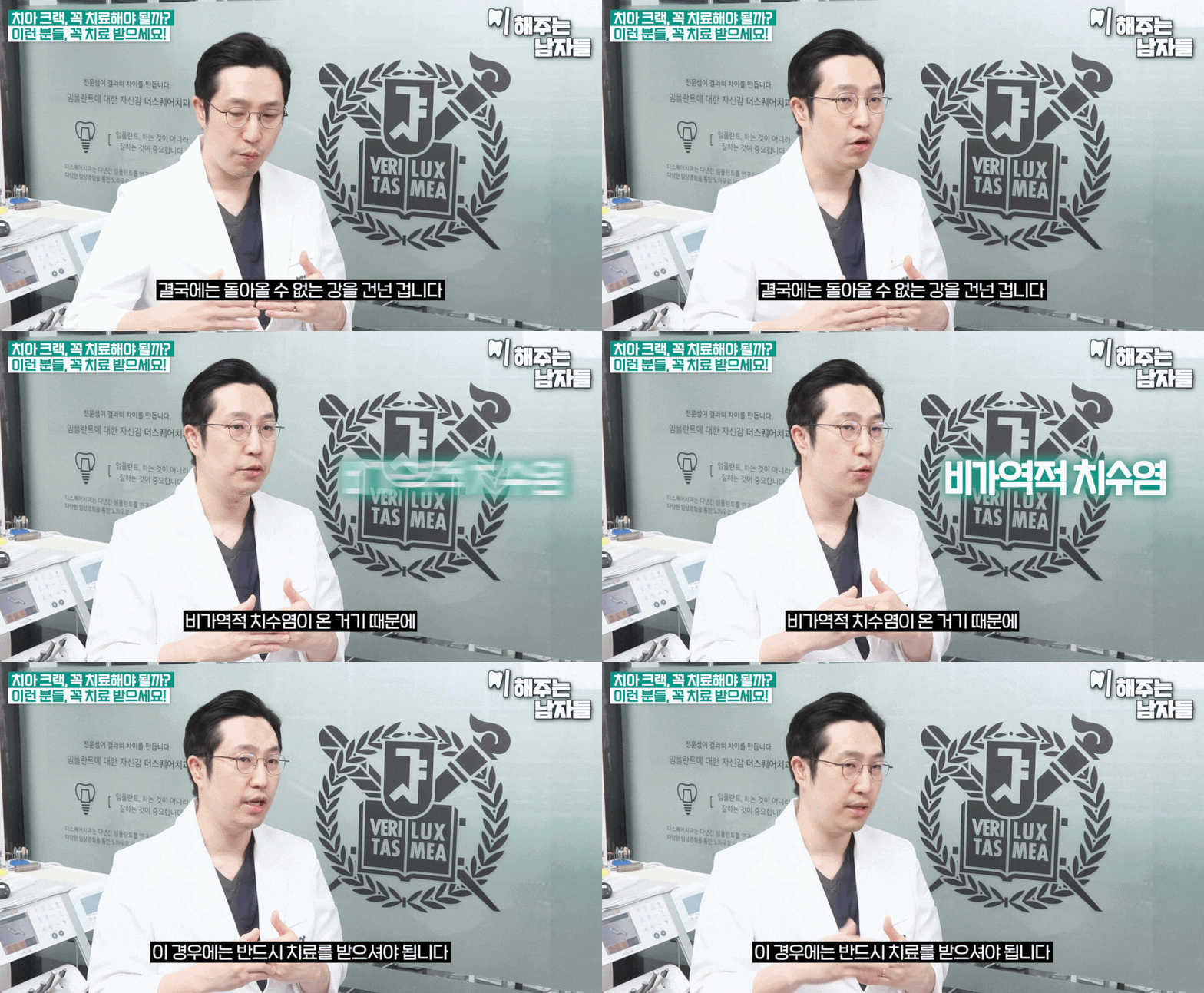
This is because these symptoms indicate that the nerve inside the tooth has become infected with bacteria and progressed to an irreversible condition,
commonly known as <irreversible pulpitis>.
Because this condition cannot heal naturally,
appropriate measures, including root canal treatment, must be taken.

How are front-tooth cracks treated?
Considering the information discussed above,
you may be wondering how a cracked tooth should be treated.
Here are the treatment methods for each stage.
| STEP 1. When the symptoms are unclear |
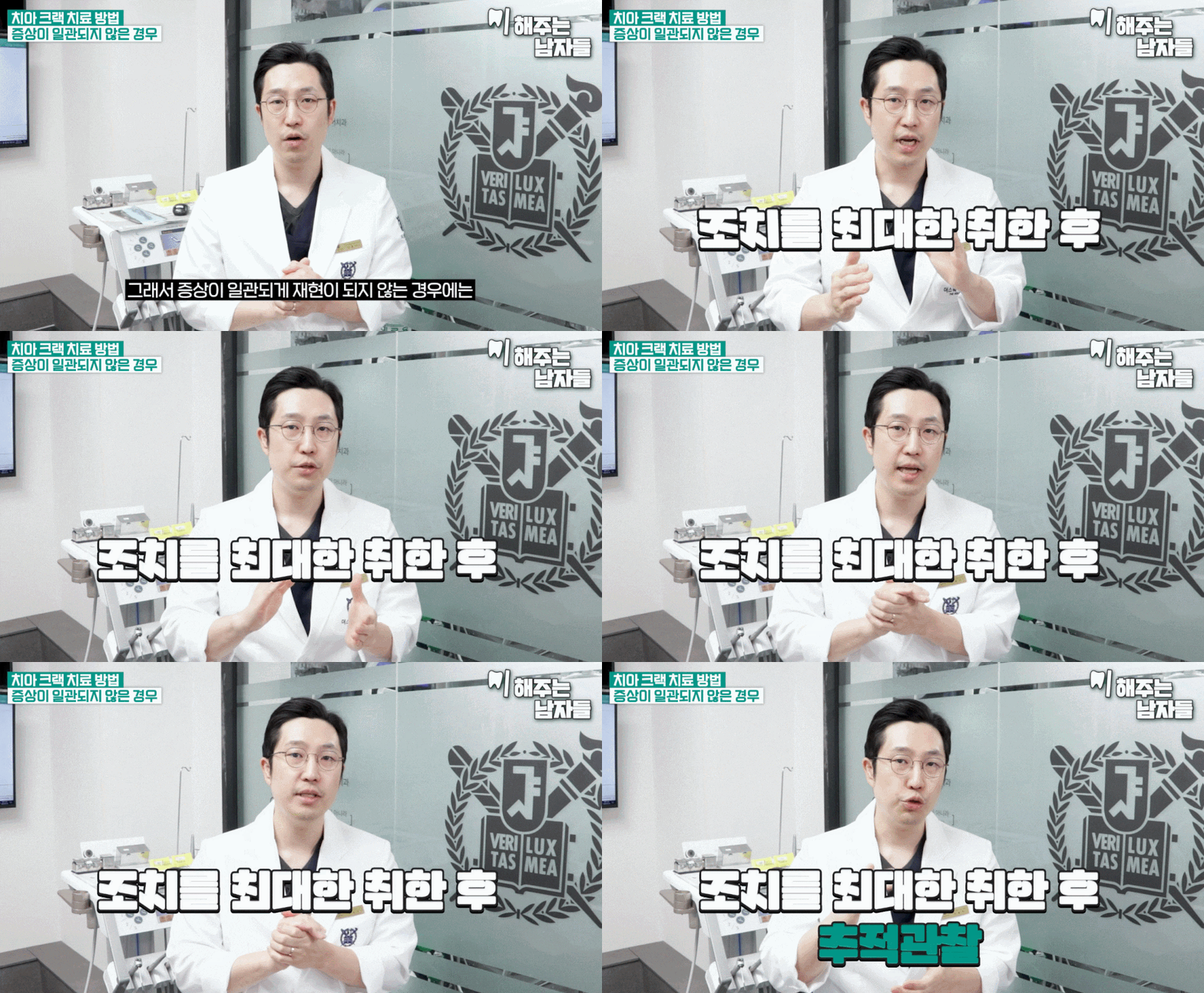
If the crack is difficult to see or the symptoms are inconsistent,
we monitor the tooth through regular examinations to determine whether the crack is progressing.
If a particular tooth is repeatedly being struck and developing cracks, occlusal adjustment may also be considered.
If there are no other symptoms but there is vague pain, the response may be monitored with medication or other measures.
In fact, even with this type of management alone, symptoms disappear or improve in about half of 10 patients.
| STEP 2. When symptoms persist |
If the condition continues to interfere with daily life despite management,
physical treatment may be necessary at this stage.
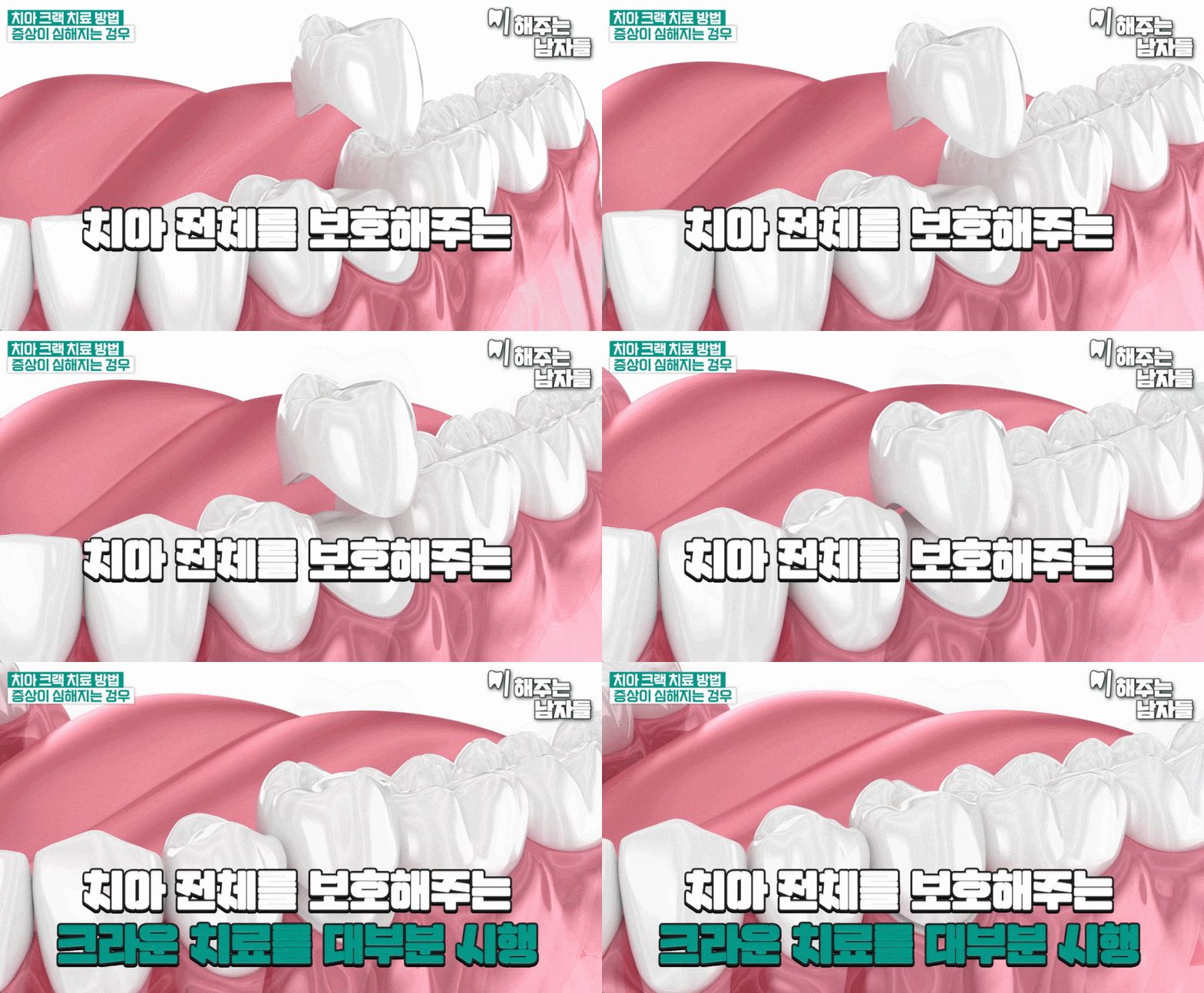
A crown may be placed to protect the cracked tooth from opening further.
A crown is, as the name suggests, a restoration placed over the tooth like a crown.
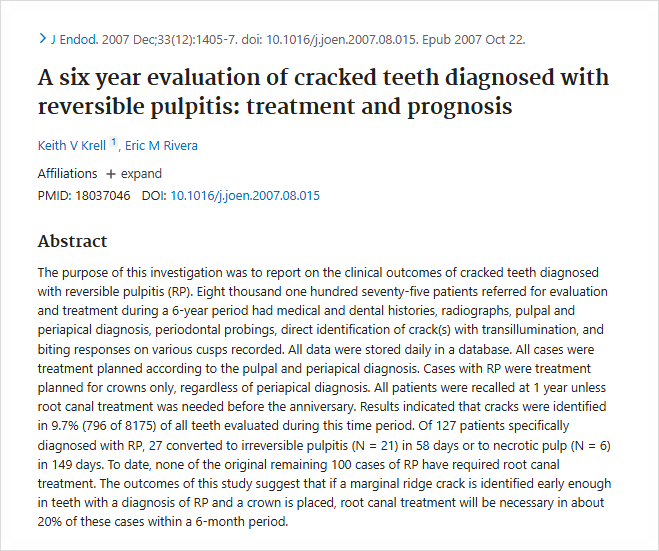
- Key point: According to a study published in JOE, the world’s leading academic journal in the field of root canal treatment,
early detection of tooth cracks and
appropriate action are important.
The study demonstrated that when appropriate measures, such as timely crown treatment, are taken,
natural teeth can be preserved in a healthy condition
without complex procedures such as root canal treatment or extraction.
- Source: J Endod. 2007 Dec;33(12):1405-7. doi: 10.1016/j.joen.2007.08.015. Epub 2007 Oct 22.
| STEP 3. Extraction |
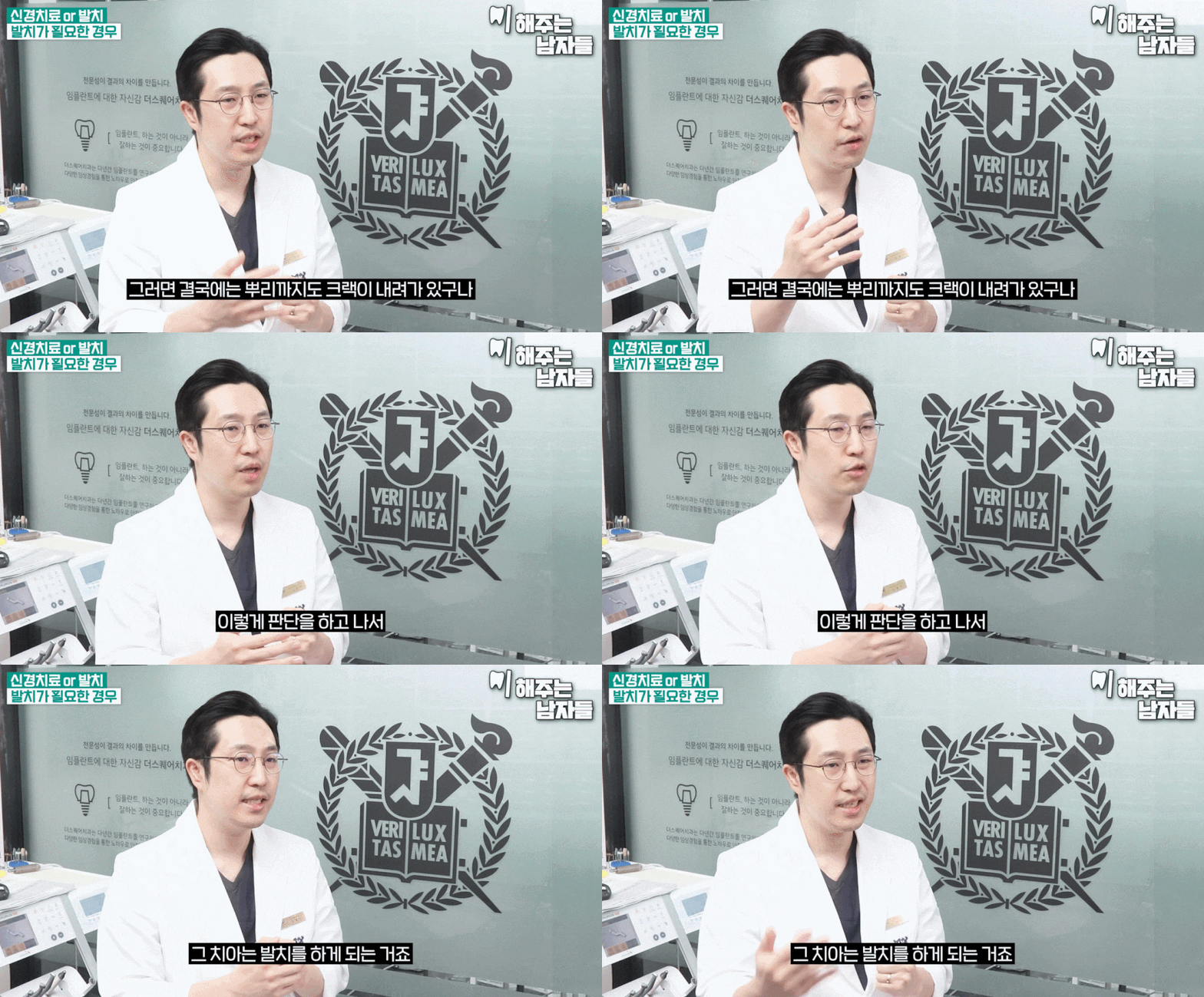
This is the most unfortunate case:
when the crack extends beyond the crown of the tooth and splits deep into the root.
A crown stabilizes the crown of the tooth, so if the root has split, covering the tooth will not resolve the problem.
In such cases, extraction may be unavoidable to prevent inflammation and bone resorption.


If you have followed the post carefully, you will have realized that
although there is no need to be excessively afraid when a front tooth develops a crack,
it should not simply be left untreated either.
The key point is accurately determining <whether treatment is necessary for your current condition>,
so visiting a dental clinic for a thorough examination should be your priority.

In particular, if you visit a hospital with specialists in each field, such as prosthodontics, comprehensive dentistry, and orthodontics,
you can receive a customized solution suited to you, from occlusal adjustment to preservation treatment. ^^
Please refer to the post below for information about treatment and appointments at The Square Dental Clinic.
Our clinic is staffed entirely by medical professionals who graduated from Seoul National University.
We pursue reliable treatment based on
specialized knowledge grounded in the latest findings,
three-dimensional diagnoses based on scientific evidence,
and adherence to established principles.
This was The Square Dental Clinic.
[Would you like to see actual reviews?]
[Would you like to ask a one-on-one question?]
[Directions]
| This post was written by The Square Dental Clinic in compliance with Article 56, Paragraph 1 of the Medical Service Act for the purpose of providing medical information. The content is based on general medical information, and diagnosis and treatment methods may vary depending on an individual’s oral condition. An in-person consultation is recommended. |