When my upper teeth started coming out one by one, I never imagined it would end up like this. At first, I thought it was simply because old cavities could no longer hold on and the teeth fell out. But before long, those “one by one” losses kept increasing, and now most of my upper teeth are gone. The sight of my missing upper teeth felt so unfamiliar. I didn’t know then that losing one tooth affects the surrounding area too, and that the jawbone can collapse much faster than expected. I’m using a temporary denture for now, and the discomfort is hard to describe.
In the past, losing teeth was often accepted as a natural part of aging, and dentures were common. But these days, as life expectancy has increased, full-implant treatment cases among older adults have risen significantly, and more people are clearly looking into implants rather than dentures.
When a situation arises where the entire upper teeth need to be treated with implants, it means more than simply losing a few teeth; it means the entire tooth function has collapsed. In such cases, approaching it by placing one implant for each individual missing tooth can be expensive, inefficient, and structurally less stable, so an integrated treatment plan that considers the overall oral structure from the beginning may be necessary.
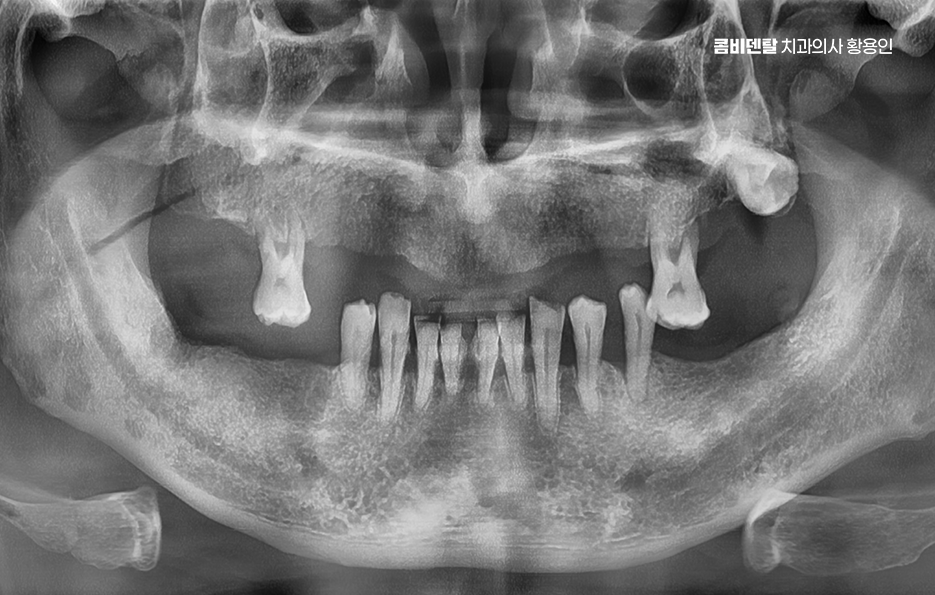
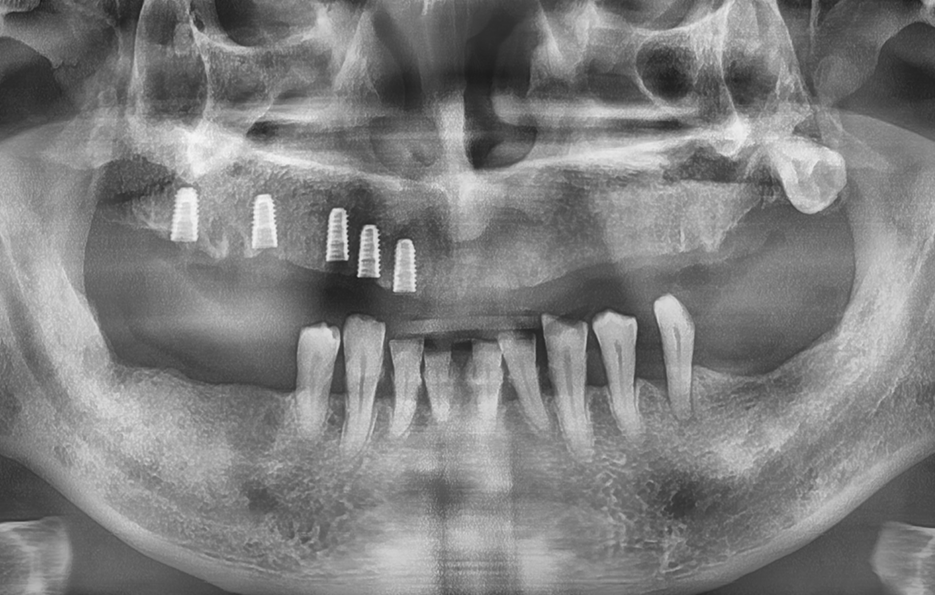
In particular, the upper teeth are highly visible when smiling and are an important area that determines the aesthetic impression of the face. For that reason, treatment needs to go beyond simply restoring chewing function and should include a delicate design that considers facial shape, the gum line, lip movement when speaking, and the balance of the bite. Treatment that takes all of this into account is what can be called full-upper-arch implant treatment.
Usually, the first step when planning a full-upper-arch implant is diagnosing the condition of the jawbone through a CT scan. Compared with the lower jaw, the bone in the upper jaw is thinner, and especially in the molar area, there is a hollow space called the maxillary sinus. Because of this, there are many cases where there is not enough jawbone to place implants. In such cases, implants cannot simply be placed, and a procedure called sinus lift surgery may be needed.
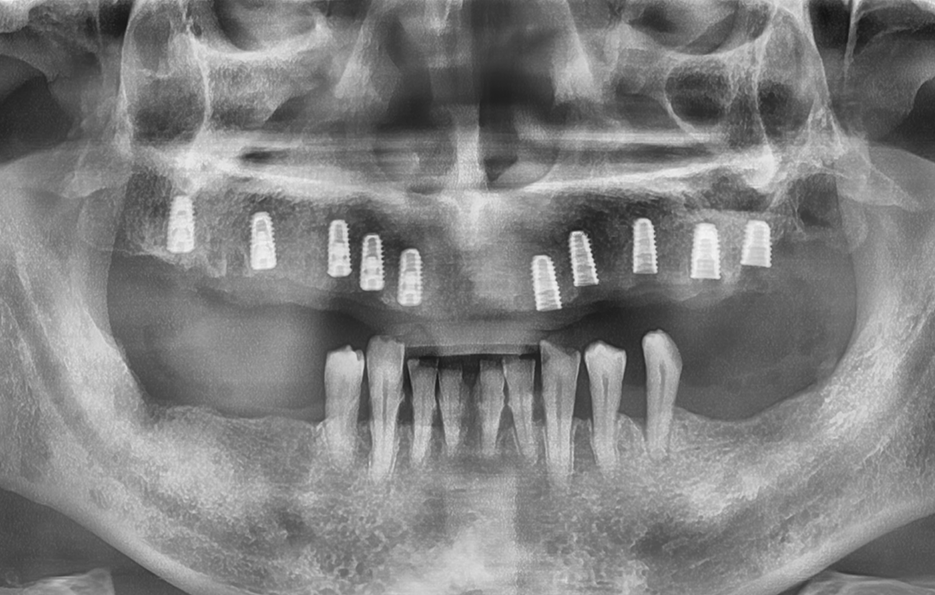
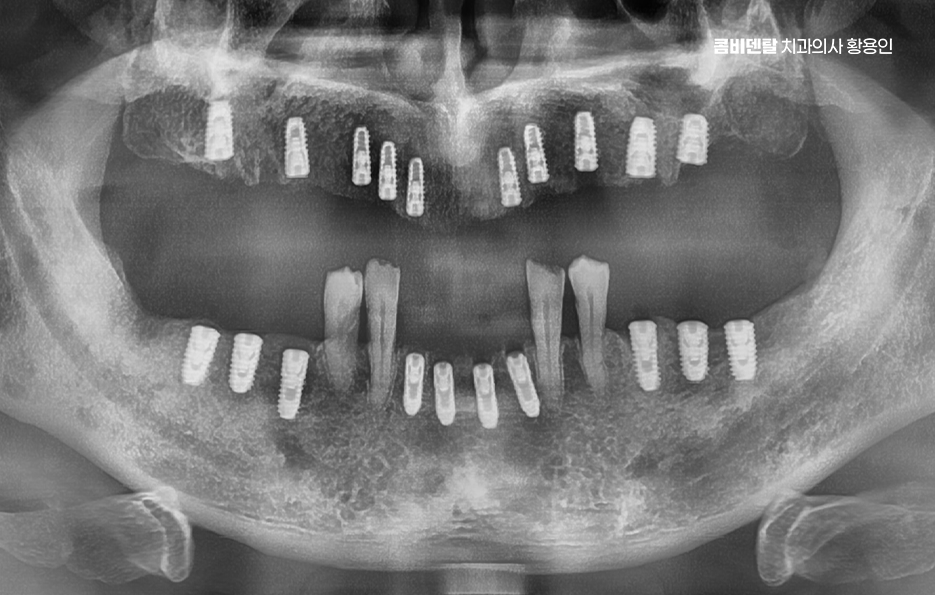
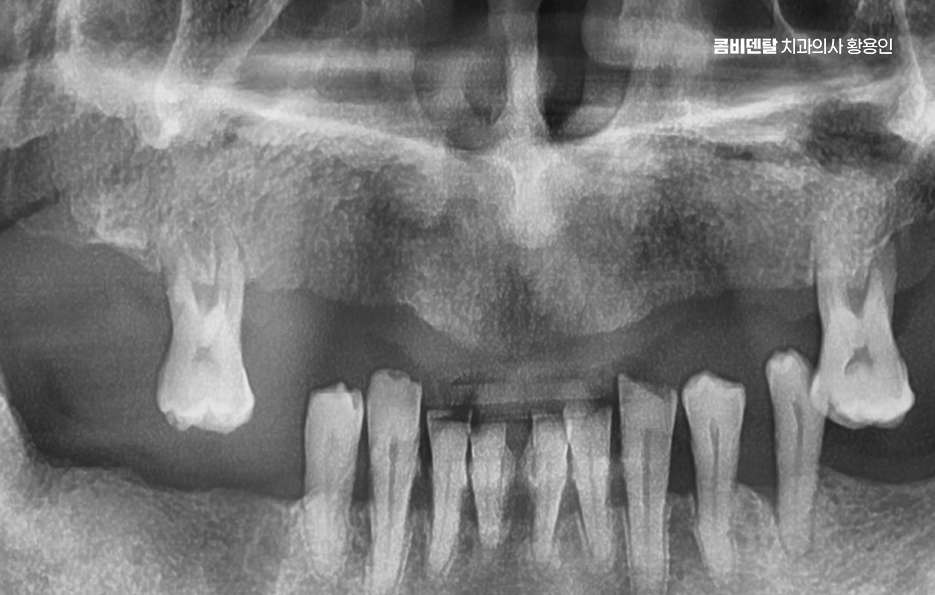
This surgery lifts the maxillary sinus membrane and places bone graft material underneath it to create enough space for the implant. In addition, the specific treatment method varies depending on conditions such as the state of the jawbone, overall health, and whether the patient smokes. For this reason, in full-upper-arch implant cases, an accurate diagnosis of whether there is enough jawbone to support the implants is the starting point of treatment.
A full implant treatment does not necessarily mean placing implants one-to-one for the number of missing teeth. In cases of complete tooth loss, treatment usually involves placing about 6 to 8 implants at regular intervals and then placing a bridge-type prosthesis connected to multiple teeth on top of them. The number of implants placed may vary somewhat depending on the patient's financial situation and the condition of the jawbone.
For example, when there is sufficient jawbone, more implants may be placed to increase support. When a lot of bone has been lost, the treatment method changes by minimizing the number of implants placed. In some cases, an option somewhere between implants and dentures, such as implant-supported dentures, may be used.
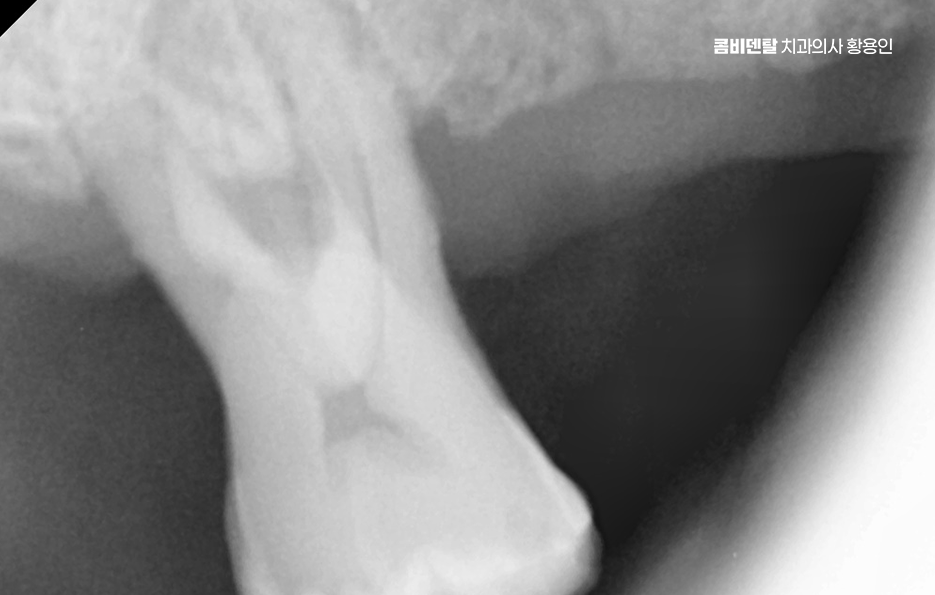
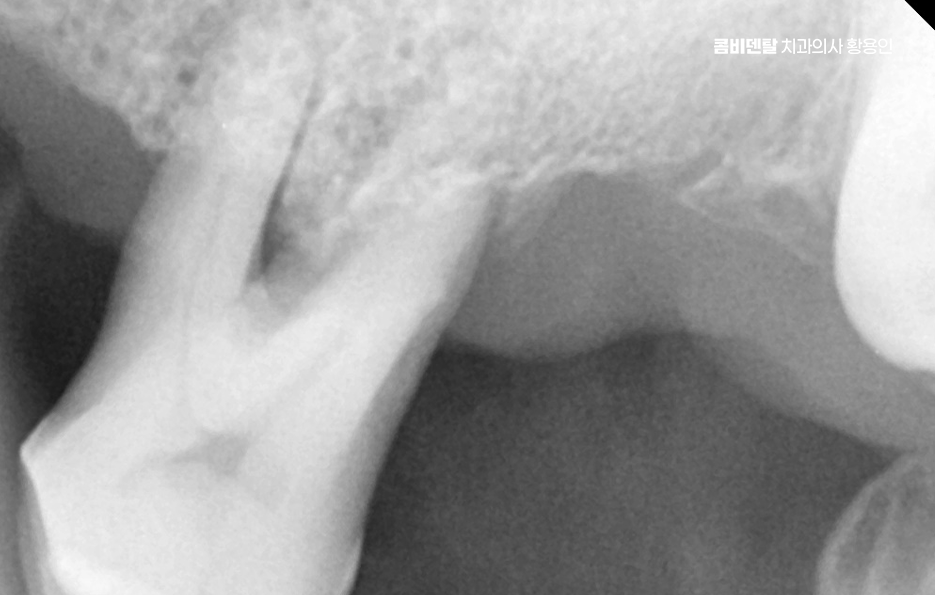
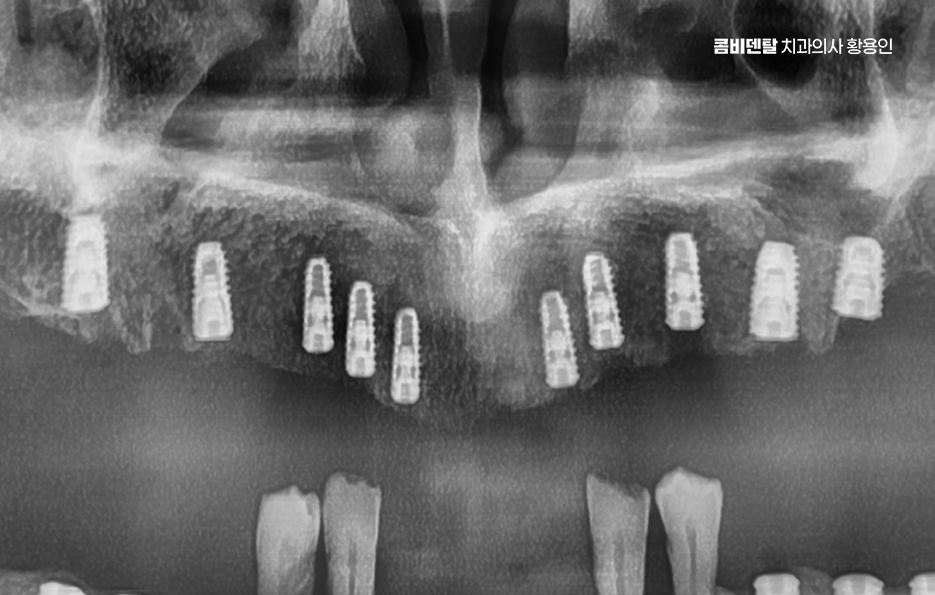
Especially when making a prosthesis for a full-upper-arch implant, it should be precisely designed by taking into account the patient's facial shape, lip line, and the length of the teeth exposed when smiling. In particular, because the upper teeth have a major effect on pronunciation and facial expressions, the focus is not only on functional restoration but also on creating a prosthesis that harmonizes with the smile line. Recently, more precise treatment has become possible through digital scanning.
Another point to note in full-upper-arch implant treatment is regular maintenance. Since implants do not have nerves like natural teeth, there may be no pain at the early stage of a problem. However, if inflammation such as peri-implantitis occurs, the jawbone can start to resorb, so regular scaling, oral hygiene management, and proper brushing habits are essential. In particular, with a full implant, even a problem with just one part can affect the entire prosthesis, so more careful management is needed. Because the burden of reoperation is that much greater, the importance of long-term aftercare alongside treatment is even higher. I hope you carefully choose a dental clinic that you can stay with for the long term.






Previous image
Next image




Previous image
Next image




Previous image
Next image




Previous image
Next image