Treatment period: 2025.05.22 ~ 2025.06.25
Boramae Dental Clinic, Seoul Remember
I am Director Park Jeong-gi.
An apicoectomy (Apicoectomy) is
a surgical procedure that removes inflammation or cysts
that have developed at the tip of a tooth root.
It is performed when
chronic lesions that cannot be resolved with regular root canal treatment
or cases that are difficult to retreatment
require this method.
Front teeth are anatomically easy to access
and have a single-root structure,
so the success rate of apicoectomy tends to be high.
In particular, because they are in an area that is aesthetically important,
Apico is a very useful solution because it can remove inflammation
while preserving the tooth.
Of course, there is no guarantee that it will always be successful,
and if it does not subside even after Apico is performed,
there is also the possibility of extraction, so
sufficient discussion with the patient is necessary.
Today, at Boramae Dental Clinic,
I will explain a related case.
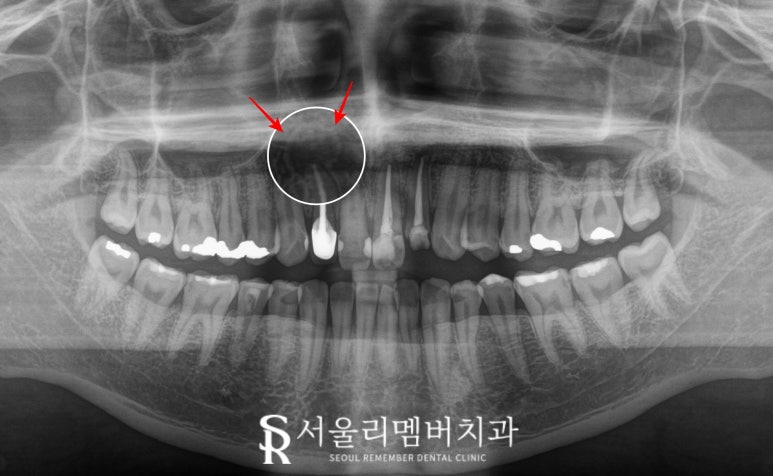
2025.05.22
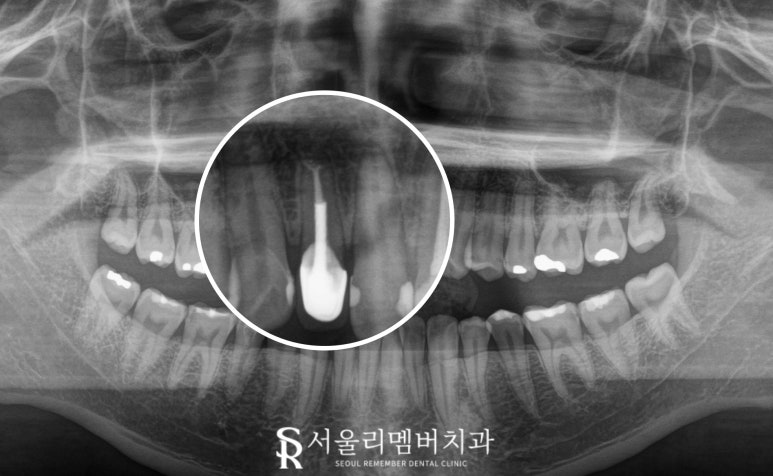
There was discomfort in the upper right lateral incisor (tooth 12),
and after taking a panoramic X-ray,
an apical abscess
was observed at the root tip.
This tooth had previously received root canal treatment,
but healing did not progress well,
so the inflammation continued to remain,
which caused the bone to dissolve.
An apical abscess is a suppurative inflammation caused by a bacterial infection
at the tip of the tooth root.
Because it was judged that recovery would be difficult with the commonly known retreatment root canal,
this case was planned with this approach.
At Boramae Dental Clinic,
I will briefly explain the procedure.
1st step: Gum reflection and access
Under local anesthesia, the gum was incised
and the mucosa was carefully reflected.
In this process, it is important to clearly expose
the problematic area
so that a surgical field can be secured.
Also, since aesthetics are important for front teeth,
the location of the incision line and even the suturing
must be carefully considered and carried out.
2nd step: Removal of inflamed tissue
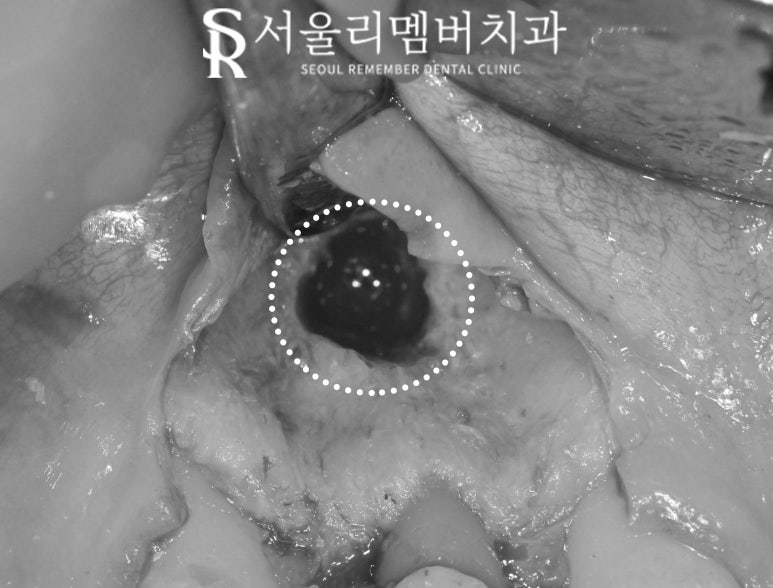
2025.05.22
Together with the abscess,
about 2-3 mm of the infected root tip was removed.
At this time, while preserving the healthy root,
a cavity was prepared for retrograde filling.
3rd step: Regenerative treatment for the bony defect
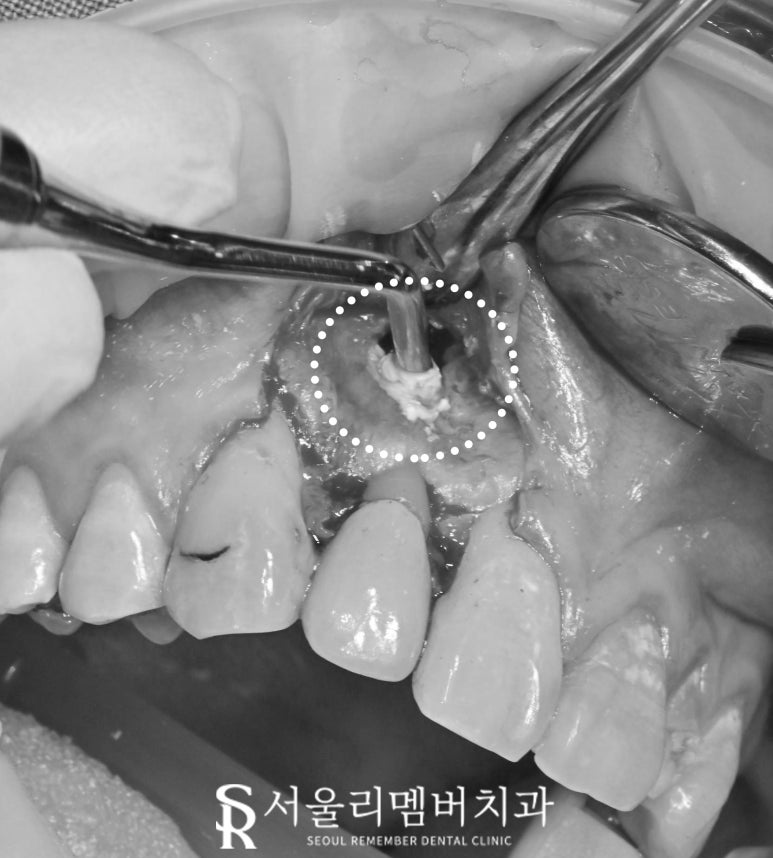
2025.05.22
At Boramae Dental Clinic,
artificial bone was placed into the dissolved space
to induce regeneration.
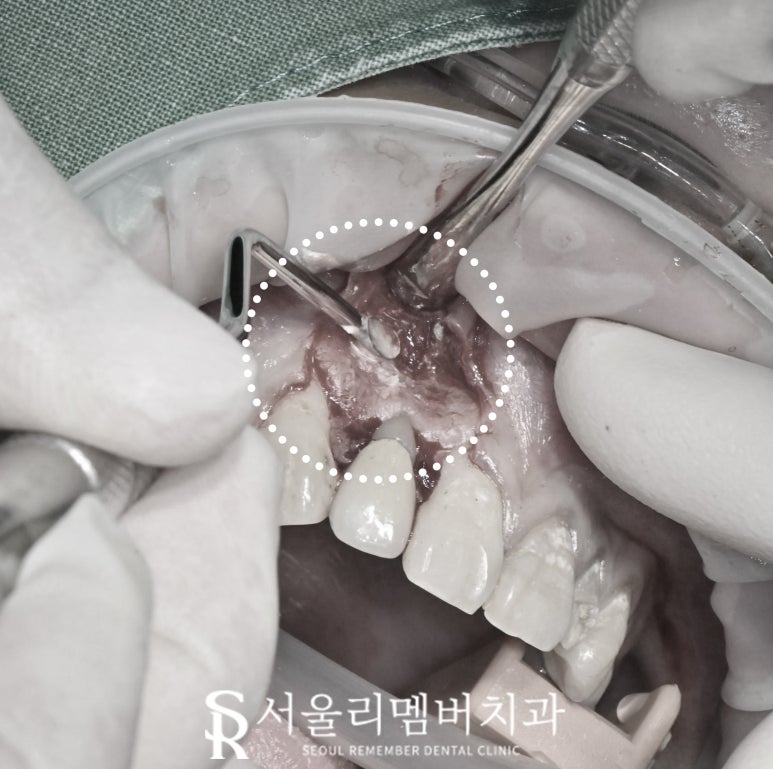
2025.05.22
Artificial bone (Bone Graft) and
PRP (Platelet-Rich Plasma)
were mixed and grafted.
This helps promote bone regeneration
and support recovery.
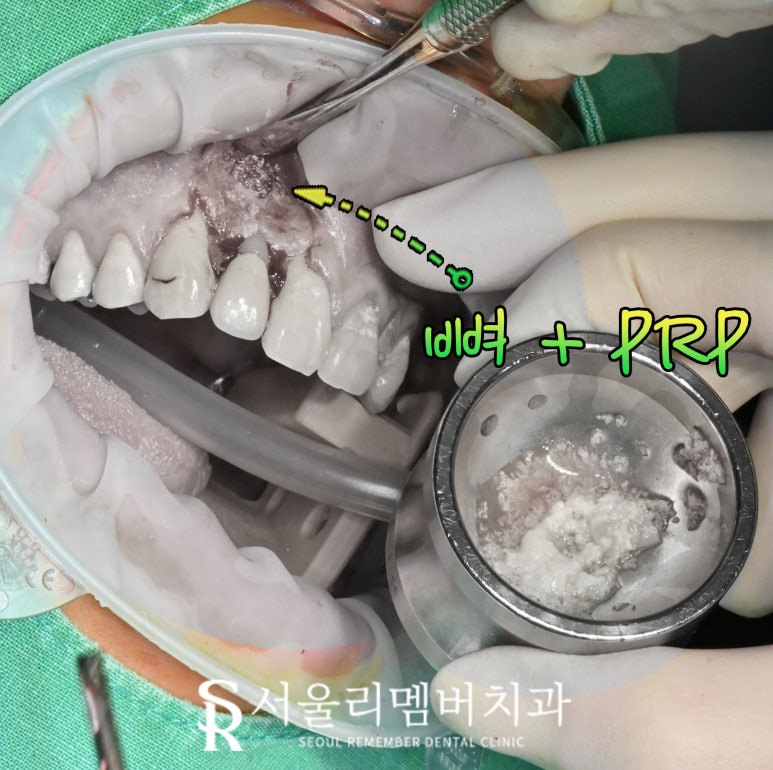
2025.05.22
Just a moment—at Boramae Dental Clinic,
I will briefly explain PRP and PRF,
which may be somewhat unfamiliar to you.
PRP (Platelet-Rich Plasma)
PRP is plasma concentrated with platelets
from the patient's own blood.
It contains a large amount of growth factors,
which play a role in promoting tissue regeneration and healing.
The advantage of PRP is that because it uses the patient's own blood,
there is no immune rejection reaction,
and the risk of infection is very low.
It can also promote both bone regeneration and soft tissue healing
at the same time,
which is useful for recovery after apico.
PRF (Platelet-Rich Fibrin)
PRF contains not only platelets
but also white blood cells,
so it is biocompatible,
and it also serves as a biological membrane
that protects the surgical site.
4th step: PRF application and suturing
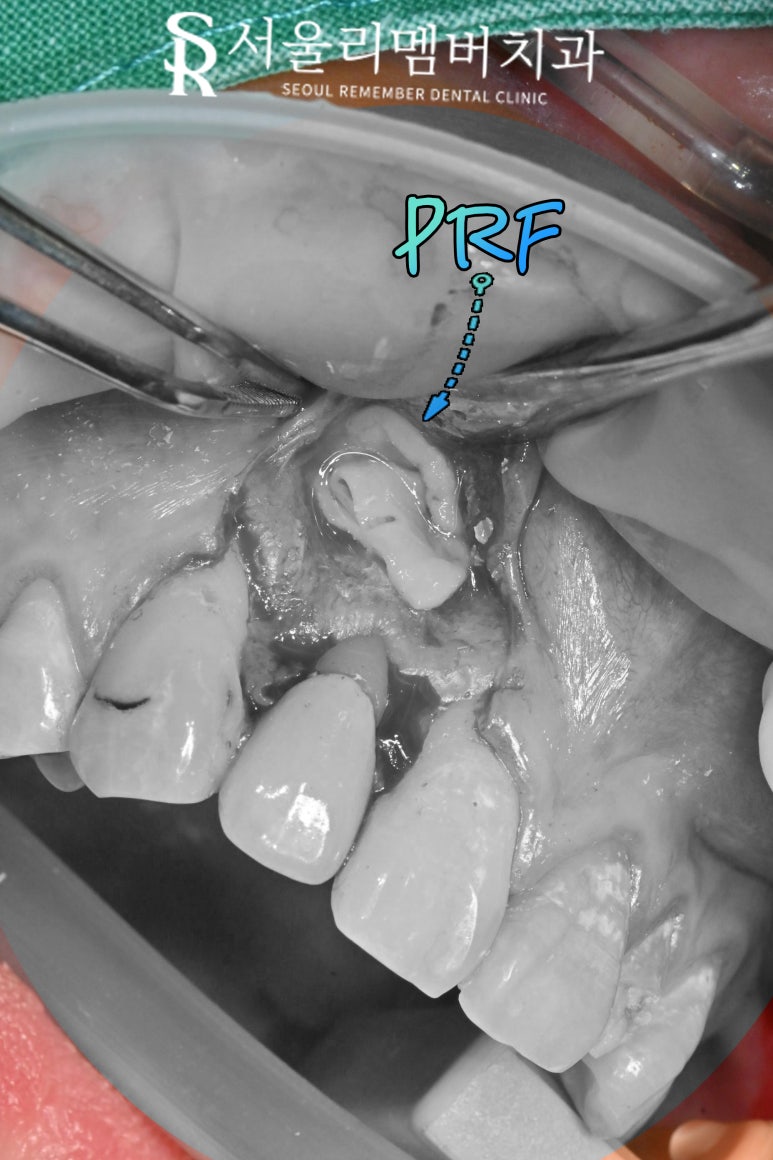
2025.05.22
At Boramae Dental Clinic,
this is what the PRF membrane looked like after the bone graft.
The PRF membrane protects the grafted bone
and serves as a barrier membrane
that prevents soft tissue from invading
the area where the bone graft was placed.
Finally, the incised gum is
sutured back into its original position.
2025.06.25
Apicoectomy in the front tooth area is
a treatment that can fundamentally resolve chronic inflammation
while preserving an aesthetically important tooth.
However, it is a surgical procedure accompanied by bleeding,
and since it is best performed when positive recovery can be expected,
you should proceed only after 충분히 consulting with the attending specialist.
Thank you for reading.
This was Director Park Jeong-gi of Boramae Dental Clinic, Seoul Remember.