I am Director Park Jeong-gi of Seoul Remember at Sadang Dental Clinic.
If your front tooth chips due to an unexpected injury in daily life,
it is only natural to feel flustered.
In particular, the maxillary central incisors
have a direct impact on aesthetics,
so prompt treatment is needed.
Today at Sadang Dental Clinic,
we will look at the process of treating a chipped front tooth
and also share some medical information.
- Slightly chipped front tooth
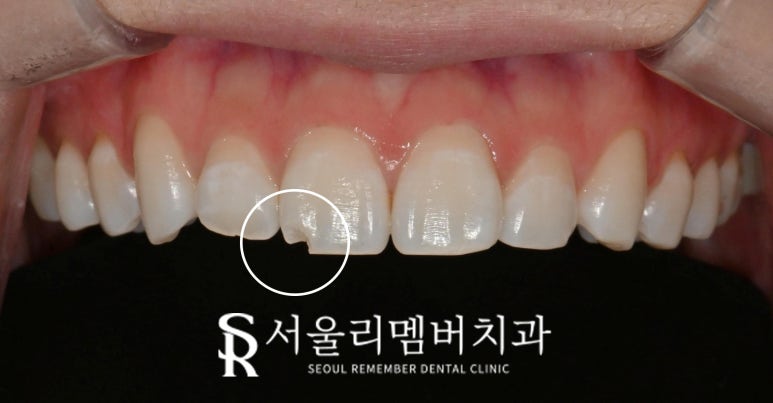
This was a case in which
the incisal edge of the upper right front tooth (tooth 11)
was fractured.
The clinical examination showed that,
fortunately, the fractured area
was limited to the enamel,
and the pulp was not exposed.
In addition, percussion testing,
which involves lightly tapping the tooth,
showed a negative response,
and in the cold test,
which evaluates the response when cold ice is applied,
it also showed a normal response,
so at this level, we judged that pulp vitality
was still being maintained.
At Sadang Dental Clinic, when these several tests suggest
that the tooth still has good vitality,
we can provide immediate restoration with resin.
- Classification of the fracture and treatment plan
Tooth fractures are classified according to the Ellis classification
as Class I (enamel only),
Class II (enamel and dentin),
and Class III (up to the pulp).
The case shown today at Sadang Dental Clinic
corresponds to Ellis Class I,
and it appears possible to restore it directly
with composite resin.
Treatment options for an incisal edge fracture
depend on the extent of the break.
Resin, laminate, and crown
are among the available methods,
and which method is chosen can be selected by the patient
based on the clinician’s diagnosis.
In this case, because the fracture was limited
to the incisal edge
and structural stability was maintained,
we proceeded with resin filling,
which minimizes both time and cost.
- Treatment process
At Sadang Dental Clinic,
we first accurately evaluate the fractured area
and check the condition of the surrounding tooth structure.
Then, after selecting the shade while also considering
the translucency of the incisal edge area,
we restored it.
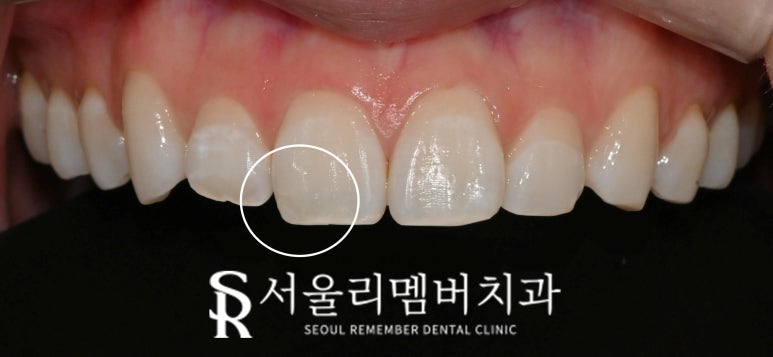
If dentin is exposed
or if the patient feels they may become sensitive during the procedure,
partial local anesthesia can be used then
to minimize discomfort.
After thoroughly cleaning the broken area,
we created a bevel on the surrounding margin
to increase the bonding surface with the resin,
and to minimize polymerization shrinkage,
we used an incremental technique,
building the material up layer by layer.
After filling, we checked the occlusion,
and after confirming that the lower teeth were not contacting too much
or that the incisal edge did not appear overly long,
we made slight adjustments if needed.
We also checked that the boundary with the natural tooth
was not stepped,
and finished by polishing it smoothly
so that it blends naturally.
- Post-treatment precautions
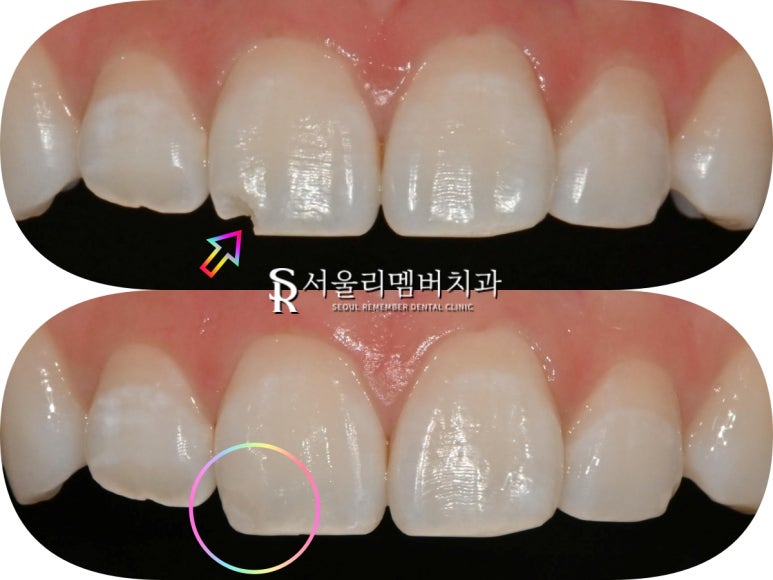
At Sadang Dental Clinic,
we will briefly explain a few precautions after resin treatment.
- For 24 hours, it is better to avoid foods that stain easily
(coffee, wine, curry, etc.).
- Biting hard foods with the front teeth
or biting your nails can cause re-fracture,
so caution is needed.
- Through regular checkups,
it is important to confirm the marginal adaptation
and any discoloration of the resin restoration.
A slightly chipped incisal area
can often be resolved on the same day
with resin filling.
Of course, as in today’s Sadang Dental Clinic case,
pulp damage must be absent
and structural stability must be maintained
for aesthetics and function to be restored
without invasive prosthetic treatment.
Just because a tooth is chipped
does not mean that everyone needs a crown or laminate.
Through an accurate diagnosis,
it is important to choose a conservative yet satisfying method.
That concludes today’s content.
Thank you for reading.
This was Director Park Jeong-gi of Seoul Remember at Sadang Dental Clinic.
Treatment date: 2025.11.25