Treatment period: 2025.07.14 ~ 2025.11.28
Nice to meet you,
I’m Director Park Jung-gi from Seoul Remember Dental Clinic near Sadang Station.
As demand increases,
side effects and
problems that follow are bound to increase as well.
In particular, implants
involve placing a titanium screw made of a biocompatible material
into the human bone, that is, the alveolar bone,
so even if the procedure is performed under strict sterilization conditions,
there are differences in the success rate of osseointegration for each individual.
Even so, titanium is the only material that our body accepts without rejection,
which is why titanium equipment is also used when bones are broken or when plastic surgery is performed.
So, to replace natural teeth,
a titanium fixture was securely placed in the jawbone,
and you were told that it had firmly bonded with the bone,
but what if it becomes loose?
Today, at the Sadang Station dental clinic,
I will explain several in-depth points under the topic of implant loosening and detachment.
One misconception people often have is:
"If a sturdy screw is placed deep into the bone,
it can be used for life."
Of course, it is a semi-permanent procedure,
but the duration varies greatly depending on
how thoroughly the patient maintains it.
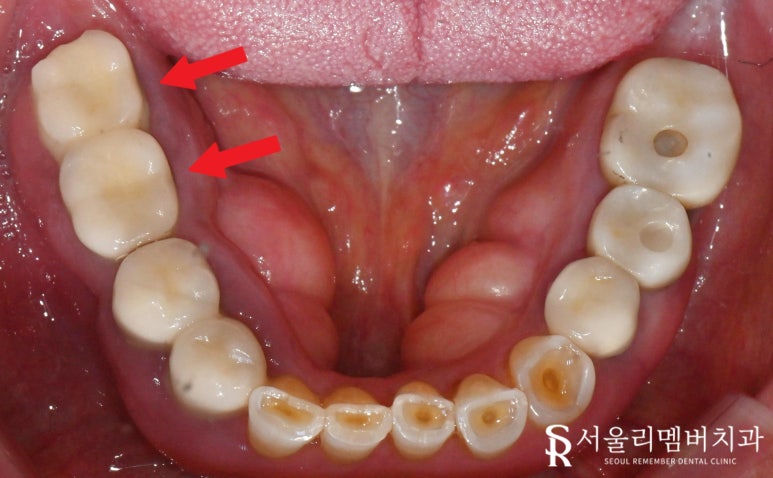
Looking at the case shown today at the Sadang Station dental clinic,
a bridge prosthesis has been restored on the two large lower right molars,
but if you look closely, the gum around that area is swollen,
and bleeding occurs with just a little stimulation.
As inflammation builds up,
there is a reaction even to very slight irritation,
and since the outside is covered with a prosthesis,
we took an X-ray to accurately check the internal condition.
However, the problem visible on the panoramic image was much more serious:
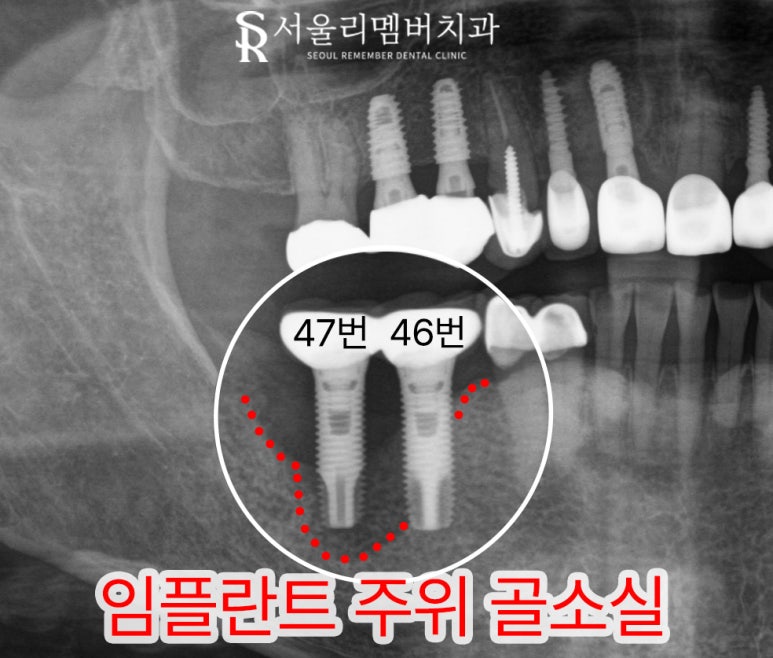
There is severe bone loss around fixtures 46 and 47.
The bone has already completely resorbed up to the end of the existing fixtures,
and at this level, the mobility must have been very significant,
but because the prosthesis was made as a bridge and connected to tooth 46,
it seems to have managed to stay in place without falling out.
However, by now fixture 46 has also lost nearly half of its bone support,
so the prognosis is poor.
What was the cause?
At the Sadang Station dental clinic,
if we infer why this problem occurred,
it is likely that the most common
and important cause was that
the surrounding area was not kept hygienically clean.
Since implants are not living natural teeth,
they have no nerves and cannot feel pain,
so even when the bone has completely resorbed
and the implant becomes loose,
it may not hurt much,
which is why the problem may not have been noticed.
In addition, food debris that once got trapped
was not removed and remained in place,
continuing to cause inflammation,
and as a result peri-implantitis developed,
leading to a condition as severe as this.
Treatment method
At the Sadang Station dental clinic,
for teeth 46 and 47,
we decided to remove the two fixtures that had failed to achieve osseointegration
and perform re-implantation.
So, using a dedicated implant removal kit,
we carefully took them out and thoroughly removed the remaining granulation tissue.
After creating such a clean environment,
we proceeded with surgery again,
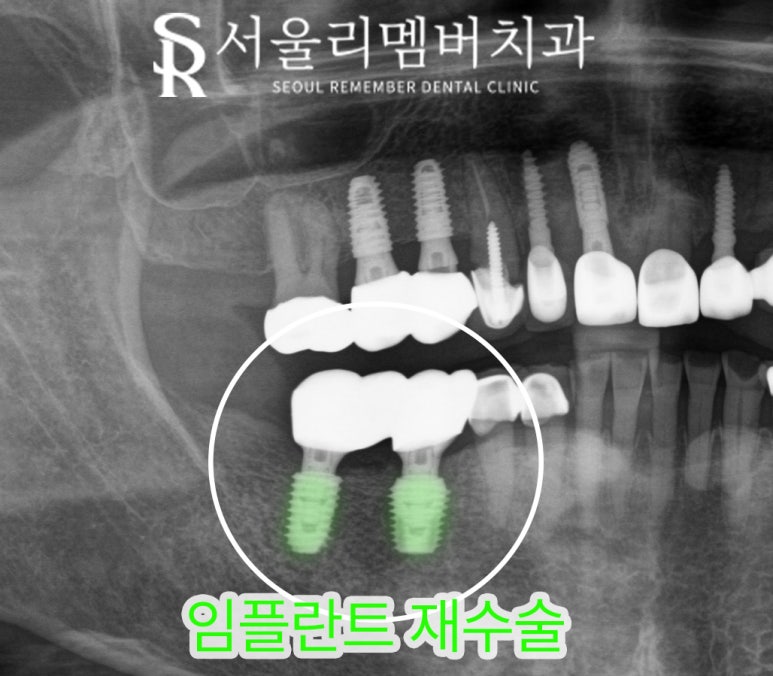
Because the bone had been so badly damaged,
we placed the implant slightly farther back than the original site
to help maintain initial stability,
and we also selected a thicker implant size
so that it could be firmly seated in the alveolar bone,
which led to a fairly successful result.
After removing all infected tissue and performing the reoperation,
the environment became clean again,
and because a large amount of bone grafting (GBR) had been done,
we can now confirm that new bone has also filled in around the area.
At the Sadang Station dental clinic,
looking at the final prosthesis,
I’ll explain one more thing.
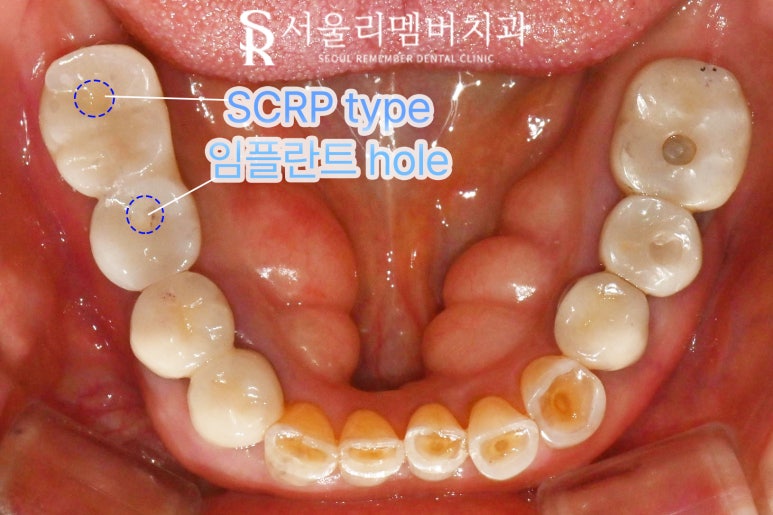
Do you see the small hole on the occlusal surface?
This is an SCRP type,
and it was intentionally made.
Over the long term,
there may be times when maintenance such as screw loosening, prosthesis fracture, or occlusal adjustment is needed,
and sometimes the inside may need to be cleaned and disinfected,
so you can think of this as something that was intentionally included from the stage of prosthesis fabrication.
In any case, from the patient’s perspective,
it is covered in a tooth-like color,
so you probably won’t notice it ㅎㅎ
Today, at the Sadang Station dental clinic,
we showed a case in which, due to peri-implantitis,
the implant was removed and then re-implanted.
It may not be that it doesn’t hurt;
it may be that you do not realize it hurts.
So even if there is no particular pain or discomfort in the mouth,
please make it a habit to keep an eye on things through regular checkups.
Thank you for reading.
I was Director Park Jung-gi from Seoul Remember Dental Clinic near Sadang Station.