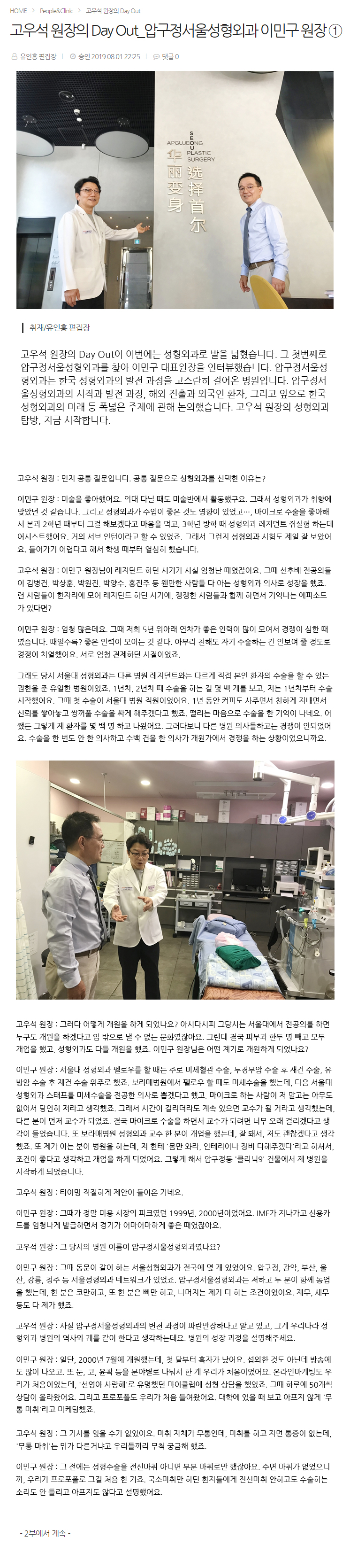
Director Go Woo-seok’s Day Out has now expanded into plastic surgery. For the first stop, we visited Apgujeong Seoul Plastic Surgery and interviewed CEO Director Lee Min-gu. Apgujeong Seoul Plastic Surgery is a hospital that has closely followed the development of plastic surgery in Korea. We discussed a wide range of topics, including the hospital’s beginnings and growth, overseas expansion and foreign patients, and the future of Korean plastic surgery. Director Go Woo-seok’s visit to plastic surgery begins now.
Director Go Woo-seok: First, a common question. What made you choose plastic surgery?
Director Lee Min-gu: I liked art. Even when I was in medical school, I was active in the art club. So I think plastic surgery suited my taste. And the fact that plastic surgery was a well-paying field also had an influence... I liked microsurgery, so starting in my second year of pre-clinical studies, I made up my mind to do that, and during my third-year vacation I assisted with rat experiments for a plastic surgery resident. I could almost call myself a sub-intern. Maybe that’s why I also did best on the plastic surgery exam. Since it was said to be hard to get into, I studied hard from my student days.
Director Go Woo-seok: Director Lee Min-gu’s residency period was actually an incredible time, wasn’t it? At that time, the senior and junior residents grew into plastic surgeons that almost everyone knows—people like Kim Byeong-geon, Park Sang-hoon, Park Won-jin, Park Yang-su, and Hong Jin-ju. When such people were all together doing their residency, do you remember any episodes from being with those outstanding colleagues?
Director Lee Min-gu: There were so many. Back then, the five years above and below us included many talented people, so competition was intense. The more so? It seems like good talent gathers. Even if we were close, the competition was so fierce that we wouldn’t even show each other our own surgeries. It was a time when everyone was watching each other very closely.
Still, compared with residents at other hospitals, the Department of Plastic Surgery at Seoul National University was the only one that gave us the authority to perform surgery on our own patients directly. I saw hundreds of surgeries being done in the first and second years, and I started operating from my first year. My first surgery was on a staff member at Seoul National University Hospital. I built trust by being friendly with him for a year—buying coffee and spending time together—and then said I would do his double-eyelid surgery at a lower price. I remember being very nervous during that surgery. In any case, I went on to perform surgery on several hundred of my own patients before leaving. Because of that, I couldn’t really compete with doctors from other hospitals. It was a situation where a doctor who had never performed surgery was competing in private practice against a doctor who had done hundreds of cases.
Director Go Woo-seok: Then how did you end up opening your own clinic? As you know, at that time, if you were a resident at Seoul National University, it was a culture where no one could even say out loud that they wanted to open a clinic. But in the end, everyone except one or two dermatologists opened practices, and plastic surgeons did too. What led you to open your own practice?
Director Lee Min-gu: When I was a fellow in the Department of Plastic Surgery at Seoul National University, I mainly did microsurgery, reconstruction after head and neck cancer surgery, and reconstruction after breast cancer surgery. I also did microsurgery when I was a fellow at Boramae Hospital, and they said they would next hire a Seoul National University plastic surgery staff member who specialized in microsurgery. I was the only one doing micro work besides myself, so I naturally assumed it would be me. So I thought that if I stayed on, even if it took time, I would become a professor. But someone else became a professor first. In the end, I thought it would take too long to become a professor while continuing microsurgery. Also, one professor in the Department of Plastic Surgery at Boramae Hospital opened a clinic, and it was successful, so I thought it could work for me too. And someone I knew was running a hospital and told me, “Just bring yourself; I’ll take care of the interior and the equipment.” I thought the terms were good, so I decided to open a clinic. That’s how I started my practice in the building called “Clinic 9” in Apgujeong-dong.
Director Go Woo-seok: So an offer came at just the right time.
Director Lee Min-gu: That was really the peak of the cosmetic market, in 1999 and 2000. It was after the IMF crisis, and credit cards were being issued on a massive scale, so the economy was unbelievably good.
Director Go Woo-seok: Was the hospital’s name Apgujeong Seoul Plastic Surgery at that time?
Director Lee Min-gu: Back then, there were several Seoul Plastic Surgery clinics run together by alumni across the country. There was a Seoul Plastic Surgery network in places like Apgujeong, Gwanak, Busan, Ulsan, Gangneung, and Cheongju. Apgujeong Seoul Plastic Surgery was a partnership between me and two others. One person only did noses, another only did bones, and I did everything else. I also handled the finances and taxes.
Director Go Woo-seok: I actually understand that the history of Apgujeong Seoul Plastic Surgery has been quite tumultuous, and I think it parallels the history of plastic surgery clinics in Korea. Please explain the hospital’s growth process.
Director Lee Min-gu: First, we opened in July 2000, and we were in the black from the very first month. We weren’t even actively promoting ourselves, but we appeared on TV a lot. Also, we were the first to divide procedures by specialty areas such as eyes, noses, and facial contouring. We were also the first to do online marketing. We provided plastic surgery consultations on Cyworld’s Myclub, which was famous for “Sun-young, I love you.” At that time, about 50 consultations were posted a day. And we were also the first to introduce Propofol. When I saw it at the university, we marketed it as “painless anesthesia.”
Director Go Woo-seok: I could never forget that article. Anesthesia itself is painless—if you’re put under anesthesia and fall asleep, there’s no pain. We were all very curious among ourselves about what was different about “painless anesthesia.”
Director Lee Min-gu: Before that, plastic surgery was done only under general anesthesia or local anesthesia, right? There was no sedation anesthesia, so we were the first to do that with propofol. For patients who had only received local anesthesia before, we explained that they could undergo surgery without general anesthesia, without hearing the sounds of the operation, and without pain.