At Ogana Cell Dermatology Clinic Jamsil Branch, we
explain the relationship between collagen and skin
"Collagen is good for skin elasticity"
"If you take collagen, you look younger"
You may have heard statements like these at least once.
One reason skin becomes thinner and duller with age
is the decrease in collagen.
Collagen plays an important role in supporting the structure
of the skin and maintaining elasticity,
so changes in its amount or quality can lead to skin changes.
Shall we take a look at the relationship between collagen and skin?
What is collagen?
Collagen is one of the most abundant proteins
that make up our body.
It accounts for about 30% of the body's total protein and
about 70–80% of the skin's protein.
Collagen supports the skin with a firm yet flexible structure
and helps keep it elastic.
In other words, collagen is a structural component that forms
a fibrous framework inside the skin, so when there is enough
collagen, the skin looks firm and vibrant, and when it decreases,
elasticity drops and wrinkles form more easily.
Types of collagen are more diverse than you might think
So far, more than 28 types of collagen have been identified.
Among them, the ones mainly involved in the skin are the following!
Type I collagen
It makes up about 90% of total collagen.
It mainly functions in the skin, bones, ligaments, and more.
Type III collagen
It is abundant in tissues related to skin elasticity,
and works together with Type I.
Type IV collagen
It is present in the basement membrane
and is an important collagen that supports skin cells.
In particular, Type I and Type III collagen play important
structural roles in the skin's dermis layer, and they tend
to decrease with aging or external damage.

How does collagen change as we age?
Collagen naturally decreases from the late 20s!
Of course, there are individual differences, so in some cases
the decrease may appear faster.
It is known to decrease by about 1% every year after the
late 20s, and after the 40s, a rapid decline in elasticity,
volume loss, and fine lines may be observed.
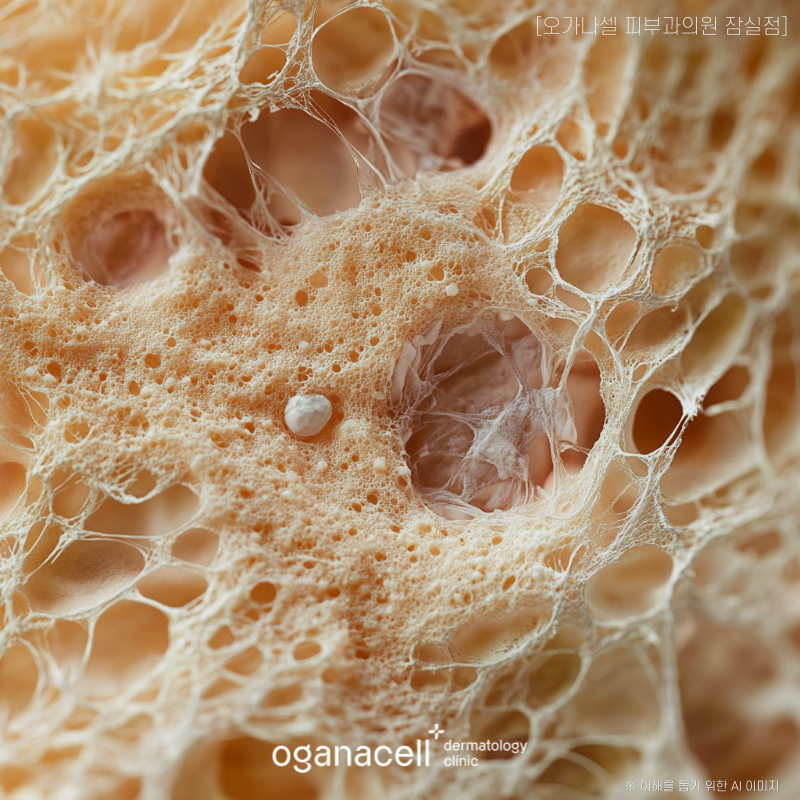
The reason collagen changes with age, such as decreased
elasticity, includes a decline in synthesis ability.
Let's take a closer look.
The function of fibroblasts declines, slowing the rate at which
collagen is produced. In other words, synthesis ability decreases.
Also, UV rays, stress, and oxidative damage activate MMPs
(matrix-degrading enzymes).
In particular, UVA is the biggest external factor that destroys
collagen. That is why we always strongly emphasize the use
of sunscreen!
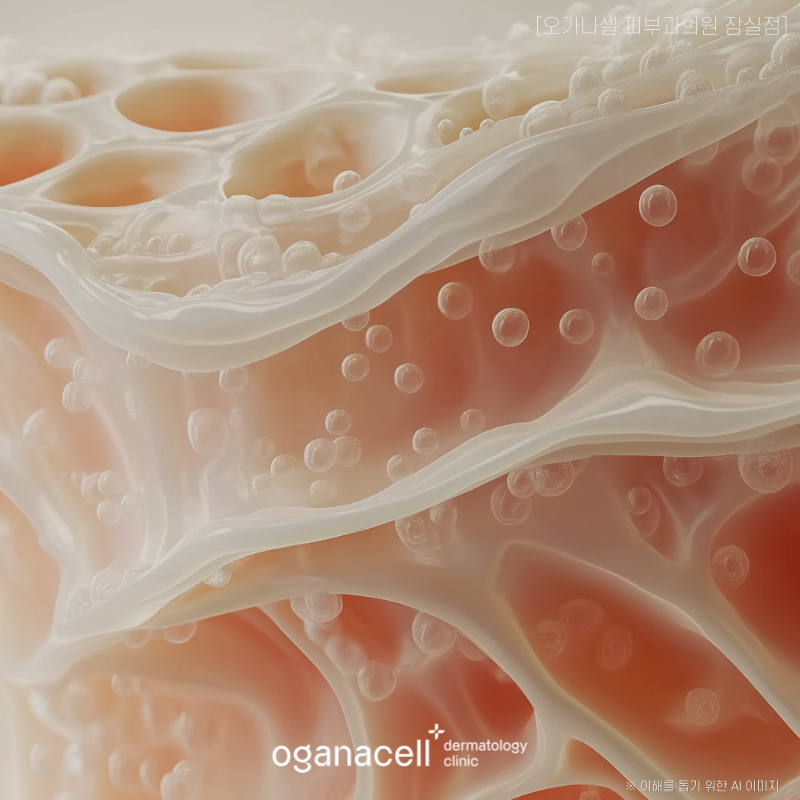
Does eating collagen help the skin?
Since collagen is a protein, when it is ingested,
it is digested and broken down into amino acids.
In other words, the collagen you eat does not directly
turn into skin collagen.
Recently, as the absorption rate of collagen peptides
(a low-molecular-weight form) has drawn attention,
research is being conducted on whether they can help create
an environment that induces collagen synthesis to a certain extent.
However, since it cannot be concluded how specific foods or
health functional foods affect the skin,
a balanced diet and healthy lifestyle habits are important.
.
Where else is collagen found besides the skin?
Collagen plays an important role not only in the skin,
but also in various parts of the body such as bones,
joints, and blood vessels.
Collagen in bones is essential for maintaining bone structure
along with calcium, and in joints, collagen in cartilage is
responsible for joint flexibility and support.
Collagen is also present in blood vessel walls,
contributing to the maintenance of elasticity.
It also serves as a support structure in muscles, organs,
and the cornea.
As such, collagen is a structural protein connected to
overall health, and the skin can be seen as one of its mirrors.
Collagen is the foundation of healthy skin structure!
Skin is not made up of just the surface.
The dermis that supports it, and the collagen structure that
supports the dermis, are the core of skin health.
Collagen naturally decreases over time, but
through everyday efforts such as lifestyle habits, diet,
and UV management, the rate of collagen loss can be eased.
Understanding the skin is not just for beauty;
it is also a process of understanding your body more deeply.
Above all, care that adds what is right for you and removes
what is unnecessary may be important. Thank you.








#Collagen #CollagenSkin #SkinCollagen #AgeWhenSkinCollagenDecreases #CausesOfCollagenDecrease #JamsilDermatology