Hello.
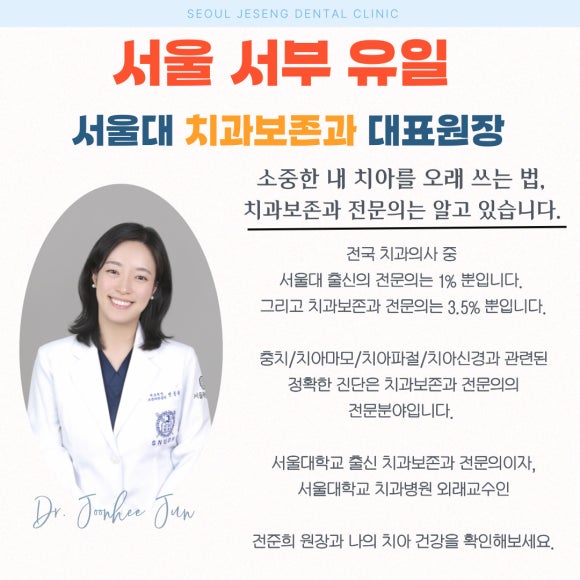
I’m Dr. Jeon Jun-hee, director of Sinchon Chia Jikimhee :)
I am a specialist in conservative dentistry.
Conservative dentistry is the department that diagnoses cavities and provides treatment according to each stage, in simple terms.
Based on my experience treating many pregnant patients and women preparing for pregnancy,
and on what I have seen and heard from them, I wrote this post.
During pregnancy, everything requires caution.
I also experienced the connection between dental care and pregnancy and childbirth firsthand through my two pregnancies and deliveries.
Especially during my first pregnancy, I would check mom cafes every day and constantly look up what was okay and what was not.
You may have seen this at least once on mom cafes or on the internet.
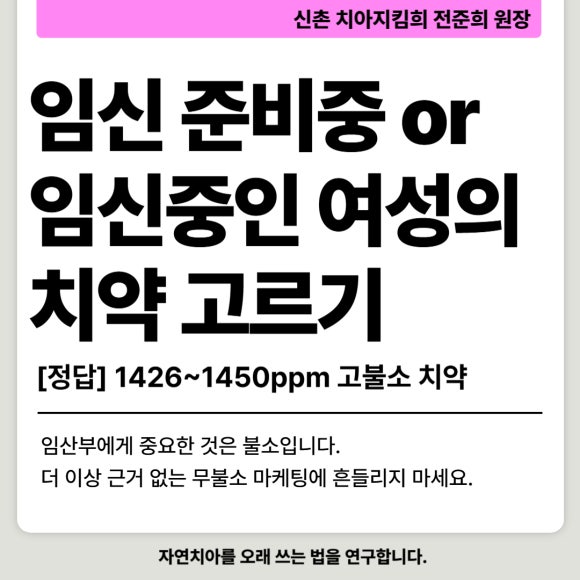
You need to use fluoride-free toothpaste during pregnancy! That is what it says.
→To put it bluntly, that is completely untrue.
In fact,
fluoride-free toothpaste is being sold under the noble-sounding name of “toothpaste for pregnant women,”
while shaking the minds of anxious expectant mothers.
It is truly deplorable.
Why you should use high-fluoride toothpaste
Not only pregnant women,
but everyone should use high-fluoride toothpaste.
Children should also use high-fluoride toothpaste once they reach an age where they can spit it out on their own.
Fluoride is one of the few scientifically proven substances that improves the condition of teeth and helps prevent cavities.
Fluoride adheres to the teeth and forms a tooth barrier that does not easily break down by acidic substances.
In addition, it directly suppresses the occurrence of cavities by reducing the number of S. mutans, a cavity-causing bacterium.
During pregnancy, do you vomit because of morning sickness or have a lot of acid reflux due to indigestion?
This means your teeth are repeatedly being attacked by stomach acid. In the oral cavity of a pregnant woman undergoing acidification like this, fluoride is absolutely necessary.
Fluoride and a child’s brain development?
I heard that the more fluoride you consume, the more negatively it affects a child’s brain development.
Such concerns were raised in a study recently conducted under the leadership of the NIH.
However, that was an explanation about the concentration of fluoride in drinking water.
When fluoride was added to tap water for public health purposes, children born in areas where the concentration was excessively high had slightly lower IQs.
Unless you squeeze toothpaste out and eat it with every meal, fluoride intake at a level that would affect the fetus simply does not occur.
Home dental care during pregnancy: how?
Choosing toothpaste for pregnant women
= high-fluoride + fluoride mouthwash
Both the NIH (National Institutes of Health) in the United States,
and the NHS (National Health Service) in the United Kingdom
emphasize the importance of oral care during pregnancy.
And at the center of it is fluoride care.
Use toothpaste containing fluoride
and use a fluoride-containing mouthwash.
High-fluoride toothpaste (1000 ppm or more, with 1400–1500 ppm being more effective for preventing caries), and if possible, fluoride mouthwash as well.
At this point, I sincerely hope you will no longer be swayed by fear marketing.
Dental Care Guardian Dr. Jeon Jun-hee’s recommendation
Personally, I recommend Sensodyne.
It is an affordable product focused on functionality.
-
Low price
-
Contains 1426 ppm fluoride
-
Contains potassium nitrate
Potassium nitrate is a scientifically proven ingredient that stabilizes the nerves in teeth and helps relieve sensitivity.
If your gums feel loose or you feel sensitivity during pregnancy,
you must use toothpaste containing potassium nitrate along with high fluoride.
#ToothpasteRecommendationForPregnantWomen
#DrJeonJunheeDentalCareGuardian