Hello.
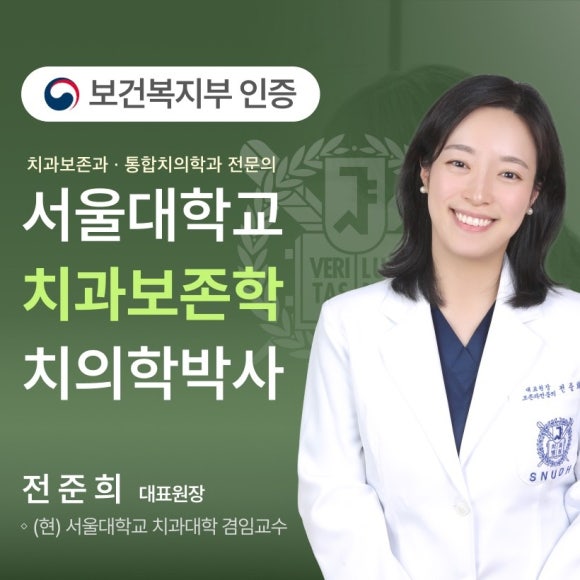
I am Jeon Jun-hee, director of a small dental clinic in Sinchon,
Sinchon Teeth Guardian, Jeon Jun-hee.
Having experienced two pregnancies and childbirths,
and while listening to patients preparing for pregnancy or
who are currently pregnant in the treatment room,
I planned this post.
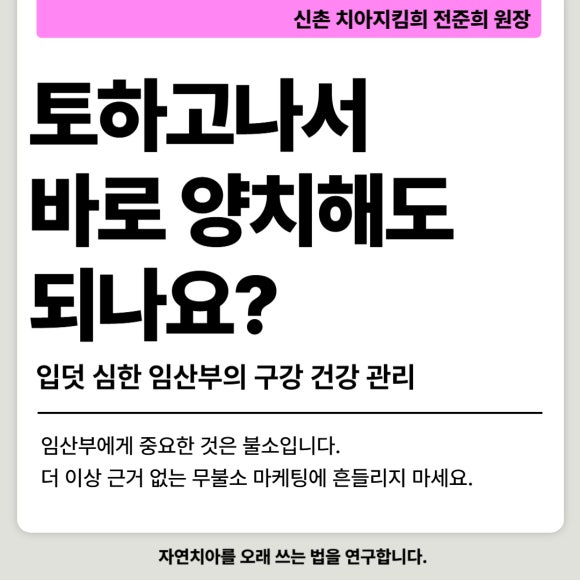
Why is oral health more important during pregnancy?
During pregnancy, various changes occur throughout the body, and oral health is no exception.
Because hormonal changes, changes in eating habits, and morning sickness can make oral diseases more likely than usual, careful management is especially needed during this period.
Cavities develop more easily during pregnancy.
Many people vomit frequently because of morning sickness or find themselves craving sweets often, right?
When vomiting makes the mouth acidic, or when you frequently eat sweet foods and brushing becomes difficult, it creates an environment where cavities can form more easily.
Brushing after vomiting? Wait a moment!
After vomiting due to morning sickness, your teeth are exposed to stomach acid, so brushing right away can actually wear down the teeth even more.
In that case, rinse with 1 teaspoon of baking soda + 1 cup of water to neutralize the acidity, then brush after about 30 minutes.
If you do not have time to prepare baking soda...
Rinse your mouth several times with bottled water or tap water.
How should you care for your mouth?
The ADA (American Dental Association) recommends brushing twice a day for at least 2 minutes with a soft-bristled toothbrush,
which seems to reflect the cultural background in schools and workplaces where people do not brush after lunch.
Foods that enter the mouth, especially carbohydrates, are broken down into sugar and become food for cavity-causing bacteria, so
it is best to brush after every meal and after every snack.
At this time,
-
Be sure to use toothpaste that contains fluoride.
-
Clean between your teeth with floss or interdental brushes at least once a day! Doing it before bed is especially effective.
-
If morning sickness is severe, using a fluoride-containing mouthwash is also a good option. The ADA also recommends having fluoride varnish applied at a dental clinic.
Non-fluoride? Low fluoride? What is the proper fluoride content?
[What fluoride does]
- It is one of the most effective ingredients for preventing cavities; it helps remineralize teeth and suppresses bacterial activity.
[Is it safe for pregnant women?]
-
Both the ADA (American Dental Association) and ACOG (American College of Obstetricians and Gynecologists) recognize the use of fluoride toothpaste as a safe and recommended oral care method for pregnant women.
-
Fluoride at 1000–1500 ppm is a concentration commonly used in over-the-counter toothpaste,
-
and using ordinary toothpaste for brushing has almost no systemic absorption and does not affect the fetus.
[Conclusion]
A fluoride toothpaste with 1400–1500 ppm is safe for everyday use by pregnant women.
A high-fluoride toothpaste with 1000 ppm or more is more effective at preventing cavities than a low-fluoride toothpaste.
However, if you are taking fluoride tablets or undergoing high-concentration fluoride treatment (5000 ppm or higher) at a hospital, it is better to decide after consulting a medical professional.
So, what is the conclusion?
Oral care during pregnancy is a healthy choice not only for yourself but also for your baby.
With brushing three times a day and regular dental checkups,
please protect your clean and healthy smile throughout pregnancy 😊
[Source] American Dental Association
<What is Director Jeon Jun-hee, a specialist in conservative dentistry, one-pick toothpaste?>
Check it out in the post below.