Hello,
I’m Jeon Jun-hee, a specialist in restorative dentistry,
and I run a small dental clinic in Sinchon.
I have also experienced two pregnancies and two births,
so from the perspective of an expectant mother,
I have thought about the safest and most effective way to manage oral health.
Following my previous post,
today I will look at the causes and treatment of pregnancy gingivitis, and
a toothpaste that helps relieve tooth sensitivity.
↓ Here is a key summary for busy modern readers. ↓
Key Summary ★★★
-
Because of hormonal changes, pregnant women are more likely to develop inflammation in the gums and the bone around the gums, and inflammation of the gum bone in particular is directly linked to the health of the fetus.
-
Scaling (= tartar removal) and gum treatment (= deep scaling) are both safe treatments that pregnant women can receive, and they are affordable treatments covered by insurance.
-
Dentin hypersensitivity (= sensitive teeth) can be improved through the toothpaste used every day; in that case, check whether it contains potassium nitrate and fluoride of 1000 ppm or more (preferably 1400–1500 ppm).
START!
My gums are swollen and bleeding – pregnancy gingivitis
During pregnancy, due to the influence of female hormones, the gums become more sensitive to bacteria.
So when brushing, symptoms such as easy bleeding or swelling of the gums (gingivitis) may occur often.
Hormones cannot be changed,
so reducing bacteria is the most efficient way to
prevent pregnancy gingivitis.
That is none other than
scaling.
If you are preparing for pregnancy,
or in the second trimester,
please visit a dental clinic with a light heart
and make sure to receive scaling (= tartar removal).
Tartar removal is covered by insurance once a year,
so you can receive it at a low cost with out-of-pocket expenses of under 20,000 KRW.
I already used my insurance scaling!
That’s okay.
Partial tartar removal, which selectively removes tartar that has formed in the meantime,
is also covered by insurance.
The cost is even lower than insurance scaling.
A gum lump that looks like a bump—should I be worried?
https://www.smilesforlifeoralhealth.org/download/module-5-slide-21/
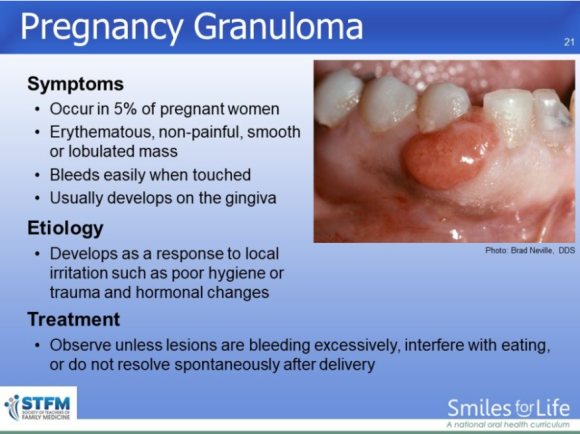
During pregnancy, a small lump called a “pregnancy granuloma” may also form.
The occurrence rate is only 5%,
but if something like this were to happen inside my own mouth,
I would be very startled too.
It usually appears on the gums and has the shape of red, soft tissue connected to the gums by a thin stalk.
There is almost no pain, but if the lump grows or bleeding is severe, it can be removed easily at a dental clinic.
It is also said that “pregnancy granuloma” occurs more often when hygiene is poor,
which once again shows how basic and
important scaling is as a preventive treatment.
Is there a link between periodontitis and premature birth?
When oral hygiene management is poor,
if simple swollen and painful gums are gingivitis,
inflammation that spreads to the bone supporting the gums below the gums,
causing more severe swelling and pain,
or even loose teeth, is called periodontitis.
It is already widely known that periodontitis occurring during pregnancy is associated with premature birth or low birth weight.
A clear causal relationship is still being studied,
but one thing is certain: even during pregnancy, periodontal treatment (= gum treatment) is safe,
and it can help improve both the mother’s oral health and the baby’s health.
Periodontitis cannot be resolved with scaling alone.
It is a stage that requires so-called deep scaling, known as gum treatment.
Because this is a treatment that pregnant women can safely receive,
don’t endure it—please visit a dental clinic and get examined.
Of course, since it is covered by insurance,
the financial burden is not large :)
My gums feel loose, and my teeth are extremely sensitive!
When gingivitis and periodontitis occur,
an unwelcome guest arrives.
That guest is tooth sensitivity,
which can be greatly improved through daily brushing.
Tooth sensitivity toothpaste! Check the ingredients
I purchased and personally tried most of the tooth sensitivity toothpastes available on the market,
or researched their ingredient lists.
Please make sure that the following two ingredients are included.
✅ 1. Potassium Nitrate
● Effect:
- A representative ingredient for relieving tooth sensitivity, it reduces sensitive symptoms by blocking nerve signal transmission in the tooth.
● Is it safe for pregnant women?
-
The U.S. FDA has approved potassium nitrate as an OTC (over-the-counter) toothpaste ingredient,
-
and because there are almost no reports of toxicity and systemic absorption is very low when used topically, it is also considered safe for pregnant women.
-
It has also been widely used for decades in tooth sensitivity toothpastes.
✅ Conclusion: It is a safe ingredient for pregnant women when used within normal amounts.
✅ 2. Fluoride 1426 ppm (Sodium Fluoride)
● Effect:
- The most effective ingredient for preventing cavities, it helps remineralize teeth and suppresses bacterial activity.
● Is it safe for pregnant women?
-
The ADA (American Dental Association) and ACOG (American College of Obstetricians and Gynecologists) both
-
recognize fluoride toothpaste use as a safe and recommended oral health practice for pregnant women.
-
Fluoride at 1000–1500 ppm is a concentration commonly used in commercial toothpastes,
-
and simple use of toothpaste for brushing results in almost no systemic absorption and does not affect the fetus.
✅ Conclusion: A 1426 ppm fluoride toothpaste is at a level that pregnant women can safely use in daily life.
However, if fluoride tablets or high-concentration fluoride (5000 ppm or more) treatment is performed at a clinic, it is better to decide after consulting the medical staff.
Three-line summary ★★★
-
Because of hormonal changes, pregnant women are more likely to develop inflammation in the gums and the bone around the gums, and inflammation of the gum bone in particular is directly linked to the health of the fetus.
-
Scaling (= tartar removal) and gum treatment (= deep scaling) are both safe treatments that pregnant women can receive, and they are affordable treatments covered by insurance.
-
Dentin hypersensitivity (= sensitive teeth) can be improved through the toothpaste used every day; in that case, check whether it contains potassium nitrate and fluoride of 1000 ppm or more (preferably 1400–1500 ppm).
What is Dr. Jeon Jun-hee’s top pick toothpaste?
[Source] American Dental Association