As the number of medical institutions using anesthetics such as propofol and midazolam has recently increased, more people have come to regard general anesthesia as a simple medical procedure.
This is because most people wake up without any problems and recover enough to return to their daily lives after resting for a certain period of time.
However, although rare, there are also many cases in which this leads to death, so caution is required.
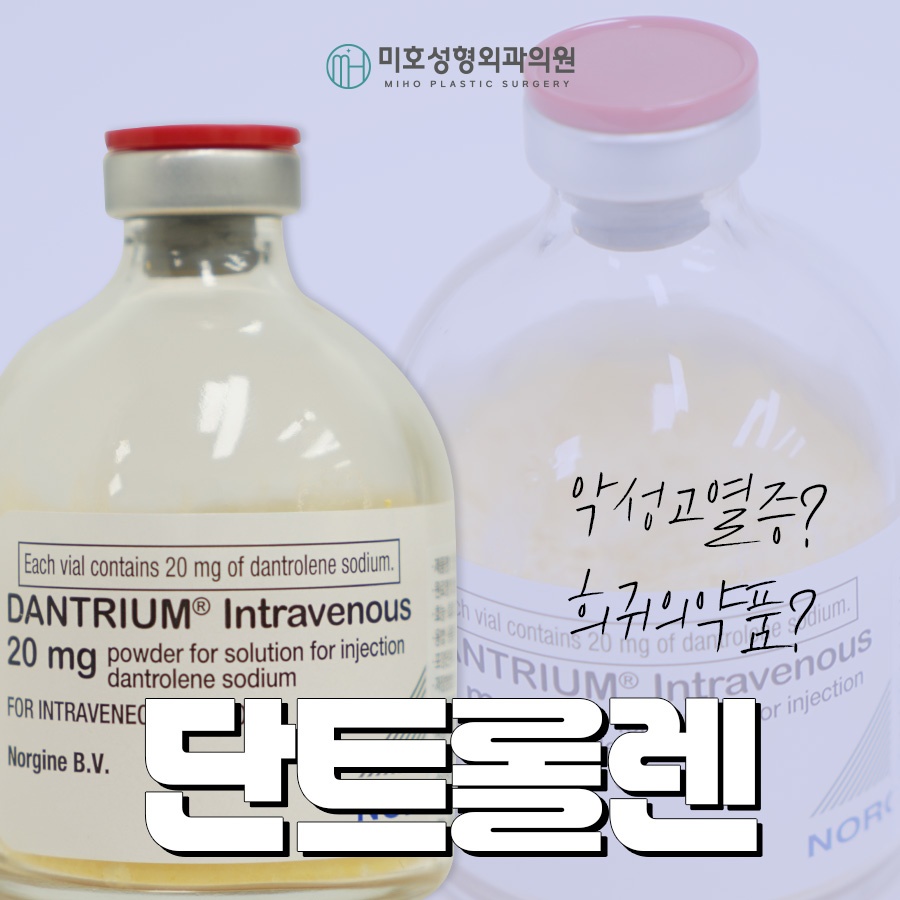
Today, we will look at malignant hyperthermia, a common topic when discussing cases like this, and dantrolene, which is considered an essential medication for improving these abnormal symptoms.

Malignant hyperthermia is one of the adverse reactions that may occur when inhalational anesthetics are used. It refers to a disease in which a metabolic disorder develops due to certain ingredients or neuromuscular blockers.
The cause of this disease has not been clearly identified.
However, during the process of inhaling the medication, potassium levels inside muscle cells rise and the metabolic rate also increases, leading to unexplained tachycardia, rapid breathing, elevated body temperature, muscle rigidity, and cyanosis.
Dantrolene is the medication prescribed in such cases, and recently, an increasing number of medical institutions have begun keeping it in stock in advance, drawing attention.

This disease is not common enough to be observed in more than one out of every 60,000 cases of general anesthesia.
However, when there is a congenital defect of the skeletal muscle membrane or a family history, the incidence may rise to as high as one in 10,000. Therefore, caution is needed if a parent or sibling has had the same disease.
In addition, more cases have been reported among people with relatively greater muscle mass, such as children and young adults, rather than infants or older adults. If anesthesia cannot be avoided, checking in advance whether dantrolene is available is also considered a good approach.
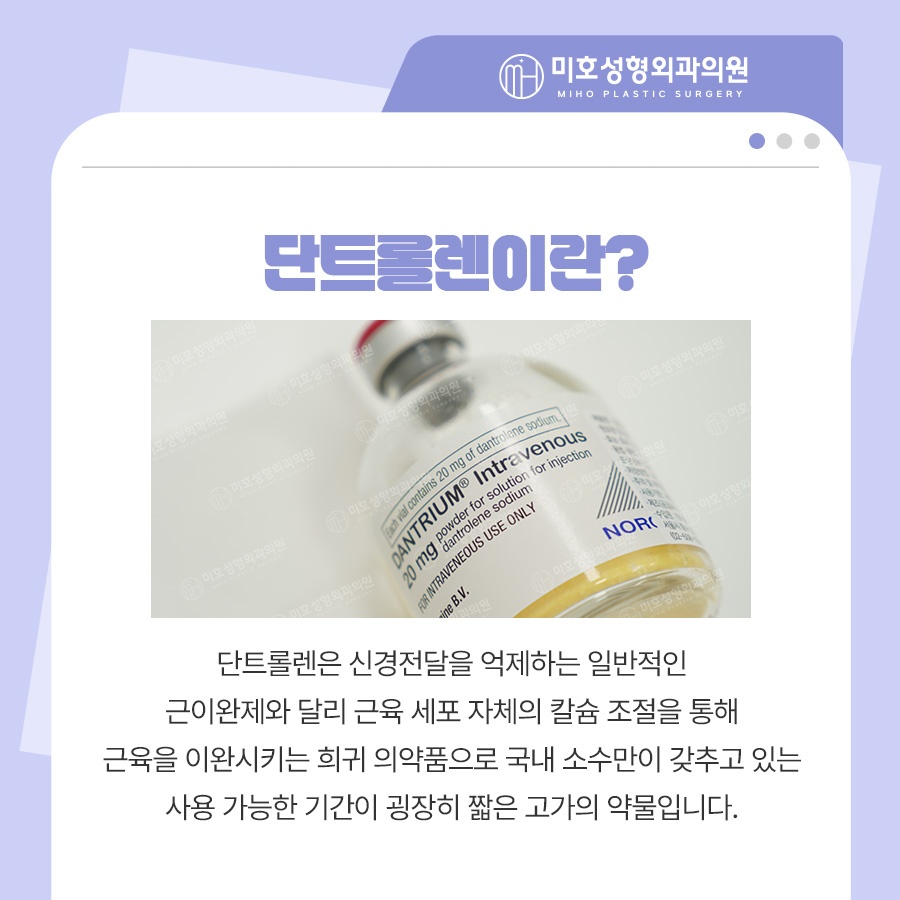
It is also helpful to know the characteristics of dantrolene, a medication that is essential when malignant hyperthermia develops, in order to protect your health.
This medication is a sarcoplasmic reticulum inhibitor. It generally blocks the separation of calcium ions from muscle cells bound to the cell membrane, prevents muscle excitation and contraction, and promotes muscle relaxation.
Unlike baclofen and similar medications, which improve symptoms by blocking nerve–muscle conduction through the brain or spinal cord, this medication acts directly on human muscle fibers, which is why it is sometimes regarded as a unique drug.
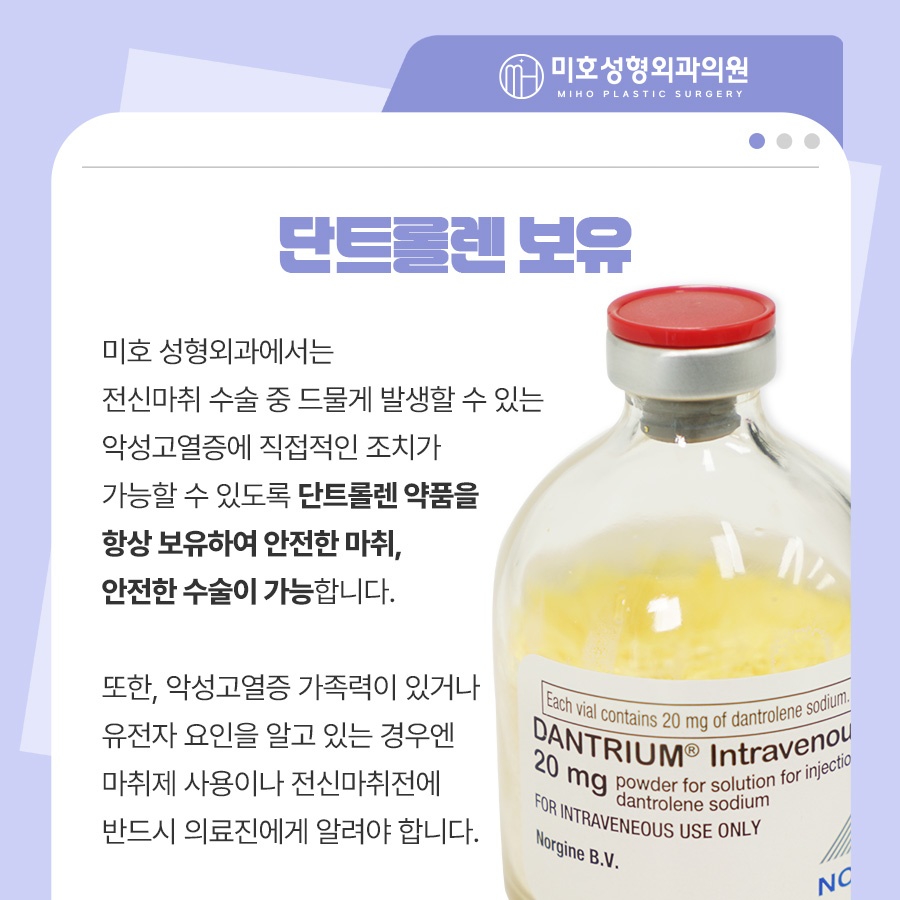
This medication is produced as oral capsules or an injection.
For malignant hyperthermia, it is used intravenously. After administration, it blocks ryanodine receptors, which control calcium movement within muscle cells, preventing the muscles from becoming rigid.
However, it is not easy to use.
For clinical use, the standard dose is 20 mg, and it is supplied in vials containing 3 g of mannitol to improve solubility.
In particular, it is marketed as a freeze-dried powder, so before administration it must be thoroughly dissolved using 60 mL of normal saline or sterile distilled water.

The appropriate concentration of the dantrolene dissolved in this way is approximately 0.33 mg/mL, and it can be used once it has become an alkaline solution with a pH of approximately 9.5.
For safety, it should also be used within six hours of preparation.
In 2022, a formulation that was easier to dilute was released and received a favorable response. With this formulation, a high-concentration solution of 50 mg/mL can be readily prepared in 250 mL of medication, and it has generally been regarded as making the preparation process more convenient.

The administration process is also important.
When symptoms appear, the use of inhalational anesthetics should first be stopped.
Then, 2 mg of dantrolene per kilogram of body weight should be injected intravenously. The interval should be adjusted according to the symptoms, and treatment should be continued for at least 24 hours.
Afterward, hyperventilation with 100% oxygen should be performed, and additional measures such as arterial or ureteral intubation may be taken if necessary.
It is also helpful to measure core body temperature to assess the condition, provide fluids, and lower the body temperature by cooling the surface of the skin.

It is important to carefully monitor whether any unusual problems develop after administering dantrolene.
Nausea, vomiting, and drowsiness are among the problems that can easily occur.
In addition, the muscles may suddenly relax, causing weakness throughout the body, and in severe cases, the person may complain of difficulty breathing.
Many people also report feeling anxious due to an irregular heart rate, and cases of temporary low blood pressure are occasionally observed.
These symptoms disappear along with the medication's effects as the body recovers, so there is generally no need for particular concern.

However, caution is needed when using the medication if there is a history of serious lung disease or breathing difficulties.
The medication's ingredients may also cross the placenta and potentially affect the fetus, so careful monitoring is required when administering the injection to pregnant women.
Careful consideration is also necessary if the person has an allergic reaction to the medication's ingredients.
Considering that there are few alternatives to this medication when malignant hyperthermia has been diagnosed, the prevailing view is that rather than unconditionally avoiding its prescription, it is more effective to use it appropriately under careful supervision by medical staff.

This disease, which is accompanied by high fever and other symptoms, progresses exceptionally rapidly after onset and can lead to death if it is not properly managed in the early stages.
It is advisable to provide intensive care for 48 hours not only during anesthesia but also after the person awakens.
Fortunately, even when these symptoms occur, recovery is generally not difficult if proper measures, such as intravenous dantrolene and oxygen administration, are taken.
However, before choosing a medical institution, be sure to check whether it has an environment capable of responding quickly to emergencies and whether sufficient supplies of the necessary medications are available.


Previous image
Next image