
Hello, I’m Dr. Kim Hyeong-taek.
In actual consultations at Cowon Plastic Surgery, many people first mention that the tip of their nose looks wide and spread out.
However, when looking at the face as a whole, quite a few people also have a low glabella or an unclear starting point of the nasal bridge, which makes the blunt appearance of the tip stand out even more.
“Will improving only the tip of my nose also make my face look less stuffy?”
In my view, the width of the nasal tip, the spread of the nostrils, the height of the nasal bridge, and the line beginning at the glabella are not elements that move independently. They need to be viewed as a structure that creates one continuous flow within the face.
It is easy to think that if the tip of the nose is blunt, only that area needs to be reduced. In reality, however, if the glabella is low and the nasal bridge appears to begin from the middle of the nose, the overall line may not connect smoothly even after refining the tip.
This is also why the change in appearance may not be as noticeable as expected.
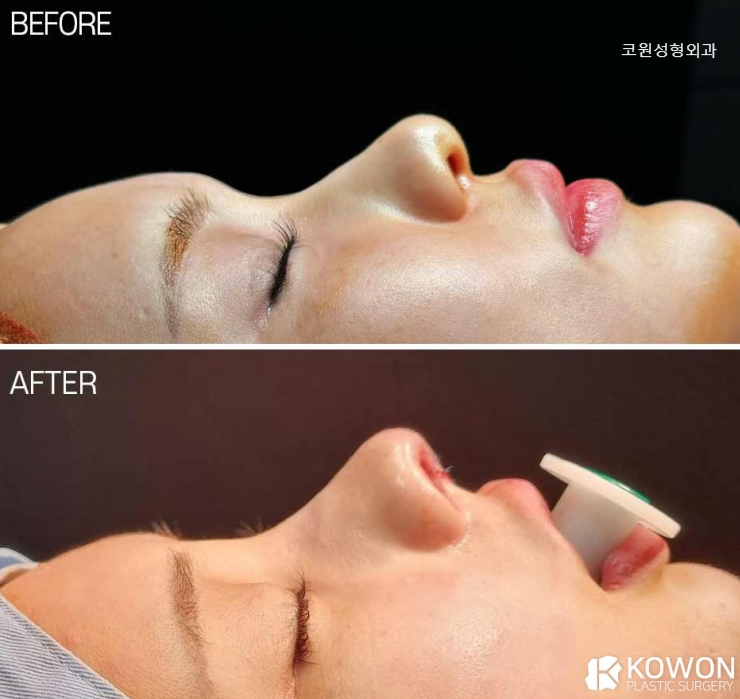
Used with the model’s consent.
Bulbous Nose Surgery Before and After
The key point in this case was that the patient had both a bulbous nose with a wide, spread-out tip and a low glabella. Before surgery, the nasal bridge did not begin naturally at the glabella and appeared to rise from the middle of the nose, making the overall nasal line look disconnected.
In cases like this, simply increasing the height of the nasal bridge is not sufficient. During consultations, I first examine the flow from the glabella to the nasal bridge and then to the tip. It is also necessary to assess which point appears low, which area appears wide, and whether there is enough supporting structure for the nasal tip.
“Will increasing only the height of the nasal bridge also reduce the bulbous appearance?”
For bulbous nose surgery, the plan was to reduce the volume that made the tip appear spread out and create a more refined shape through repositioning the nasal tip cartilage, suturing the tip cartilage together, and refining the soft tissue of the tip. At the same time, it was important to create a support structure between the tip cartilages so that the shape would remain stable and not easily become distorted.
When the glabella is particularly low, a process is needed to create a natural starting point for the nasal bridge. Standard, prefabricated silicone implants may have a structure that makes it difficult for them to blend smoothly into the glabella area. Depending on the facial structure, the possibility that the line may appear awkwardly interrupted must also be considered.
In this case, we also considered using cartilage particles to create a sense of continuity in the glabella area, or adjusting the line from the glabella to the nasal bridge with a custom-made implant tailored to the individual’s bone structure.
Custom-made implants can be produced using silicone or autologous cartilage, and their advantages include the ability to finely adjust the starting point and height according to the individual’s facial structure.
As a result, the previously disconnected nasal bridge line was naturally connected from the glabella, creating one continuous flow in which the nasal tip and bridge no longer appeared separate.
Even in the photos taken immediately after surgery, the spread-out appearance of the tip had been refined, and the low-appearing starting point had been improved, resulting in a noticeably softer and more balanced overall impression.
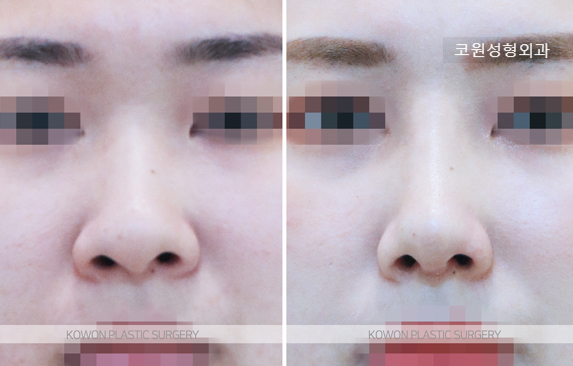
Used with the model’s consent.
Bulbous Nose Surgery Before and After
[Introduction to a Reference Case]
In the reference case, the nostrils also spread widely to the sides in addition to the nasal tip cartilage being spread out, so non-incisional nostril reduction was performed at the same time. The reason the nose looked more refined from the front was that the nasal tip cartilage was adjusted together with the width of the nostrils.
“Is nostril reduction always necessary if I have a bulbous nose?”
In practice, that is not always the case.
If the blunt appearance is caused by separated nasal tip cartilage, it may improve with only suturing the tip cartilage together and repositioning the cartilage.
Conversely, if the nostrils themselves spread widely to the sides, considering nostril reduction as well may result in a more balanced approach.
During consultations, some people worry that nostril reduction may make their smile look awkward or leave scars.
In such cases, there are methods that reduce the burden of scarring, such as non-incisional nostril reduction, rather than only incisional techniques. Even when an incision is necessary, carefully planning the design and direction of the sutures can help reduce excessive pulling or an unnatural appearance.
The important point in bulbous nose surgery is not to apply the same method to everyone. The necessary extent can only be determined after identifying whether the cause of the wide appearance is the cartilage, soft tissue, nostril width, or the fact that the nasal tip appears relatively larger because of a low nasal bridge and glabella.

[The Doctor’s Note]
What I have noticed through my practice is that concerns about a blunt nasal tip often conceal more diverse structural causes than people might expect.
Some people have nasal tip cartilage that spreads widely, some have thick soft tissue, and others have a low glabella and nasal bridge, which makes the tip appear relatively emphasized.
That is why, during consultations, I do not begin by deciding whether the tip can be reduced. First, I check where the nasal bridge should begin at the glabella to suit the face, how much the tip should be narrowed without becoming excessive, whether the nostril width should also be adjusted, and whether there is any deviation of the central axis.
“ What degree of change would look natural on my face?”
In practice, the thickness of the skin, the strength of the cartilage, the width of the face, and the degree of projection of the forehead and lips all need to be considered together. It is also important to carefully assess whether the line can remain continuous from the glabella to the tip after surgery.
If you are considering this issue, rather than focusing only on how much the tip should be reduced, you need to first identify why the nose looks bulbous. The plan should be established through a thorough consultation that accurately examines the individual’s structure, improves the areas that need it, and avoids excessive changes.
I believe this is close to the foundation of natural-looking nose surgery.
A post worth reading for reference on the topic above
“Bulbous Nose Surgery Before and After: When Reducing Only the Width Is Enough and Which Structures Should Be Considered Together”
#BulbousNoseSurgeryBeforeAndAfter