Hello. I am Dr. Oh Jeong-min, the director of Doctor O Clinic, who always does my best.
Today, I’d like to talk about the MAST test, one of the allergy tests.

The MAST (Multiple allergen simultaneous test) is a test that measures the level of immunoglobulin IgE in the blood against allergenic substances.
It is divided into three categories: inhalation (through breathing), food (through eating), and skin contact, and is used to identify the cause of immediate-type allergic reactions.
At Doctor O Clinic in Mullae, we perform MAST testing for more than 90 items.
When I explain test results to patients,
I often hear questions like,
"Where can you encounter something like this?"
So today, I’d like to look at the allergenic substances that are asked about most often.
- House dust
What are the two most common types of house dust mites in Korea?
Dp (Dermatophagoides pteronyssinus) and Df (Dermatophagoides farinae) — where are they found?

House dust mites Dp and Df are mites that live in fabric environments such as bedding, carpets, upholstered sofas, curtains, and stuffed toys.
Dp reproduces in environments with high humidity and temperature,
and Df also reproduces well in dry environments,
so in Korea, it is common to test positive for both Dp and Df.
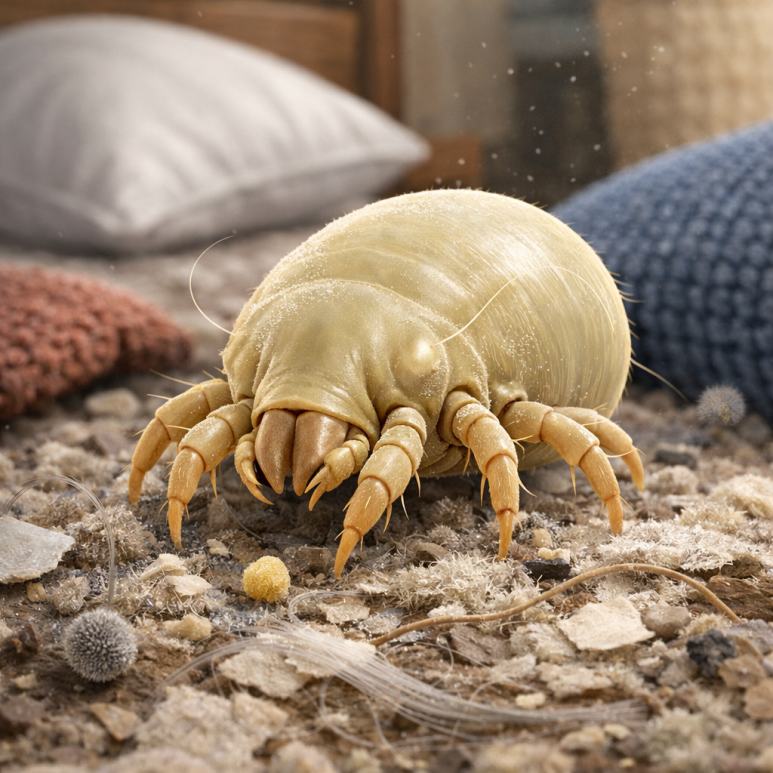
House dust refers to clumps of dust that accumulate throughout the home.
It means dust masses that gather on the floor, under the bed, on curtains, under furniture, and inside closets.
In other words, it refers to a mixture of mites, mold, skin flakes, and similar materials.
- Mites
Acarus siro is a mite that commonly appears in kitchen food storage environments.
It can be encountered in flour, starch powder, frying mix that has been stored for a long time, cereal, nuts, pet food, and ingredients left for a long time around the countertop, and it is a storage mite that reproduces in powdery environments rather than in water.
Storage mites refer to all mites that grow in storage environments.
Therefore, Acarus siro is also considered a type of storage mite.
It is found in rice, barley, wheat, mixed grains, dried seafood, red pepper powder, curry powder, pet food, old kitchen cabinets, storage boxes, and similar places.
The higher the humidity, around 70% or so, the more rapidly they reproduce, and while stored in old ingredients, they spread like dust, become airborne, are inhaled, and trigger allergies.
Acarus siro and storage mites are mites that commonly grow in old flour, grains, feed, and dried foods at home, and they are often encountered in kitchen storage areas.
Therefore, if you test positive for these mites, I recommend cleaning the kitchen thoroughly on a nice day with all the windows open and while wearing a mask.
- Mold

- Penicillium (Penicillium notatum)
This is one of the most common indoor molds found in poorly ventilated indoor spaces, old bread/cheese/fruit, air conditioner filters, inside humidifiers, behind wallpaper, under sinks, and in bathroom tile gaps.
Because it is a mold that is encountered in everyday life and closely connected to our daily environment, it is a type of mold that frequently triggers allergic rhinitis and asthma.
- Cladosporium (Cladosporium herbarum)
A common mold found both indoors and outdoors, it is found in house dust, air conditioner vents, and inside closets during the rainy season.
- Aspergillus (Aspergillus fumigatus)
This mold tends to grow in places where moisture and dust accumulate, and it is found inside air conditioners/heaters/humidifiers, on moldy walls and condensation areas, in the soil of potted plants on balconies, and on laundry that has not fully dried.
It worsens allergies and asthma, and it is a medically very important mold because it can also cause opportunistic infections.
- Alternaria (Alternaria alternata)
This is a common outdoor mold found in outdoor air, fallen leaves/trees/soil, gardens/parks, window frames at home, balconies, and on the surface of vegetables or fruit.
If you have asthma, it is a good idea to check the cleaning and hygiene status of places where this mold is often observed, such as window frames, flowerpots, balconies, and the surfaces of vegetables and fruit.
- Rhizopus (Rizopus nigricans)
This is the black mold seen on bread, sweet potatoes, and fruit, and it is found on moldy bread, mold on stored foods such as potatoes/sweet potatoes/onions, inside food waste bins, and in cooking spaces left unattended for long periods.
These molds are easily encountered in most humid environments, potted plants and soil, old foods, air conditioners, and bathrooms in everyday life.
If you have a respiratory condition, it is important to prevent this through frequent ventilation, cleaning, and humidity control.
It is more difficult to apply allergy test results to daily life than it is to simply know the results.
In this post, I briefly organized information about the MAST test and the allergy items that are often asked about.
At Doctor O Clinic in Mullae, allergy testing is available when acute allergy symptoms occur, and consultation on the results is also available.
Just because something tests positive does not mean it must always be restricted.
What allergen is meaningful for me, and whether I should avoid it completely or limit my intake,
why not discuss it with Dr. Oh, a specialist in family medicine, and gradually adjust your environmental management and eating habits?
- The definition and principles of the MAST test explained in this post were based on the following sources.
Han JY, et al. J Clin Med. 2021;10(6):1234. Multiple Allergen Simultaneous Test-Immunoblot Assay for Immunoglobulin E Detection in Patients with Isolated Allergic Conjunctivitis.
Kim Dong-young, et al. Korean Journal of Otorhinolaryngology-Head and Neck Surgery. 2018;61(1):29-36. Comparison of multiple allergen simultaneous test (MAST) and ImmunoCAP in the diagnosis of allergic rhinitis.
Yeongdeungpo Mokdong Allergy Testing Doctor O Clinic
7 minutes on foot from Exit 3 of Mullae Station
Consultations are provided by a female physician and a family medicine specialist.
Inquiries: 02-2632-5553
KakaoTalk channel: Doctor O Clinic
http://pf.kakao.com/_rFdxeG
#MullaeDermatology #Mullae Allergy #Yeongdeungpo Allergy #Mokdong Allergy #MAST