All posts are written directly by Dr. Oh Jung-min, Director of Dr. O Clinic
Hello.
I’m Dr. Oh Jung-min, Director of Dr. O Clinic, here with sincerity.
As the weather gets hotter, sebum and sweat increase, and people use more sunscreen, interest in cleansing naturally rises.
In fact, in the clinic, I hear questions like these at least once a day.
"I have acne-prone skin, can I use an oil cleanser?"
"Does using a foam cleanser damage the skin barrier?"
"Do I really not need to rinse off micellar water?"
"Shouldn’t my face feel squeaky clean after washing to mean it’s properly cleansed?"

Since cleansers are products we use every day, using one that doesn’t suit my skin for a long time can lead to acne, dryness, stinging, and worsening dermatitis.
When many people choose a cleanser,
'I have oily skin, so I should use a foam cleanser'
'I have sensitive skin, so I should use a gel cleanser'
'I have acne-prone skin, so I should avoid oil cleansers'
They often choose based only on the texture like this.
But there is another, more important standard when choosing a cleanser.
First, what do I need to remove?
Whether it’s a light sunscreen or a waterproof sunscreen,
and whether you also use cushion foundation or regular foundation,
depends on how much cleansing power you need.
Second, what condition is my skin in right now?
Whether you have acne, dermatitis,
or whether your skin barrier is damaged,
determines the appropriate cleansing strength.
In other words, a cleanser is not simply a matter of "which texture is best"
but a product that balances cleansing power and skin irritation.
Features of Each Type of Cleanser
First, let’s briefly summarize the characteristics of water, oil, foam, milk, and gel cleansers.
- Water cleanser (micellar cleanser)
A water cleanser is a light and convenient texture, like water.
Micellar water is a typical example, and it is usually used by soaking it onto a cotton pad and wiping the face.
It can help remove light sunscreen and light makeup.
However, because water cleansers are used by wiping with a cotton pad,
repeated rubbing itself can become a source of skin irritation.
In particular, sensitive skin, redness-prone skin, and skin with dermatitis should be careful about the "friction from wiping."
Even if a product says it does not need to be rinsed,
for people with sensitive skin, it is safer to lightly rinse with water after use.
→ Water cleansers are light and convenient, but sensitive skin should be careful about cotton-pad friction and any residue left behind.
- Oil cleanser
Oil cleansers are good at dissolving oily residues such as sunscreen, makeup, and sebum.
For people who use waterproof sunscreen, long-wearing cushion foundation or foundation, or color makeup, using an oil cleanser is a good option.
In a study comparing waterproof sunscreen removal, oil cleansers were reported to remove waterproof sunscreen residue more effectively than washing with water or using a regular cleanser.
In other words, for people who use long-lasting sunscreen or makeup,
using only a mild cleanser may leave residue on the skin and actually worsen skin problems.
→ Oil cleansers do not have to be avoided just because you have acne-prone skin.
The most important thing is to use a product that emulsifies well with water and to rinse thoroughly.
- Foam cleanser
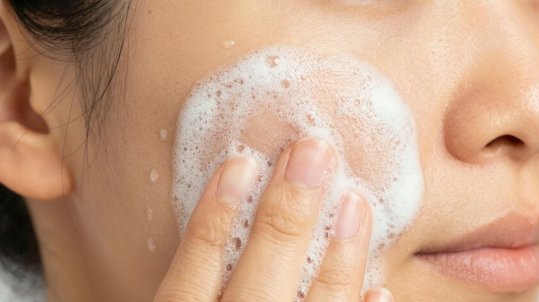
Foam cleansers are the most familiar type.
Because they lather well and tend to have strong cleansing power, they can suit people with a lot of sebum or those who want a fresh finish.
But the problem is when you use a foam cleanser that is stronger than what your skin can tolerate, day after day.
If your face feels squeaky after washing, your skin feels tight,
it becomes dry unless you apply moisturizer right away,
or it stings when you apply skincare products,,
then that product is too strong for your skin, and it would be better to stop using it.
This does not mean foam cleansers are always bad. What matters is whether the cleansing strength is something your skin can handle.
→ Foam cleansers have the advantages of strong cleansing and a refreshing feel, but if tightness and stinging repeat after washing, it is better to switch products.
- Milk cleanser
Milk cleansers have a soft, lotion-like texture and are closer to cleansing in a way that leaves the skin less dry rather than washing strongly.
Their main ingredients are also surfactants and moisturizing ingredients,
so they are more suitable for dry skin, sensitive skin, skin with dermatitis, or skin with a weakened barrier.
However, in terms of cleansing power, milk cleansers may not be enough to remove waterproof sunscreen or long-lasting makeup.
→ Milk cleansers are gentle and can help provide moisture,
but they may be insufficient for removing heavy sunscreen and makeup, so using them together with a foam cleanser can help make up for the lack of cleansing power.
- Gel cleanser
Gel cleansers often have a fresh, water-based texture, so they are often preferred by oily skin and acne-prone skin.
But gel does not automatically mean gentle.
Gel cleansers may contain acid ingredients such as salicylic acid, fragrance, or irritating ingredients,
so you should always check your skin’s reaction after using a gel cleanser.
→ Gel cleansers have the advantage of a fresh feel, but you should let go of the idea that gel automatically means gentle.
A cleanser is not something you choose just by looking at the texture.
The goal of cleansing is not to remove as much as possible,
but to remove what is necessary properly while disturbing the skin barrier as little as possible.
That is the most important standard for choosing a good cleanser.
In the next part, I will organize the content into which cleanser is more appropriate for each skin type.
#Yeongdeungpo dermatology #Mullae dermatology #acne #cleanser #milk #oil #dry skin #skin barrier