Hello,
I’m Lee Juri, the chief director of Seoul Bardi Dental Clinic.
Among implant surgeries, there is a particularly difficult and demanding area.
That is the upper molar implant area where the maxillary sinus is located.
In the upper molar area,
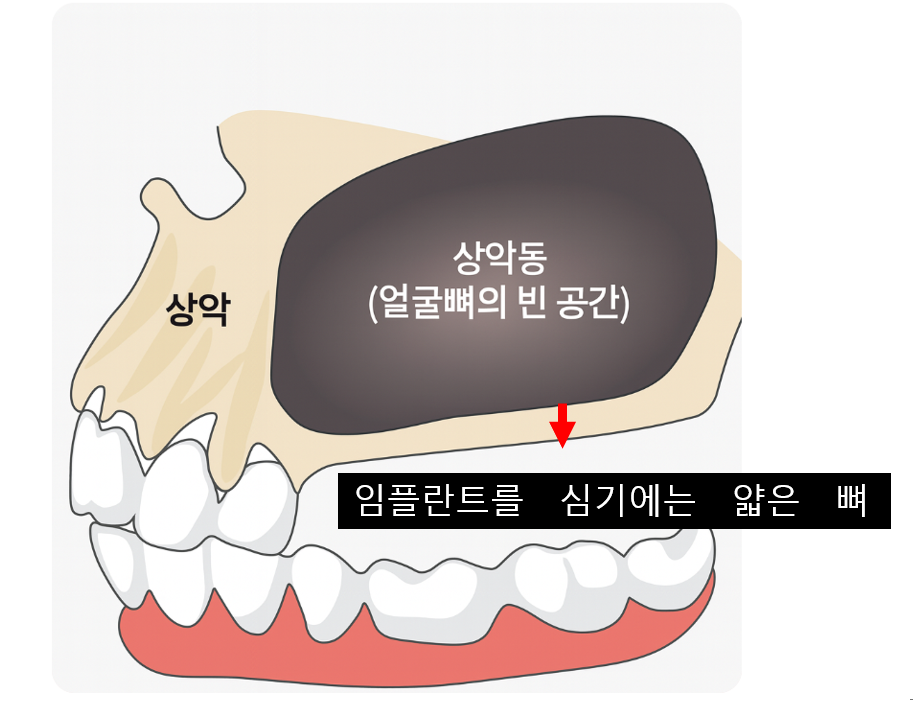
because of its anatomical structure, the bone is thin,
and the maxillary sinus is situated above it,
so even a small difference can create a risk of complications.
That is why the surgery period can also be long~
Today, I’ll explain a difficult case in which even implant placement itself was a major challenge.
<Table of Contents>
| 1. Tooth inflammation perforates the maxillary sinus. |
|---|
| 2. Implant surgery with sinus lift |
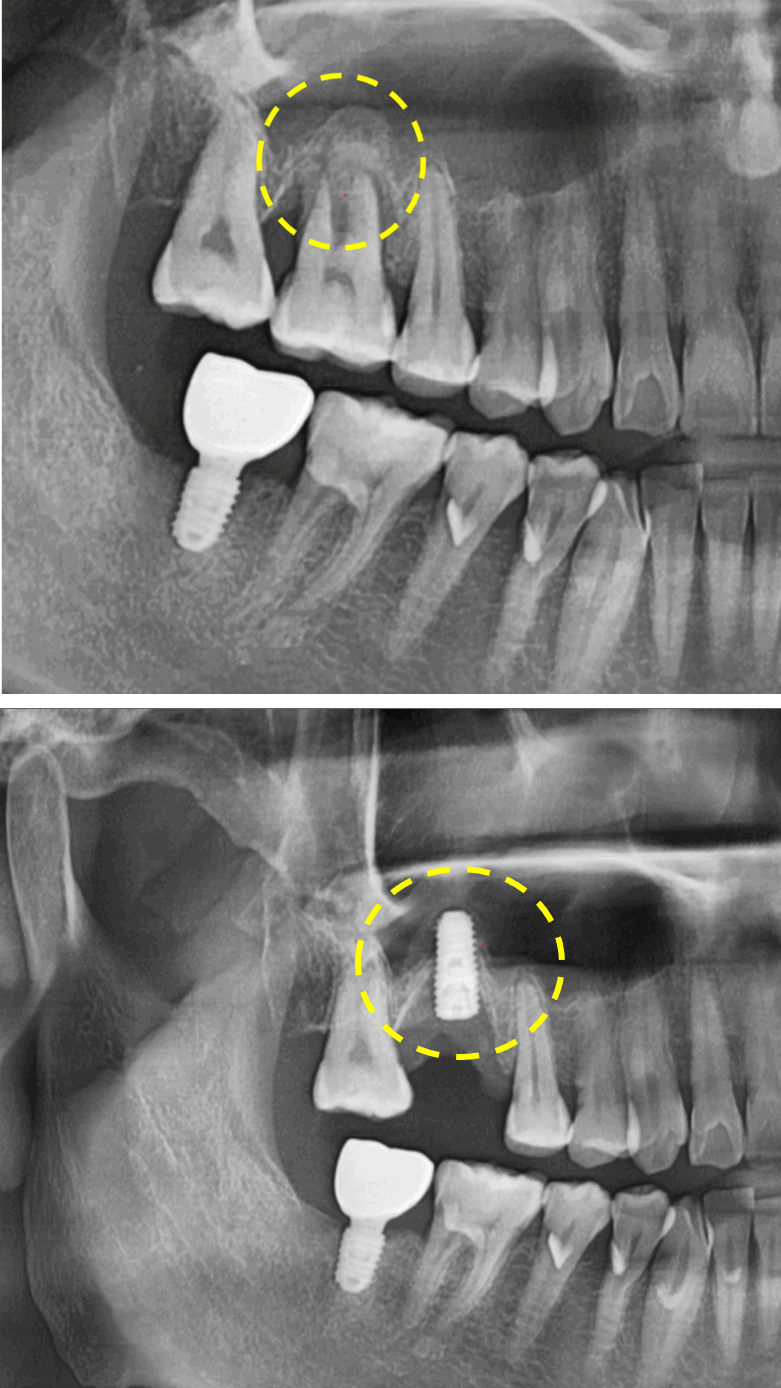
- Tooth inflammation perforates the maxillary sinus.
 240720
Please never delay treatment for upper molars.
If possible, it is better to treat them quickly.
Because the upper jaw bone is thin, if inflammation develops, the jawbone rapidly resorbs.
The longer it is delayed,
because there is no bone left,
bone grafting is also needed,
and in some cases, maxillary sinus surgery is required as well.
In the end, the treatment period gets longer,
and the cost increases, making the patient’s burden greater..
| Go see a case where bone grafting was done twice |
|---|
| Mangwol-dong dental clinic: if the inflammation is severe, implant placement is not possible right away.. : Naver Blog |
| Dental clinic near Myeongil Station: root inflammation developed, so it got.. : Naver Blog |
| Godeok Station implant, gum bump, bone grafting done twice.. : Naver Blog |
Because upper molars are the area with the highest implant difficulty,
the earlier treatment begins, the less burden the patient has.
The longer it is left alone,
the more complicated the surgery becomes,
and the longer the treatment takes.
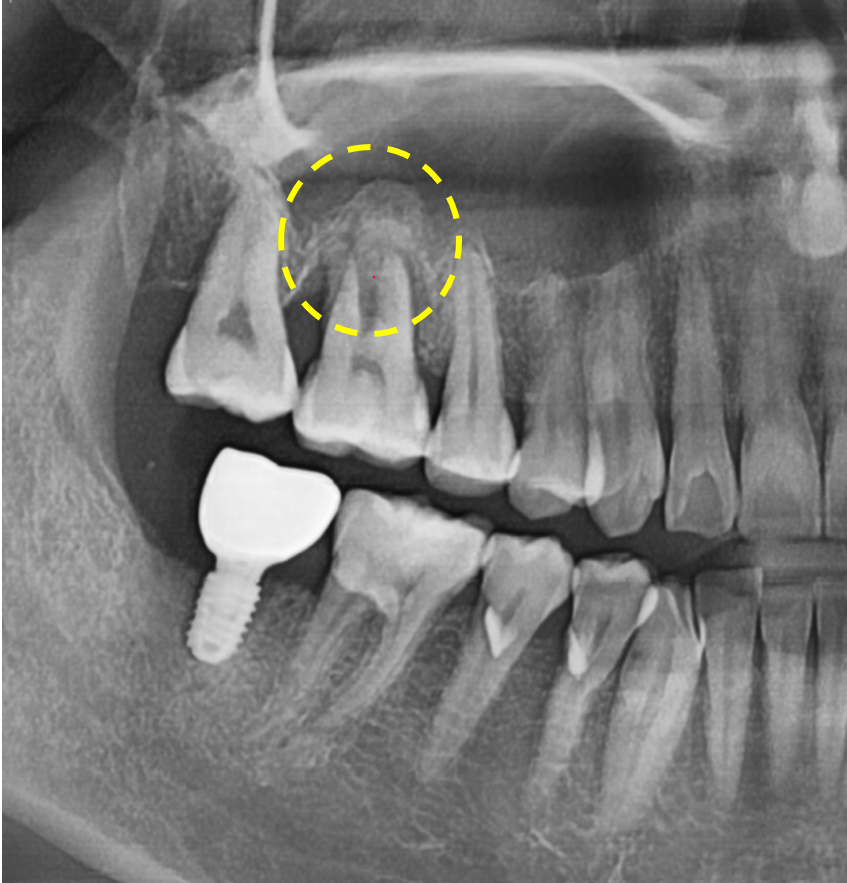
The patient who visited our clinic this time
was also a difficult case in which the sinus floor had been perforated.
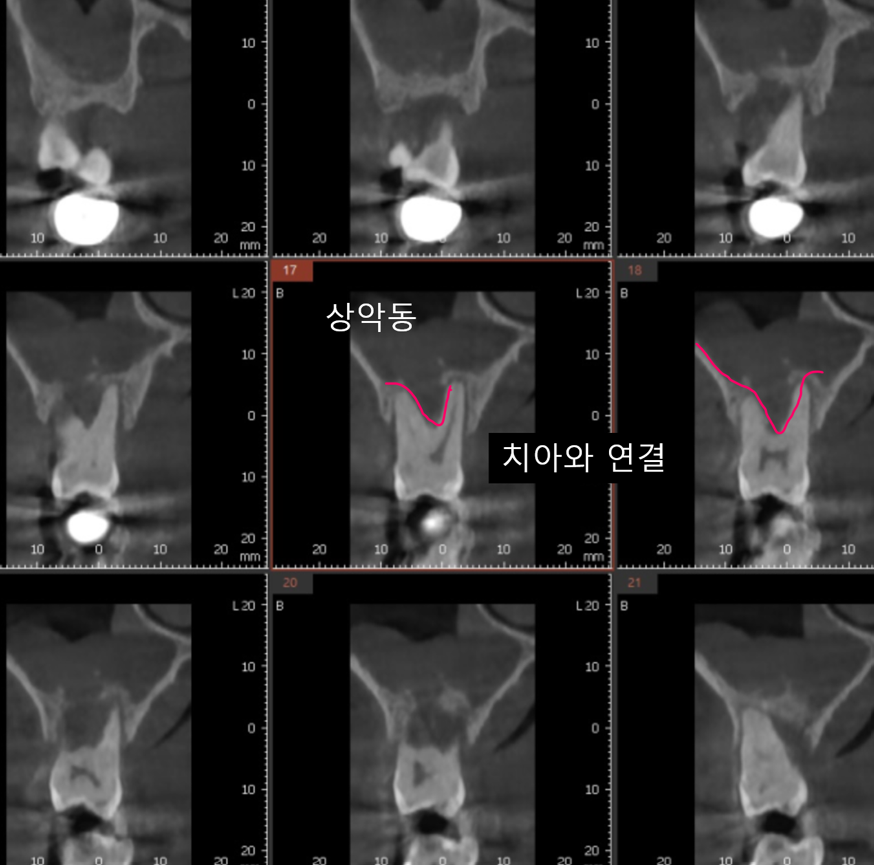 250317
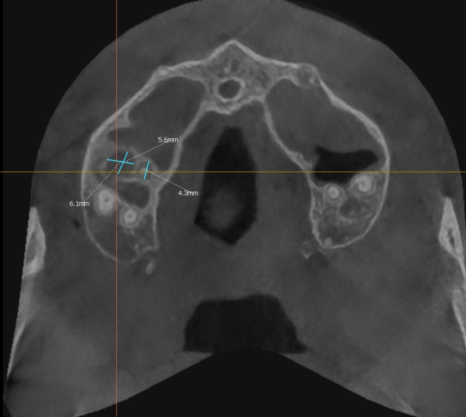
Usually, the bone only becomes thinner,
but when we checked with CT,
it had perforated the maxillary sinus completely.
This is not a common case.
Teeth are hard tissue, so they appear white,
and the maxillary sinus is mucosa, so it appears black,
and you can see that they are connected near the root tip.
However, through thorough planning and a sufficient healing period,
we were able to complete treatment successfully in about 5 months.
- Implant surgery with sinus lift
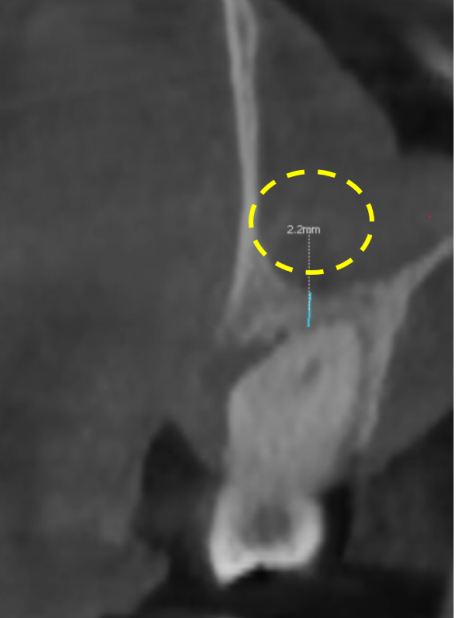
 250317
To reduce the chance of failure,
we analyzed the CT scan.
We measured the amount of remaining bone,
and after extracting the tooth,
we thoroughly removed the infected tissue.
If the inflamed tissue is not properly scraped away at this stage,
infection can occur.
The grafted bone may also be resorbed and fail to settle,
or the implant may not bond firmly to the bone.
Sometimes, more time is spent removing these inflammations
than on the surgery itself.
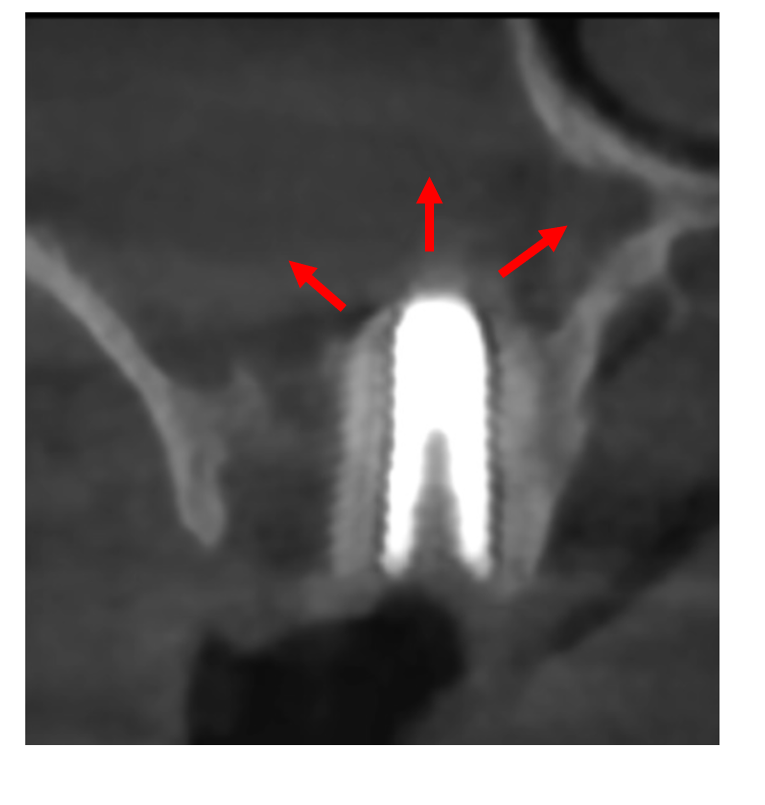
On the day of extraction, we lifted the maxillary sinus membrane
and performed bone grafting.
The implant was placed at the same time as well.
When placing an implant in a molar,
it needs a length of at least about 8 mm,
but because the bone becomes thin,
there is not enough vertical depth,
so the implant is placed while lifting the maxillary sinus upward.
 250405
\
The sinus membrane is extremely thin
(it is about the same thickness as the membrane of an egg white.)
If anything goes wrong, sinus perforation can occur.
The patient already had a partially open area,
so we proceeded very carefully.
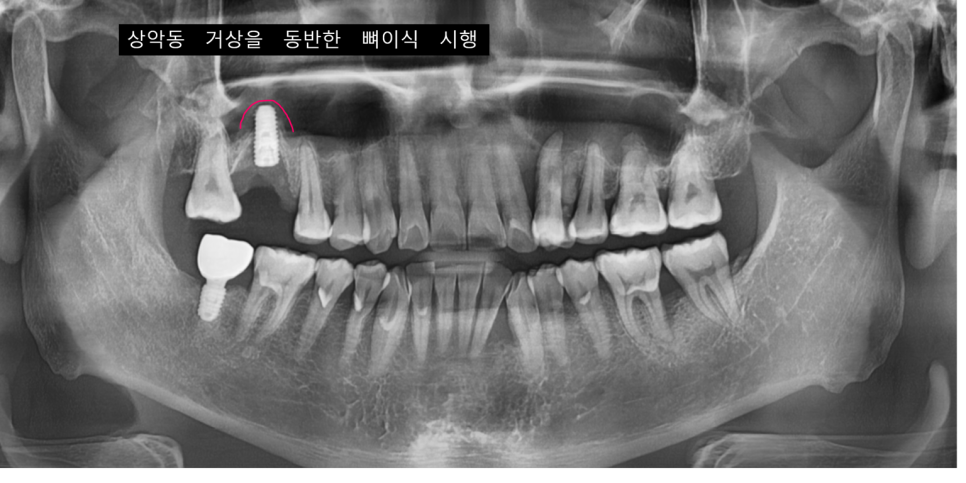 250430
Because the patient had a perforated maxillary sinus,
there was a possibility of progressing to sinusitis.
We checked after surgery to see whether there was nasal congestion,
or discomfort such as runny nose or headache.
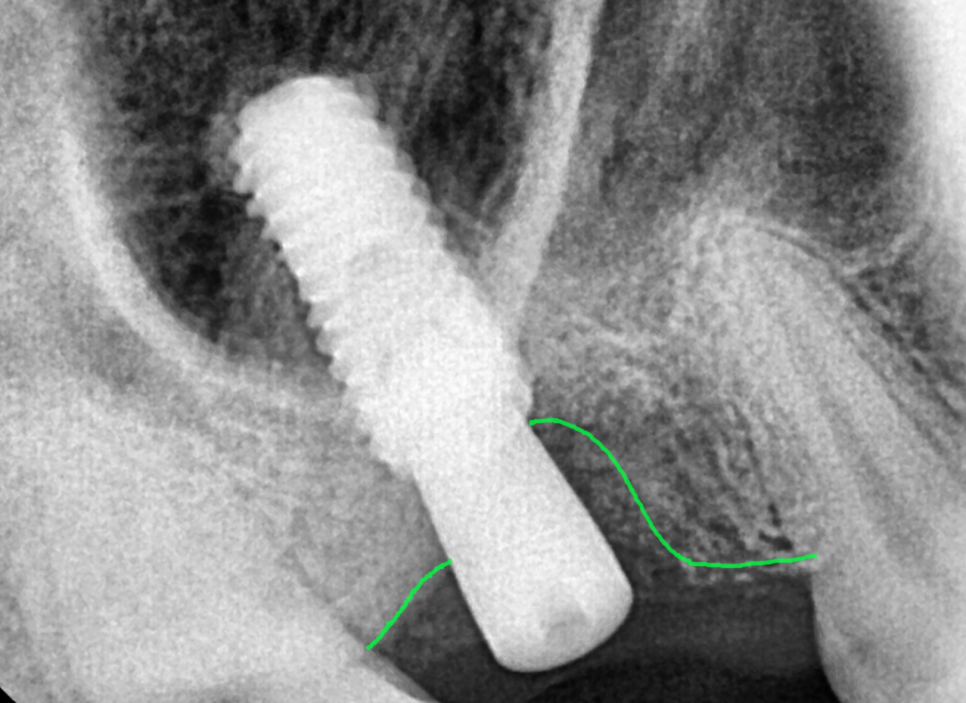 250830
It took about 5 months.
We allowed enough recovery time,
kept observing to make sure the bone stabilized,
and when the implant had bonded well with my bone,
we completed the prosthetic restoration as well.
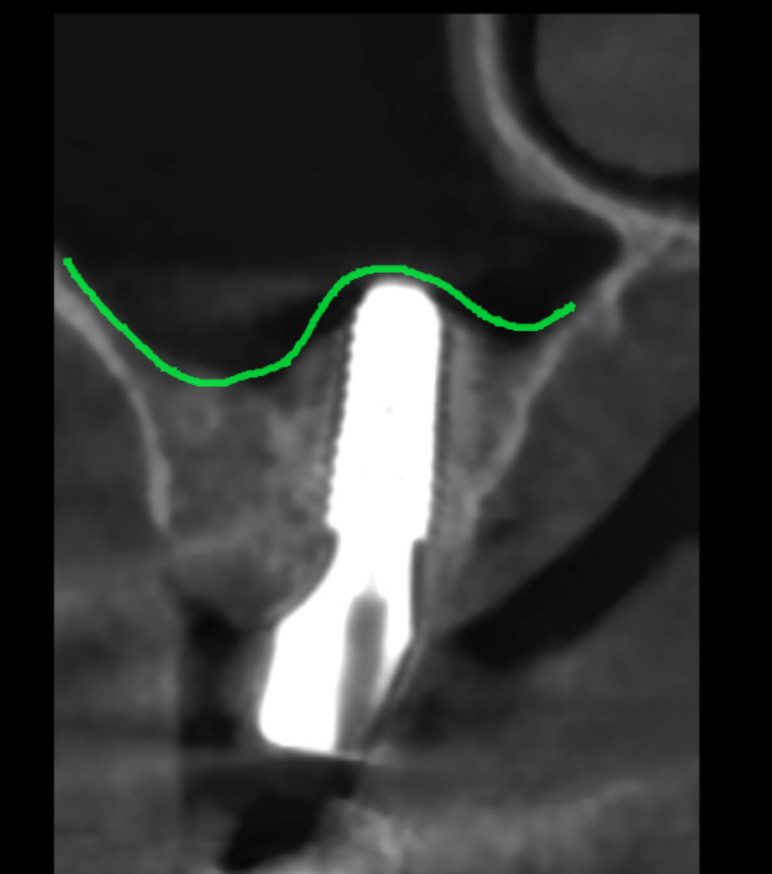 250912
The patient had a perforation of the sinus floor,
and after the implant surgery,
you can see that the sinus floor is separated from the implant.
In any case, if there is inflammation in an upper molar,
it is best to treat it as soon as possible without delay.
Even treatment that could end simply in the early stage,
can, if delayed, lead to sinus perforation and a long surgical process.
Thank you for reading this long post until the end ^^
 Surgery After Maxillary Sinus Perforation Caused by Tooth Inflammation in an Upper Tooth Implant Area
#UpperToothImplant #SinusSurgery #UpperToothImplantSurgery #SinusPerforation