Hello.
I am the director of Seoul Bardi Dental Clinic.
As we get older,
have you ever felt that food gets stuck more often than before?
Some patients who visit our clinic sometimes tell us this.
It is so uncomfortable because food gets stuck every time, they say.
They also say it is frustrating because they cannot keep removing it with a toothpick every time they are outside.
In fact, from a dentist’s point of view, it would be ideal if you managed it every time after a meal with interdental brushes or dental floss...
Realistically, I completely understand that it is hard to keep up with every moment, too...^^
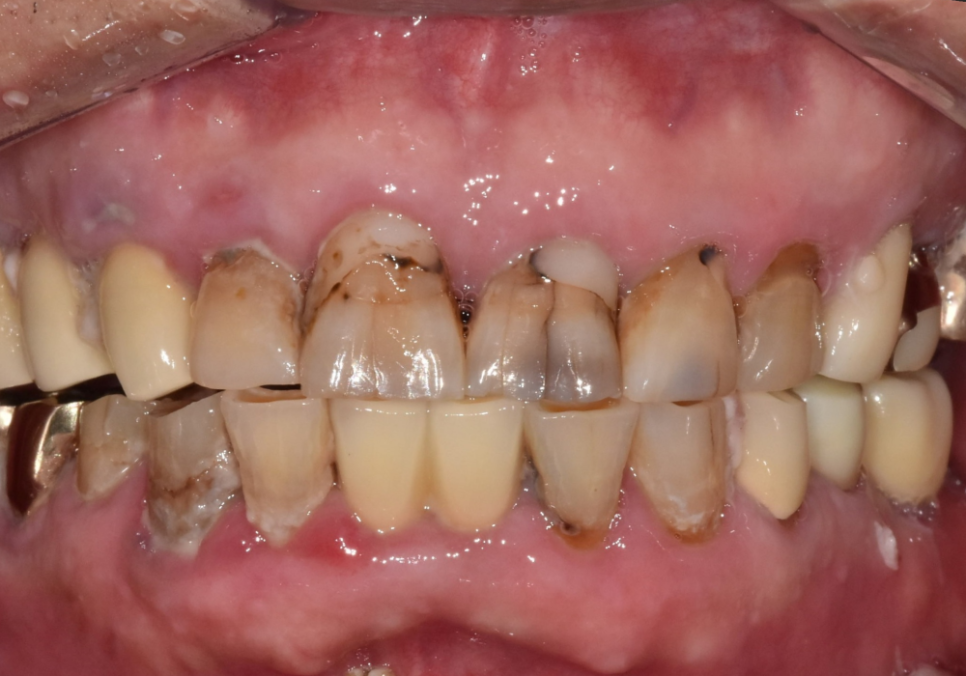
Because of that,
you end up postponing care for a day or two,
and then one day, you notice that the space between your teeth has turned black,
and you come to the dentist in surprise.
Today, I’ll explain why food gets stuck especially easily in the front teeth as we age,
and how it was resolved through a real case.
Why does food get stuck in the front teeth so often?
Food Getting Stuck in the Front Teeth: Why Does It Happen More Often Than It Did When You Were Younger? A Treatment Case of Front Teeth That Turned Black
As we get older, the spaces between teeth widen
as part of the natural aging process.
This happens because the gums gradually recede,
creating empty spaces between the teeth called a black triangle.
The term black triangle may sound a little unfamiliar.
Simply put, it refers to
a small triangular gap that forms
between teeth and along the gumline.
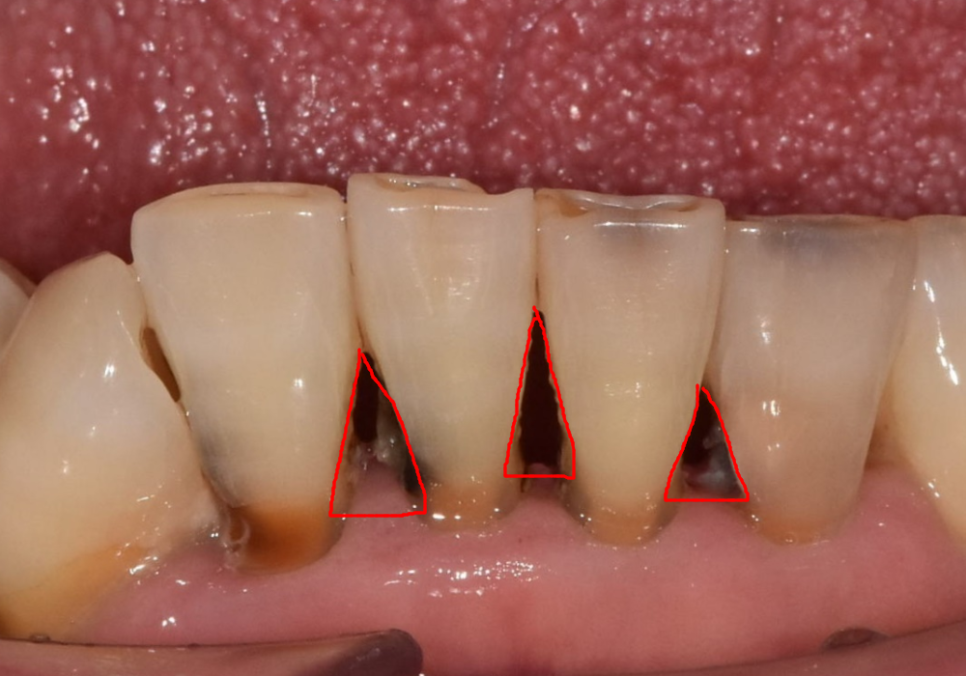
Normally, pink gums
should fill that space completely,
but as we age or if gum disease develops,
the gums recede downward.
This space becomes a very good place for food to remain.
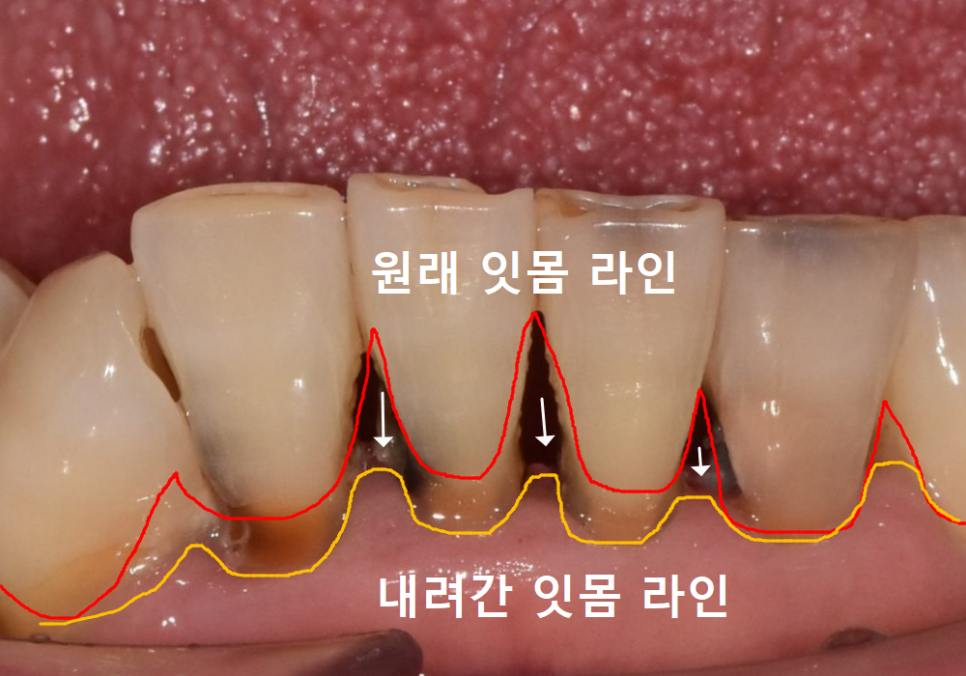
When food repeatedly gets caught in the gap,
tooth decay between the teeth can occur easily,
and this becomes a major cause of black discoloration inside the tooth.
Patient case: food trapping and secondary decay
Food Getting Stuck in the Front Teeth: Why Does It Happen More Often Than It Did When You Were Younger? A Treatment Case of Front Teeth That Turned Black
A patient who recently visited our clinic had severe food trapping between the front teeth,
and the teeth had become darkly discolored.
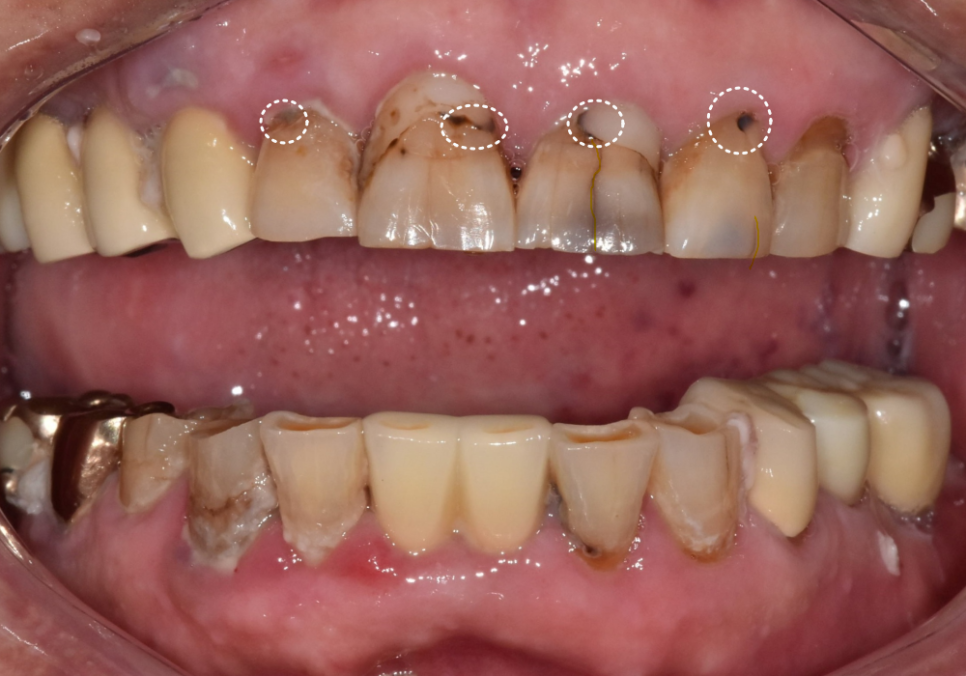 240223
Even to the naked eye, deep decay was visible,
and inside the area that had previously been treated with resin,
secondary decay was progressing.
The upper front tooth also had a crack.
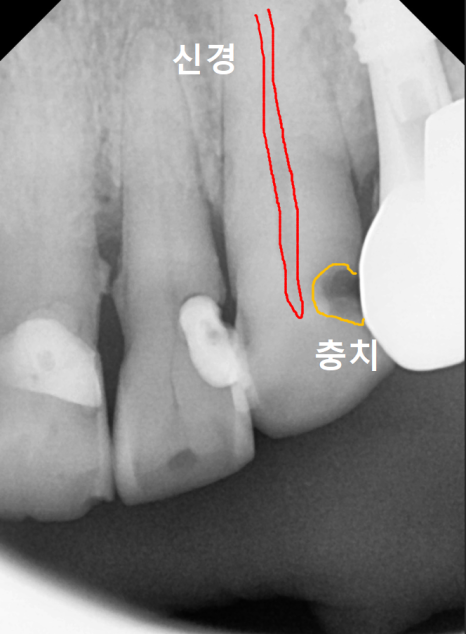
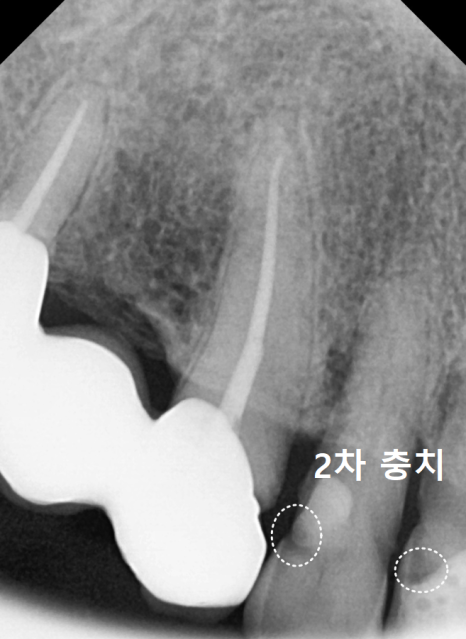 240223
Looking at the X-ray, the decay had progressed very close to the nerve...
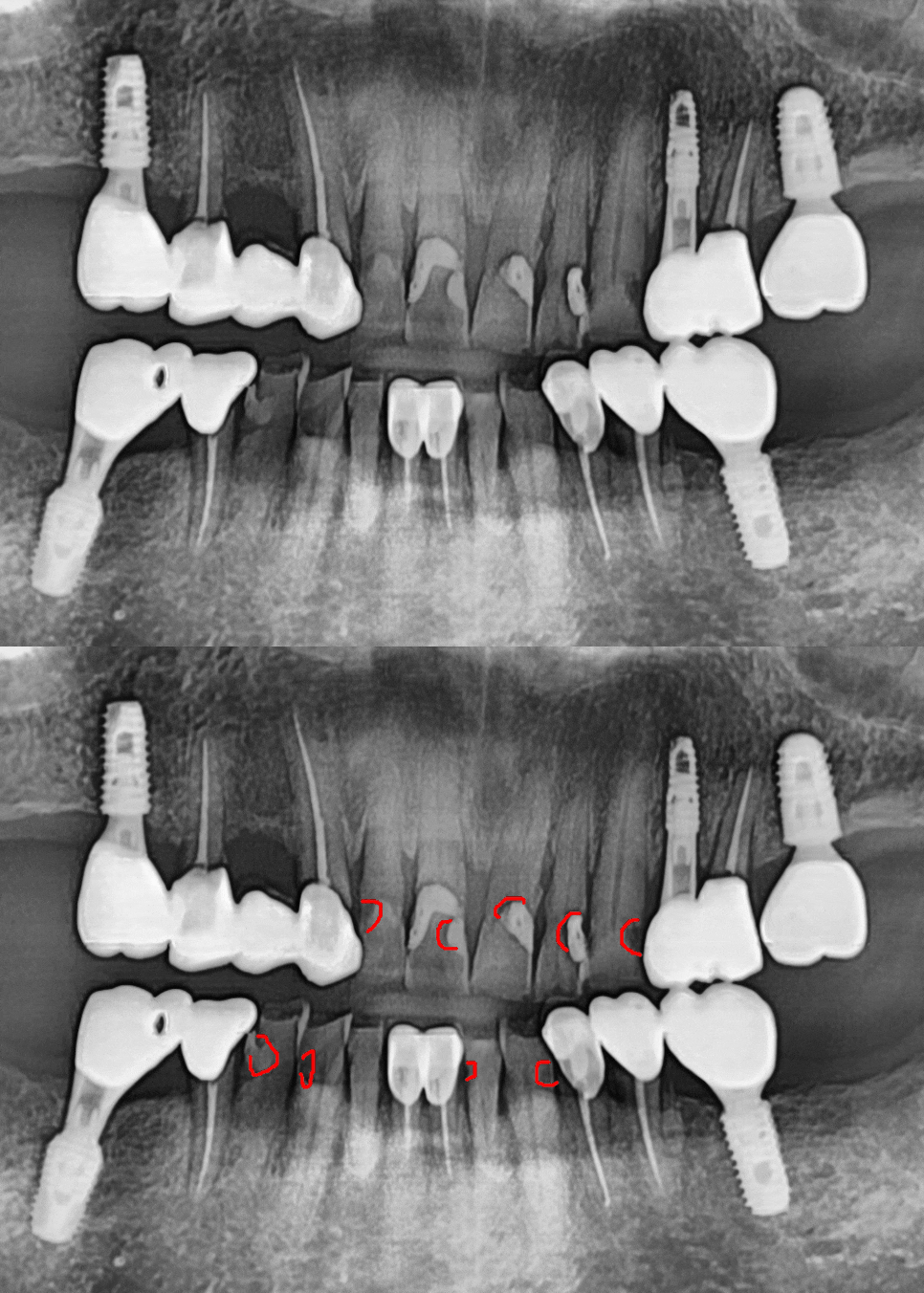 240223
The front teeth that developed problems this time were planned to be treated with root canal therapy,
then made into a splint-type prosthesis connecting the restorations.
Treatment plan
- Upper front teeth
#12~23 root canal treatment and zirconia splint
- Lower front teeth
#42, 43, 44 and #32, 33 root canal treatment
and zirconia splint
- Treatment approach
Considering the patient’s age, proceed slowly and sequentially starting from the upper jaw
What is a splint?
Food Getting Stuck in the Front Teeth: Why Does It Happen More Often Than It Did When You Were Younger? A Treatment Case of Front Teeth That Turned Black
The word splint may feel a little difficult,
but simply think of it as a method of joining several teeth together as if they were putting an arm around each other.
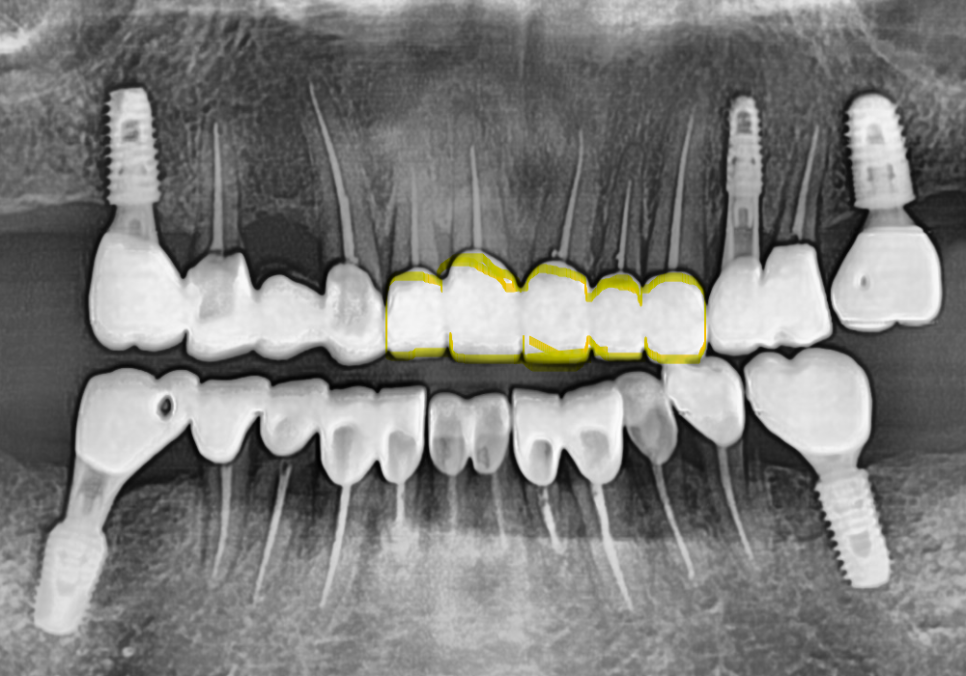
Unlike crowns, which are made for each tooth individually,
it is characterized by connecting multiple prosthetic units like a bridge.
Why is this method effective for people who are bothered by food getting stuck?
Because it can be designed to fill the spaces between teeth smoothly and without gaps.
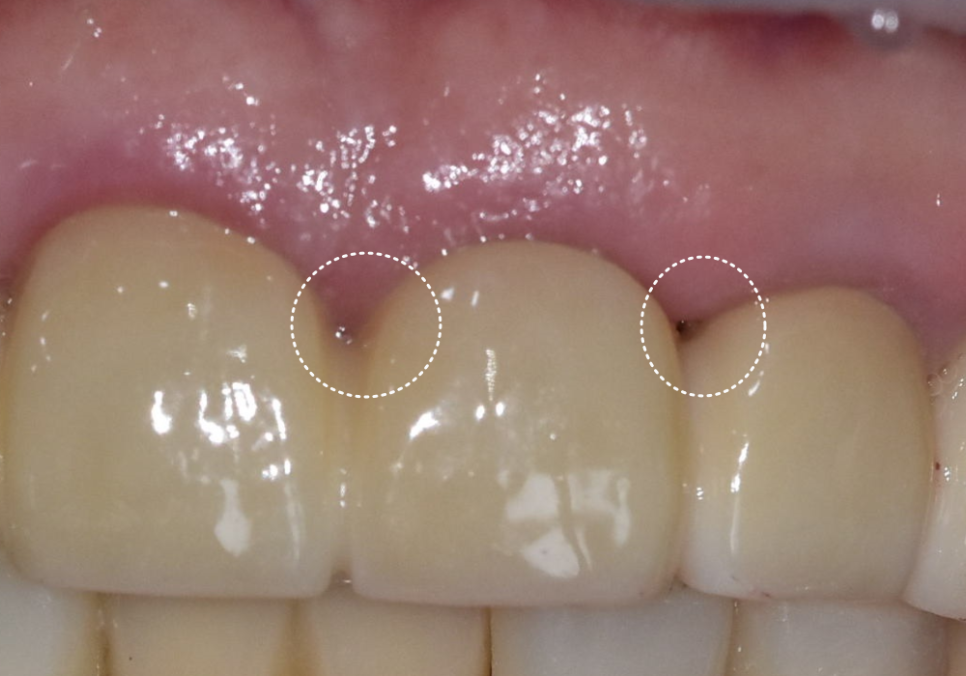
It plays the role of blocking the pathway where food can enter.
Also, by joining weakened teeth together, they support one another,
so you can feel much more stability.
However, there are also things to be careful about.
Food Getting Stuck in the Front Teeth: Why Does It Happen More Often Than It Did When You Were Younger? A Treatment Case of Front Teeth That Turned Black
Because the teeth are connected to each other,
a regular dental floss does not go in from top to bottom.
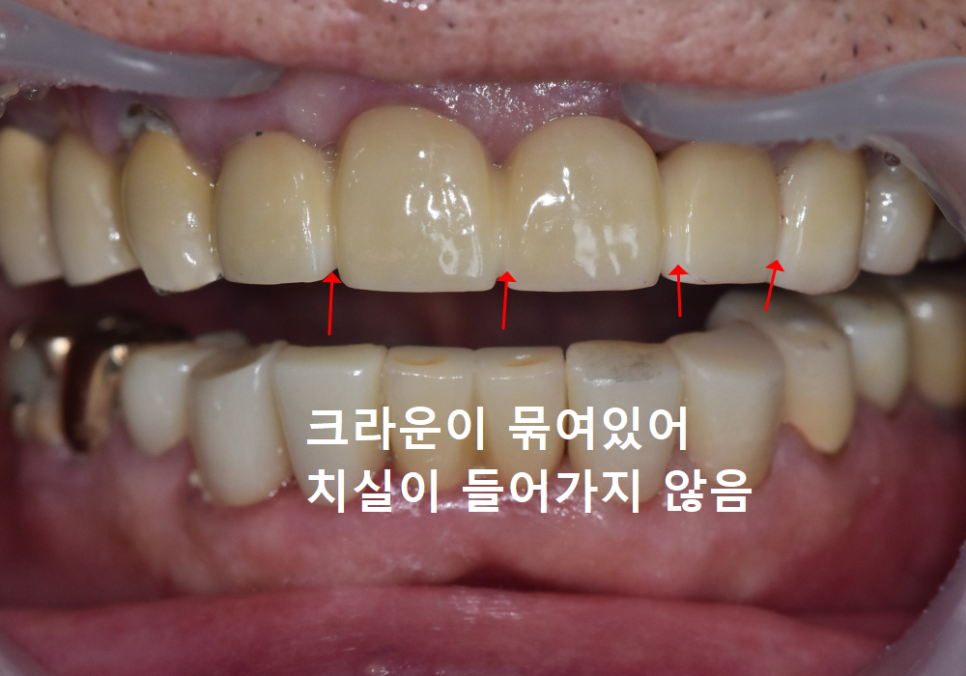
Food trapping is reduced,
but if the underside of the prosthesis is not cleaned carefully,
the risk of decay developing inside actually increases.
That is why after splint treatment,
you need to manage it using interdental brushes.
If care becomes neglected, the entire prosthesis may need to be remade,
so regular checkups are absolutely necessary.
Treatment method for food getting stuck in the front teeth with a splint
Food Getting Stuck in the Front Teeth: Why Does It Happen More Often Than It Did When You Were Younger? A Treatment Case of Front Teeth That Turned Black
Considering the patient’s age, we continued treatment gradually from the upper jaw so it would not be too much of a burden.
After carefully completing root canal treatment for each area,
we went through temporary teeth
and then made the final prosthesis.
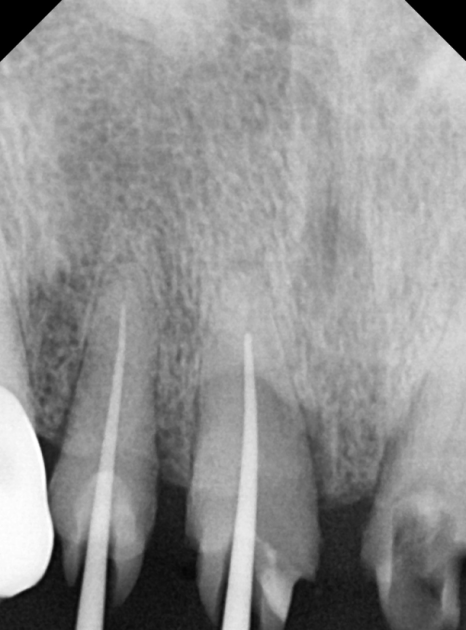
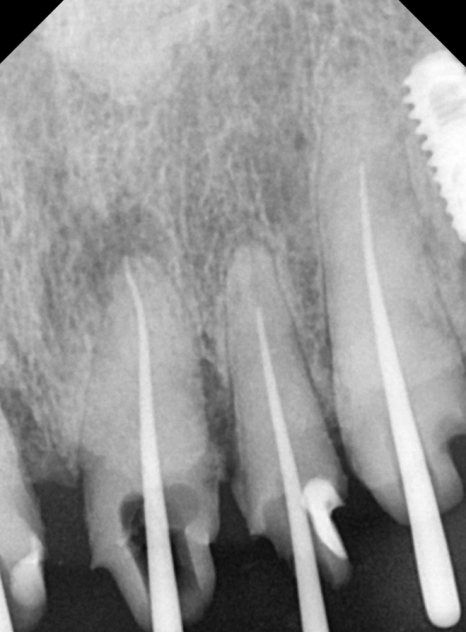
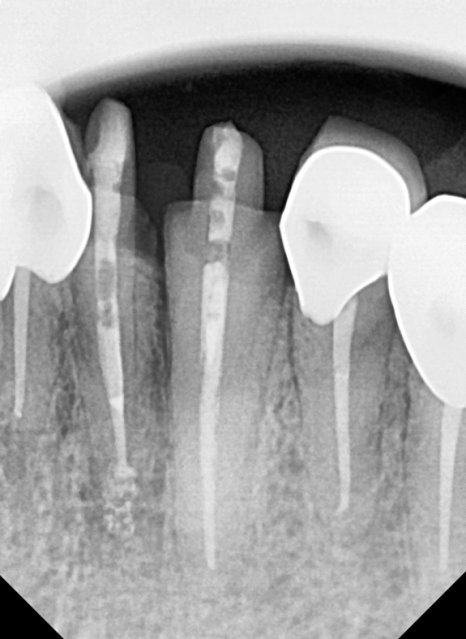
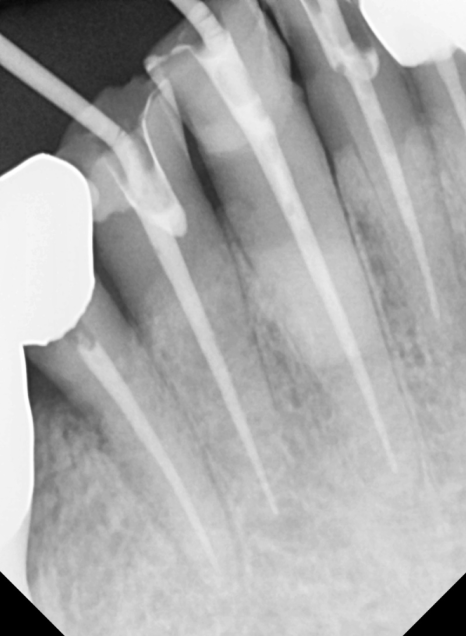 240502
When placing the prosthesis,
we focused on designing it precisely so that food would get stuck as little as possible.
When setting the crowns, we also gave detailed instructions on how to use interdental brushes
and explained how to care for them.
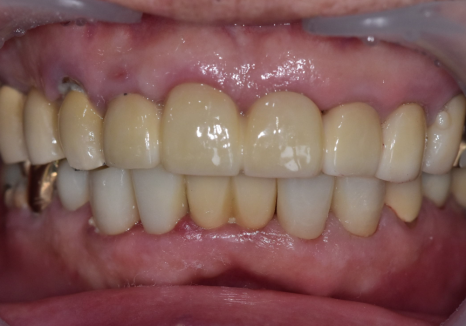
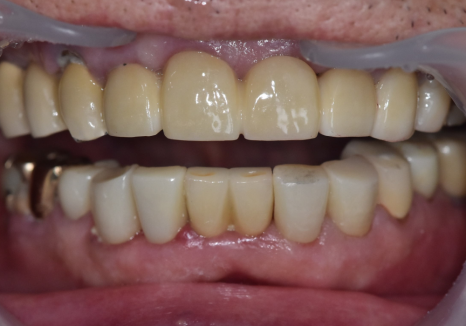 240711
This is how it looked after the treatment was completed.
The darkly discolored areas have disappeared,
and overall the impression looks cleaner and neater.^^
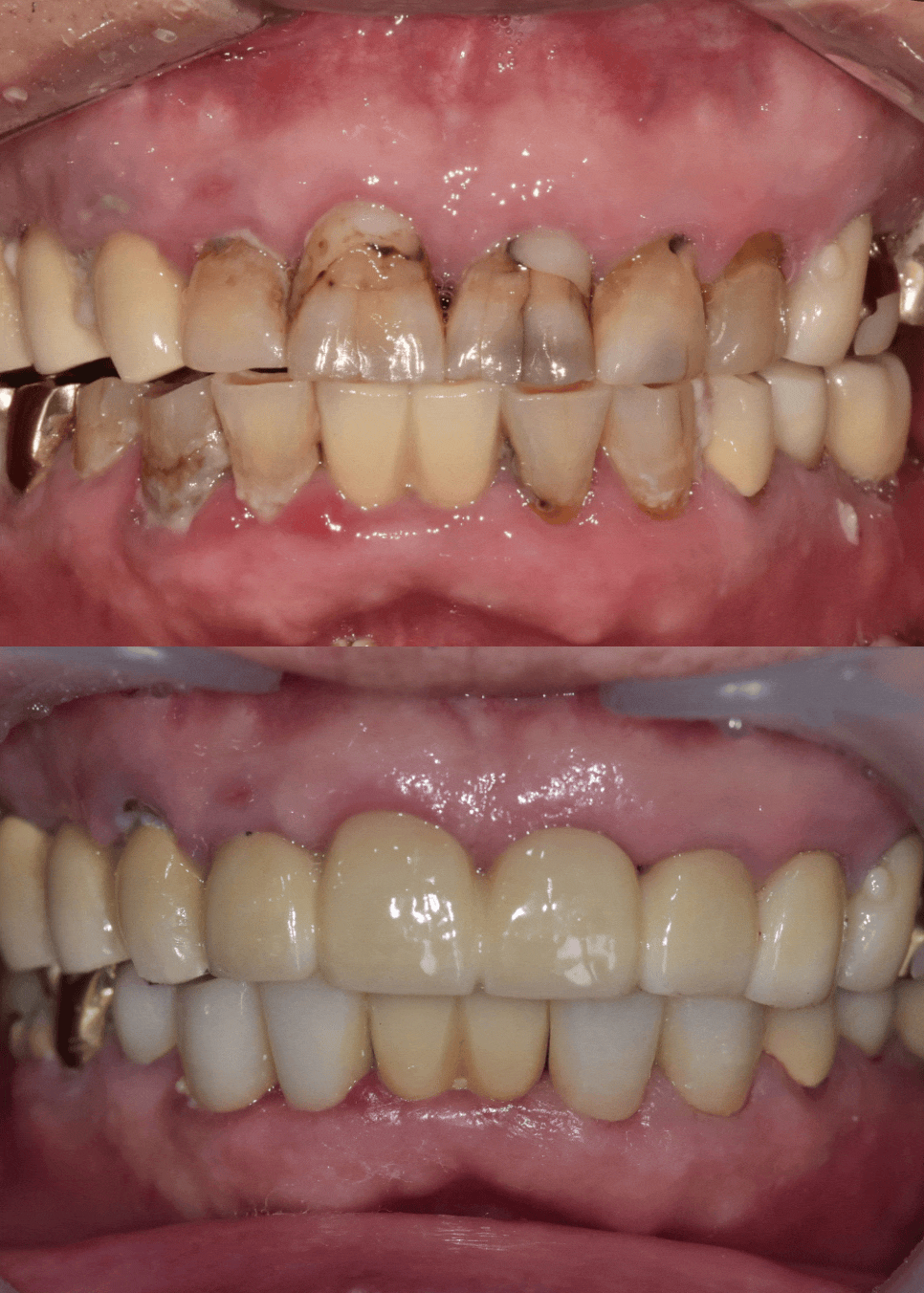 240223(before) 240711(after)
Front tooth decay often progresses deeper inside than what is visible on the surface.
Have you noticed that food has been getting stuck more often lately?
Beyond simple discomfort,
it may be a warning sign from your teeth.
Rather than simply receiving treatment,
it is very important to carefully consider what the optimal design is
for your age and oral environment.
If you are hesitating because of similar concerns,
why not get a precise diagnosis before it becomes too late?
We will think together with you about the path that can keep your teeth healthiest for the longest time.
Thank you.
▼Check the clinic location▼
Food Getting Stuck in the Front Teeth: Why Does It Happen More Often Than It Did When You Were Younger? A Treatment Case of Front Teeth That Turned Black
| Go to reservation call |
|---|
| 02-481-4278 |
| This post was written directly by Seoul Bardi Dental Clinic for the purpose of providing medical information in compliance with Article 56, Paragraph 1 of the Medical Advertising Act. The information provided is for reference only, and we recommend that you visit a medical institution to receive guidance from medical professionals regarding symptom assessment and accurate care methods. All procedures/surgeries performed at the dental clinic may involve risks depending on the individual (inflammation, bleeding, swelling, etc.). Please make your decision after sufficient consultation with medical professionals in advance. The treatment cases in this post were photographed with the consent of the patients who completed treatment at our clinic, and the before/after photos were taken under the same conditions. |