| This post was written directly by Seoul Vardi Dental Clinic for the purpose of providing medical information, in compliance with Article 56, Paragraph 1 of the Medical Service Act. We recommend using the information provided for reference only. For symptom assessment and accurate care instructions, please visit a medical institution and receive guidance from a medical professional. All procedures and surgeries performed at dental clinics may involve risks depending on the individual, such as inflammation, bleeding, and swelling. Please make your decision after having a thorough consultation with a medical professional in advance. The treatment cases shown in this post were photographed with the consent of patients who completed treatment at our clinic, and the before-and-after photos were taken under identical conditions. |
Hello!
I am the director of Seoul Vardi Dental Clinic.
▼ Check the dental clinic location ▼
When you have been using dentures for a long time,
they gradually begin to feel loose.
Even after having them adjusted at the dental clinic, they soon start to lift again,
and speaking also becomes uncomfortable.
At this point, many people say something similar:
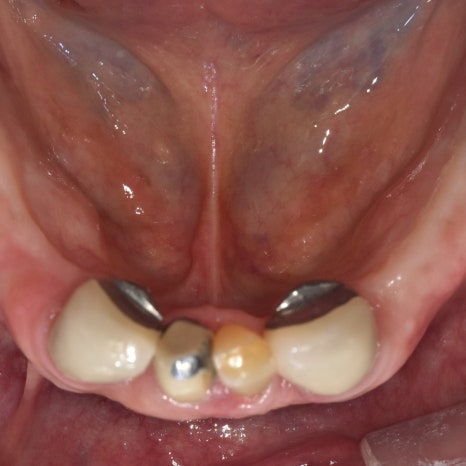
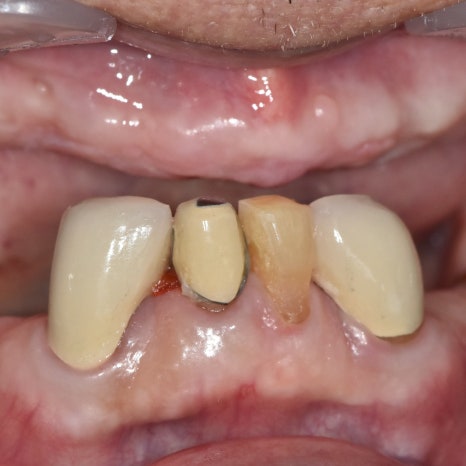
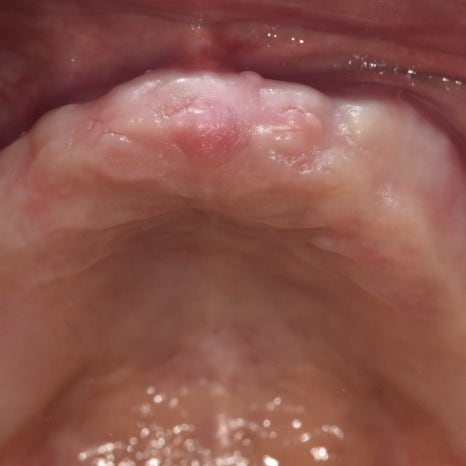
Example photos
I want to stop wearing dentures.
Can I switch to implants?
Is it really possible at my age?
Can all of them be placed at once?
How much will it cost?
Let me answer these questions first.
Switching from dentures to full-arch implants is certainly possible.
However, four conditions must be met.
When treatment is carried out after meeting these conditions,
the average 5-year survival rate of immediately loaded full-arch implants
has been reported to be as high as 97.4%.
(Del Fabbro et al., 2019, J. Clin. Med.)
Today, for those who are considering replacing long-used dentures with full-arch implants,
I will summarize the four conditions you must check before getting started
and the overall treatment process.
The order is as follows.
| CHAPTER 1. The real reason dentures stop fitting over timeCHAPTER 2. Full-arch implants: We start by checking these four thingsCHAPTER 3. Treatment process |
| Chapter 1. The real reason dentures stop fitting over time |
Many people find that their dentures fit well at first,
but become loose after several years.
You may wonder, "Was something wrong with the denture treatment...?"
But in fact,
the alveolar bone beneath the dentures
gradually shrinks.

The alveolar bone is bone that is normally maintained
when the tooth roots provide stimulation.
Dentures simply rest on top of the gums
and cannot stimulate the bone,
so the bone is resorbed and becomes lower the longer the dentures are used.
| Chapter 2. Full-arch implants: We start by checking these four things |
These are the four things we check first
when you come in for a consultation.
If even one of them does not fit,
the entire treatment plan may change.
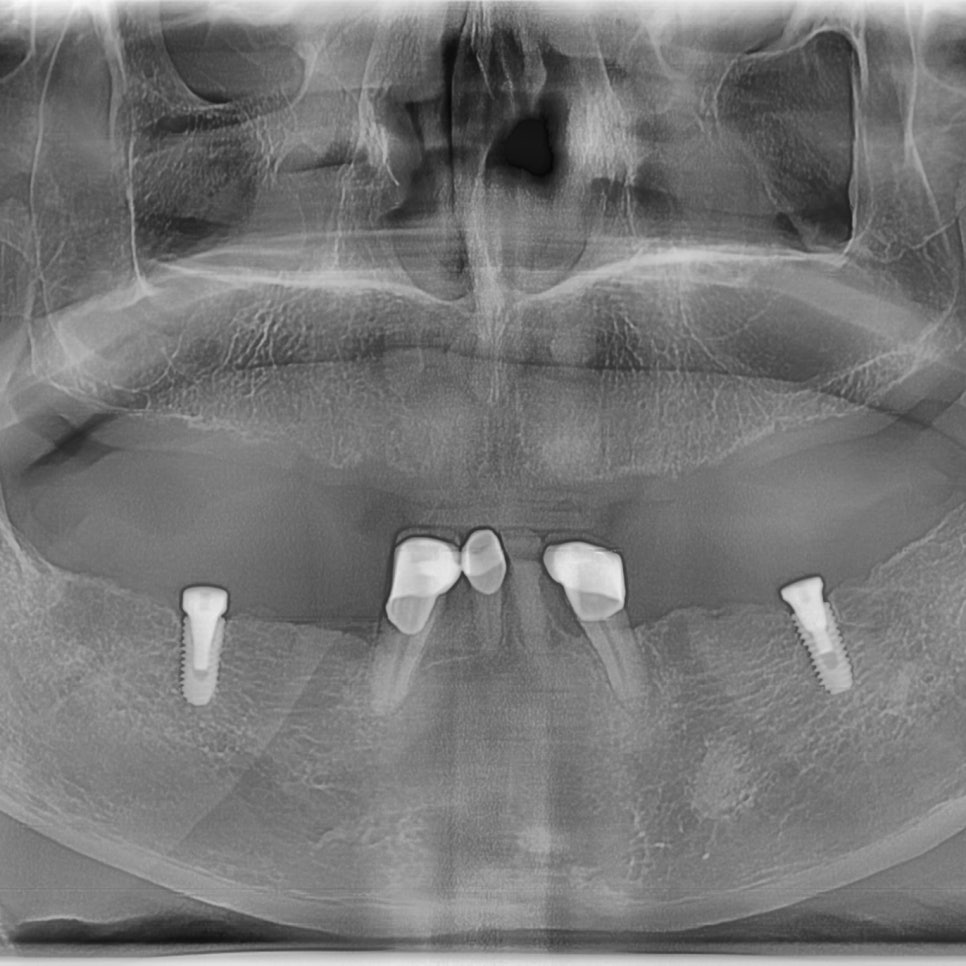
Example photo
- Is there enough bone remaining?
This is the most important point. Using CBCT (3D CT),
we measure the height and thickness of the bone in the upper and lower jaws.
If there is enough bone, the implants can be placed right away.
If there is not enough, bone grafting may be needed,
or the placement position and angle may need to be adjusted.
In particular, the maxillary molar area is close to the maxillary sinus (the hollow space beside the nose),
so if there is insufficient bone, a sinus lift (lifting the bone to secure space)
may be necessary.
<For more information about sinus lifts ↓↓↓>
- What is your budget?
The cost of full-arch implants
varies significantly depending on the number of implants placed.
Full-arch prosthetics can be made with 6–8 implants in the upper jaw and 4–6 in the lower jaw.
An implant-supported denture (overdenture), which combines a denture with four implants,
is also an option.
Since this method can restore chewing function to approximately three times that of conventional dentures
(up to around 70%),
it is an option worth seriously considering
if your budget is a concern.
- Can you allow sufficient time for treatment?
Full-arch implant treatment takes an average of 8–12 months.
(※ This varies depending on the patient’s dental condition.)
| Implant placement → Waiting for osseointegration (4–6 months) → Second surgery → Temporary teeth → Final prosthetics. |
All of these steps are necessary.
Some people ask for everything to be completed within a month,
but the time required for the bone to settle cannot be shortened.
- Are you taking any medications?
Osteoporosis medication (bisphosphonate class) — risk of jawbone necrosis
Anticoagulants (for preventing blood clots) — bleeding management during surgery
Medication for high blood pressure or diabetes — checking whether levels are well controlled
This does not mean that you should stop taking your medication.
Instead,
we develop a plan for how it should be adjusted
through consultation with your internal medicine physician.
| Chapter 3. Treatment process |
Because vague fears can be the greatest concern,
I will explain the treatment process
in chronological order.
① Surgery (Month 0)
Simulating the placement positions with a digital guide
→ Making incisions only where necessary
② Temporary dentures / Waiting for osseointegration (Months 1–5)
Time is needed for the implants to bond with the bone (osseointegration).
During this period,
you can regain some ability to eat and speak with temporary dentures.
③ Second surgery (Months 5–6)
The gums are opened slightly and connecting components are attached.
④ Temporary teeth (Months 6–7)
You will have a 2–3 week adjustment period with the temporary teeth.
During this time, the shape, color, and height are decided together with you.
(A denture may be used instead in some cases.
This depends on the patient’s condition.)
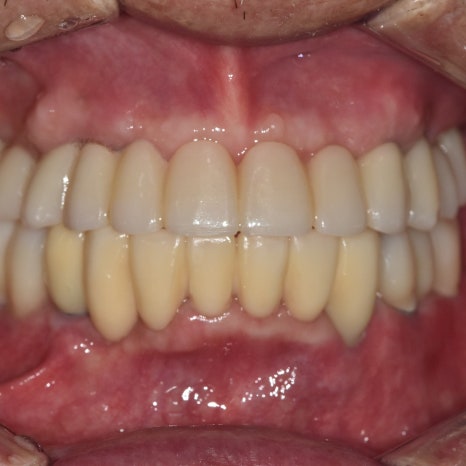
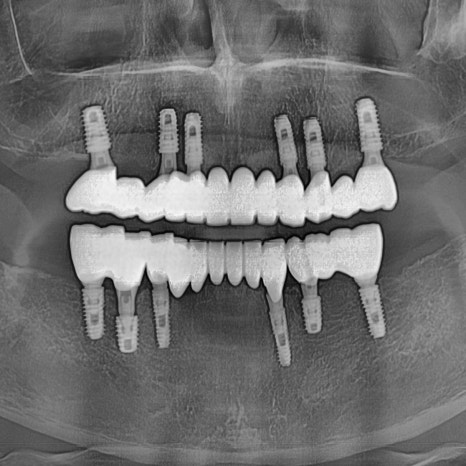
Example photos
⑤ Final prosthetics (Months 8–9)
The final prosthetics are made and fitted
using the shape adjusted with the temporary teeth.
Because they are made directly in our in-house dental laboratory,
color and shape modifications can be made quickly.
[Reference paper] A Systematic Review of Survival Rates of Osseointegrated Implants in Fully and Partially Edentulous Patients Following Immediate Loading Del Fabbro M et al. (2019) J. Clin. Med. 8, 2142. https://www.ncbi.nlm.nih.gov/pmc/articles/PMC6947536/
Let me summarize.
How much bone remains, what your budget is, whether you can make time,
and what medications you are taking.
If you identify these four points first,
a manageable plan can be developed.
The advice we give most often is this:
"Faster is not necessarily better.
The best pace is the one that suits the condition of your bone."
You do not have to choose our clinic.
Wherever you receive your consultation,
if you review the four conditions above and the treatment process,
you will be able to judge for yourself
whether the plan is excessive or reasonable.
If you have any questions, please leave a comment~
Thank you.