Hello!
I am the director of Seoul Bardi Dental Clinic.
▼ Check the Dental Clinic Location ▼
| This post was written directly by Seoul Bardi Dental Clinic for the purpose of providing medical information, in compliance with Article 56, Paragraph 1 of the Medical Advertising Act. We recommend using the information provided for reference only. Please visit a medical institution and receive guidance from a medical professional for an assessment of your symptoms and accurate treatment methods. All procedures / surgeries performed at a dental clinic may involve risks depending on the individual (such as inflammation, bleeding, and swelling). Please make your decision after having a thorough consultation with a medical professional in advance. All images were created using AI to aid understanding. |
"I knew it was cracked,
but yesterday, while chewing something hard, I heard a 'crack,'
and since then it has been painful and loose whenever I touch it."
Cracked teeth often have no symptoms at first,
so most people simply leave them alone.
Then, at some point,
they split after taking a decisive blow.
But even when it is the same 'tooth,'
the difference between a tooth that can be saved
and one for which extraction is the only option
comes down to the depth of the fracture line.
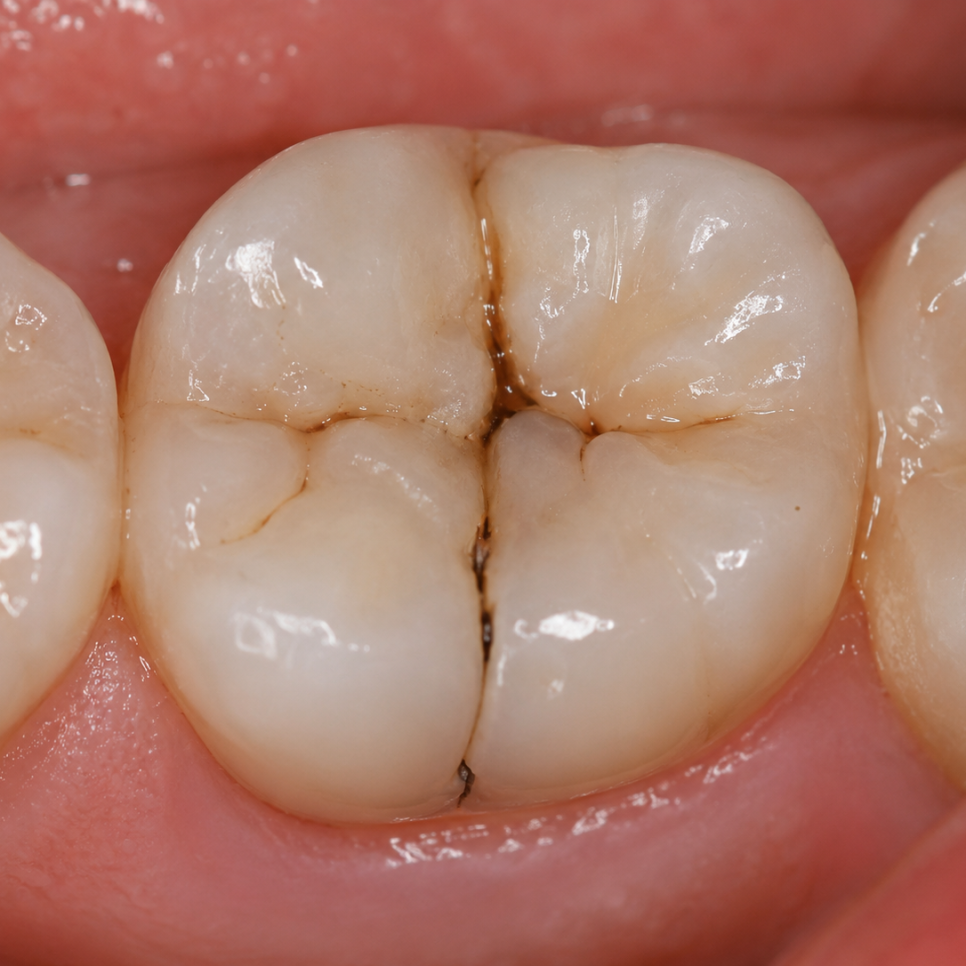
Today, I will explain why teeth split,
how treatment differs depending on how far the crack has progressed,
and what happens next if extraction is necessary,
along with the supporting evidence.
| Chapter 1. Why are the 'small premolars' especially prone to splitting? |
First, some teeth are more likely to split than others.
The second premolar, the fifth tooth from the front,
has a relatively high fracture frequency statistically.
In fact, vertical root fractures are reported more commonly in premolars
and lower molars.
(PMC, literature on vertical root fractures)
The reason lies in their position.
Although they are smaller than molars,
they are located directly in front of the molars,
which bear the greatest force when chewing,
so they receive relatively high loads.
Because they must withstand heavy loads despite their small size,
they are vulnerable to cracks.
| Chapter 2. The depth of the split determines the tooth's fate |
This is the key point.
Even with the same type of fracture,
treatment changes completely depending on how far it has split.
It can be broadly divided into three stages.
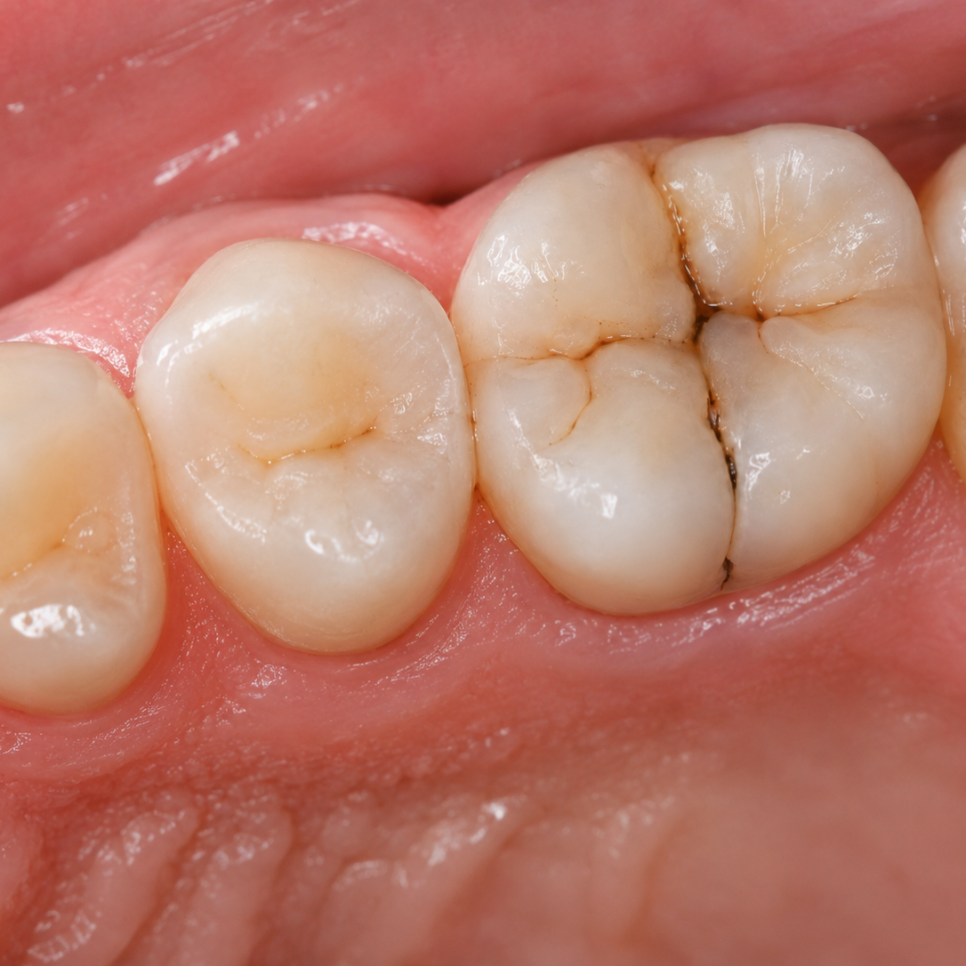
First, when the fracture has not reached the nerve (pulp)
and is limited to the crown.
If the nerve has not been affected, the pain may be
a temporary reaction to the impact.
If the fractured fragment is small, it may be smoothed and monitored;
if it is large, the tooth may be saved by covering it with a crown.
Second, when the fracture has passed through the nerve
but has not extended below the root, beneath the alveolar bone.
This should be considered the beginning of a nerve infection.
If the exposed area is small, a pulp-preserving treatment such as MTA may be performed;
if it is large, root canal treatment is performed.
Even so, there may still be a chance to save the tooth itself.
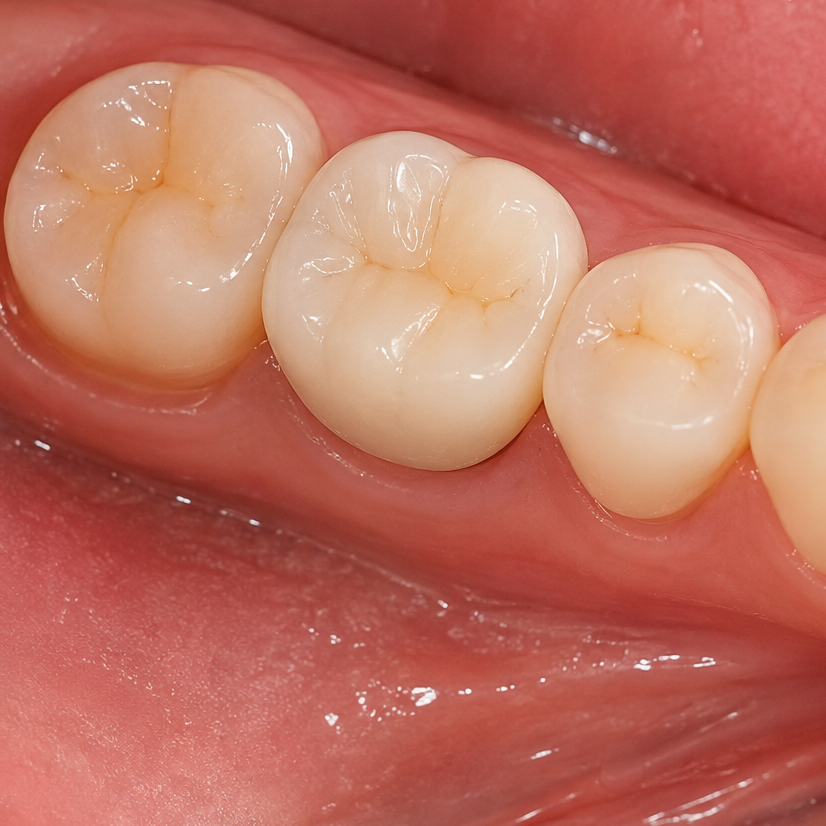
Third, when the fracture line passes through the root
and extends below the gum bone, beneath the alveolar bone.
This goes beyond the question of whether the nerve can be preserved;
it becomes a question of whether the tooth can be extracted.
In fact, the standard treatment for a complete vertical root fracture
is extraction.
When the fracture line extends below the gum and the bone and periodontal tissues
can no longer support the tooth, preservation is difficult.
(PMC, review of vertical root fracture management)
| Chapter 3. When examining a loose tooth... |
There is a characteristic symptom
in the third case.
The split portion may be very loose,
but it does not fall out unless force is applied.
This is because the fractured fragment is still attached
to the alveolar bone by tiny fibers called the periodontal ligament.
These fibers hold it in place, so there is pain and mobility,
but it does not completely detach.
However, because the fracture has passed through the nerve,
it hurts when touched and may throb faintly even when left alone.
This is not a good sign.
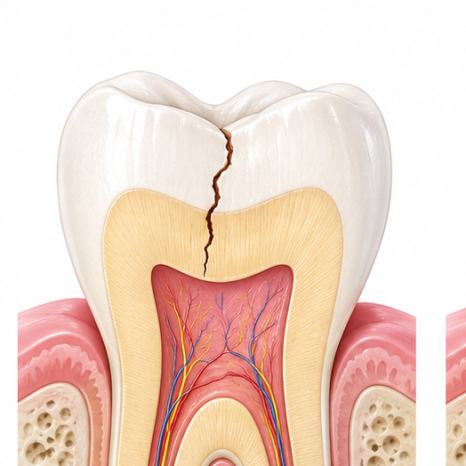
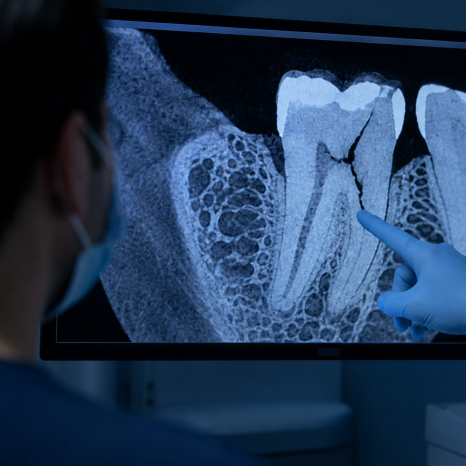
To accurately assess this condition,
a CT scan that can show in three dimensions how far down the fracture line extends
is necessary.
The visible appearance and the actual depth are often different.
| Chapter 4. If extraction has been decided, what happens next? |
If the fracture line extends deeply below the bone
and extraction is unavoidable,
the process does not end with removing the tooth.
The next step is to consider how to restore that site.
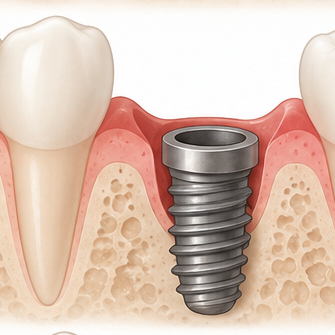
One option is immediate implant placement after extraction.
This involves placing an implant immediately in the site where the tooth was removed.
Several studies report that immediate implant placement after extraction due to a vertical root fracture is safe and effective.
However, there is an important condition.
If there is an acute infection in the area,
immediate placement should be avoided.
(PMC, studies on immediate implants)
There are also cases in which 'immediate loading' is possible,
meaning that the implant can be used immediately after placement.
This depends on how firmly the implant is initially retained.
It may be considered when the initial stability, or insertion torque, is generally
30–45 Ncm or higher,
and the stability quotient, or ISQ, is 60–70 or higher.
(Summary of multiple clinical studies)
If these conditions are not met, the procedure should not be forced.
A temporary tooth may be used instead, or several months may be allowed to pass
before placing the final restoration.
In other words, this does not mean that 'everything can be completed on the same day.'
It is an option only when the bone condition and implant stability are sufficient.
Today, I explained the boundary line that determines the fate
of a cracked or split tooth.
In summary, even with the same fracture,
whether the nerve has been reached
and whether the fracture has extended below the alveolar bone
determine whether the tooth can be saved
through smoothing, a crown, or root canal treatment,
or whether extraction is necessary.
A tooth that is loose but does not fall out
may simply be held in place by the periodontal ligament.
It may instead be a sign of a deep fracture.
An accurate diagnosis is possible only by confirming the depth
of the fracture line with a CT scan.
Timing is crucial.
If a known crack is left untreated,
the fracture line may eventually extend below the alveolar bone,
turning a tooth that could have been saved into one requiring extraction.
If you have a cracked tooth or a tooth that feels sharp or tingly when chewing,
I recommend having it checked before it splits further.
If you have any questions,
please feel free to contact us at any time.
We will honestly determine first whether the tooth can be saved.

[References]
PMC (Vertical root fractures and their management, 4001262) — Premolars and mandibular molars are vulnerable to vertical root fractures
PMC (Management of vertical root fractures, 10903158) — Extraction is the standard treatment for complete fractures and subgingival fractures; preservation is not possible when the bone and periodontal tissues cannot provide support