Hello!
I am the director of Seoul Bardi Dental Clinic.
▼ Check the Dental Clinic Location ▼
| This post was written directly by Seoul Bardi Dental Clinic for the purpose of providing medical information, in compliance with Article 56(1) of the Medical Service Act regarding medical advertising. We recommend using the information provided for reference only. For an assessment of your symptoms and accurate guidance on how to manage them, please visit a medical institution and consult with a medical professional. All procedures and surgeries performed at a dental clinic may involve individual risks, such as inflammation, bleeding, and swelling. Please make your decision after having a sufficient consultation with a medical professional in advance. All images were created using AI to aid understanding. |
| Directions |
When a problem develops in a single tooth,
most people come in for treatment right away.
However, quite a few people do not visit the dentist
until their front teeth and molars have deteriorated
to the point that they are failing at the same time.
In these cases, many people want to have
their front teeth treated first.
The front teeth are immediately visible when smiling
and are directly connected to social life.
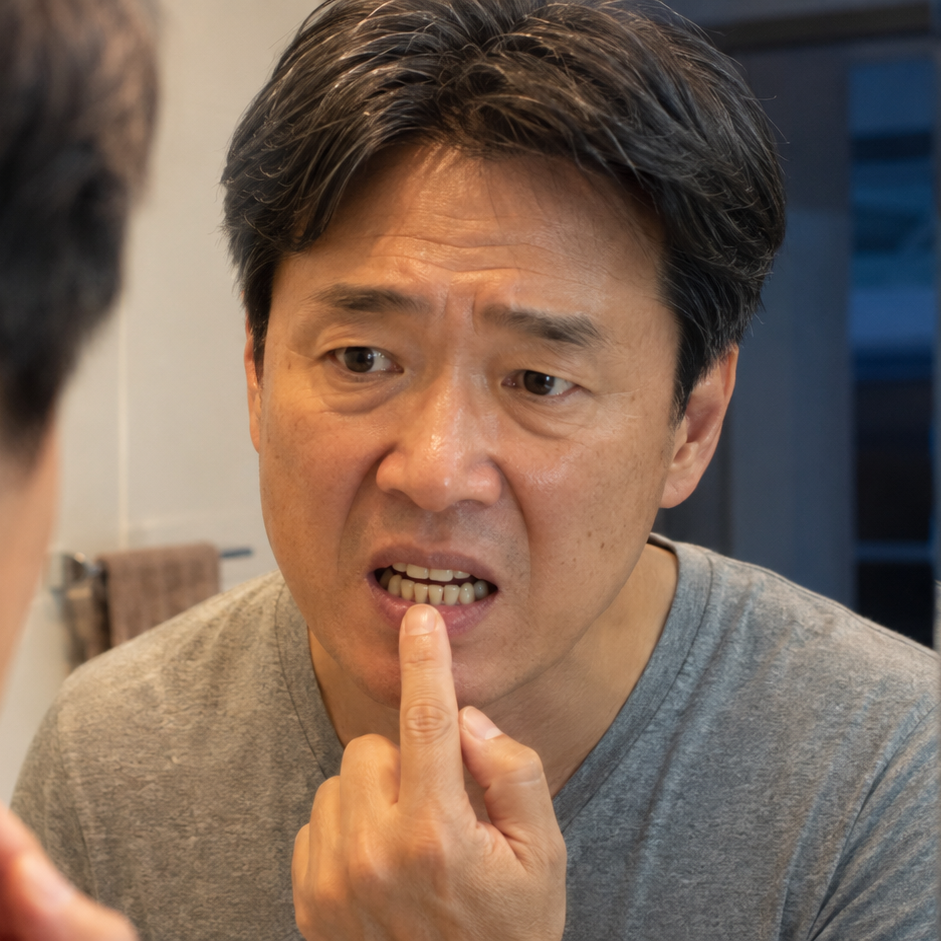
However, when dentists determine
the order of treatment,
they often recommend treating the molars first.
Today, I will explain, with supporting evidence,
why treating the molars before the front teeth
can actually be the way to protect the front teeth.
| Chapter 1. The Front Teeth and Molars Have Different “Roles” |
These two types of teeth perform different functions.
The front teeth cut food,
while the molars crush and grind
the food after it has been cut.
Although the front teeth are more noticeable aesthetically,
the molars actually handle most of the chewing force.
Therefore, when the molars are weak,
food is swallowed without being crushed finely enough.
Several studies have reported that
reduced chewing function can affect
swallowing, digestion, and nutrient intake.
However, this does not mean that “a person will definitely
develop an illness if they have no molars.”
It means that reduced chewing efficiency
may become a burden on digestion and nutrition.
| Chapter 2. When the Molars Fail, the Force Shifts to the Front Teeth |
This is where the key point begins.
The real reason the molars should be treated first
is the front teeth.
When the back molars are missing or become shorter,
the chewing force that the molars originally absorbed
shifts toward the front teeth.
The front teeth were not originally designed
to withstand force of that intensity.
As a result, the front teeth may flare outward,
become loose, or deteriorate quickly.
Dentists refer to this phenomenon
as “posterior bite collapse.”
It describes the process in which the entire bite
collapses toward the front as molar support breaks down.
The front teeth becoming spaced apart
and receiving excessive load are typical results.
Therefore, if you leave the molars untreated
and make only the front teeth look attractive first,
the front teeth can immediately be overloaded
and are more likely to develop problems again.
It is like repairing the front
without first building the “back pillars” of the molars.
| Chapter 3. The Loss of Height Can Change Even the Appearance of the Face |
When the teeth are extensively damaged,
the height at which the upper and lower teeth meet—
that is, the occlusal vertical dimension—
often decreases as well.
When only a few chewing contact points remain,
the height can collapse accordingly.
When this height decreases,
the lower part of the face becomes shorter
and wrinkles around the mouth deepen,
which can create an appearance that looks older
than a person’s actual age.
(Regarding the occlusal vertical dimension,
prosthodontic literature, Int J Esthet Dent 2019)

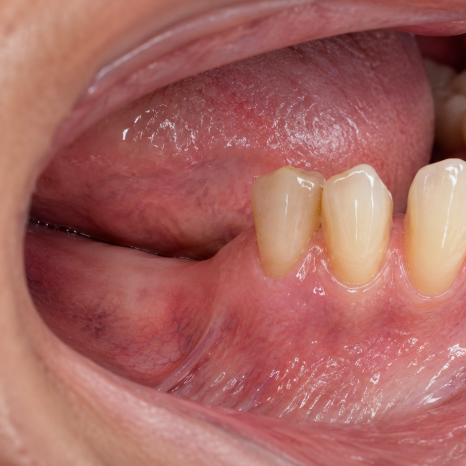

That is why there is an order to restoring
the height that has collapsed.
First, the molars are used to establish
a normal height and set the reference,
and the front teeth are completed on top of it.
For the length, shape, and aesthetics of the front teeth
to turn out properly,
there must first be a reference line based on
the height established by the molars.
This is why stable posterior support
and occlusal height are considered the foundation
of full-mouth reconstruction.
(Occlusal Concepts in Full Mouth Rehabilitation
and other prosthodontic literature)
| Chapter 4. Then, When Are the Front Teeth Treated? |
Based on what we have discussed so far,
you may be concerned that
“the front teeth will not be treated until much later.”
This is where the practical issue of treatment duration arises.
Therefore, when the conditions are appropriate,
implants for the front teeth and molars
may be placed together on the same day.
The teeth requiring removal
(teeth with only the roots remaining, severely decayed teeth,
and loose teeth) are extracted,
and implants are placed in the upper and lower jaws at once.
This can reduce the burden of undergoing multiple surgeries
and significantly shorten both the period without teeth
and the overall treatment period.


However, placing implants simultaneously in this way
is not possible for everyone.
The amount and density of the remaining bone,
as well as the initial stability immediately after placement,
must be adequate for this option to be considered.
Therefore, precise CT analysis is an essential prerequisite.
In other words, it is a treatment plan that
“follows the proper order while shortening the duration.”
Today, I explained why, when the front teeth and molars
have problems at the same time,
the molars should be treated first.
To summarize:
The molars are the functional center of chewing force,
and when the molars fail, that force shifts to the front teeth,
causing them to deteriorate quickly as well.

In addition, to properly restore the aesthetics of the front teeth,
there must first be a reference based on
the normal height established by the molars.
That is why the order that truly protects the front teeth
is often “molars first.”
Of course, not every case is the same.
The order and method may vary depending on
the condition of the remaining teeth and bone,
as well as the bite.
When the conditions are appropriate,
simultaneous implant placement may shorten the treatment period.
What matters is a treatment plan that considers
not only the visible front teeth,
but also the function and height of the entire mouth.
If your front teeth and molars are bothering you at the same time,
we recommend first having your teeth evaluated
to determine which order is right for you.
If you have any questions,
please feel free to contact us anytime.^^

[References]
Posterior bite collapse: Guidelines for Treatment Based on Form and Function (J Prosthodont, 2022) / AGD Treatment Guidelines
— When molar support is lost, the bite collapses forward, causing spacing and excessive load on the front teeth.
Occlusal Concepts in Full Mouth Rehabilitation: An Overview (PMC4257939 and other prosthodontic literature) — Stable posterior support and occlusal height are the foundation of full-mouth reconstruction.
Prosthodontic literature on the occlusal vertical dimension (Int J Esthet Dent, 2019) — A decrease in occlusal height can shorten the lower face and create an aged appearance.
Chewing and its influence on swallowing, gastrointestinal and nutrition-related factors: a systematic review (Crit Rev Food Sci Nutr, 2022)
— Reduced chewing function can affect swallowing, digestion, and nutrition.