Hello!
I am the director of Seoul Bardi Dental Clinic.
▼ Check the clinic location ▼
| This post was written directly by Seoul Bardi Dental Clinic in compliance with Article 56, Paragraph 1 of the Medical Service Act for the purpose of providing medical information. The information provided is intended for reference only. For an assessment of your symptoms and accurate care instructions, please visit a medical institution and consult with a medical professional. All procedures and surgeries performed at a dental clinic may involve individual risks, such as inflammation, bleeding, and swelling. Please make your decision after having a sufficient consultation with a medical professional in advance. All images were created using AI to aid understanding. |
When you visit a dental clinic, you often hear that
“prosthetic restorations usually last 8–10 years.”
So when 10 years are approaching,
you may worry, “Do I need to replace it now?”
However, in the clinic, I regularly see perfectly intact
prosthetic restorations that have been used for 20 or even 30 years.
Several patients come in with restorations like these every day.
Seeing this, I feel that 8–10 years may be a fairly conservative estimate.
Today, I will discuss what actually determines
the lifespan of a prosthetic restoration,
as well as a case in which secondary decay that developed beneath
a gold inlay that had been functioning well for over 10 years
was treated again with a ceramic inlay.
| Chapter 1. The Lifespan of a Prosthetic Restoration Is Not a Fixed Number |
First, let’s clarify a common misconception.
“8–10 years” is closer to an average,
not a lifespan that applies to everyone.
Looking at actual data,
there are fairly significant differences between materials.
In a study combining the annual failure rates
of molar restorations,
cast-gold inlays and onlays had the lowest rate at 1.4%,
while ceramics were around 1.7–1.9%.
A meta-analysis examining ceramic inlays separately
reported 5-year survival rates of 92–95%
and a 10-year survival rate of 91%.
In other words, most restorations remain in good condition
at the 10-year mark.
With proper brushing and care,
it is reasonable to consider the lifespan of a prosthetic restoration
as being close to semi-permanent in practical terms.
| Chapter 2. Then Why Do Restorations Need to Be Replaced? The Problem Is the “Margin” |
If their lifespan is close to semi-permanent,
why does retreatment become necessary?
It is usually not because the restoration itself has worn out,
but because secondary decay develops along the edges, or margins.
Studies also identify secondary caries as the leading cause
of restoration failure,
followed by fractures and marginal defects.
One report found that 73.9% of composite resin replacement cases
were due to secondary caries.
To summarize, restorations are generally removed and replaced
in the following situations:
When secondary decay develops along the restoration margin
When a hole develops in the restoration
When the remaining tooth structure around the restoration breaks away
That was also the case with this patient.
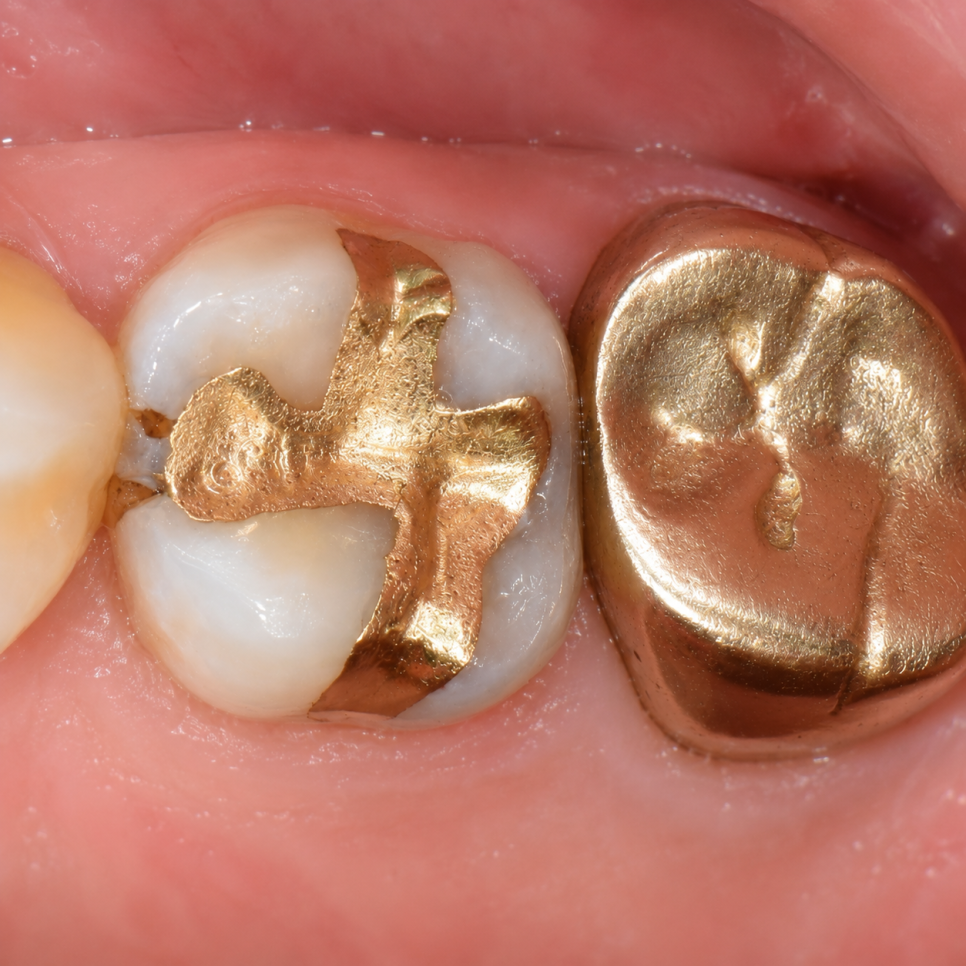
The patient visited us because food kept getting stuck
in an upper molar that had been treated more than 10 years earlier,
“as if there were a hole.”
There was decay on the front proximal surface of the tooth,
and an unfavorable area was also visible toward the back.
| Chapter 3. The Most Concerning Part Is That “It Doesn’t Hurt” |
This is the key point.
Decay that develops between teeth, on the proximal surfaces,
has no noticeable symptoms in the majority of cases.
Even when the decay is quite deep, there may be no pain,
so it is very often discovered by chance
when someone comes in for scaling.
This patient also came in not because of pain,
but because of the discomfort caused by food getting stuck.
Therefore, rather than thinking, “It’s fine because it doesn’t hurt,”
you should understand that “it may still be progressing even if it doesn’t hurt.”
The area between the tooth and the restoration is a blind spot
that is difficult to assess both visually and through pain symptoms.
This is why regular scaling and dental checkups are essential.
| Chapter 4. Principles of Retreatment: We Do Not Remove Everything Just Because It Is Dark |
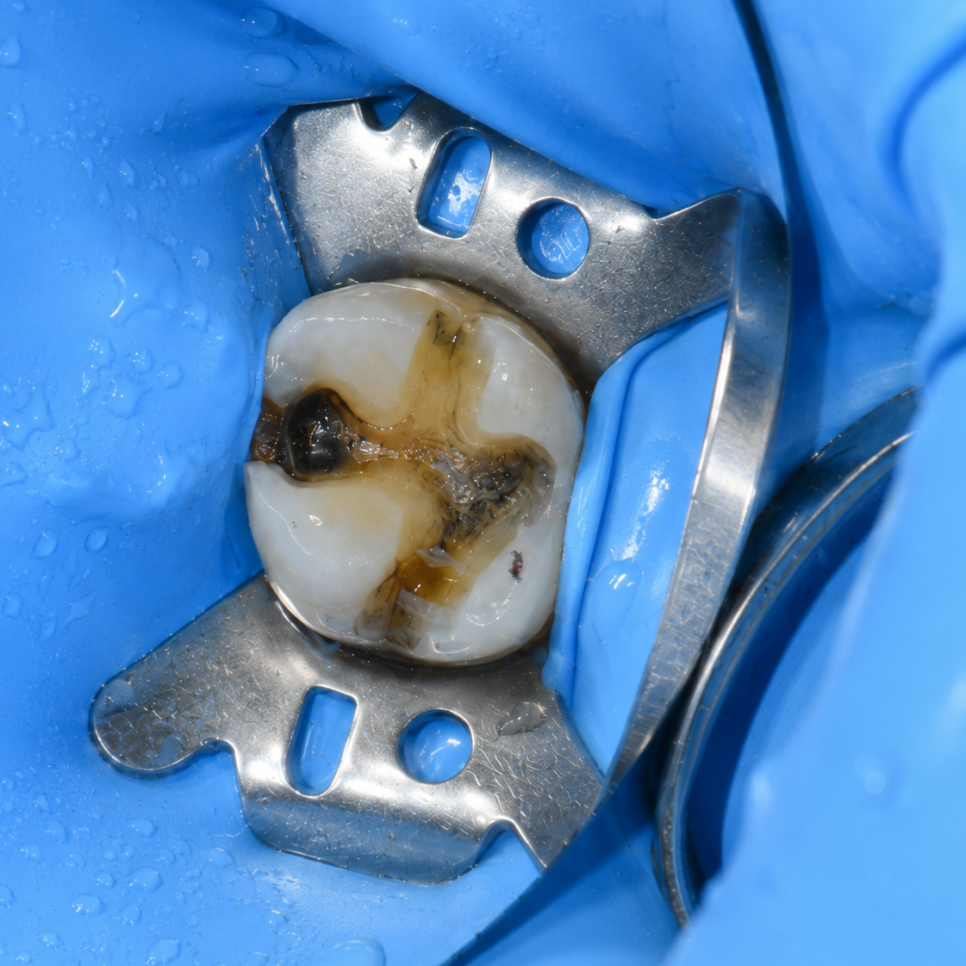
In this case, after administering anesthesia,
we removed the gold inlay and found unfavorable areas
on both the front and back sides.
There is one important principle here.
We do not automatically remove everything
just because it is black or brown.
We remove areas that are scraped away with an instrument.
If an area does not scrape away,
we judge it to be firm discoloration and leave it in place.
Aggressively removing everything only increases
the likelihood of lingering sensitivity after treatment
and the need for root canal treatment.
| Chapter 5. How to Avoid Root Canal Treatment as Much as Possible When the Area Is Close to the Pulp |
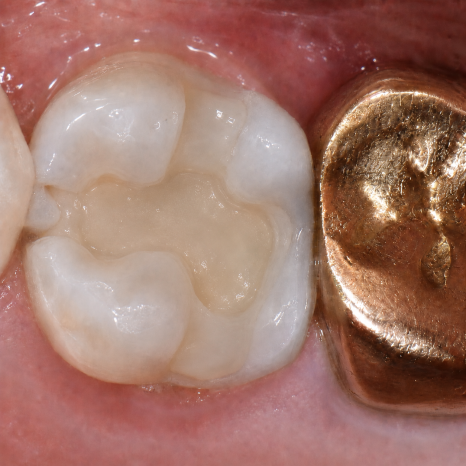
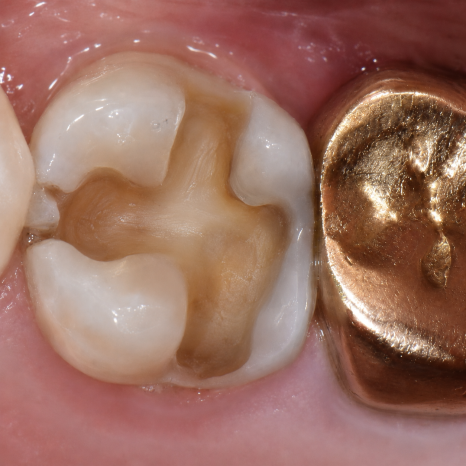
For deep areas, we place a protective material
to reduce pulp sensitivity before proceeding with the inlay.
Fortunately, the patient had no sensitivity after treatment
or discomfort when chewing,
so we decided to monitor the tooth through regular checkups.
If the pulp is exposed and bleeding occurs while removing the decay,
we first control the bleeding with pressure as quickly as possible
and then perform a pulp-capping procedure by covering it with MTA.
There is also something I want to explain honestly here.
Pulp capping is an attempt to avoid root canal treatment
as much as possible;
it is not guaranteed to work 100% of the time.
In fact, studies report that the long-term success rate
of direct pulp capping in extensive decay is not high.
If symptoms continue afterward,
root canal treatment may ultimately become necessary.
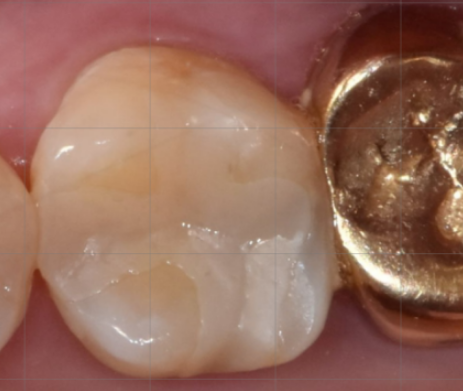
That is why it is so important to prevent pulp exposure
in the first place.
In other words, selective caries removal,
as mentioned earlier, is extremely important.
Today, I discussed the lifespan of prosthetic restorations
and retreatment.
To summarize, the lifespan of a prosthetic restoration
is not fixed at 8–10 years.
With proper care, it can be used
for a period that is practically close to semi-permanent.
The reason restorations need to be redone
is usually not that the material has worn out,
but that secondary decay has developed along the margins.
This decay often does not hurt,
so it is difficult to detect on your own.
And even during retreatment,
removing as much as possible is not always the right approach.
Selective removal—leaving the areas that can be preserved—is a way to protect the natural tooth.
If you have a restoration that is more than 10 years old,
or an area where food gets stuck unusually often,
we recommend having it checked even if there is no pain.
If it is found before pain develops,
treatment may end with an inlay.
Once pain begins, however,
root canal treatment may become necessary.
Regular scaling and dental checkups
are ultimately the most reliable approach.
If you have any questions, please feel free to contact us at any time.

[References]
Manhart J et al. (PubMed 20230962) — Annual failure rates of molar restorations: cast-gold inlays/onlays 1.4%, ceramics 1.9%, CAD/CAM ceramics 1.7%; the main causes of failure were secondary caries, fractures, and marginal defects
(PubMed 27287305) — Survival rates of ceramic inlays/onlays: 92–95% at 5 years and 91% at 10 years
Practical study of Class II restorations (PubMed 23167471)
Bjørndal L et al., Int Endod J (2019)
Decisions in Dentistry / Cochrane — Selective caries removal reduces pulp exposure by 77% compared with complete removal and is more effective for preserving pulp vitality