Hello!
This is Seoul Bardi Dental Clinic.
▼ Check the clinic location ▼
| This post was written directly by Seoul Bardi Dental Clinic for the purpose of providing medical information, in compliance with Article 56, Paragraph 1 of the Medical Advertising Act. We recommend using the information provided for reference only. Please visit a medical institution and receive guidance from a medical professional to identify your symptoms and determine the appropriate management method. All procedures and surgeries performed at dental clinics may involve individual risks, such as inflammation, bleeding, and swelling. Please make your decision after having a thorough consultation with a medical professional in advance. All images were created using AI to help with understanding. |
When tooth decay is too extensive,
when secondary caries develops beneath an existing restoration,
or when a severe fracture cannot be treated
with an inlay or resin,
we recommend a crown.
However, many people ask,
“Please make it a tooth-colored crown.”
In fact, tooth-colored crowns used in dentistry
are broadly divided into two types:
PFM (porcelain-fused-to-metal crowns) and zirconia.
On the outside, both are white
and look similar.
However, their internal structures are completely different,
which can lead to different results 10 years later.
Today, we will explain how these two materials differ,
the advantages and disadvantages of each,
and why we choose zirconia,
along with the supporting evidence.
| Chapter 1. What Is PFM? — Metal Inside, Porcelain Outside |
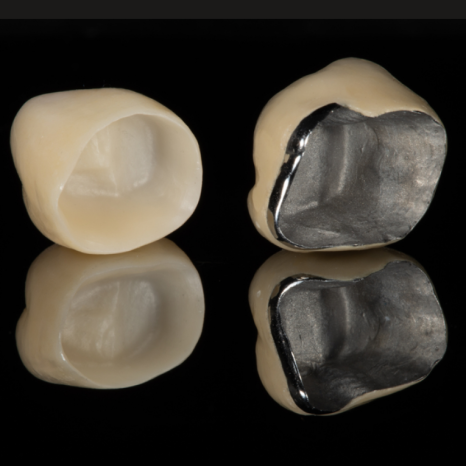
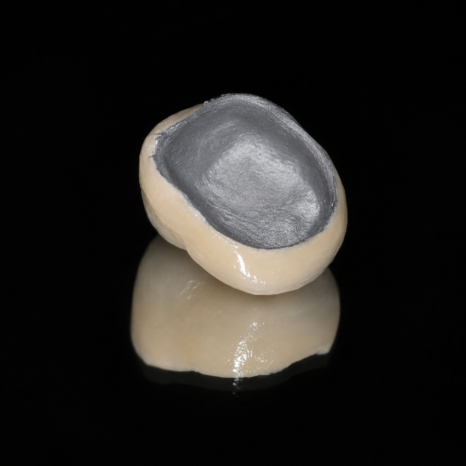
PFM is short for “Porcelain Fused to Metal.”
As the name suggests,
it means porcelain on the outside
and metal on the inside.
A thin metal framework is made,
and tooth-colored reinforced porcelain
is layered and fired over it.
Gold is biocompatible,
but its color makes it less aesthetically pleasing.
PFM addressed this drawback and was widely used
for a long time as a “tooth-colored crown.”
It also has clear advantages.
It is more aesthetic than a gold crown,
and is generally more reasonably priced
than zirconia.
| Chapter 2. PFM’s Weaknesses Come from Its “Structure” |
PFM’s limitations do not come from the materials being poor.
They come from the structure itself,
which consists of two materials layered and bonded together.
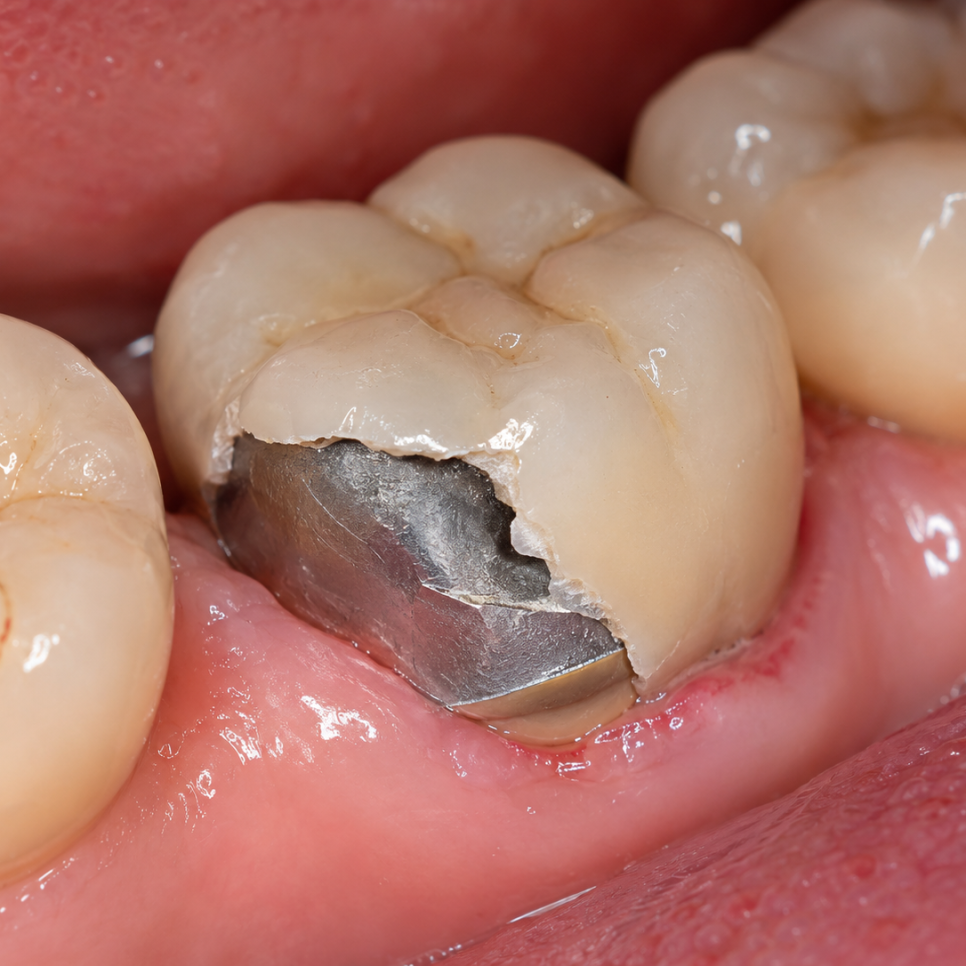
First, the porcelain can fracture.
Because porcelain is layered and fired over a metal framework,
the boundary between them—the core-ceramic interface—
becomes the weakest point.
If the two materials have slightly different thermal expansion properties,
or if bonding is inadequate,
the porcelain may break away over time.
Long-term follow-up studies have reported
chipping of the porcelain in 9–25% of PFM restorations,
which can compromise aesthetics and eventually require
the crown to be replaced.
The problem is that once it breaks,
a sharp fractured surface remains.
Many patients visit the clinic because their tongue or cheek
is irritated and painful from rubbing against it.
Second,
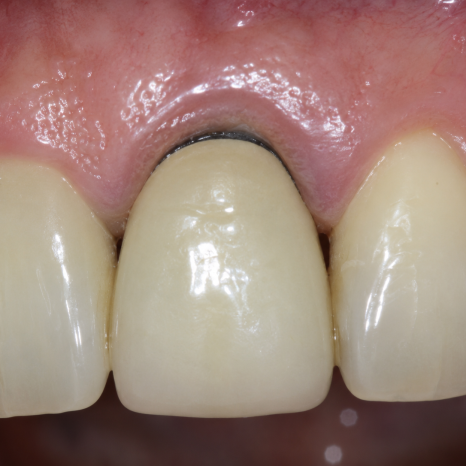
the gum margin may appear dark.
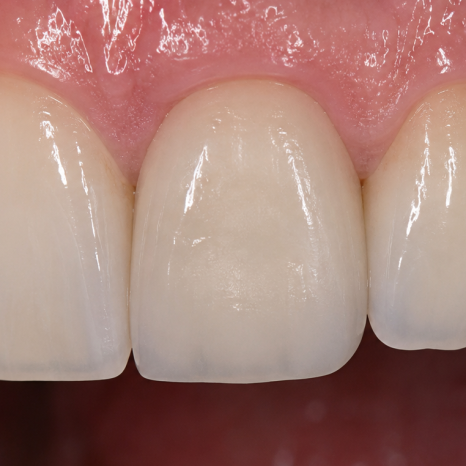
One important characteristic of natural teeth
is the way light passes through them.
Because PFM contains metal,
light cannot pass through it.
As time passes, this can cause the boundary
between the gums and the artificial tooth
to appear dark.
This is especially noticeable in visible areas such as the front teeth.
When the gum line begins to turn dark,
you may inevitably find yourself wondering,
“Do I need to have it redone now?”
Third, the result depends on the people making it.
PFM is made by shaping wax,
melting and casting the metal,
and layering and firing the porcelain
one layer at a time—all by hand.
Therefore, quality can vary considerably
depending on where it is made.
| Chapter 3. How Is Zirconia Different? |
Zirconia takes a completely different approach.
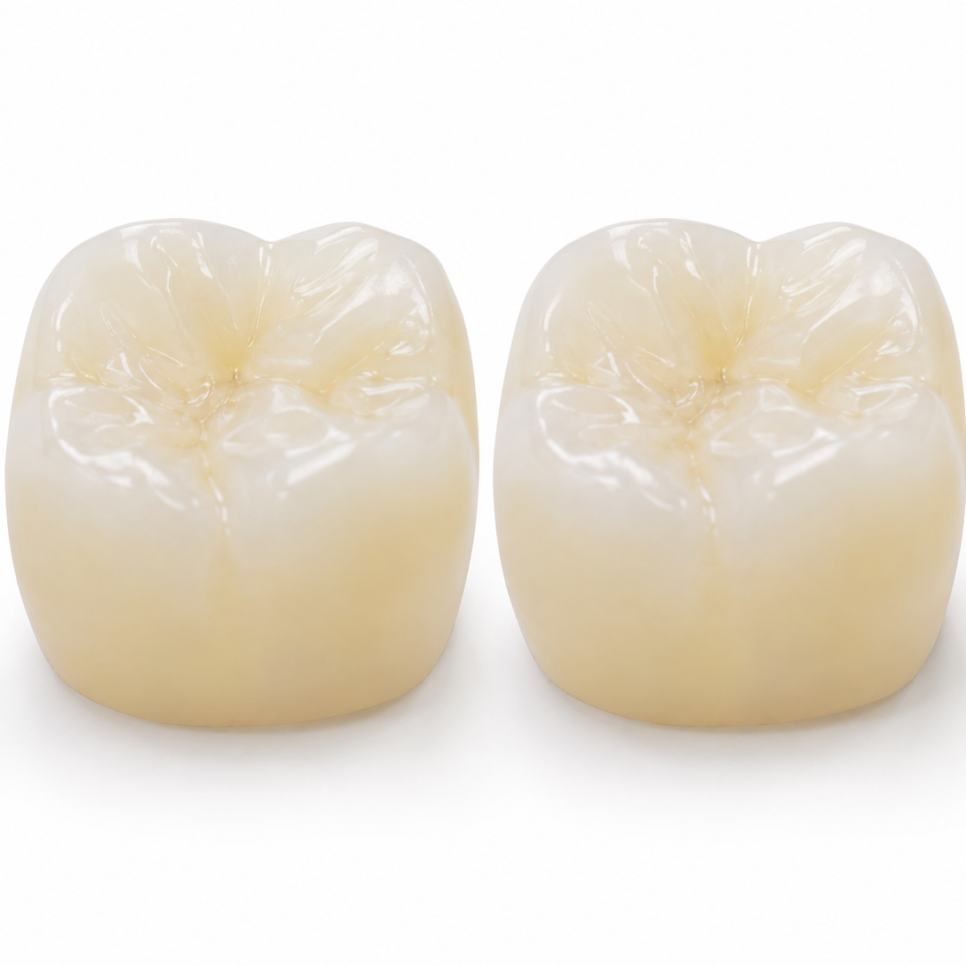
It is an artificial restorative material
similar in color to natural teeth,
with strength comparable to that of natural teeth.
It is used in various applications,
including front teeth, molars, and bridges.
The biggest difference is the manufacturing method.
Because it is milled from a single block
using a dedicated milling machine,
rather than being built up layer by layer by hand,
its quality is consistent.
And this fact—that it is made from one solid block—
is its key strength.
Since porcelain is not layered separately,
the core-ceramic interface mentioned earlier
does not exist, reducing the number of points
where fractures can occur.
| Chapter 4. Zirconia Does Not Have Advantages “in Every Respect” |
There is one thing we would like
to say honestly here.
Saying that “zirconia is always better in every way”
would be an exaggeration.
The two materials have similar five-year survival rates.
In other words, this does not mean that
“PFM becomes unusable quickly.”
PFM can also last for a sufficiently long time.
So what are zirconia’s real strengths?
They are aesthetics and resistance to chipping.
To summarize:
Longevity (survival rate) → Similar for both
Aesthetics and gum-margin color → Zirconia has an advantage
Price → PFM has an advantage
| Chapter 5. Why We Use Only Zirconia Despite This |
Then why do we choose zirconia?
Coming to the dentist in the first place
is not an easy decision,
and proceeding with treatment is also a major commitment.
. However, if the porcelain breaks after a few years
or the area between the gums turns dark,
forcing you to have it redone,
neither you nor we can feel at ease.
The cost of zirconia may feel
like a burden right now.
However, if you later have to replace it once more
for aesthetic reasons,
choosing zirconia from the beginning
may ultimately be less expensive.
Today, we compared the two types
of tooth-colored crowns.
To summarize,
PFM and zirconia may look similar on the outside,
but their internal structures are different.
PFM consists of porcelain layered over metal,
so chipping can occur at the interface,
and the metal can block light,
causing the gum margin to appear dark.
Zirconia is milled from a single block,
so there are fewer points where it can fracture,
and it offers aesthetic advantages.
However, since the longevity itself
is similar for both materials,
it is more accurate to understand this
not as “PFM is bad,”
but as a choice based on
“what you consider more important.”
If you are preparing for crown treatment,
rather than deciding based only on the material’s name,
we recommend considering the tooth’s location
and your priorities— aesthetics, cost, and chewing forces—together.
If you have any questions,
please feel free to contact us at any time.
We will provide honest guidance
with a focus on helping your treatment last as long as possible. ^^

[References]
Pjetursson BE et al., Clin Oral Implants Res (2018, meta-analysis) — 5-year survival rate: metal-ceramic 98.3% vs. zirconia 97.6%; zirconia had significantly fewer aesthetic complications
Systematic review and meta-analysis (PubMed 41489982, 2026) — 5-year survival rate of tooth-supported crowns: metal-ceramic 97.1%, monolithic zirconia 96.8%; the monolithic design had significantly fewer ceramic fractures and instances of chipping
JCCP (2025) — Long-term follow-up found chipping in 9–25% of PFM restorations, leading to reduced aesthetics and crown replacement
PMC (10899163) — The core-ceramic interface is the weakest point; differences in coefficients of thermal expansion and inadequate bonding are causes of chipping