Hello!
I am the director of Seoul Vardy Dental Clinic near Sangil-dong Station.
▼ Check the clinic location ▼
“Doctor, my tooth is moving.”
If you can feel this movement yourself and have come in for an examination,
it often means the condition has already progressed considerably.
Tooth mobility is barely noticeable in the early stages,
so by the time you can detect it yourself,
the supporting structures have often already been significantly damaged.
People’s reactions generally fall into two categories.
They either become frightened, thinking,
“Now all my teeth are going to fall out,”
or they put it off, thinking,
“It doesn’t hurt yet, so it must be fine.”
Neither is actually correct.
A loose tooth does not automatically need to be extracted,
and the absence of pain does not mean it is safe.
Tooth mobility has grades.
Those grades help determine whether a tooth can be saved or needs to be extracted.
Today, we will go through, step by step,
why teeth become loose and which teeth can be saved or need to be extracted.
| Chapter 1. Why Do Teeth Become Loose? The Cause Lies in the “Support” |
Let’s start with the cause.
Even healthy teeth move very slightly.
The periodontal ligament between the tooth root and the jawbone
acts as a cushion that absorbs impact.
This is normal.
The problem occurs when this supporting structure breaks down.
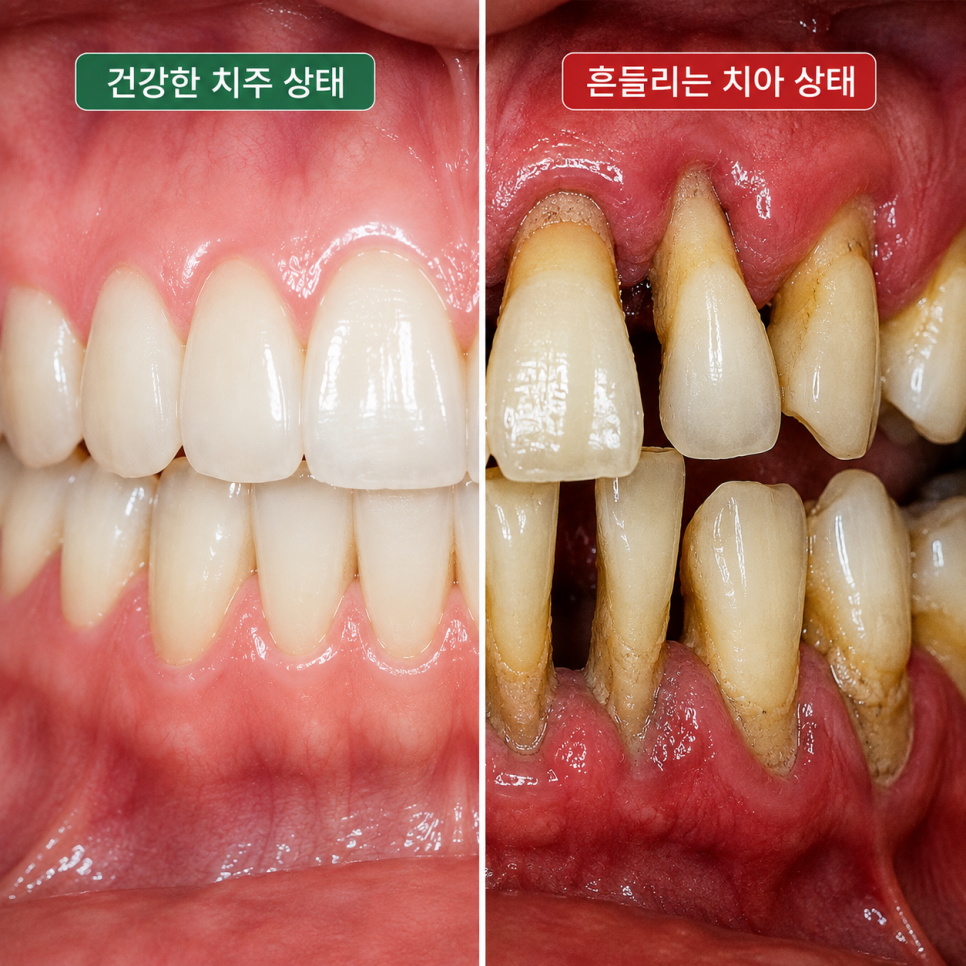
Pathological tooth mobility is most commonly caused by periodontitis (gum disease),
which results in the loss of the jawbone and periodontal ligament that support the tooth.
Excessive biting forces or trauma can also be causes.
(Miller mobility classification literature)
In other words, it is not necessarily that the tooth itself has become weak;
rather, the “ground” in which the tooth is planted has collapsed.
That is why the degree of mobility
serves as a sign of how much jawbone remains.
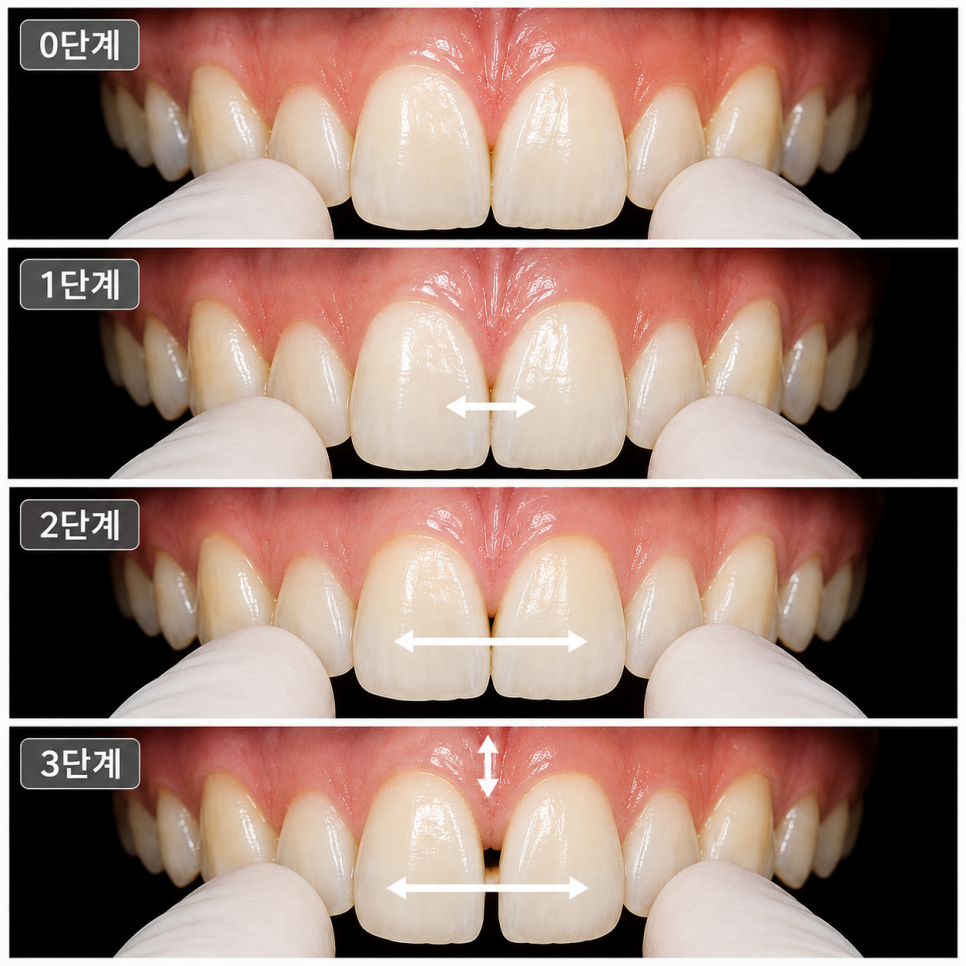
| Chapter 2. Mobility Also Has Grades: Mobility Classification |
Dentists do not assess tooth mobility merely by visual estimation;
it is divided into grades.
The widely used Miller classification is as follows.
| Grade 0 |
|---|
| Normal. No movement noticeable to the naked eye |
| Grade 1 |
| Mild horizontal movement of 1 mm or less |
| Grade 2 |
| Moderate horizontal movement of more than 1 mm |
| Grade 3 |
| Severe movement, with significant horizontal movement as well as vertical movement (up and down) (Source: Miller mobility classification) |
The grade is determined by considering whether the tooth moves only sideways,
whether it also moves up and down,
and how it responds when pushed with an instrument.
This grade is the starting point for determining the direction of treatment.
| Chapter 3. So, Can the Tooth Be Saved? The Grade Determines the Answer |
To give you the conclusion first,
not every loose tooth needs to be extracted;
it depends on the grade.
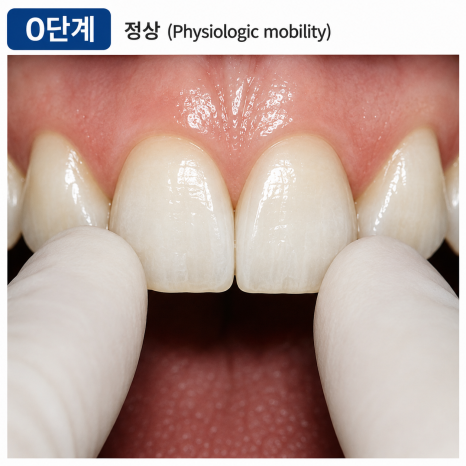
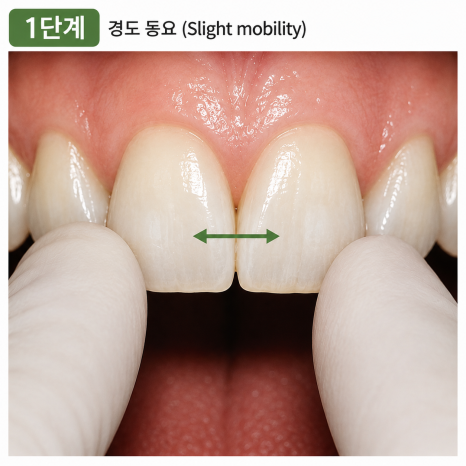
Early stage (Grade 1)
: It may be reversible.
Gum treatment to remove the causes—plaque and bacteria—such as scaling and root planing,
together with oral hygiene care, often helps reduce mobility.
Intermediate stage (Grade 2)
: Active treatment is needed before the condition worsens.
The tooth is reassessed after gum treatment,
and if sufficient bone remains, splinting may be considered
to stabilize the loose tooth by attaching it to adjacent teeth.
If biting forces are the cause,
the bite may also be adjusted.
Severe stage (Grade 3)
: This is the point at which the decision to extract or save the tooth varies the most.
If very little bone support remains and the tooth is uncomfortable to chew with,
extraction followed by bone grafting and an implant may be a realistic option.
The key point is this:
Teeth that can be saved are managed with gum treatment and retained for as long as possible,
and only teeth with truly poor prospects are selectively extracted.
A loose tooth is not automatically extracted all at once.
| Chapter 4. The Real Reason Gum Disease Is Concerning |
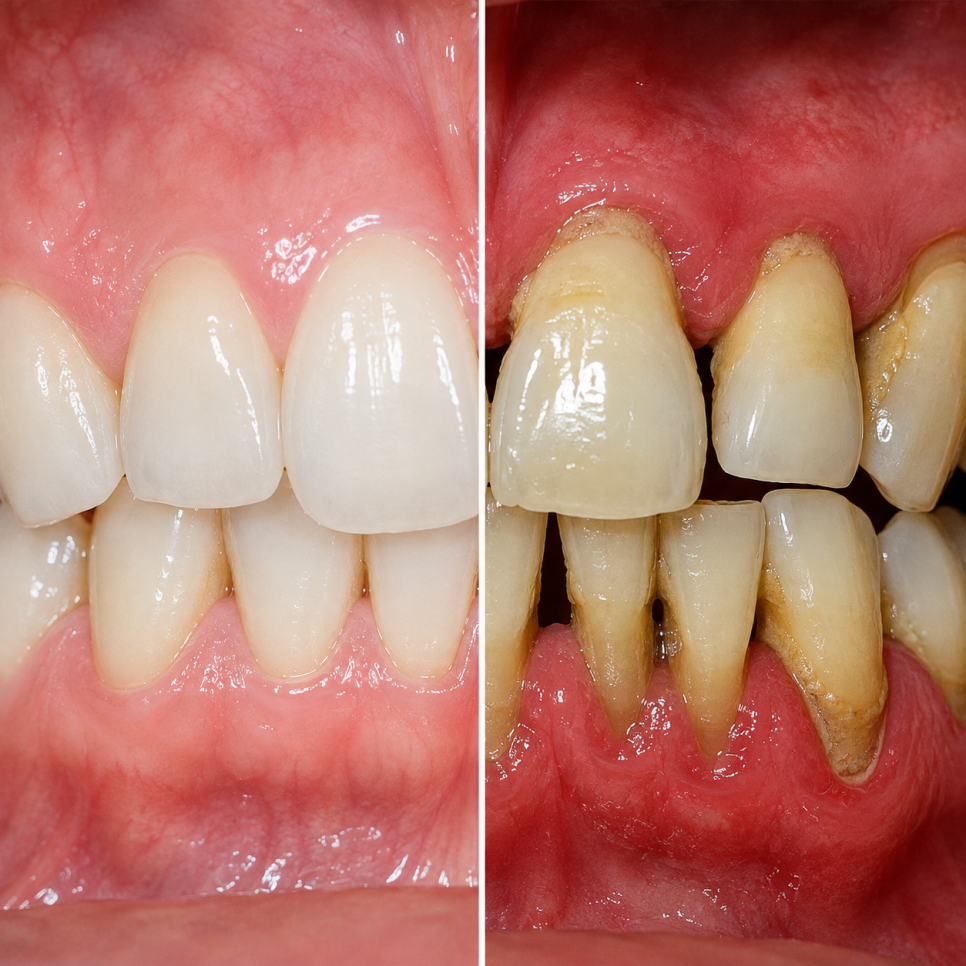
There is an important characteristic to point out here.
Mobility caused by gum disease is generally not a problem affecting only one or two teeth.
Because periodontitis tends to progress throughout the mouth,
even if the most severely affected tooth is extracted,
the remaining teeth may also be loose.
That does not mean all loose teeth can be extracted.
Therefore, treatment is not about “solving the problem of the single worst tooth.”
It involves managing the gum condition of all the teeth,
saving those that can be saved and giving up on those that cannot,
as part of an overall treatment plan.
Even when extraction and implants are performed,
they are only part of the bigger picture of managing the gums as a whole.
| Chapter 5. Implants Can Also Become “Loose”: Why Care After Placement Matters More |
There is one more thing you should know.
Extracting a loose natural tooth and placing an implant is not the end of the process.
If implants are not properly maintained,
peri-implantitis can develop as the surrounding jawbone breaks down,
and the implant may eventually become loose and fail.
The gum disease that made the natural tooth loose
can affect implants in the same way if it is not managed.
Therefore, whether you have natural teeth or implants,
gum care and regular checkups ultimately determine their longevity.
Treating loose teeth and caring for the remaining teeth and implants
are, in fact, part of the same process.
Tooth mobility is not a sign that the tooth itself has become weak;
it is a sign caused by the collapse of the jawbone supporting it.
Tooth mobility has grades,
so in the early stages it may be reversible with gum treatment,
and only severe cases require selective extraction.
A loose tooth does not automatically need to be extracted.
And because gum disease progresses throughout the mouth,
the entire set of teeth must be managed together.
<Are Gum Medications a Treatment?>
If you feel that a tooth is loose,
it may be a sign that the condition has already progressed to some extent,
so it is best to have it checked while the mobility is still at a low grade.
There are far more options for saving a tooth when you come in during the early stages.
If you have any questions,
please feel free to contact us anytime.
Thank you.

| This post was written directly by Seoul Vardy Dental Clinic for the purpose of providing medical information, in compliance with Article 56(1) of the Medical Service Act. We recommend using the information provided for reference only. Please visit a medical institution and consult a medical professional for an assessment of your symptoms and accurate care instructions. All procedures and surgeries performed at a dental clinic may involve individual risks, such as inflammation, bleeding, and swelling. Please make a decision after having a thorough consultation with a medical professional in advance. All images were created using AI to aid understanding. |