▼ Check the Dental Clinic Location ▼
| This post was written directly by Seoul Bardi Dental Clinic for the purpose of providing medical information, in compliance with Article 56, Paragraph 1 of the Medical Service Act regarding medical advertising. We recommend using the information provided for reference only. Please visit a medical institution and consult with a medical professional for symptom assessment and accurate care instructions. All procedures and surgeries performed at dental clinics may involve risks depending on the individual, such as inflammation, bleeding, and swelling. Please make your decision after having a sufficient consultation with a medical professional in advance. To help with understanding, all images were created using AI. |
Hello!
I am the director of Seoul Bardi Dental Clinic.
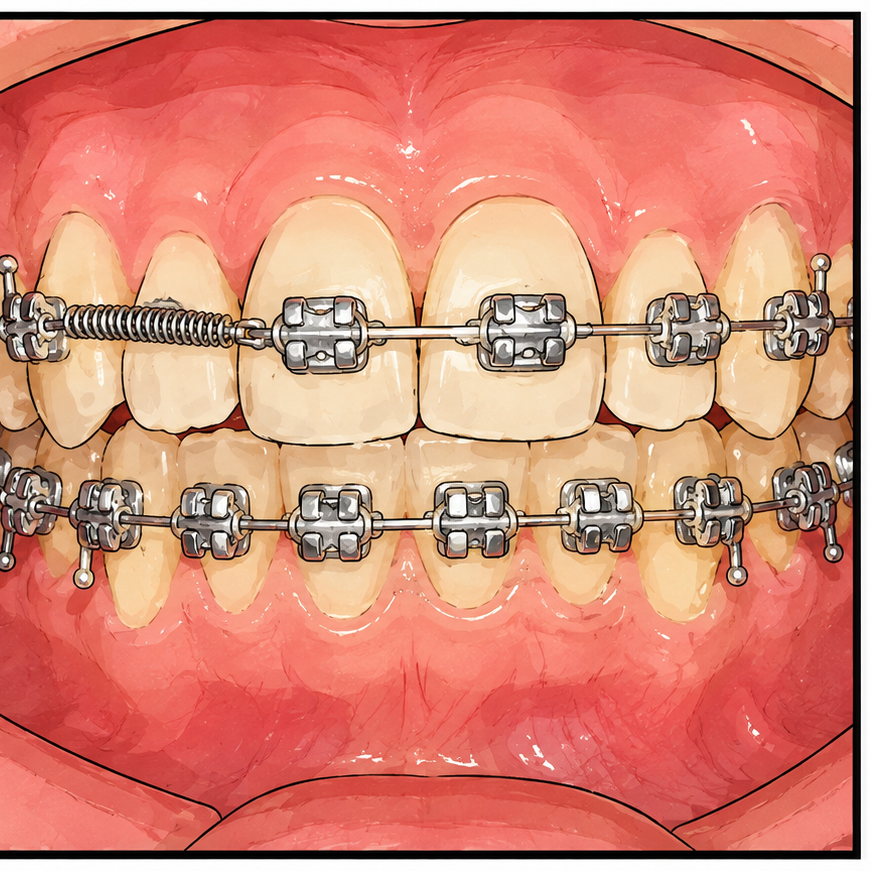
“Doctor, something like a ballpoint pen spring
was put in. What is it?”
When you begin orthodontic treatment,
various components are used in addition to the wire.
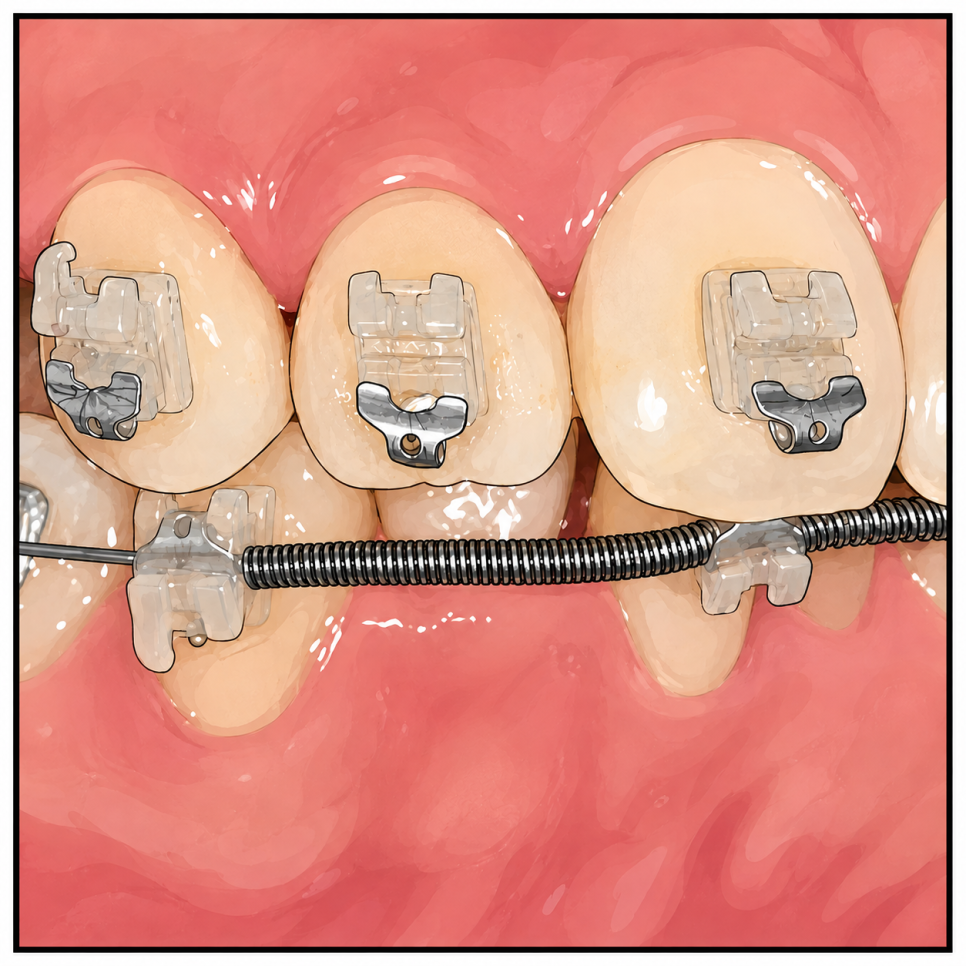
One device that particularly stands out
is the one shaped like a spring.
It is called an open coil.
Although it looks small and simple,
it pushes the teeth apart.
Today, I will explain how it works,
why it is adjusted at every appointment,
and why it is not inserted with excessive force,
along with the supporting evidence.
| Chapter 1. What Is an Open Coil? |
As its name suggests, it is a coil that opens space.
A spring is placed on the wire between brackets,
and it is inserted while compressed to a length shorter than its original length.
When you press a ballpoint pen spring with your hand,
you can feel the force trying to make it expand again.
That force gradually pushes the teeth on both sides apart.
As they are pushed apart,
space is created between them.
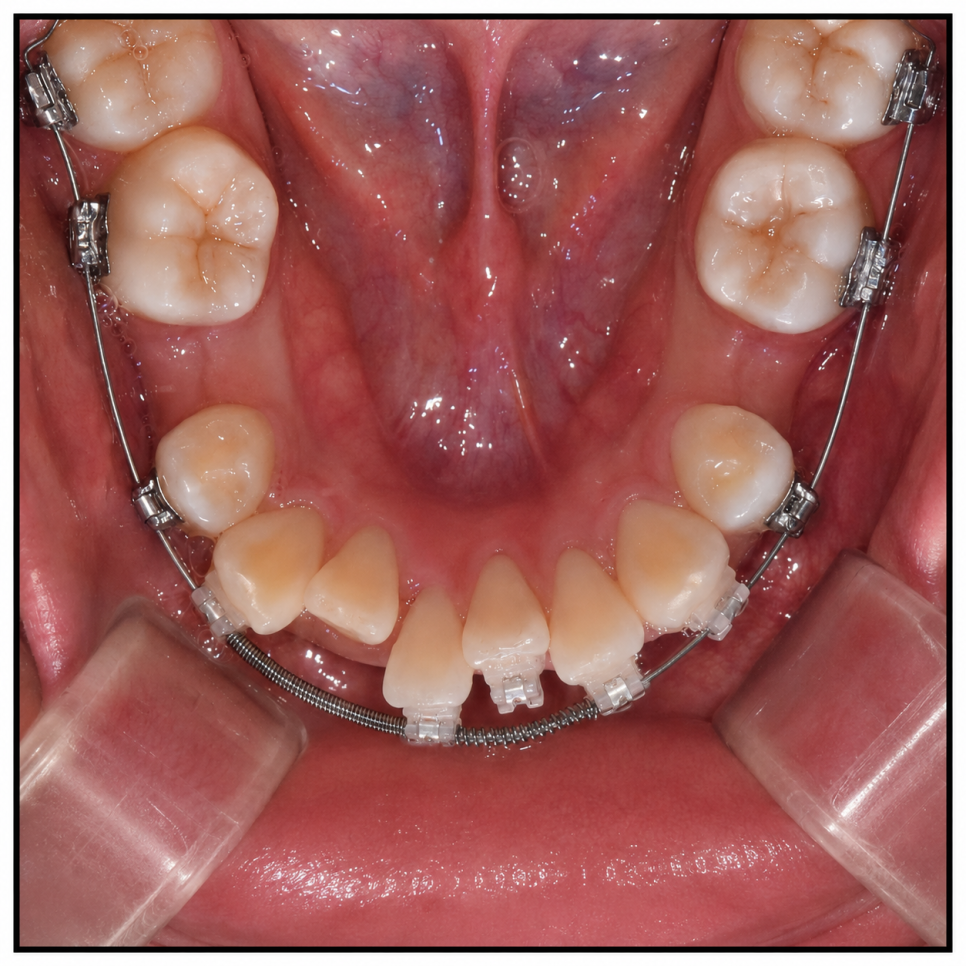
That is why it is called an open coil.
There is also a close coil, which closes spaces that have opened.
| Chapter 2. When Is It Used? |
It is used when there is not enough space.
If the lower front teeth are crowded together,
there is no room to align them properly.
At this point, an open coil pushes the neighboring teeth apart
to create room first.
The same applies when a tooth buried in the gum
needs to be brought down.
If there is no room for it to emerge,
it has nowhere to come out no matter how much it is pulled,
so space must be secured first.
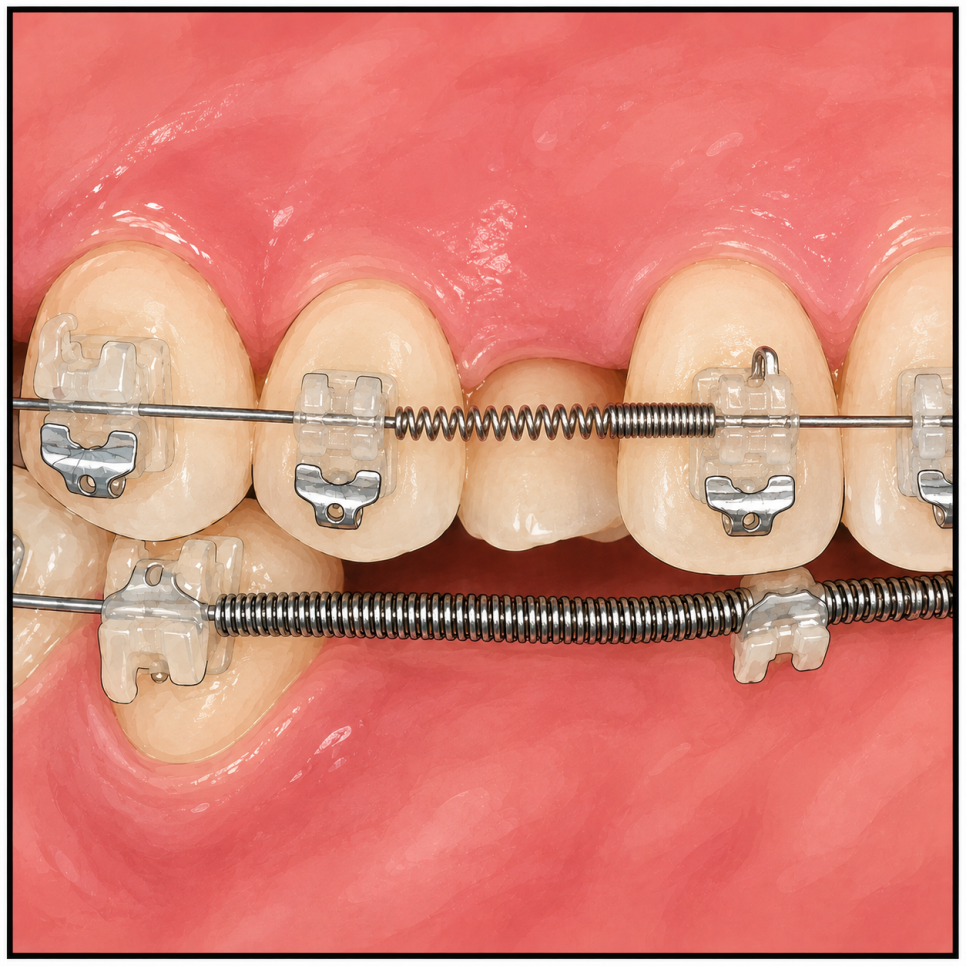
It is also used when the space left by a missing tooth
has become narrower, to restore it to its original width.
In summary, there is one purpose:
To create space in advance for the tooth to move into.
The duration varies from person to person,
but it is generally used for about one to three months
and removed once the necessary space has been created.
| Chapter 3. Why Is It Adjusted at Every Appointment? |
This is the point I most want to discuss today.
An open coil looks like a simple component
that can simply be inserted and left in place.
However,
how much it is compressed when inserted
determines the amount of force.
One study conducted compression tests on 23 nickel-titanium open coils.
At 25% compression, the force ranged from approximately 25 g to 133 g depending on the product. At 50% compression, it ranged from approximately 65 g to 296 g.
Even with the same spring,
the force differed by two or three times depending on the degree of compression,
and the difference between products
was close to fivefold.
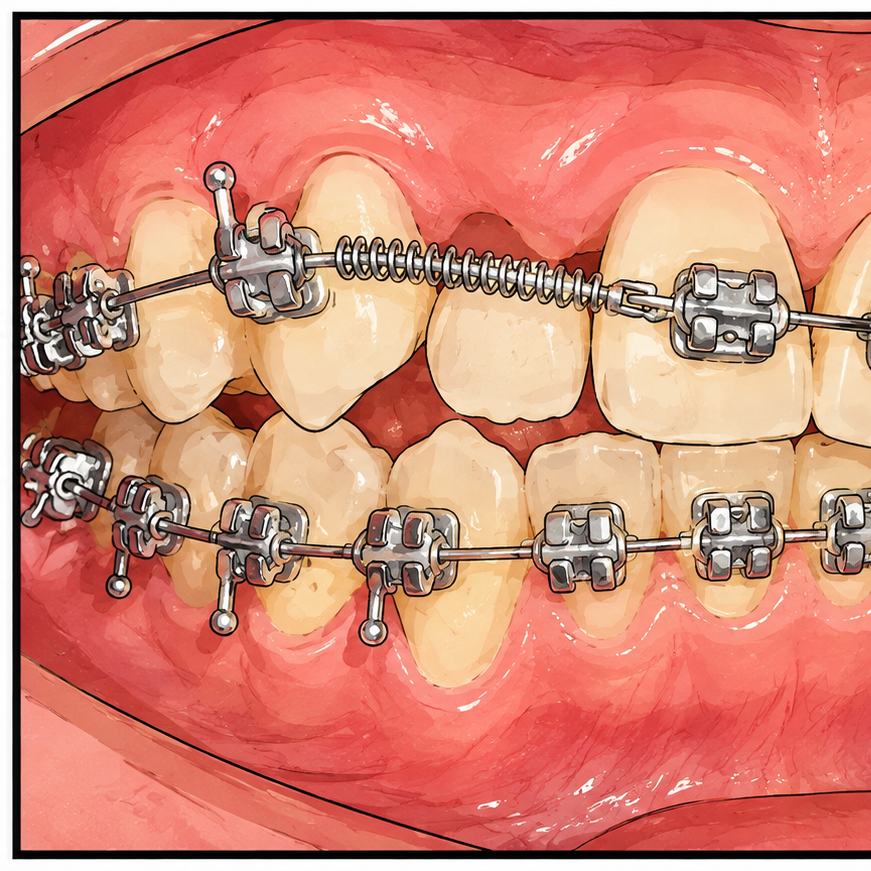
The researchers reached the following conclusion:
You cannot rely solely on the force stated by the manufacturer;
you must also consider how much the spring has been compressed.
That is why it is checked
and adjusted every time.
It is not a device that can simply be inserted and left alone.
| Chapter 4. Wouldn’t It Finish More Quickly If More Force Were Used? |
Many people ask this.
They wonder whether pushing harder would create space more quickly,
since the teeth are being pushed apart anyway.
That is not the case.
Teeth gradually move through a process
in which bone is resorbed
and then filled in again
within the jawbone around the teeth.
This process
has a limit to its speed.
Increasing the force does not make the movement
faster by the same amount.
Instead, something else increases.
A positive correlation has been confirmed
between the magnitude of orthodontic force
and root resorption.
This means that the stronger the force,
the more the end of the root may be resorbed.
Severe root resorption exceeding 4 mm
occurs in 1–5% of orthodontically treated teeth,
and it increases as the treatment period becomes longer.
Conversely, some reports have found
that resorption decreased when force was paused during treatment.
| Chapter 5. What Does It Feel Like Once It Is Inserted? |
It feels sore for the first few days.
You may feel your teeth being pushed,
and chewing food
may feel uncomfortable or distracting.
This generally means that force is actually being applied,
and most people become accustomed to it after a few days.
The spring may touch the inside of your lips,
causing a foreign-body sensation or mouth ulcers.
In that case,
applying orthodontic wax can make it much more comfortable.
Food also tends to become stuck between the coils of the spring.
Since there are more spaces to clean than when you only have brackets,
be sure to use an interdental brush as well.
If the spring comes out or has shifted along the wire,
do not wait until your next appointment.
Please contact the clinic.
Space will not be created during that time,
and space that has already opened may become narrower again.
<Please read this before starting orthodontic treatment ▼>
Today, we discussed open coils.
They are devices that use the force of a compressed spring trying to expand
to push the teeth on both sides apart
and create space for a tooth to move into.
Although they look simple,
the force can differ by two or three times depending on how much they are compressed.
Also, pushing harder does not make the treatment period itself
end more quickly.
It only increases the risk of damage to the roots.
If you have wondered why each orthodontic component
is placed where it is and to that particular extent,
you may now understand a little more.
Thank you for reading this long post.