| This post was written directly by Seoul Vardy Dental Clinic for the purpose of providing medical information, in compliance with Article 56, Paragraph 1 of the Medical Advertising Act. We recommend using the information provided for reference only. For symptom assessment and accurate care instructions, please visit a medical institution and consult a medical professional. All procedures and surgeries performed at dental clinics may involve individual risks, such as inflammation, bleeding, and swelling. Please make your decision after having a thorough consultation with a medical professional. All images were created using AI to aid understanding. |
If the year you were born is an even-numbered year,
you are eligible for a dental checkup.
National Health Insurance dental checkups
are provided at no cost.
Hello!
I am the director of Seoul Vardy Dental Clinic.
Today,
I will summarize how to check whether you are eligible for a National Health Insurance checkup,
what is examined during the checkup,
and what you may want to take care of before the end of the year.
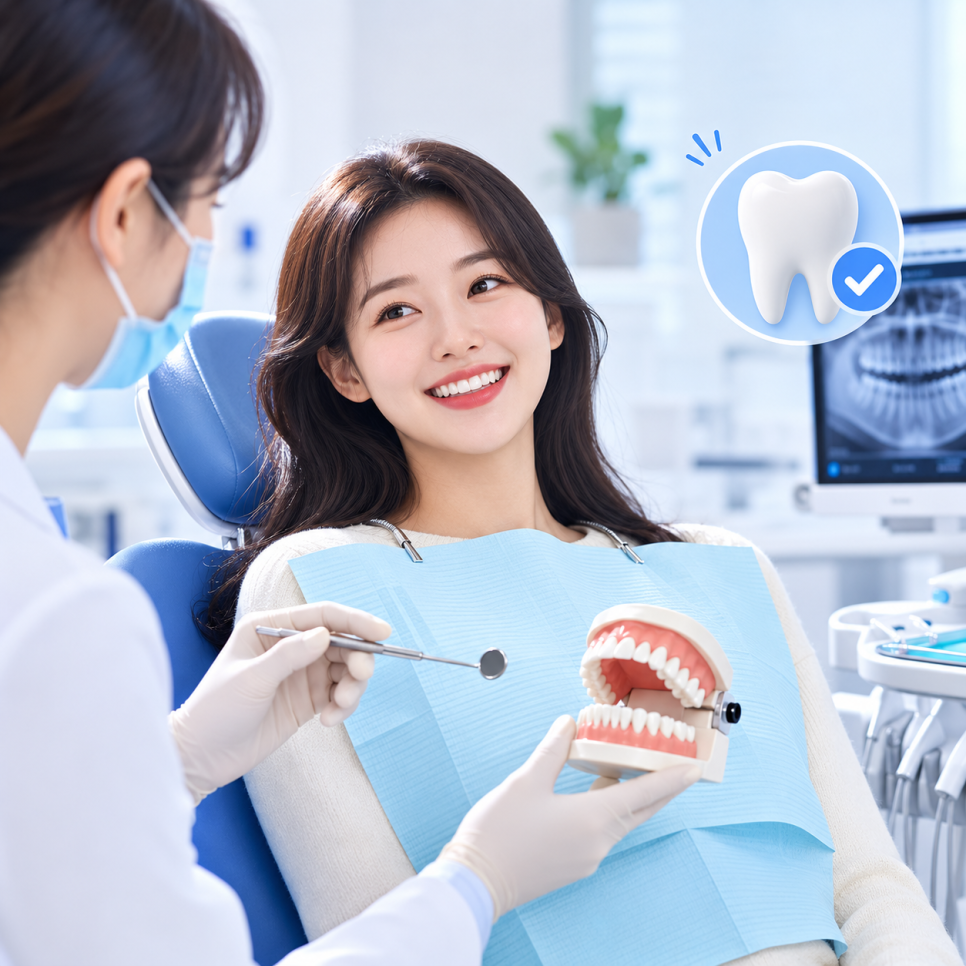
- Check whether you are eligible
The criterion is your year of birth.
Because 2026 is an even-numbered year,
people born in an even-numbered year are eligible.
If you miss it this year,
the next opportunity will be in 2028.
The details vary slightly depending on your type of enrollment.
Among employee subscribers,
office workers are examined once every two years based on their year of birth.
This year, those born in an even-numbered year are eligible.
Non-office workers can receive the checkup every year,
regardless of their year of birth.
Regional subscribers and dependents
are eligible once every two years if they are at least 20 years old.
This year, those born in an even-numbered year are eligible as well.
Recipients of Medical Aid
are eligible once every two years between the ages of 20 and 64.
There is a separate schedule for infants and young children.
They receive four checkups at age-appropriate times
from 18 months through 65 months of age.
If you are unsure, checking your eligibility directly is the most reliable option.
There are four ways to check.
- On the National Health Insurance Service website,
log in and go to
My Health Management, Health Checkup Information,
and Checkup Eligibility in that order.
-
You can also check immediately
in the Health Insurance app under the Health Checkup menu.
-
You can check by phone as well.
The service center number is 1577-1000.
-
You can also visit a dental clinic and ask them to check.
If it is a designated dental clinic,
the front desk can look you up through the National Health Insurance system.
There is one more thing you should know.
Dental checkups are not available at every dental clinic.
They are available only at clinics
designated as checkup institutions.
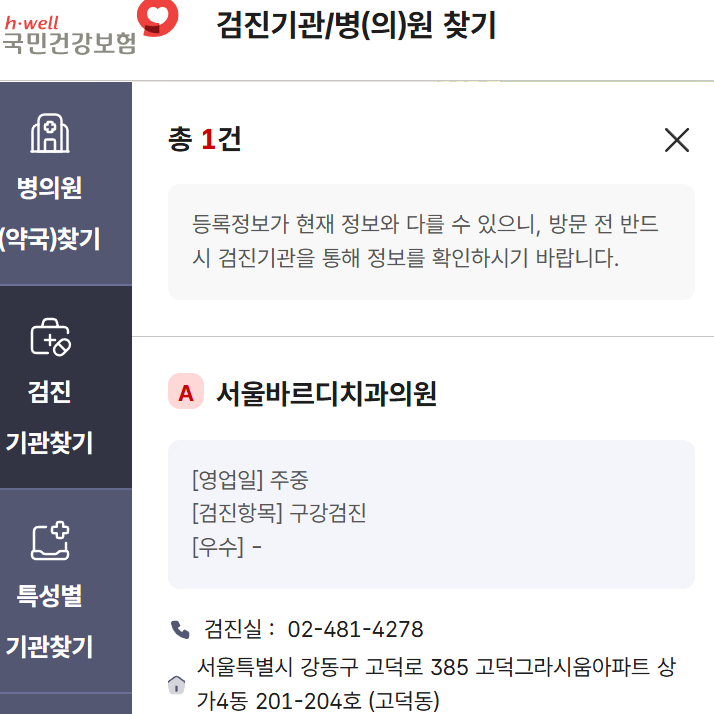
▼ Check the dental clinic location ▼
When you arrive, you will fill out one medical questionnaire.
You can complete it at the dental clinic,
so there is nothing you need to prepare separately.
- Seven out of ten do not get one
Let’s look at one figure.
The participation rate for national dental checkups
is around 27%.
Although both are national health checkups,
the participation rate for general health checkups is 75%.
(Reported by Dental News)
This means that people go for their general health checkup
but simply skip the dental checkup.
The reasons are generally similar.
It is because they do not have pain right now.
However, with dental diseases,
by the time pain begins,
the condition has often already progressed.
Gum disease can destroy bone without causing pain,
and cavities between teeth are not easily visible from the outside.
It means passing up the opportunity
to have them checked at no cost.
- What is examined during the checkup
I will start with the basic items.
First, we conduct an interview and consultation.
We ask about your brushing and eating habits,
and whether you have pain or tooth sensitivity.
Next, we examine the condition of your teeth.
We check whether there are areas where cavities are suspected,
whether existing restorations are in good condition,
and whether any teeth are missing.
We also examine your gums.
We check for inflammation
and assess how much tartar has accumulated.
We examine the oral mucosa and temporomandibular joints as well.
We check whether there are any unusual areas on the mucosa,
and whether your jaw makes sounds or causes pain.
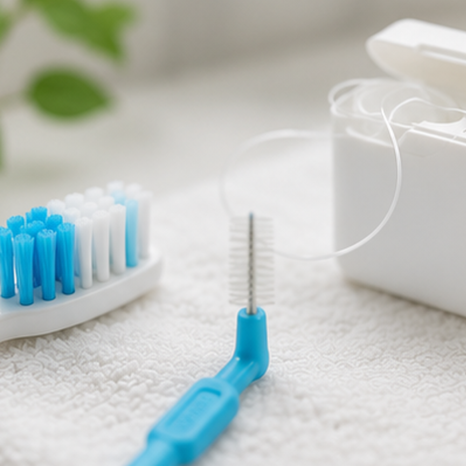
Finally, we assess your oral hygiene
and explain how to use a toothbrush, dental floss, and an interdental brush.
For certain age groups, such as those who are 40 years old,
additional items, such as a dental plaque examination,
may also be included.
This is the scope of what you receive at no cost.
- What cannot be seen during the checkup
This is something you should be sure to understand.
The national dental checkup consists of
an interview and visual examination—in other words,
asking questions and looking with the eyes.
Therefore, some procedures are not included.
First, detailed imaging examinations.
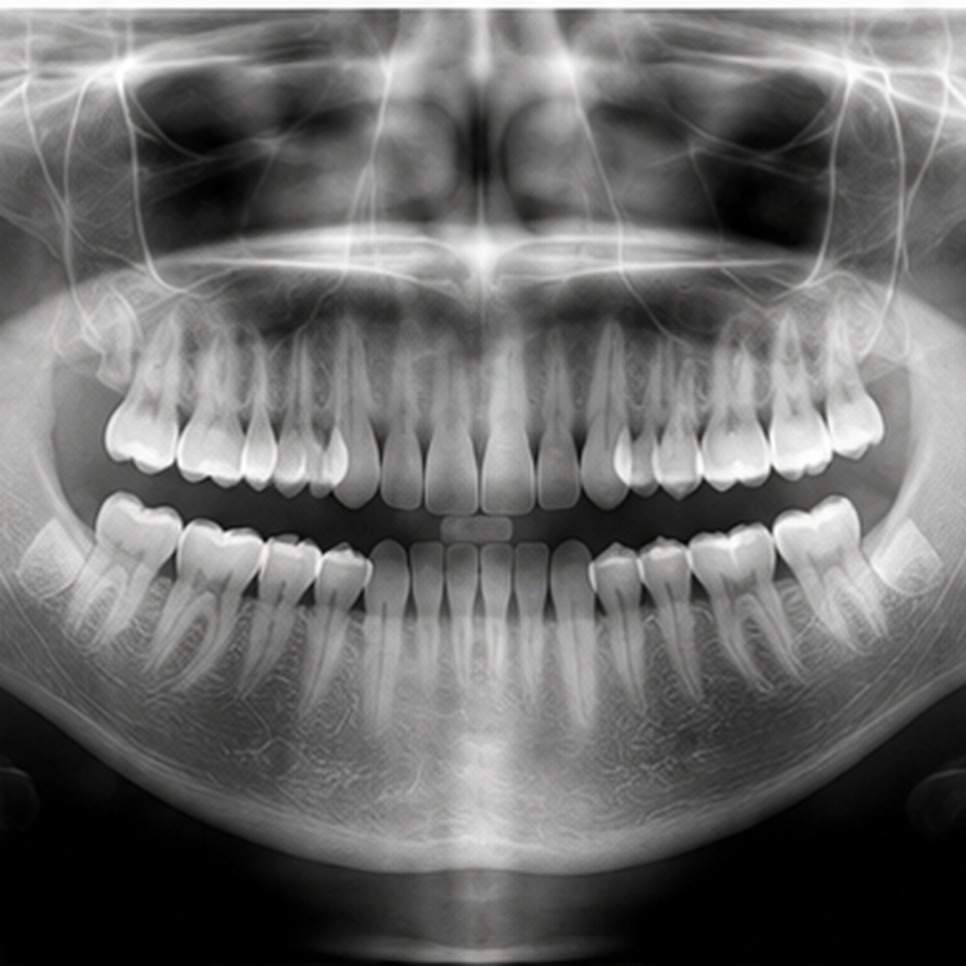
Panoramic or periapical radiographs
are not included in the basic checkup.
A detailed periodontal examination is not included either.
The basic checkup does not involve measuring
the depth of each gum pocket individually.
Treatment is also not part of the checkup.
Cavity treatment, scaling, and gum treatment
are all provided as separate consultations and procedures.
Dental organizations have also pointed out that lesions
that are difficult to identify with the naked eye—such as periodontal disease,
cavities between teeth, teeth embedded beneath the gums,
and cysts—may be missed.
In fact, dental organizations have proposed
adding panoramic imaging to checkups in stages,
and the government is reviewing cost-effectiveness and radiation exposure.
In summary:
The current dental checkup
is not an examination that guarantees “there are no abnormalities.”
Rather, it screens for visible problems
and provides guidance on how to manage your oral health.
If it has been a long time since you visited a dental clinic,
I recommend having an X-ray taken as well.
Problems between the teeth and around the roots
can only be seen through imaging.
If covered by National Health Insurance,
a panoramic X-ray generally costs around KRW 6,000 to 7,000 out of pocket.
You will be informed of the exact amount when you register.
- What disappears on December 31
Finally, there is one more thing
I would like to mention.

Scaling.
If you are at least 19 years old,
you can receive scaling once a year through National Health Insurance.
The important point here is the eligibility period.
It is once between January 1 and December 31 each year.
(According to guidance from the National Health Insurance Service)
If you do not receive it this year,
that annual appointment is lost.
It does not carry over to next year.
You may see explanations online saying
“one year must pass from the date of your last scaling,”
but that differs from the National Health Insurance standard.
It is based on the calendar year.
Therefore, even if you had scaling last December,
once the year changes,
you can receive the current year’s service again.
Since it is August,
there are still more than four months left.
However, when December arrives,
people who had the same idea tend to crowd in.
Coming while there is still time
means you may not have to wait.
If you receive the dental checkup and scaling on the same day,
you do not need to make a separate visit,
and the consultation fee is not charged twice.
- How to avoid a wasted trip
Check two things before you come.
First, whether the dental clinic
is a designated national dental checkup institution.
Second, whether a checkup
can be provided under your name this year.
One phone call can confirm both.
If you have already received the checkup this year
or this is not your eligible year,
the checkup cannot be carried out even if you visit,
so it is best to confirm first.
Today, we discussed dental checkups.
Because 2026 is an even-numbered year,
those born in an even-numbered year are eligible,
and there is no cost.
Whether you are eligible for a National Health Insurance checkup
can be confirmed in one minute
on the National Health Insurance Service website or app.
Check your eligibility first.
Thank you for reading this long post.