| This post was written directly by Seoul Vardy Dental Clinic for the purpose of providing medical information, in compliance with Article 56, Paragraph 1 of the Medical Service Act. We recommend using the information provided for reference only. For symptom assessment and accurate management methods, please visit a medical institution and receive guidance from a medical professional. All procedures and surgeries performed at a dental clinic may involve risks such as inflammation, bleeding, and swelling, depending on the individual. Please make your decision after having a sufficient consultation with a medical professional in advance. To aid understanding, all images were created using AI. |
We hear two completely opposite concerns
with similar frequency during consultations.
“My jaw hurts. Will orthodontic treatment make it better?”
“I heard orthodontic treatment can make the jaw worse.”
Hello!
This is Seoul Vardy Dental Clinic.
Based on the evidence,
neither is true.
There is no clear evidence that orthodontic treatment
can fix the temporomandibular joint,
nor that it damages it.
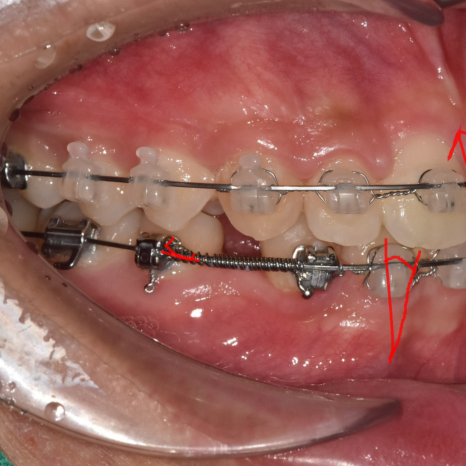
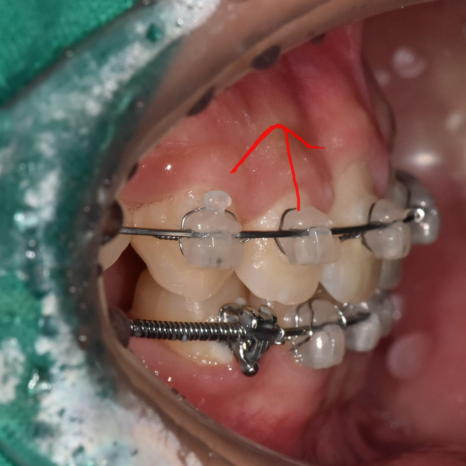
However, temporomandibular joint symptoms themselves
are very common.
Today, I will organize this seemingly contradictory point
along with the evidence.
These cases are
far more common than you might think
Let’s look at the numbers first.
According to data from the Korean Association of Oral Medicine,
53% of Koreans
have at least one self-reported symptom
related to the temporomandibular joint.
32% experience facial pain or headaches.
That means more than half of the population.
However, having symptoms
is different from needing treatment.
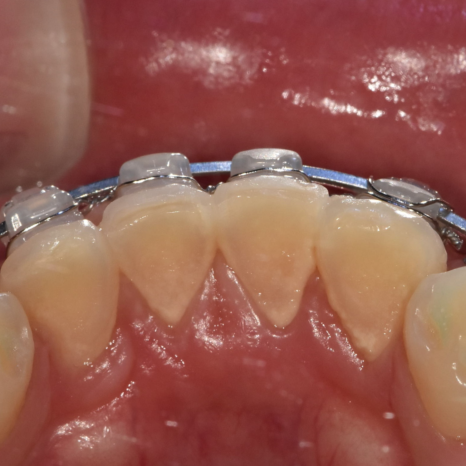
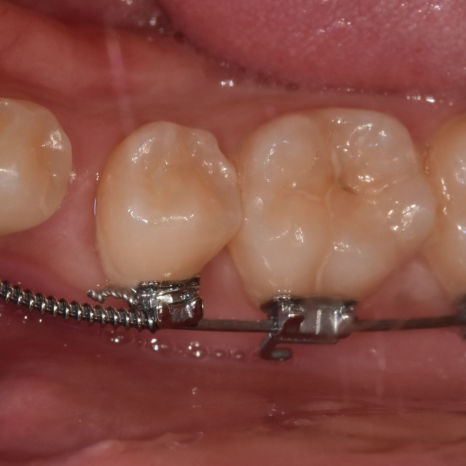
If there is a sound when opening the mouth,
but no pain or disruption to daily life,
observation may be recommended.
The male-to-female ratio among those
who seek treatment is approximately 1:3 to 1:9,
and the frequency and severity increase
from the teens through the thirties.
(Korean Association of Oral Medicine)
This is exactly the age range
when many people begin orthodontic treatment.
The explanation that it is
“because of malocclusion”
When you read articles about the temporomandibular joint,
you often see the explanation that jaw pain occurs
because the teeth do not fit together properly.
However, professional association data
presents a slightly different view.
It does mention malocclusion
as one of the contributing factors.
But the same material clearly states
that it is difficult to identify a single definite cause.
Instead, it considers these factors
to work together:
Teeth grinding or clenching,
posture, stress,
as well as behavioral, emotional, environmental,
and cognitive factors.
In other words, the explanation that jaw pain occurs
because the teeth do not fit together properly
is only partially correct.
Temporomandibular joint symptoms
do not arise from a single cause.
< Do I really need orthodontic treatment for crooked front teeth? ↓↓>
Then, does orthodontic treatment make things worse?
Let’s look into this as well.
There is a meta-analysis examining the relationship
between fixed orthodontic treatment in adolescents
and the occurrence of temporomandibular disorders.
It found that orthodontic treatment
neither increased nor decreased temporomandibular disorders.
(Applied Sciences, 2024)
Therefore, neither the claim that
“orthodontic treatment damages the jaw”
nor the claim that
“orthodontic treatment cures the jaw”
is supported by evidence.
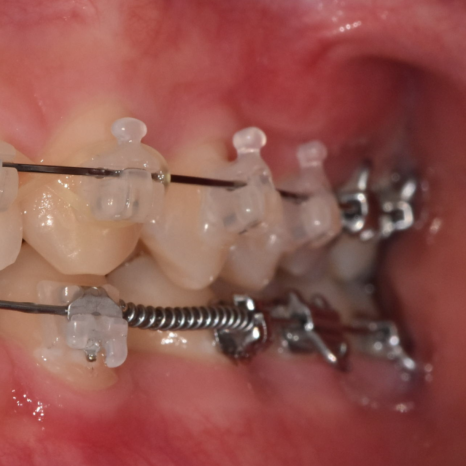
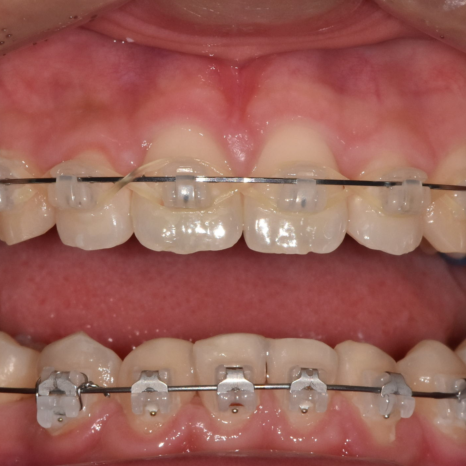
Why, then, does the jaw hurt during orthodontic treatment?
There is one important clue here.
When temporomandibular joint symptoms already exist,
there is a considerably high likelihood
that the symptoms will continue.
Orthodontic treatment is not creating a problem that did not exist;
rather, an existing problem
may simply remain.
As noted earlier,
more than half of people have temporomandibular joint symptoms,
and many of them do not even realize it.
They simply continue as usual
if there is a sound without pain.
If orthodontic treatment begins in that state,
symptoms may become noticeable
while wearing the appliances.
Changes caused by the orthodontic treatment itself
are added to this as well.
As the teeth move,
the bite relationship temporarily becomes unstable.
When areas that used to make contact no longer do,
and areas that did not touch make contact first,
the muscles around the jaw need time to adapt.
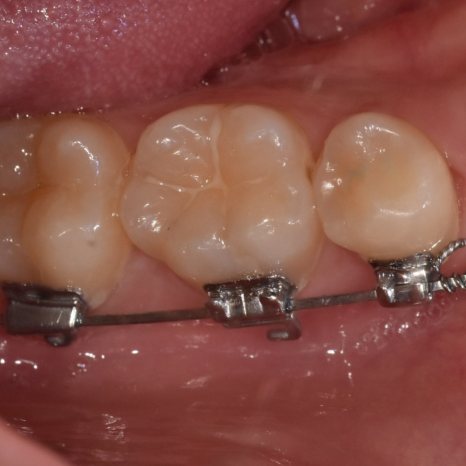
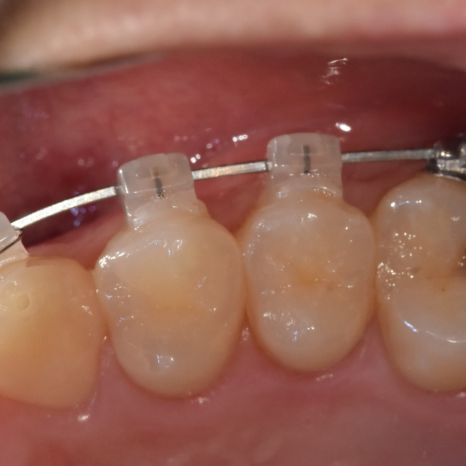
During periods when elastics are used,
jaw movement may also be restricted,
and discomfort may unconsciously lead
to a habit of clenching the teeth.
So we check these things before starting.
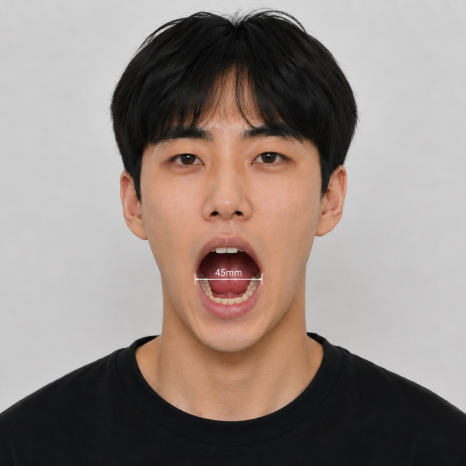
Whether there is a sound in the jaw,
how widely the mouth opens,
and whether there are any painful areas
are assessed during the diagnostic stage.
If symptoms are already present,
we may address them before orthodontic treatment,
or proceed slowly with lighter forces
at the beginning.
What should you do first if it hurts?
There is an established order of steps
when the jaw hurts.
The professional association states that beginning
with reversible treatments is the usual and desirable approach.
Exercise therapy, behavioral therapy, physical therapy,
medication, and occlusal appliance therapy—in that order.
And this order works in practice.
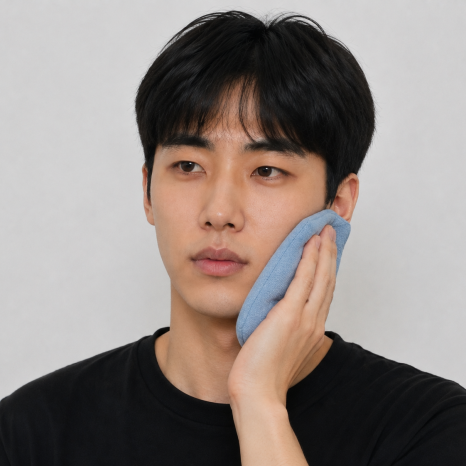
Here are the things you can do at home first:
Reduce chewy and hard foods,
relax the muscles around the jaw with a warm compress,
avoid movements that open the mouth wide,
and do not rest your chin on your hand.
Most people improve at this point.
So if your jaw feels uncomfortable during orthodontic treatment,
do not wait until your next appointment;
please let us know then.
When addressed early,
many cases can be resolved with simple methods.
▼ Check the dental clinic location ▼
Today, we discussed orthodontic treatment
and the temporomandibular joint.
Temporomandibular joint symptoms are common enough
that more than half of people experience them.
However, it is difficult to conclude
that malocclusion is the cause,
and there is also no clear evidence
that orthodontic treatment causes temporomandibular disorders.
The important thing is to check before beginning treatment.
If symptoms already exist,
they may continue during orthodontic treatment.
And if it hurts, do not endure it.
When reversible methods are used early,
75% to 90% of cases improve.
If your jaw feels uncomfortable,
please let us know right away.
We look forward to seeing you in the clinic!

| Directions |