Hello, this is the Gangnam branch of Lee Jiham Dermatology.
Today, we would like to share the treatment experience of a patient who had been dealing with skin concerns for a long time. Have you ever felt weighed down by uneven skin texture every time you looked in the mirror? There may have been moments when you tried to cover it with makeup but still felt limited. In our practice, we often see how upsetting this can be.

Why are skin indentations not simple?
The marks left on the skin are not a single type, but a damaged condition in which several forms exist in combination. From a specialist’s perspective, each individual mark differs in depth, shape, and background of occurrence. Just as a symphony cannot be completed by a single instrument, skin damage cannot be fundamentally resolved with only one approach.
When an inflammatory response occurs in the skin, the body automatically activates its recovery mechanism. However, if the inflammation is severe and persists for a long time, protein fibers form unevenly during the recovery stage, causing the marks to become fixed. Sunken areas are cases where protein fiber formation is insufficient, and sometimes rigid fibrous structures form in the lower layers of the skin and pull the surface downward. Because these rigid tissues pull on the skin like invisible strings, improvement is limited if only the surface layer is managed.
When I explained this to the patient, they asked, “Then my condition can’t be solved with laser alone?” That is correct. That is why we use an integrated treatment system called CLO Scar Restoration.

What are the features of CLO Scar Restoration?
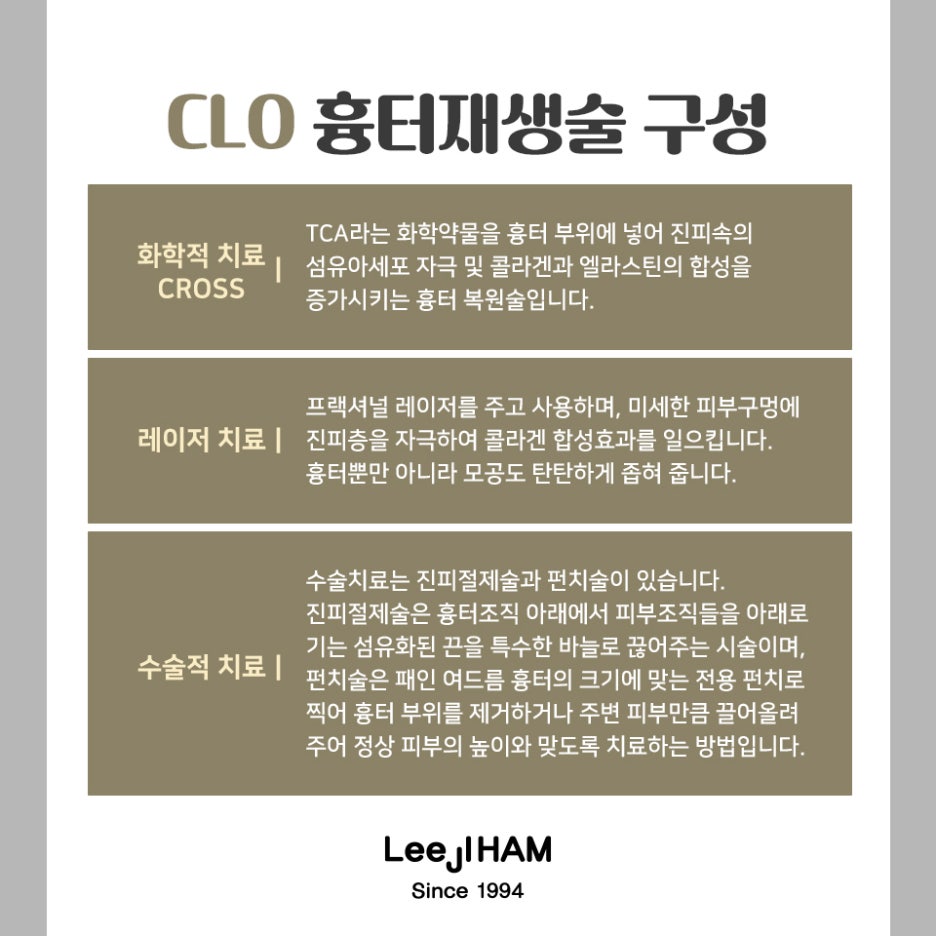
CLO Scar Restoration is a protocol that combines three pillars—chemical methods, laser technology, and surgical procedures—to improve various types of skin indentations at the same time.
The key to CLO Scar Restoration is tailoring this three-pronged approach to each patient’s condition. It maximizes efficiency by applying the optimal treatment for each type at the same time to complex skin damage that could not be addressed with a single method.
For narrow, deep ice pick types, TCA chemical treatment is used. For broadly depressed boxcar types, rigid fibrous tissue is separated through a surgical procedure, and for overall skin rebuilding and surface improvement, a fractional laser is applied. Because all three procedures are performed in a single session, both time efficiency and results are superior compared with doing them separately.
A real treatment case
When explaining the plan to the patient, the first thing I emphasized was the importance of time. Acne scar treatment cannot be expected to show immediate changes with a one-time procedure. This is because skin rebuilding and protein fiber formation take sufficient time. In general, with CLO Scar Restoration, noticeable improvement can be seen after about 3 to 5 sessions.
During the first procedure, we carefully analyzed the patient’s skin condition. We focused TCA CROSS on about 50 deep ice pick-type areas on the cheeks. For 30 broadly depressed boxcar-type areas near the jawline, we separated rigid fibrous tissue through dermal subcision. And for overall regeneration, we applied a fractional laser across the entire face.
The procedure took about one hour, and the patient said, “This is better than I expected. It’s manageable thanks to the numbing cream being applied well.” Of course, there are individual differences, but because the anesthetic cream is applied sufficiently, the pain burden is not significant.
Immediately after the procedure, facial redness and mild swelling appeared. I explained, “This is a normal reaction. It is evidence that the skin has entered the regeneration process.” I also provided detailed instructions on post-procedure care.
How CLO Scar Restoration works
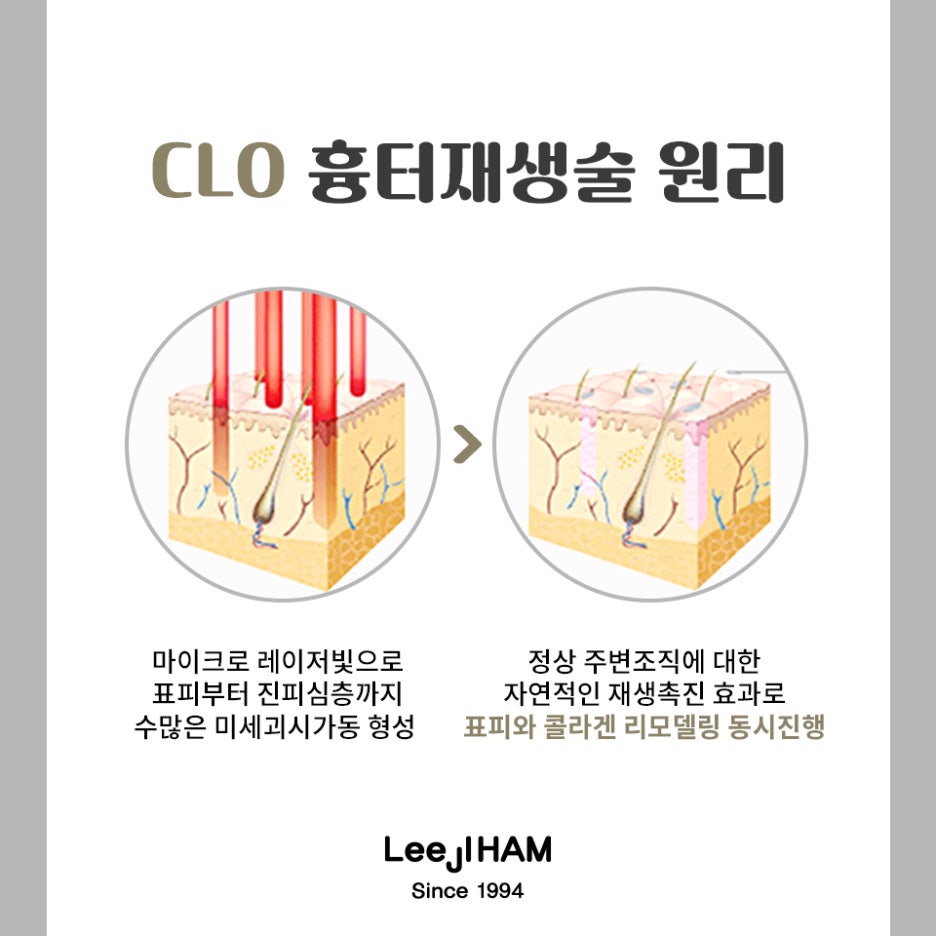
The reason CLO Scar Restoration shows better results than a single treatment is that it approaches the complex structure of skin indentations in three dimensions. Even on one person’s face, there can be multiple types of marks with different depths and shapes mixed together. Laser alone makes it difficult to sufficiently fill deep indentations, and chemical treatment alone has limits in improving overall skin texture. Surgical approaches alone cannot induce overall regeneration.
However, when these three methods are used together, the strengths of each technique can be maximized while their weaknesses are offset, leading to the best possible results. TCA fills the base of deep indentations, the laser is responsible for overall regeneration and texture improvement, and surgical treatment releases the rigid structures pulling on the skin, creating an environment in which the indentations can rise.
The importance of long-term skin care
Improvement through CLO Scar Restoration does not mean care is finished. Since skin is living tissue, continuous care is essential. Sun protection is a habit that should be practiced not only immediately after the procedure, but for life. Ultraviolet rays are a major cause of aging and can also damage protein fibers, potentially reversing the improved condition.
Moisture management should also be maintained consistently. The skin must retain adequate moisture for regeneration to proceed smoothly, and the skin barrier becomes stronger as well. It is also important to prevent new inflammation from occurring. This is because additional inflammation can lead to new marks forming again.
I recommended that the patient regularly check their skin condition. Visiting every 3 to 6 months to assess the condition and receiving light laser care or moisturizing procedures if needed can help maintain a good condition for longer.
Instead of mornings spent sighing in front of the mirror, I hope you start your day with a smile. Your skin has a much stronger recovery ability than you may think. Do not give up. With the right treatment and consistent care, it can improve 충분히.











Previous image
Next image









Previous image
Next image