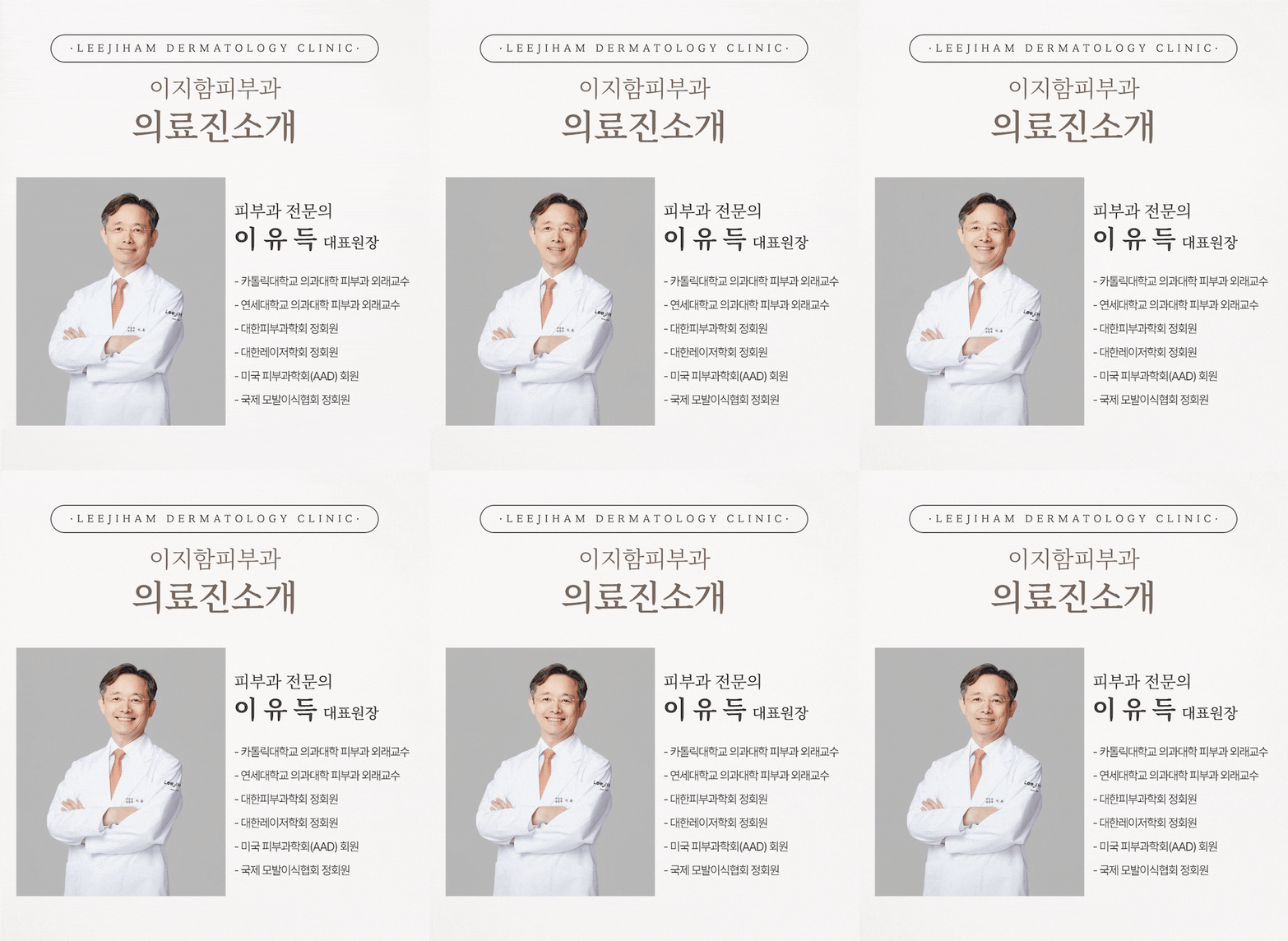
[Dermatologist Lee Yuduk]
Hello,
A place that creates a comfortable face
rather than excessive change.
This is Easyham Dermatology.
"Have you found brown spots on your face while looking in the mirror, and are you worried about age spots and melasma that cannot be covered with makeup?" Pigmentary conditions are skin concerns experienced by many people.
In particular, as we get older, interest in melasma and age spot removal increases, and it is connected not only to cosmetic concerns but also to skin health. Today, let’s look at why dermatology treatment can help manage pigmentary conditions and what approaches are available.
A beauty consulting service that is 'beneficial'
I am dermatologist 'Lee Yuduk'.
What is the difference between melasma and age spots?
In the dermatology clinic,
we often see people who visit
for pigmentary conditions.
Even when they are both brown spots,
melasma and age spots
have completely different characteristics,
so without an accurate diagnosis,
proper management is difficult.
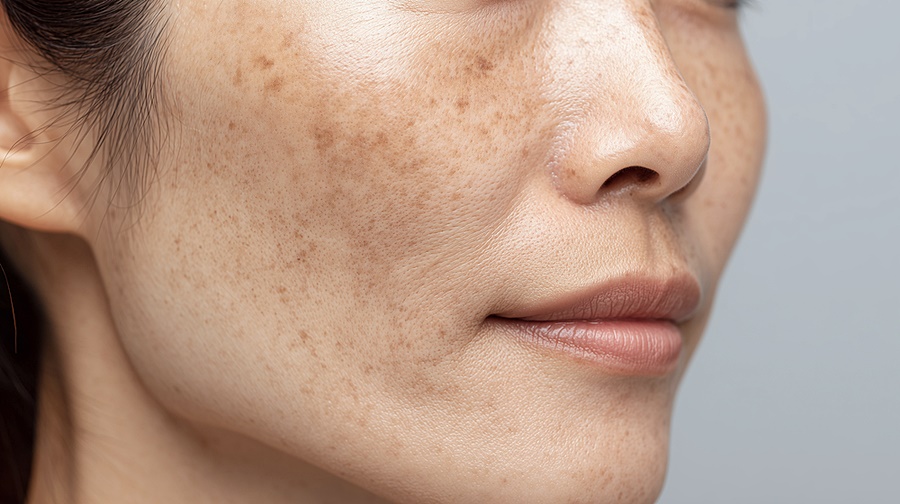
Melasma appears as
brown or grayish-brown patches
caused by excessive melanin deposition,
and it usually appears symmetrically
on both cheeks, the forehead,
and around the nose.
Its edges are unclear
and it tends to spread widely.
In many cases, pigment is deposited
not only in the epidermis but also
in the dermis.
Age spots are medically called
seborrheic keratosis, and unlike melasma,
they are slightly raised on the skin surface
and have relatively clear borders.
They are a type of benign tumor
that often develops after middle age,
mainly in areas exposed to
sunlight for a long time.
Because these two conditions differ
in cause, depth, and shape,
the management methods must also differ.
Why is dermatology treatment necessary?
Whitening products or cosmetics used at home
have their limits.
In the case of melasma and age spot removal,
pigment often settles deep in the dermis,
so surface-level approaches
make it difficult to achieve the desired change.
Also, something that looks like melasma
may actually be another pigmentary condition,
so an accurate diagnosis
must come first.
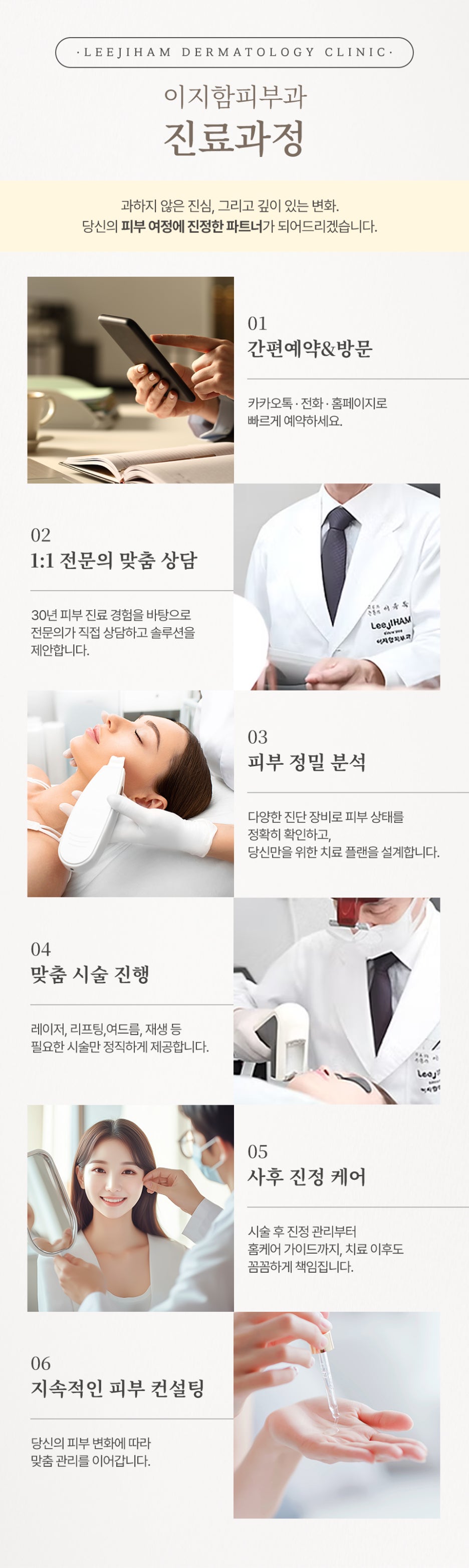
At the dermatology clinic, a Wood’s lamp examination
can be used to identify the depth and type of pigment,
and a customized care plan
that matches each person’s skin condition
can be suggested.
In the case of age spots,
even though they are benign tumors,
there are cases where it is necessary to check
for the possibility of malignant change,
so a specialist’s diagnosis is important.
What kinds of management methods are there?
IPL and laser toning are widely used
for melasma management.
IPL uses a broad wavelength range of light
to address not only pigment but also
vascular lesions and changes in skin tone
at the same time.
Laser toning is a method that uses a laser
with a specific wavelength to act on
deeper pigment layers in a focused way
and break down the pigment.
Depending on the skin condition,
the two methods may be combined appropriately,
or other devices such as a PICO laser
may be used together.
For age spots, removal may be attempted
with a CO2 laser or cryotherapy.
Because they are raised on the surface,
a different approach from melasma is needed,
and in general, treatment is often performed
about 1 to 2 times, though there are individual differences.
However, even after removal,
new age spots can still appear,
so ongoing sun protection management
is important.
How does the treatment process proceed?
Melasma and age spot removal
is carried out over several sessions
depending on the degree of pigment deposition.
In general, treatment is often received
about 5 to 10 times at intervals of 2 to 4 weeks,
though this varies from person to person.
Immediately after the procedure,
the pigment may temporarily look darker,
which is a natural reaction as pigment from
deep within the skin rises to the surface.
As time passes,
the dead skin cells on the skin surface
may shed, and changes in skin tone
may also appear.
Age spot removal is relatively simple,
but a temporary scab may form in the treated area,
and it is important not to pick it off
until it naturally falls away.

Post-treatment care is important
The most important thing after melasma
and age spot removal
is preventing recurrence and preventing
new pigment formation.
Ultraviolet rays are the biggest cause
of pigmentary conditions,
so you should use a sunscreen with SPF50+
every day.
Even indoors, UV rays enter through windows,
so it is best to apply it carefully in the morning
and reapply every 2 to 3 hours.
For about a week after the procedure,
please avoid saunas, steam rooms,
and excessive exercise, and do not rub the area
too hard or force dead skin to come off.
Adequate moisturizing care is also necessary.
If the skin becomes dry,
pigment deposition can occur more easily,
and recovery may also be slower.
In particular, melasma is also affected by
hormonal changes and stress,
so lifestyle management should also be done together.
Verified methods and honest diagnosis
Pigmentary conditions may look like
the same brown spots,
but their depth, type, and causes
are all different.
Some people may have pigment only
in the epidermis,
while others may have deep deposition
even in the dermis.
In addition, there are many cases where
melasma and age spots coexist,
so an approach suited to each is needed.
Above all, it is important to accurately understand
the visitor’s skin condition
and manage it steadily within a range
that does not place excessive burden on the skin,
rather than using aggressive methods.
Rather than a place that talks about dramatic changes
with just one procedure,
it is better to choose a place
that can manage things together
from a long-term perspective.
To those who are worried about
pigmentary conditions,
I would like to say this.
Melasma and age spots are conditions
for which positive changes in skin condition
can be expected when managed with
the appropriate method.
However, do not be impatient,
and based on an accurate diagnosis,
it is important to receive an approach
that suits your own skin.
Every skin is different.
Rather than a simple method,
what should come first is diagnosis and
customized care that matches each person’s skin condition.
Through honest treatment, verified methods,
and the hands of a specialist,
we aim to be a hospital that can be trusted
for a long time rather than for just one procedure.