
[Dr. Lee Yudeuk, Dermatology Specialist]
Hello,
A place that creates a comfortable face
rather than excessive change.
This is Easyham Dermatology.
Have you ever looked in the mirror one day and noticed tiny white, grain-like bumps around your eyes or on your forehead? Small raised spots that don’t even hide well with makeup, and that keep bothering you. If you searched online, you may have seen the terms milia and syringoma, and felt confused about what each one actually is. Today, we’ll take a detailed look at the difference between syringoma and milia, which many people are curious about.
A beauty consultation that gives you something to gain
I’m dermatologist Lee Yudeuk.
Difference between syringoma and milia
How can you tell them apart?
To understand the difference between syringoma and milia,
you first need to know exactly what each one is.
Just as apples and pears are both
fruits but have different properties,
these two also share the common point
of being small bumps on the skin,
but they are fundamentally different conditions.
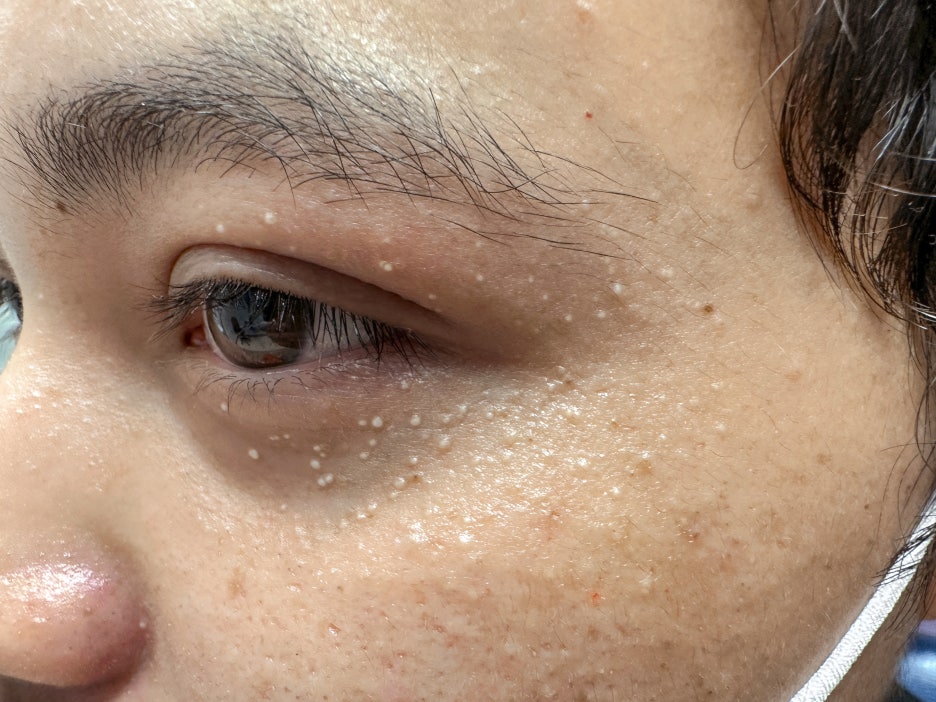
Milia are small white cysts
that form when keratin builds up
near the surface of the skin.
Simply put, a tiny pocket forms in the skin,
and dead skin cells, or keratin,
accumulate inside it layer by layer.
It’s like keeping white powder
inside a small bundle.
Because they look like tiny grains,
they are often called whiteheads,
but strictly speaking,
they are a different condition from acne.

Milia usually appear around the eyes,
especially under the eyes and on the eyelids,
and also on the forehead and cheeks.
They are very small, about 1 to 2 millimeters,
and are white or close to a milky color.
Their surface is smooth and round,
and they feel firm when touched.
Many people describe them as feeling
like tiny pearls embedded in the skin.
By contrast, syringoma develops through a completely different mechanism.
Our skin has structures called sweat glands
that release sweat.
Among them, syringoma is a benign tumor
that forms when part of the eccrine sweat glands
grows excessively.
You may be surprised by the word tumor,
but it has nothing to do with cancer,
so there is no need to worry too much.
Syringoma most often appears concentrated
under the eyes and around the eyelids.
Sometimes it also appears on the cheeks,
the forehead, and even the chest.
Its color is close to skin color,
apricot, or a light brown,
so it tends to resemble the skin more than milia.
It is about 1 to 5 millimeters in size,
slightly larger than milia,
and the surface has a mildly bumpy texture.
When touched, it does not feel as hard as milia
and is relatively soft.

Why does it happen?
Among the differences between syringoma and milia,
the causes of their development are also quite different.
If you understand why each one occurs,
it can help with prevention and care.
Milia mainly occur when the skin’s
keratin shedding function is disrupted.
Our skin constantly makes new cells,
and older cells turn into keratin
and shed away.
If this process does not go smoothly,
the keratin becomes trapped in the skin
and forms milia.
It is like water pooling because a drain is clogged;
the outlet for keratin gets blocked and it builds up.
This is also why milia are commonly seen in newborns.
That’s because the skin’s keratin-shedding function
has not yet fully developed.
Most cases disappear naturally as the child grows.
In adults, they can occur after excessive exfoliation,
skin damage, or burns.
Using cosmetics that are too heavy
or too oily can also clog pores
and cause milia to form.
Sometimes they appear without any special reason,
which is related to an individual’s skin characteristics.

The cause of syringoma is completely different from that of milia.
The exact cause has not yet been fully identified,
but genetic factors are known to play the biggest role.
If someone in your family has syringoma,
you are also more likely to develop it.
If a parent or sibling has many small bumps
under the eyes, that suggests a genetic predisposition.
It is also closely related to hormones.
It often appears for the first time during puberty
or suddenly increases during pregnancy.
It is thought to be influenced by female hormones,
and in fact it is much more common in women than in men.
In particular, it occurs frequently in women
in their 20s to 40s after puberty,
which makes sense when you consider that this is a period
of active hormonal activity.
How to tell them apart by appearance
You can also distinguish syringoma from milia by sight.
Of course, an accurate diagnosis requires
a specialist’s examination,
but a rough distinction is possible.
First, look at the color. Milia are
white or close to a milky color.
They look like white grains stuck on
the surface of the skin.
By contrast, syringoma is skin-colored,
apricot, or light brown,
so it blends in more with the skin tone.
From a distance, it may not be very visible,
but up close it has a bumpy texture.
There is also a difference in size.
Milia are usually 1 to 2 millimeters,
so they are very small,
and their size is almost uniform.
Syringoma is about 1 to 5 millimeters,
so it is larger than milia,
and its size tends to vary.
Some are small, while others are a bit larger.
You can also tell them apart by touch.
Milia feel hard and firm when touched.
It feels as if a tiny bead is embedded in the skin.
Syringoma feels relatively soft and less firm.
When pressed, it may feel like it sinks in slightly.
Location is also a clue.
Milia can appear not only around the eyes
but also across the face, such as the forehead,
cheeks, and around the nose.
Syringoma usually appears concentrated
under the eyes and on the eyelids,
especially the lower eyelids.
Of course, there are exceptions,
but if there are many bumps mainly under the eyes,
it is more likely to be syringoma.

Healthy skin begins with accurate understanding.
When something appears on the skin,
the most important thing is to know exactly what it is.
Rather than being stressed by vague worries
or incorrect information,
it is much more helpful to understand it accurately
and respond appropriately.
Syringoma and milia are not life-threatening conditions,
but it is also true that they can cause
appearance-related and psychological stress.
Still, now that you know the difference between syringoma and milia,
you may feel a little less anxious when you look in the mirror.
I hope today’s information
has been helpful in understanding your skin concerns.




 Previous image
Next image
▲[Easyham Dermatology] We provide care in a comfortable and warm atmosphere.
Previous image
Next image
▲[Easyham Dermatology] We provide care in a comfortable and warm atmosphere.
If you looked in the mirror and thought,
“What is this?”
and became curious,
we recommend that you do not worry alone
and instead learn exactly what it is.
Because every skin is different,
each person needs understanding and care
that suits their own skin.
We believe dermatology care is not simply treatment,
but a process of completing your beauty.
Most of all, what matters is
naturalness without excess
and long-term trust.
In order to become the name
that comes to mind first when skin concerns arise,
we will continue to provide honest
and safe care without change.












 Previous image
Next image
Previous image
Next image









Previous image
Next image