
The moment you feel that your skin has changed,
you should first identify the reason behind it.
“Things used to be fine, but lately my face seems a bit saggy.” Many people in their mid-30s come in with this concern.
You may clearly feel that your skin’s elasticity has declined, but it can still feel unclear why that is happening and which device approach would be appropriate.
Today, we’ll look at the causes of reduced elasticity by age group from a dermatological perspective, and go over the criteria for choosing a device that matches those causes.
In your 30s, changes that begin
where they are not visible
In the early to mid-30s, the skin often still
looks firm on the outside.
But changes have already begun
inside the skin.
Collagen begins to decrease by about 1%
each year after the mid-20s,
and the elasticity of elastin fibers
also gradually declines.
The cause of reduced elasticity by age group
during this period is mainly the decrease
of collagen and elastin in the dermis,
and fine lines begin to appear first
around the eyes and forehead.
Even if there is no dramatic change
on the surface, dermal density is already
changing little by little.
In your 40s, when the effect reaches the fascia layer
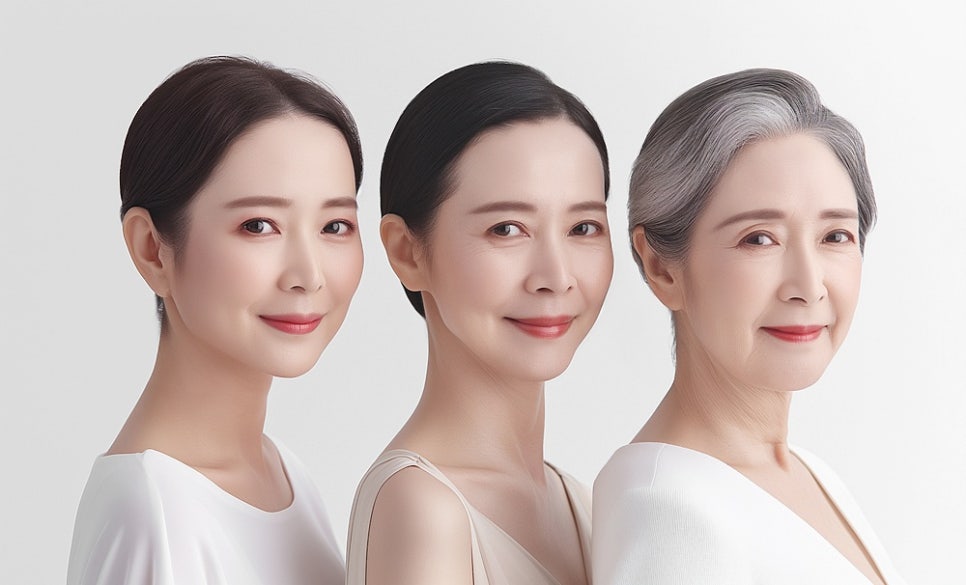
When you enter your 40s, the pattern
changes.
In addition to changes in the dermis,
the fascial layer known as the SMAS
(superficial musculoaponeurotic system)
also begins to loosen.
The support ligaments that hold up the skin
also weaken, causing the midface to droop
downward,
and changes such as deeper nasolabial folds
or a less defined jawline appear.
The decline in elasticity during this period
goes beyond a simple reduction in
surface-level collagen;
it can be seen as the loosening of the
structural support system itself.
This is exactly why simple moisturizing or
epidermal stimulation alone is difficult
to fully address the issue.
In your 50s, a stage where volume loss and gravity work together
In your 50s, changes in the fat layer
are added as well.
As facial fat pads lose their position
and shift downward or decrease in volume,
the area below the cheekbones looks hollow,
and the area around the mouth looks saggy.
For women, after menopause,
a decrease in estrogen is also one factor,
as collagen synthesis declines more rapidly.
At this age,
the causes of reduced elasticity by age group
are a complex combination of three factors:
collagen, fascia, and volume.
This is why a single approach that targets
only one of these is less effective
than a comprehensive plan that considers
each layer.
Ultrasound and radiofrequency work at different depths
When choosing a lifting device,
the first thing you should understand is
that each device delivers energy to
a different layer.
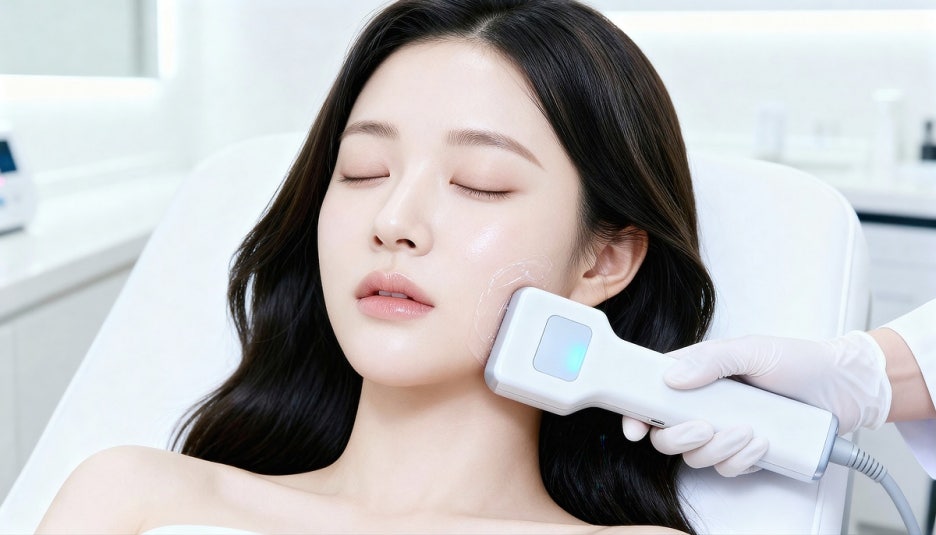
Ultrasound-based devices such as Ulthera Prime,
Doublo Gold, V-ro, and Shurink deliver HIFU
(high-intensity focused ultrasound) energy
deep into the SMAS layer without irritating
the skin surface.
This is a particularly meaningful approach
after your 40s, when structural sagging
has begun.
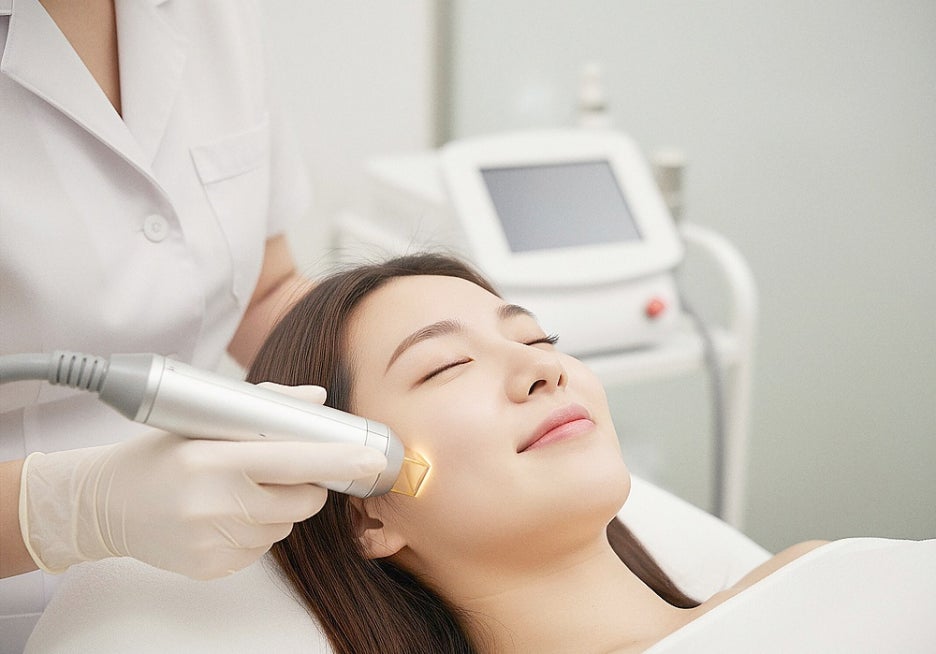
By contrast, Thermage, a radiofrequency-based
device, uses electric current to apply heat
stimulation throughout the dermis,
inducing collagen synthesis and
skin tightening.
Although both are called “lifting,”
the layers they mainly stimulate are different.

The device name comes after my skin thickness and degree of sagging
Even at the same age, skin thickness and
the condition of the supporting tissue
vary from person to person.
If the skin is relatively thin and the main concern
is collagen loss rather than sagging,
a radiofrequency approach that stimulates
the full dermis evenly may be suitable.
If the main cause is loosening of the fascia layer,
an ultrasound approach that delivers focused energy
to deeper layers may be more appropriate.
Also, depending on skin thickness,
the most suitable model can differ even
among ultrasound devices.
Rather than choosing a device because it is well known,
the important order is to first identify where
the cause of reduced elasticity by age group lies,
and then discuss device selection.
About EZHUM’s approach to lifting
EZHUM Dermatology starts from the premise
that every skin is different.
Even among people in their 40s,
some experience fascia loosening first,
while others first show a decline in
skin density itself.
Rather than a simple comparison of which device
is better,
we first ask what this person’s skin needs now.
After lifting, sun protection is the most important,
and the dermis needs time
to synthesize collagen.
During this period, exposure to ultraviolet rays
can reduce its effectiveness,
and excessive heat stimulation
should be avoided.
By combining sufficient water intake
and moisturizing care,
consistent care builds up over time
and creates a more comfortable face.


Previous image
Next image
The cause of reduced elasticity by age group
will be considered together with the direction
that best fits each person’s skin,
and we will strive to be a clinic you can trust
for a long time.











Previous image
Next image









Previous image
Next image









Previous image
Next image